
For almost three years the story was simple: central banks all raised rates together, then all cut them together. In the summer of 2026 that synchronicity broke. On June 11, 2026 the European Central Bank raised rates for the first time since 2023, while the Federal Reserve remained steady where it had been since December 2025. Two economies, two diagnoses, two directions — and the best time to understand through which channels a decision made in Frankfurt or Washington ends up, months later, on the mortgage payment of an Italian family.
What is a central bank
A central bank manages the money and credit of a currency area. It is not a commercial bank: it does not have private clients, it does not grant mortgages. It acts as the bank to banks: it issues legal tender, holds the reserves of credit institutions, lends them liquidity and — above all — sets the price at which that liquidity is exchanged.
That price is the policy rate, the lever from which everything else derives: how much a deposit account yields, how much a loan costs, how much government bonds yield, how much one currency is worth compared to another.
Two different mandates (and it's not a minor detail)
The most important difference between the ECB and the Fed does not concern the tools, which are almost identical, but the objectives set by law.
| ECB | Federal Reserve | |
|---|---|---|
| Mandate | Hierarchical: price stability comes first | Dual: price stability and maximum employment, with equal standing |
| Inflation target | Symmetric 2% over the medium term | 2% over the long run (measured by the PCE index) |
| Who decides | Governing Council: Executive Board plus national governors, on a rotating basis | FOMC: 7 governors plus 5 regional Fed presidents, on a rotating basis |
| Leadership in 2026 | Christine Lagarde | Kevin Warsh, from May 22, 2026 |
The consequence is tangible. If employment weakens while inflation remains high, the Fed must balance two conflicting objectives; the ECB, formally, does not: it must bring inflation back to 2% and only then can it support growth. This is one reason why, in the face of similar shocks, the two institutions react at different times.
The tools: three levers, not one
1. Policy rates
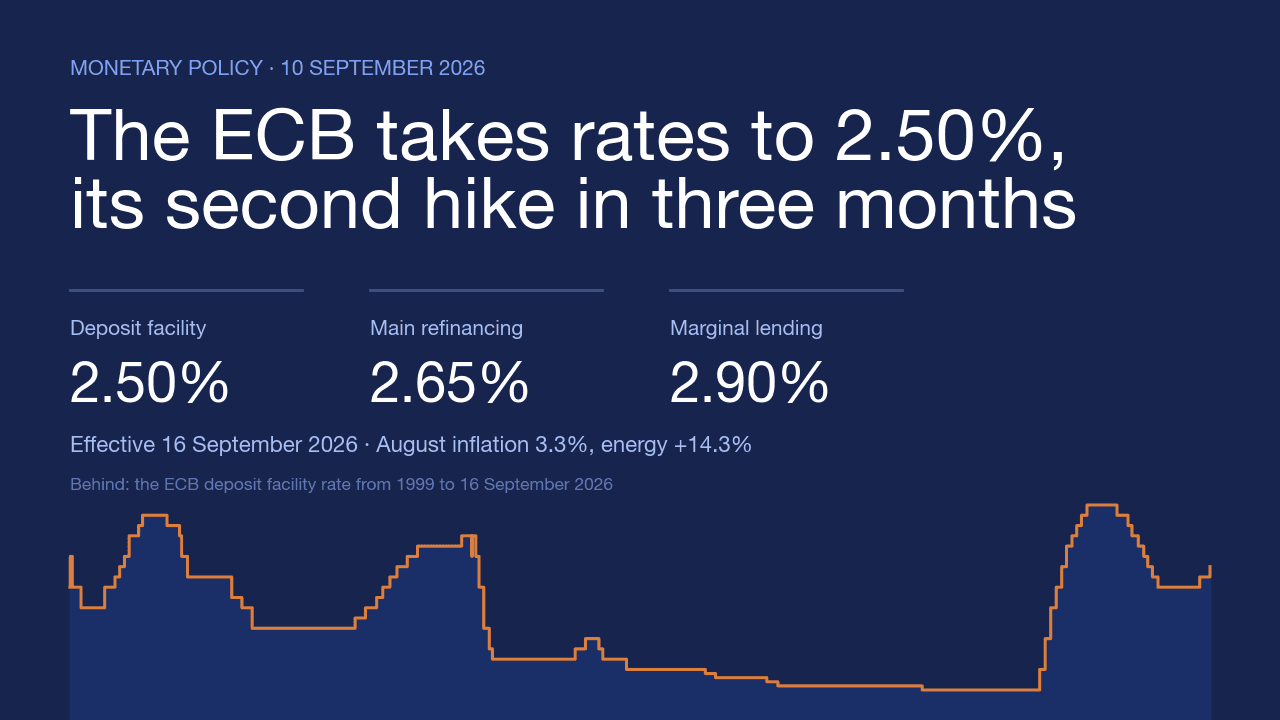
The ECB does not have just one rate; it has three, and they form a corridor. As of June 17, 2026: 2.25% on deposits (how much banks earn for parking liquidity at the ECB), 2.40% on main refinancing operations, 2.65% on marginal lending. What matters for markets is the deposit facility rate: since the European banking system is awash in excess liquidity, it is the floor for all other rates.
The Fed, on the other hand, operates with a target range for federal funds, steady at 3.50%-3.75% since December 11, 2025.
2. The balance sheet: QE and QT
By buying securities (quantitative easing) a central bank injects liquidity and pushes down long-term yields; by ceasing to reinvest maturing ones (quantitative tightening) it does the opposite. The Eurosystem's balance sheet had approached 9,000 billion euros in 2022, about 70% of the area's GDP. In 2026 it allows approximately 330 billion in APP program securities and 173 billion in PEPP securities to mature without replacement: over half a trillion returning to the market and silently tightening financial conditions, without touching policy rates.
3. The words
Forward guidance — stating in advance what one intends to do — has zero cost and immediate effect, because markets price in expectations before the decision arrives. It is also a tool one can choose not to use: the new Fed chair announced the intention to provide less forward guidance, making meetings harder to anticipate.
How a decision reaches your payment
The transmission chain has four links and takes months to traverse.
- The central bank moves the policy rate.
- Interbank rates adjust almost immediately: in July 2026 the 3-month Euribor hovered around 2.4%-2.5%, just above the ECB deposit facility rate.
- Banks reprice mortgages, loans, and deposits: at the end of July 2026, for a typical 30-year mortgage of 150,000 euros, the average TAN of offers was 3.28% for fixed-rate and 2.89% for variable-rate, for a payment of around 625 euros. The most aggressive promotions dropped to 1.92%, but these are teaser offers: the variable rate cannot stay long below the index that governs it, and the 3-month Euribor at that time was above 2.3%.
- Households and businesses change consumption and investments; with a delay of several quarters the economy slows down or speeds up, and inflation moves.
The fourth link is the most misunderstood: a rate hike does not immediately lower prices; it acts on inflation that will materialize twelve or eighteen months later. This is why decisions always seem to be delayed compared to the news.
The 2022-2026 cycle, in seven stages
No textbook explains monetary policy better than the last four years. The 2022 tightening was the fastest in the euro's history: 450 basis points in fourteen months, from a negative deposit facility rate to a historical high.
| Period | ECB (deposit facility rate) | Fed (target range) |
|---|---|---|
| July 2022 | 0.00% (end of negative rates, from −0.50%) | 2.25%-2.50% |
| September 2023 | 4.00% (historical high) | 5.25%-5.50% (peak, from July 2023) |
| June 2024 | 3.75% (first cut) | 5.25%-5.50% |
| September 2024 | 3.50% | 4.75%-5.00% (first cut, −50 bp) |
| June 2025 | 2.00% (cycle low) | 4.25%-4.50% |
| December 2025 | 2.00% | 3.50%-3.75% |
| June 2026 | 2.25% (first hike since 2023) | 3.50%-3.75% |
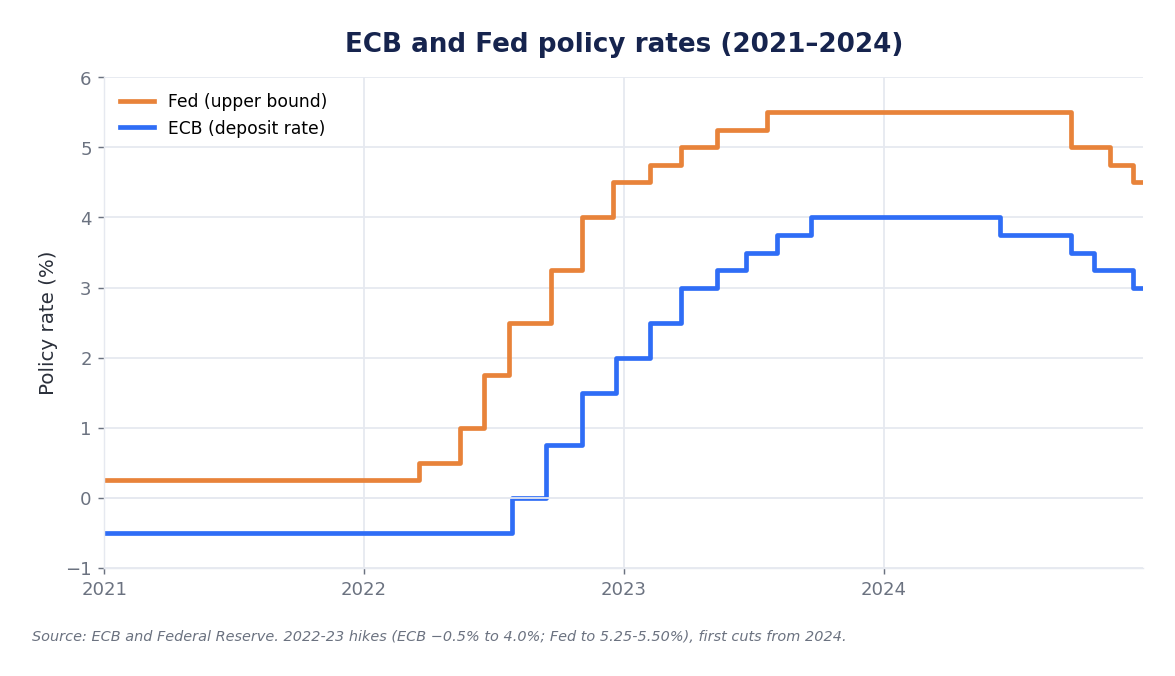
Until 2025 the script was this: the Fed moves first, the ECB follows. The differential between the two rates explains a good part of the euro-dollar exchange rate movements: capital moves where it is better remunerated.
The turning point of June 2026: when the shock comes from energy
Then the script changed. The conflict in the Middle East caused energy prices to soar and euro area inflation rose to 3.2% in May 2026, with the energy component in double digits. On June 11 the Governing Council raised the three rates by 25 basis points, unanimously.
The logic is that of second-round effects: an energy price increase is in itself a temporary shock, which a central bank could even ignore. It becomes a problem when it transfers to goods, food, and services and when it enters the expectations of workers and businesses, triggering a wage-price spiral. The Eurosystem staff macroeconomic projections of June 2026 capture the risk: average inflation at 3.0% in 2026, 2.3% in 2027 and 2.0% in 2028, with a peak of 3.4% in the third and fourth quarters of 2026.
The price is on growth: the same projections indicate euro area GDP at +0.8% in 2026, +1.2% in 2027, and +1.5% in 2028, with a downward revision for the first two years. The first quarter of 2026 had already closed in contraction, −0.2% quarter-on-quarter according to Eurostat (June 5, 2026), revised from +0.1% of the preliminary reading: macroeconomic data are corrected, sometimes substantially.
In the subsequent meeting, on July 23, 2026, the ECB left rates unchanged, again unanimously, to measure the duration of the shock. Meanwhile, inflation had already retreated: 2.8% in June 2026, with the core component at 2.4%.
Why Europe and the United States diverge
In mid-2026 the two blocs showed distinct pictures.
| Indicator | Euro area | United States |
|---|---|---|
| Consumer inflation (June 2026) | 2.8% | 3.5% |
| Core inflation | 2.4% | 2.6% |
| Unemployment | 6.2% (May 2026) | 4.2% (June 2026) |
| Policy rate (July 2026) | 2.25% on deposits | 3.50%-3.75% |
The reasons for the divergence are threefold. The first is energy exposure: Europe imports most of the energy it consumes, the United States is a net exporter, and the same oil shock affects the two continents with different signs. The second is the labor market: with unemployment at 4.2%, the Fed has a margin that the ECB, at 6.2%, does not. The third is the starting point: the Fed comes from much higher rates and has room to wait, the ECB had already fallen to 2.00%.
The differential is visible in the exchange rate. On July 28, 2026 the ECB reference rate quoted 1.1367 dollars per euro, down from 1.1435 on July 17. A weaker euro makes imports more expensive — starting with energy, which is paid for in dollars — and fuels imported inflation: the circle closes.
Independence, and why it has become a topic again
Central banks are deliberately separated from governments. The reason is historical rather than theoretical: if those who decide public spending could also print money to finance it, the temptation to pay bills with inflation would be irresistible. Independence ensures that the price objective is taken seriously even when it is unpopular.
In 2026 the topic returned to the center of American debate. Kevin Warsh was confirmed by the Senate on May 13, 2026 with a vote of 54 to 45, the most divided ever, and was sworn in as the seventeenth Fed chair on May 22, 2026, for a term expiring on May 21, 2030. Jerome Powell remained on the Board of Governors: the terms of governor and chair are distinct, precisely to make transitions less abrupt.
The signal to watch is not the statements but the voting numbers. A committee that decides unanimously is saying that the data interpretation is shared; a split committee is saying that the picture is ambiguous and that the next move is uncertain.
What to watch now
Three elements will tell where the cost of money will go in the coming quarters.
The first is the duration of the energy shock. If energy prices fall, European inflation declines on its own and the June hike remains an isolated episode; if they remain high, second-round effects become real and further tightening is needed. At the end of July 2026, money markets were pricing in further increases by March 2027, and the ECB meeting on September 10, 2026 — one of the four annual meetings with macroeconomic projections — is the first concrete opportunity.
The second is core inflation, stripped of energy and food: this indicator measures how entrenched the shock has become, and in June 2026 it stood at 2.4% in the euro area and 2.6% in the United States.
The third is the American labor market. With the dual mandate, an increase in unemployment changes the Fed's calculation much more than a similar data point would change the ECB's.
The fundamental point remains: central banks do not command the economy; they regulate its temperature, with powerful but slow tools. Understanding their mandate and timing is not about guessing the next move: it's about correctly interpreting the one just made.
Sources: European Central Bank, «Key ECB interest rates» and monetary policy decisions of June 11 and July 23, 2026; Eurosystem staff macroeconomic projections, June 2026; Eurostat, press releases of July 17, June 5, and July 2, 2026 for euro area inflation, GDP, and unemployment; Federal Reserve, «Open Market Operations» and Board of Governors website; USAFacts on Bureau of Labor Statistics data (July 22, 2026); CNBC (July 14, 2026) for US consumer prices; CNBC, CBS News, and Al Jazeera (May 2026) for the change at the Fed's helm; ECB, euro reference exchange rates (July 28, 2026); Facile.it and Mutui.it (July 2026) for Euribor and Italian mortgages. Macroeconomic data are subject to revision.
Disclaimer: the information provided in this article is for informational and educational purposes only and does not constitute personalized financial advice in any way. It is recommended to consult a qualified professional before making any investment decisions.