

Anthropic filed a confidential draft prospectus with the Securities and Exchange Commission on 1° giugno 2026. Since then, the question circulating among bankers is no longer if the company developing Claude will go public, but at what price: investor models, reported on 13 e 14 agosto 2026 by Financial Times, CNBC, and Fortune, are working on a valuation of 2.000 miliardi di dollari. It would be the largest placement ever seen, ahead of SpaceX's on 12 giugno scorso. The operation is led by Goldman Sachs, Morgan Stanley, and JPMorgan, with the Nasdaq indicated as the venue and ottobre 2026 as a possible window.
On 14 agosto, Reuters, in an exclusive by Echo Wang, added the missing piece: the number on which that valuation rests is an internal revenue forecast between 190 and 200 miliardi di dollari in 2028. It must be placed alongside the only official data the company has published, the 47 miliardi di ricavi annualizzati communicated on 28 maggio. The ratio between these two figures — not their absolute value — is what truly explains how Wall Street is pricing the deal of the year. And that ratio tells a different story from what the headlines suggest.
The document is already there, the public prospectus is not
The distinction matters because it changes what can and cannot be known. The 1° giugno filing is a confidential draft registration statement: it gives the company the option to list once the SEC has completed its review, but it is not public. No one, outside the scope of the operation, has read a certified income statement from Anthropic. All the numbers circulating — including those in this article — come from company press releases, sources close to the operation cited by agencies, or models built by investors.
A practical consequence follows that is worth keeping in mind for the rest of the piece: the 2.000 miliardi are not a declared target by Anthropic, which declined to comment to Reuters. They are the endpoint of the spreadsheets of those who would like to buy. Similarly, the ottobre window and the choice of the Nasdaq are not confirmed by the company. When the prospectus becomes public, the market will for the first time see revenues according to American accounting principles, gross margin, multi-year spending commitments, customer concentration, and cash burn. None of these items are verifiable today.
From one billion to 47 in seventeen months
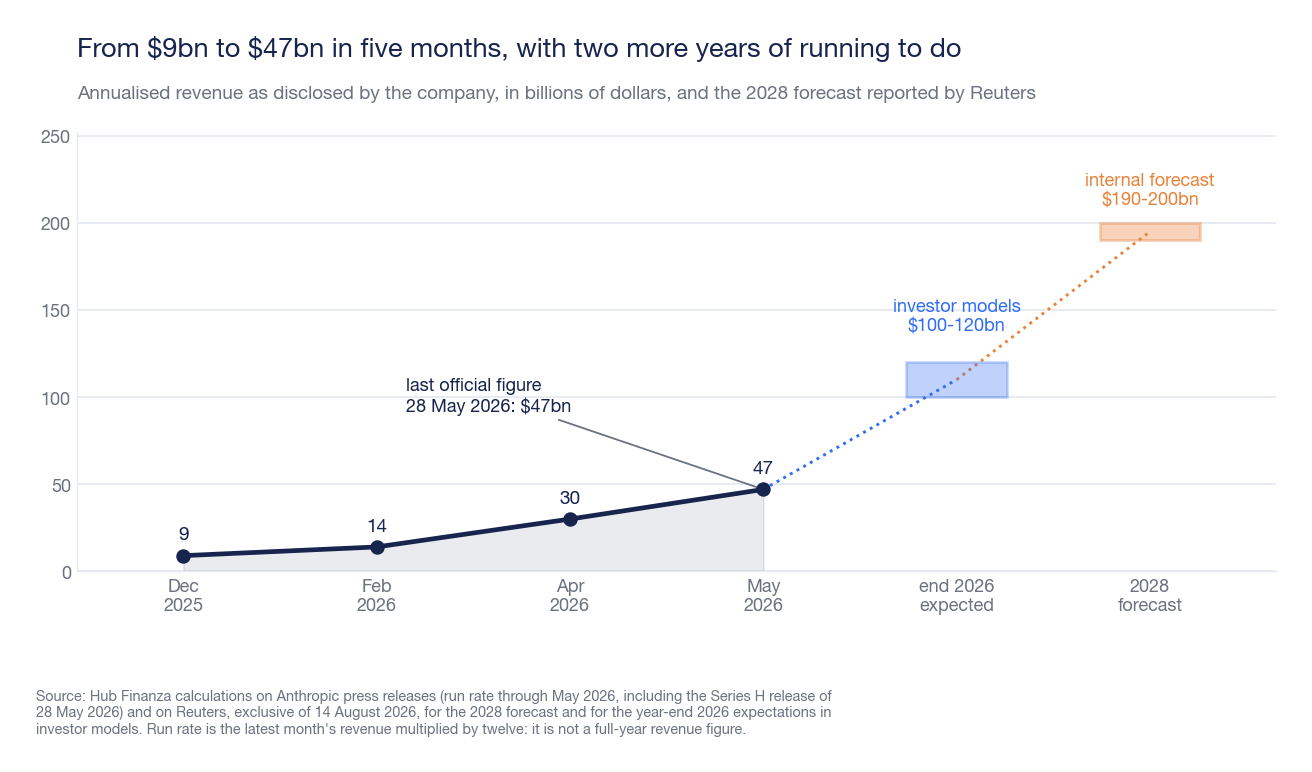
Growth is the fact from which everything stems, and it is documented step by step by the company's announcements. Annualized revenues were approximately 1 miliardo di dollari in dicembre 2024. They became 9 miliardi by the end of 2025, 14 in febbraio 2026, 30 in aprile, and 47 on 28 maggio, when Anthropic announced Serie H: 65 miliardi raised at a post-money valuation of 965 miliardi, with Altimeter, Dragoneer, Greenoaks, and Sequoia leading the round and 15 miliardi coming from cloud operators, Amazon for 5.
A technical clarification is due, as it is usually overlooked. The run rate is not annual revenue: it is the last month's revenue multiplied by twelve. For a company growing at these rates, this systematically inflates the figure compared to the revenues actually collected in the year. Quarterly numbers show this well: in the primo trimestre 2026, Anthropic invoiced approximately 4,8 miliardi, in the secondo 10,9 — more than double. Annualizing the secondo trimestre gives 43,6 miliardi, not 47, and the difference is exactly the growth that occurred within the quarter. The two measures are consistent; they are not the same thing. A divergence between sources should be noted: on 14 agosto, Bloomberg reported a preliminary figure higher than 11,5 miliardi for the secondo trimestre, while CNBC, WSJ, and Reuters stopped at 10,9. The figure corroborated by multiple outlets is used here.
Why bankers shifted the metric to 2028
The method Reuters describes is a ratio between enterprise value and revenues. It is the ordinary tool for valuing a company that is growing rapidly and earning little. The anomaly lies in the chosen year: bankers are not applying the multiple to 2026 revenues, but to those of 2028. Looking two years ahead is unusual, and Reuters attributes this both to the speed with which turnover is moving and to the difficulty of finding a metric for a company that is still spending heavily to build its infrastructure.
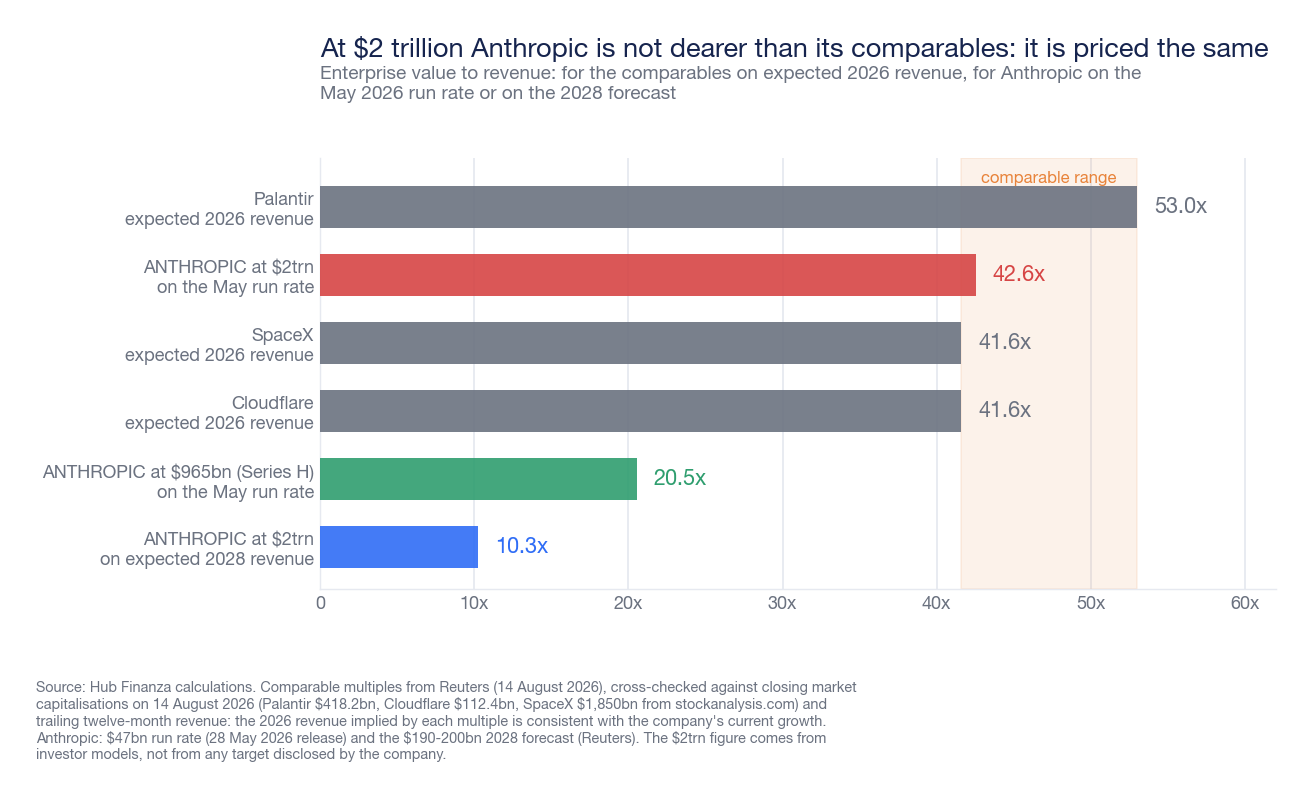
This choice is not neutral, and it is the point where it is worth doing the math rather than just reporting it. The three terms of comparison cited by the agency's sources are Palantir, at 53 times expected 2026 revenues; SpaceX and Cloudflare, both at 41,6 times. These multiples are verifiable: at the close on 14 agosto 2026, Palantir capitalized 418,2 miliardi, Cloudflare 112,4, SpaceX 1.850. Dividing the market capitalizations by the multiples yields implicit 2026 revenues of 7,9, 2,7, and 44,5 miliardi — figures consistent, for each of the three, with revenues over the last twelve months and with the current growth rate. The verification holds.
At two trillion, the price is already that of comparables
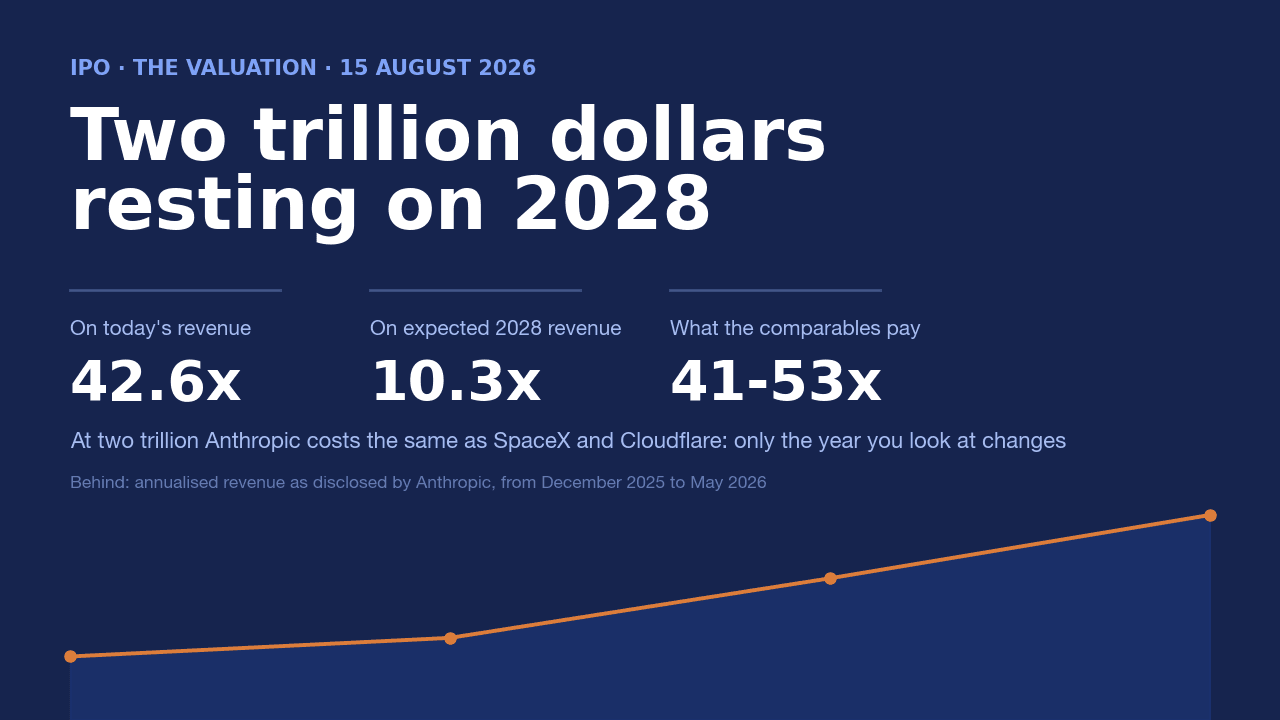
And here is the calculation that none of the reports have made, and which overturns the current interpretation. Two trillion in valuation divided by today's 47 miliardi in annualized revenues gives 42,6 times. This is practically identical to the 41,6 of SpaceX and Cloudflare, and is significantly below Palantir's 53. Put differently: the record valuation that newspapers present as a bet on the future is, based on current revenues, in line with what the market already pays today for listed and observable companies.
The 2028 forecast therefore does not serve to justify the 2.000 miliardi: it serves to make them seem prudent. On the 190-200 miliardi of 2028, that price drops to 10,0-10,5 times revenues, a multiple that for a growing software company is by no means aggressive. Moving the metric by two years does not raise the valuation; it makes it appear conservative. It is a perfectly legitimate and very common presentation technique in placements, but it must be recognized for what it is.
The most instructive comparison, however, is internal. Serie H in maggio priced Anthropic at 965 miliardi, which is 20,5 times the run rate: less than half of what listed comparables pay, and even less than OpenAI, valued at approximately 852 miliardi in marzo on an annualized turnover that Bloomberg on 13 agosto indicated above 40 miliardi. Between maggio and ottobre, therefore, public investors would be asked to pay double the multiple compared to the last private round, with the same declared revenues. Either the private placement in maggio left a lot on the table, or the public market is being asked to double the valuation in five months solely based on expected growth. The two interpretations are not equivalent, and the public prospectus will also help understand which of the two holds.
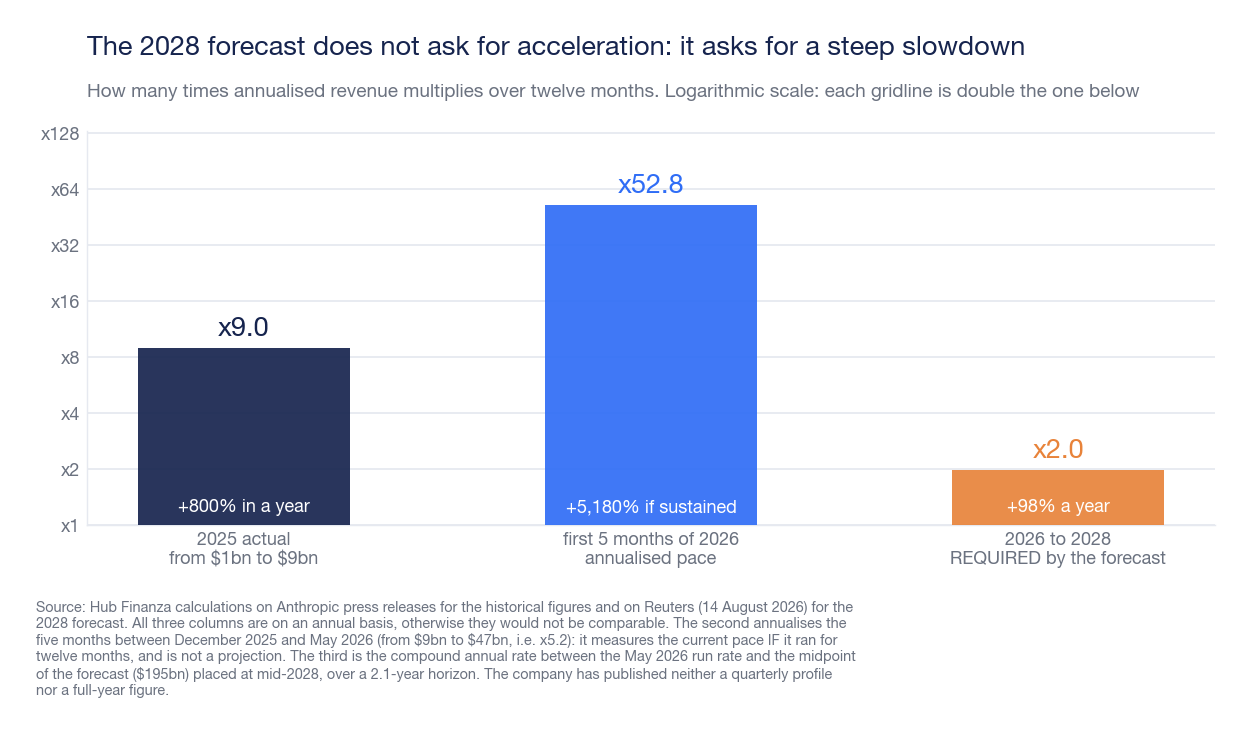
The forecast does not ask to accelerate, it asks to slow down
There is a second misunderstanding to clarify, and it goes in the opposite direction of the first. The 190-200 miliardi by 2028 seems a reckless projection; measured against the path already taken, it is a prudent projection. Taking annualized revenues from 47 miliardi to 195 — the midpoint of the range — over a horizon of just over two years requires a compound annual growth rate of around 98%: a doubling per year. That's not insignificant. But in 2025, turnover had multiplied by nine, and the pace of the first five months of 2026, if it continued for twelve months, would correspond to a multiplier of almost fifty-three.
The forecast, in other words, already incorporates a violent deceleration compared to the recent trajectory. This undercuts the easiest objection — "the 2028 numbers are science fiction" — and shifts the real question elsewhere: not whether Anthropic can still grow significantly, but whether the market it is serving is deep enough to absorb two hundred billion in annual spending on language models by 2028, and at what prices. No financial model can answer this, and it is worth remembering before treating any projection as a given.
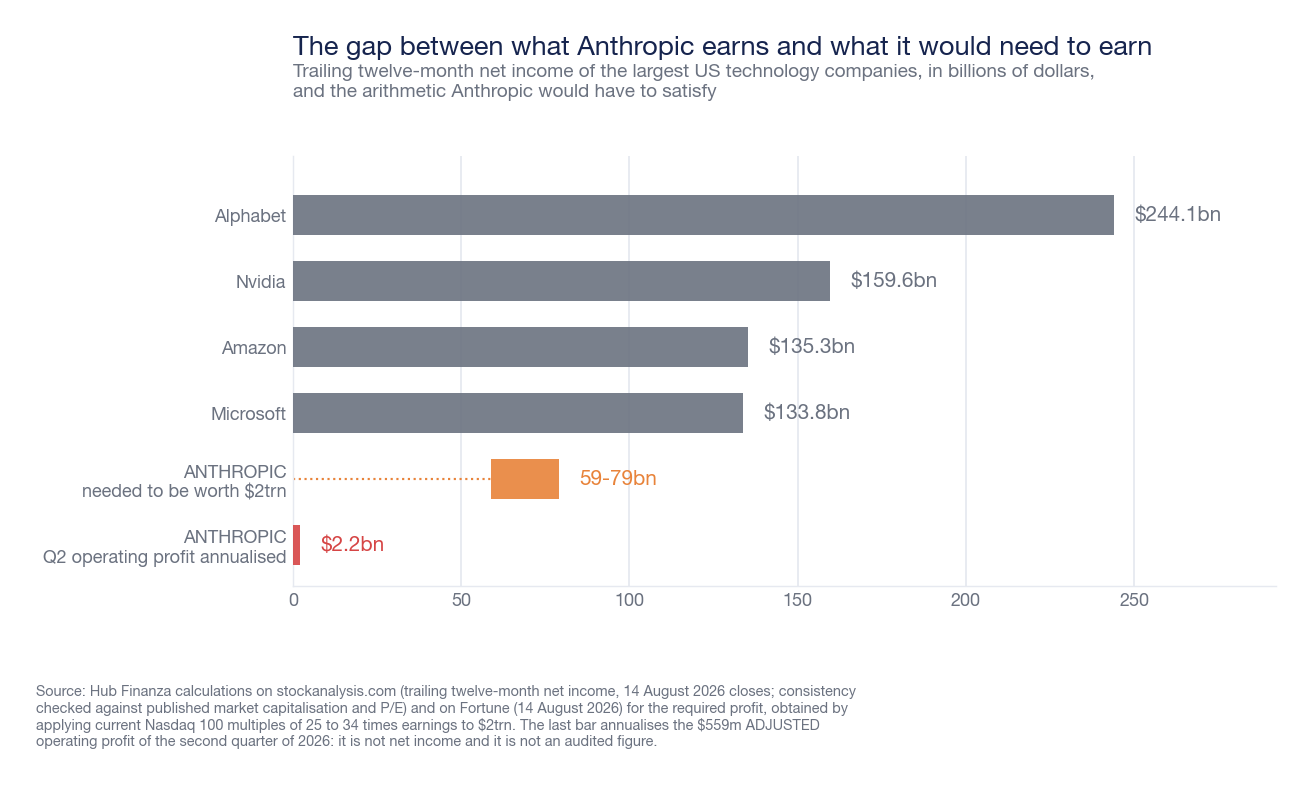
The 559 million that are not enough
In the secondo trimestre 2026, Anthropic declared the first operating profit in its history: 559 milioni di dollari. This is a real achievement and should be recognized, but three clarifications diminish its scope. The first: on revenues of 10,9 miliardi, that result represents an operating margin of 5,1%, compared to margins in mature software that range between 30 and 45%. The second: it is an adjusted profit — it excludes stock-based compensation — and is not a net profit. The third: it is not certified by any auditor, because the company does not yet have public company transparency obligations.
The gap to close is what Fortune calculated on 14 agosto and which our verification confirms: applying the Nasdaq 100's current multiples to 2.000 miliardi — between 25 and 34 times earnings — would require an annual profit between 59 and 79 miliardi di dollari. Annualizing the 559 milioni of the quarter yields 2,2 miliardi: about one-thirtieth of the minimum required. To give scale, over the last twelve months, Alphabet earned 244,1 miliardi, Nvidia 159,6, Amazon 135,3, and Microsoft 133,8. Anthropic would need to stably position itself in that range to justify the price with ordinary market parameters.
Opinions diverge on how that margin appeared, and the divergence is legitimate. Avery Marquez of Renaissance Capital told Fortune that "getting close to operational profitability" is what makes the valuation "perhaps not so crazy." Conversely, analyst Ed Zitron argued on 21 maggio on his website that profitability would be an effect of accounting and timing rather than a structural improvement in the accounts: this is a critical position explicitly of opinion, not a documented reconstruction, but it captures a point that the Wall Street Journal formulated neutrally — it is not known what accounting criteria Anthropic is using to record revenues and costs. Evan Schlossman of Neostellar Capital points to the decisive question: whether computing capacity is owned, long-term leased, or short-term purchased, because the defensibility of that margin depends on it.
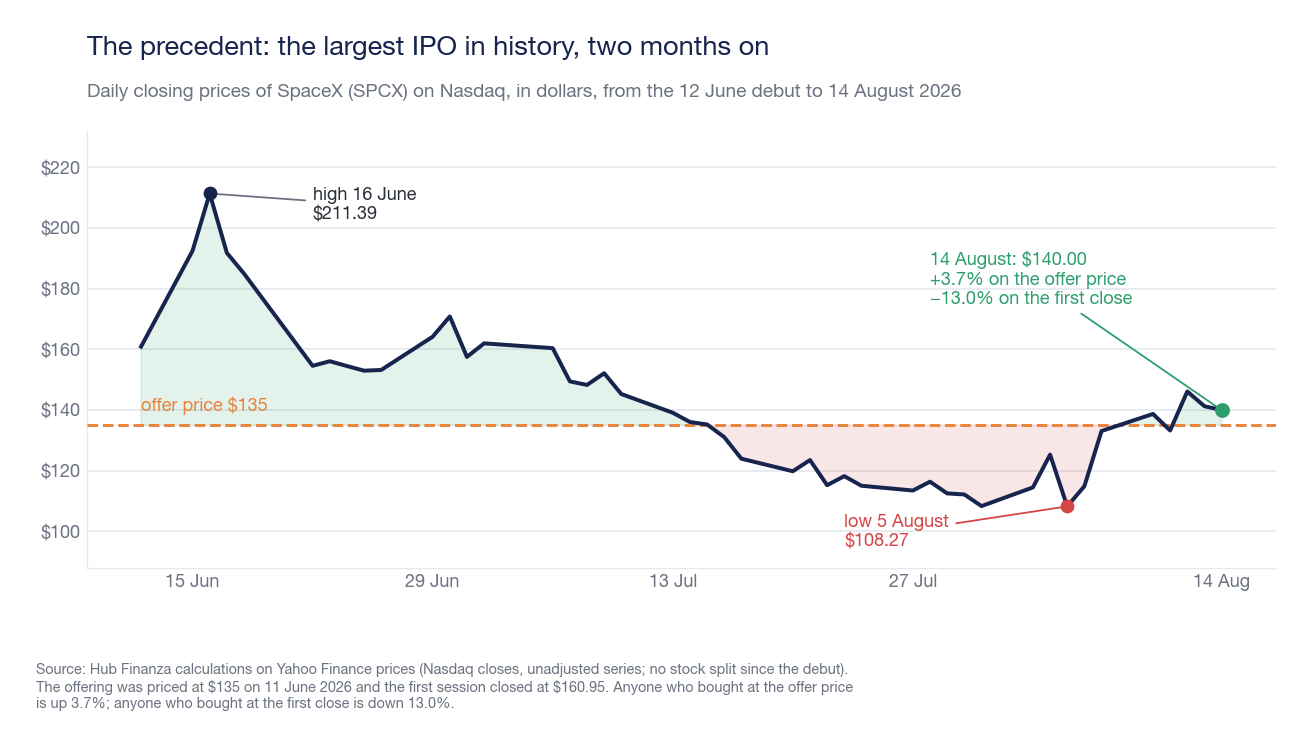
The precedent is two months old and is called SpaceX
That SpaceX appears among the comparables is not coincidental: it is the only company to have recently faced a placement of comparable scale, and it has only been listed for two months. Its performance is the most concrete data available to anyone wishing to get an idea of how the market treats such an operation, and it deserves to be read precisely, because it lends itself to two opposite yet true interpretations.
The placement was priced at 135 dollari on 11 giugno; the first session closed at 160,95; the high, on 16 giugno, was 211,39. Then the stock fell to 108,27 dollari on 5 agosto, before rising to 140,00 at the close on 14 agosto. The result is that those who bought at the placement price today gain 3,7%, while those who bought at the first close — that is, almost all retail investors, who do not access the placement — lose 13,0%. In two months, the stock has fluctuated by 95% between its minimum and maximum.
The lesson is not that mega IPOs go badly: it is that the first-day price and the placement price are two different assets, sold to two different categories of investors. Eleven weeks of history on a single stock do not make a statistical rule, and it is worth stating this explicitly instead of transforming a precedent into a law. But the distance between +3,7% and −13,0% on the same stock on the same day is a useful reminder in view of ottobre.
What to watch for, and when
Three appointments will punctuate the coming months. The first is the publication of the prospectus, which normally follows the SEC's review, initiated on 1° giugno, by eight to twelve weeks: this will be the first opportunity to replace data from anonymous sources with certified financial statements, and the items to look for are gross margin, commitments to purchase computing capacity, and revenue concentration on major customers. The second is the confirmation or denial of the expected run rate at the end of 2026, which investor models place between 100 and 120 miliardi: this is the first reality check on the trajectory that underpins all the reasoning. The third is the placement price range, which will tell if the 2.000 miliardi was a forecast or an ambition.
Meanwhile, the most honest metric for judging the valuation remains that based on today's revenues, not those of 2028: at 42,6 times, Anthropic would be placed at the price the market already pays for SpaceX and Cloudflare. The question to ask is not whether that multiple is absolutely high — it is in line with comparables — but whether the comparables themselves are priced correctly. As an anonymous investor summarized to Reuters, Anthropic might even achieve the 2.000 miliardi; it remains to be seen whether artificial intelligence will truly generate all the additional productivity that those valuations presuppose.
Sources
2028 revenue forecast, valuation method, and comparable multiples from Reuters, exclusive by Echo Wang on 14 agosto 2026, picked up by MarketScreener, Yahoo Finance, and Global Banking & Finance Review. Serie H round, post-money valuation of 965 miliardi and run rate of 47 miliardi from Anthropic's official press release on 28 maggio 2026; run rate trajectory up to maggio 2026 from the company's previous communications, dated one by one. Confidential prospectus filing with the SEC on 1° giugno 2026, appointed banks and ottobre window from CNBC (1° giugno and 15 luglio 2026) and Washington Post (1° giugno 2026). Expected valuation of 2.000 miliardi from investor models reported by Financial Times, CNBC, and Fortune (13-14 agosto 2026): this is not a declared company target, and the company declined to comment. Primo and secondo trimestre 2026 revenues and adjusted operating profit of 559 milioni from CNBC (20 maggio 2026), Wall Street Journal, and Reuters (14 agosto 2026); Bloomberg, on 14 agosto 2026, reported a preliminary figure above 11,5 miliardi for the secondo trimestre. Profit needed to justify 2.000 miliardi at current Nasdaq 100 multiples from Fortune (14 agosto 2026), with comments from Avery Marquez (Renaissance Capital) and Evan Schlossman (Neostellar Capital); critical stance on profitability from Ed Zitron (21 maggio 2026), cited as opinion. OpenAI run rate and valuation from Bloomberg (13 agosto 2026). Market capitalizations, revenues, and net profits for the last twelve months of Palantir, Cloudflare, SpaceX, Alphabet, Nvidia, Amazon, and Microsoft from stockanalysis.com, closing figures for 14 agosto 2026, with cross-verification of market capitalization and price/earnings ratio. Daily SPCX quotes from Yahoo Finance, unadjusted series: no stock splits have occurred since its debut. Calculations for multiples, compound growth rates, margins, and consistency between implied revenues and ongoing growth are editorial elaborations based on the cited data.
Transparency note: this article discusses Anthropic, the company that develops the artificial intelligence model used by Hub Finanza's editorial team in text production. All reported data comes from external and independent sources — company press releases, news agencies, financial publications, and market data providers — and has been verified and recalculated by the editorial team according to the ordinary procedure applied to any other article.
This article is for informational purposes only and does not constitute financial advice, investment research, a solicitation for public savings, or a personalized recommendation to buy or sell. The assessments expressed are the opinions of the editorial team based on public data as of the publication date and may change without notice. The value of investments can decrease as well as increase, and past returns are not indicative of future returns. Before making any investment decision, it is advisable to consult a qualified financial advisor and evaluate the consistency of the operation with one's objectives, time horizon, and risk tolerance.