

On Thursday, November 12, 2026, NVIDIA announced the immediate resignation of Jensen Huang as CEO and director: CFO Colette Kress leads the company ad interim. Earnings are due on November 17. We distinguish what is documented from what is reported.
What is documented and what is not
Every statement carries its source. We distinguish official documents, press rumors, private details, and legal actions: a news item repeated by many outlets does not gain in credibility for this reason.
Confirmed by official documents. At 8:48 AM New York time (2:48 PM in Italy) NVIDIA released the statement «NVIDIA Announces CEO Transition»; at 8:52 AM the Form 8-K with items 5.02 and 9.01 was accepted on EDGAR. The board accepted Huang's resignation as president, CEO, and director, effective immediately. Colette Kress, 59, with the company since 2013, is interim CEO and remains CFO, while the board searches for a new CEO, internal or external. Harvey C. Jones, 73, on the board since 1993, is the first chairman of the board in NVIDIA's history. Jones declares full confidence in Kress and the continuity of operations, customer commitments, and product roadmap. The statement confirms that earnings are due on Tuesday, November 17, as expected.
What the documents do not say. Neither the statement nor the 8-K indicate the reasons for the resignation, exit, consulting, or transition agreements, the compensation of Kress and Jones, or a timeline for the successor search. They do not mention the independent investigation opened on November 8, assigned on November 10 to Joon H. Kim and the firm Wachtell, Lipton, Rosen & Katz: we do not know if it is ongoing. A statement from Huang does not appear in the press release.
Reported by the press, not documented. The statement speaks of resignation; Bloomberg, according to the summaries we have been able to read, instead titles it as a removal decided by the board. This is the most significant difference and one that the documents do not resolve. The Wall Street Journal had anticipated Wednesday evening that the board was preparing to replace him. We could not directly read the articles from Bloomberg and the WSJ, nor the pages of CNN and Axios: we cite them only as reported by other sources.
Private details. The New York Times and Bloomberg wrote about Huang's personal relationships, one with a person whom U.S. agencies, according to the newspaper, believed to be linked to Chinese services; Beijing speaks of unfounded accusations. These concern individuals and are partly unverified: for the risk to the stock, financial and governance consequences matter, which is why we do not reconstruct them or name third parties.
Legal actions. Reuters reported on Monday, November 9, about a shareholder class action against NVIDIA and Huang, for alleged omission of information about his ties, without indicating court or plaintiff, and of a possible congressional subpoena if Huang did not respond to a briefing request. We do not know if these requests remain active after the resignation. Wednesday evening, Senators Elizabeth Warren and Chris Coons formally requested the administration to preserve all documents on the case, with confirmation by Tuesday (Yahoo Finance). Legal actions are allegations by one party, not determinations.
What the stock did
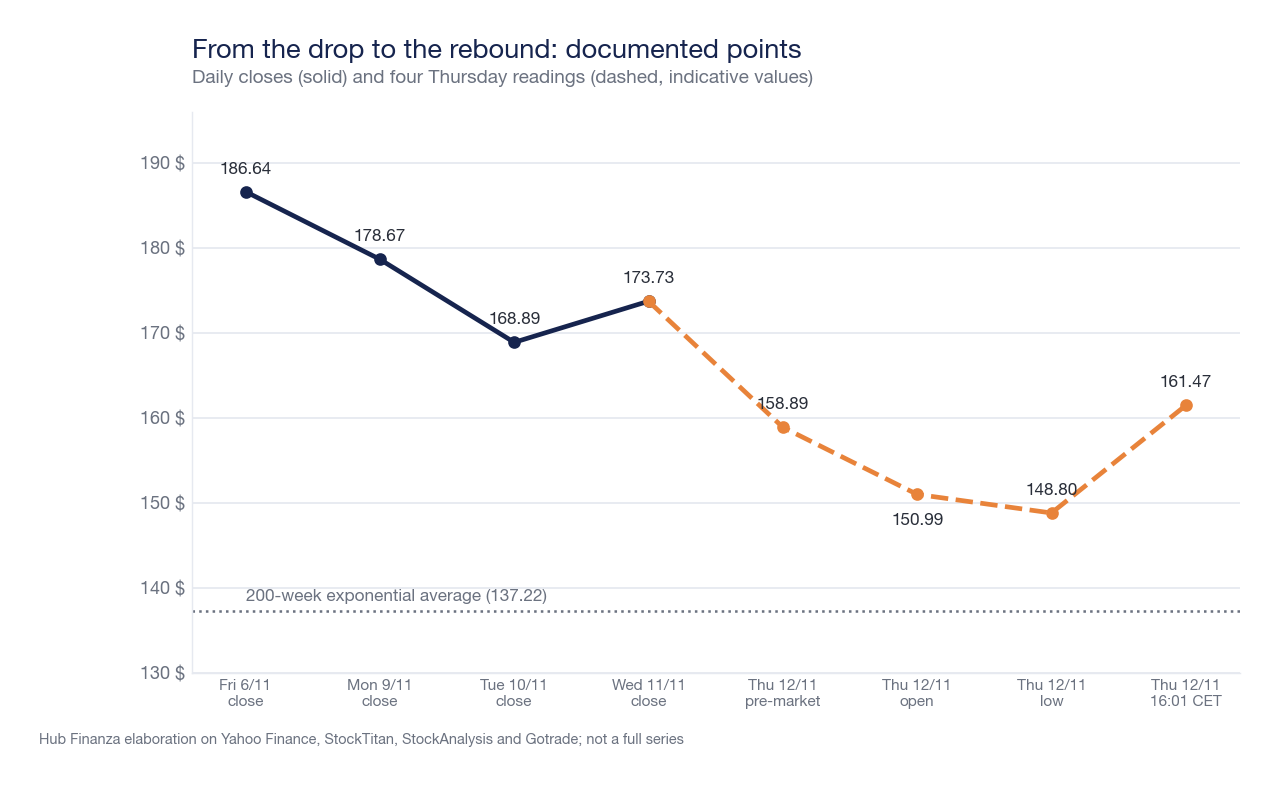
According to CNBC, the stock had lost 4.3% on Monday, November 9, and 5.5% on Tuesday, then recovered 2.9% on Wednesday, November 11, closing at 173.73 dollars. After the statement at 2:48 PM Italian time, pre-market quotes indicated approximately 158.89 dollars (−8.5%), with an overnight low of 156.20, the lowest in over a year according to Yahoo Finance. The closing high was 239.24 dollars, on October 6 (Yahoo Finance). The opening, low, and rebound of Thursday's session are in the following section.
At 4:01 PM, Yahoo Finance indicated an intraday market capitalization of approximately 3.899 billion dollars, compared to about 4.200 billion at Wednesday's close (StockTitan). Yahoo Finance reports over 600 billion lost in the last week and approximately 2.000 billion from the October high: these are estimates with different timeframes. Reuters indicated a stake of about 3.6% for Huang (LSEG data): the resignation as CEO says nothing about his shareholding.
Analysts reacted with six downgrades between Wednesday evening and Thursday morning, all preceding the statement (CNBC, Thursday, November 12):
| Company | Rating | Price target (dollars) |
|---|---|---|
| Melius Research | from buy to neutral | from 315 to 185 |
| Evercore | from outperform to in-line | from 465 to 186 |
| Bernstein | from outperform to market perform | from 400 to 200 |
| Oppenheimer | from outperform to perform | removed |
| William Blair | from outperform to market perform | not indicated |
| KeyBanc | from overweight to sector weight | not indicated |
| Citi | buy confirmed | from 285 to 225 |
| Yorkville (Dan Ives) | outperform confirmed | 300 with Huang, 225 without |
Hub Finanza analysis based on CNBC and Yahoo Finance, November 12, 2026; ratings expressed before the resignation statement.
The lowest targets, between 185 and 225 dollars, are above Thursday's price: this is a fact, not a forecast. A price target is an analyst's opinion, not a price the market must reach. After the statement, according to StockAnalysis headlines we have not read in full, Goldman Sachs lowered its target from 300 to 220 dollars, BMO raised it to 240 removing the stock from «top picks», StoneX moved to «hold» speaking of the loss of the «irreplaceable architect», and Baird writes that the stock may not have bottomed out yet. Stifel confirmed «buy» with a target from 315 to 205 (Yahoo Finance).
Thursday's rebound and the levels to watch
The stock opened at 150.99 dollars (−13.1%), touched a daily low of 148.80 (−14.3%), and at 4:01 PM Italian time (10:01 AM in New York) was trading at approximately 161.5 dollars, −7.1% compared to Wednesday: Yahoo Finance and StockAnalysis showed 161.47 and 161.77, StockTitan, delayed by 15 minutes, 160.91. From the low, the recovery is about 8.5%, more than half the distance separating it from Wednesday's close: the drop was about 25 dollars at its lowest point, and about 12 at 4:01 PM. Volumes are high, 297.8 million shares against an average of 131.1 million (Yahoo Finance). The sources we have read do not indicate a specific reason for the rebound. The daily high so far is 163.10, below the old 52-week low.
The levels to watch are few and documented. The first is the previous 52-week low, 164.27 dollars: Yahoo Finance describes it as a «floor» that had held twice in 14 months, now breached downwards and not yet recaptured by the rebound. The second is Wednesday's close, 173.73, from which the decline began. Below the price is the 200-week exponential moving average, which weights recent closings over almost four years more heavily: 137.22 dollars on TradingView (our recalculation on weekly closings: 137.4-137.6), about 15.0% from the 4:01 PM price. Above the price, in an independent calculation based on daily closings, the 50-day and 200-day simple moving averages are worth approximately 217 and 204 dollars, respectively 34% and 27% above: they indicate how much the stock has deviated from its recent trend.
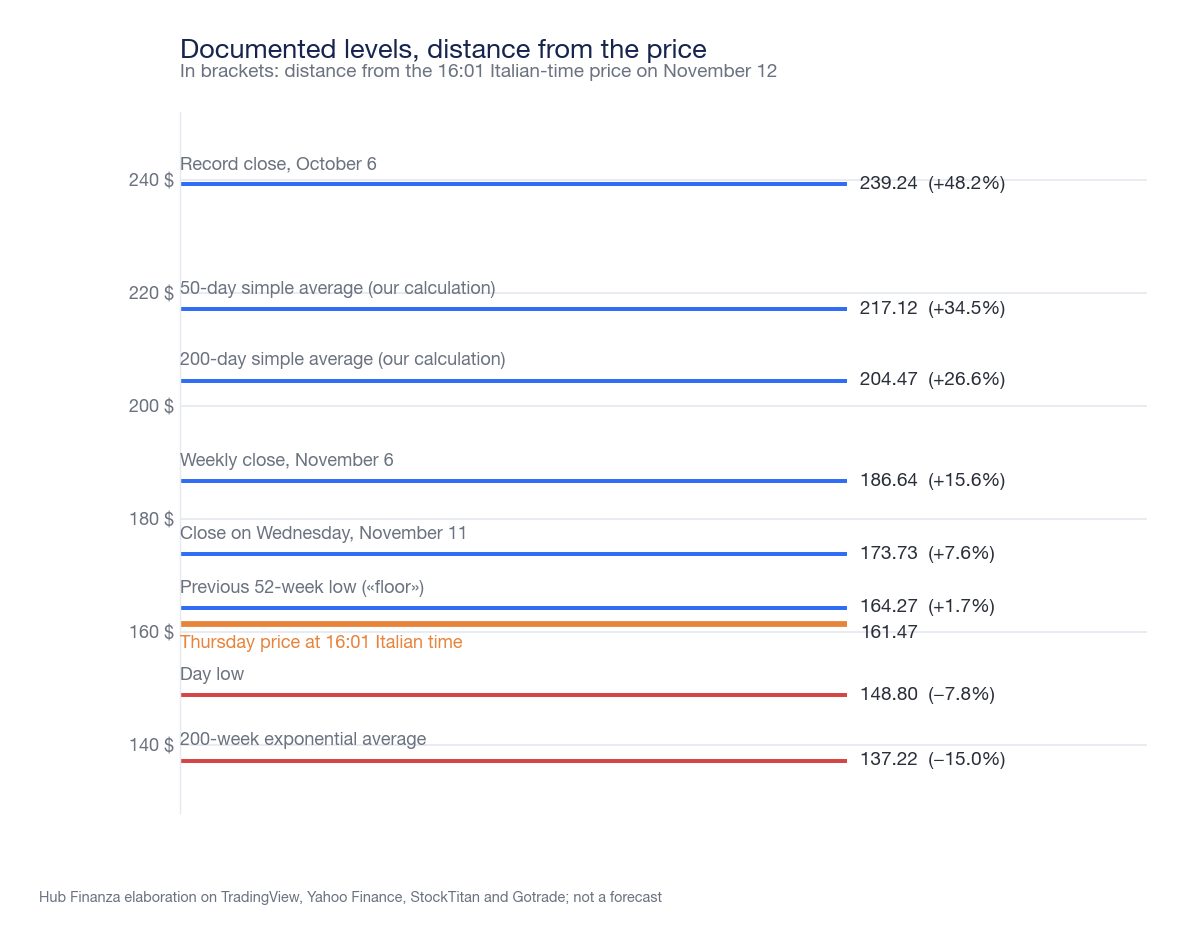
A necessary caution: a technical level is a convention, not a barrier. On a day with high volumes, corporate news, and analysts revising ratings, levels can be crossed in minutes. They serve to orient oneself on distances, not to predict where the price will stop. Below is the interactive candlestick chart, on which these levels can be traced.
How much is the man worth to the company?
Huang co-founded NVIDIA in 1993 and led it until yesterday; the annual report recalls the risk of strong dependence on long-standing management, as reported by Yahoo Finance. The risk has three different facets.
The first is operational: the strategy (CUDA platform, annual cadence of architectures, relationships with major customers) is rooted in a team and not in one person alone, but a change in leadership in the middle of a product cycle (Blackwell and Rubin), with a CFO also holding the CEO position, is an execution risk. The second is regulatory: the case intertwines chip exports to China, on which Congress is demanding tougher rules. The third is governance: the board has a chairman for the first time and must choose the successor under the market's scrutiny.
What precedents teach us
Academic literature gives us few certainties. The only sample whose numbers we have read in the full text is that of Jenter, Matveyev, and Roth (458 deaths of CEOs of listed U.S. companies, 1980-2012): sudden death produces an average abnormal return of −2.32% over three days, −3.25% if it's a founder, and −8.82% if the founder is young; if the head is old and long-serving, the reaction can be positive. The lesson is dispersion: the market prices who leaves, why, and who arrives. Almost all samples are of small and medium-sized companies: none isolate those worth trillions.
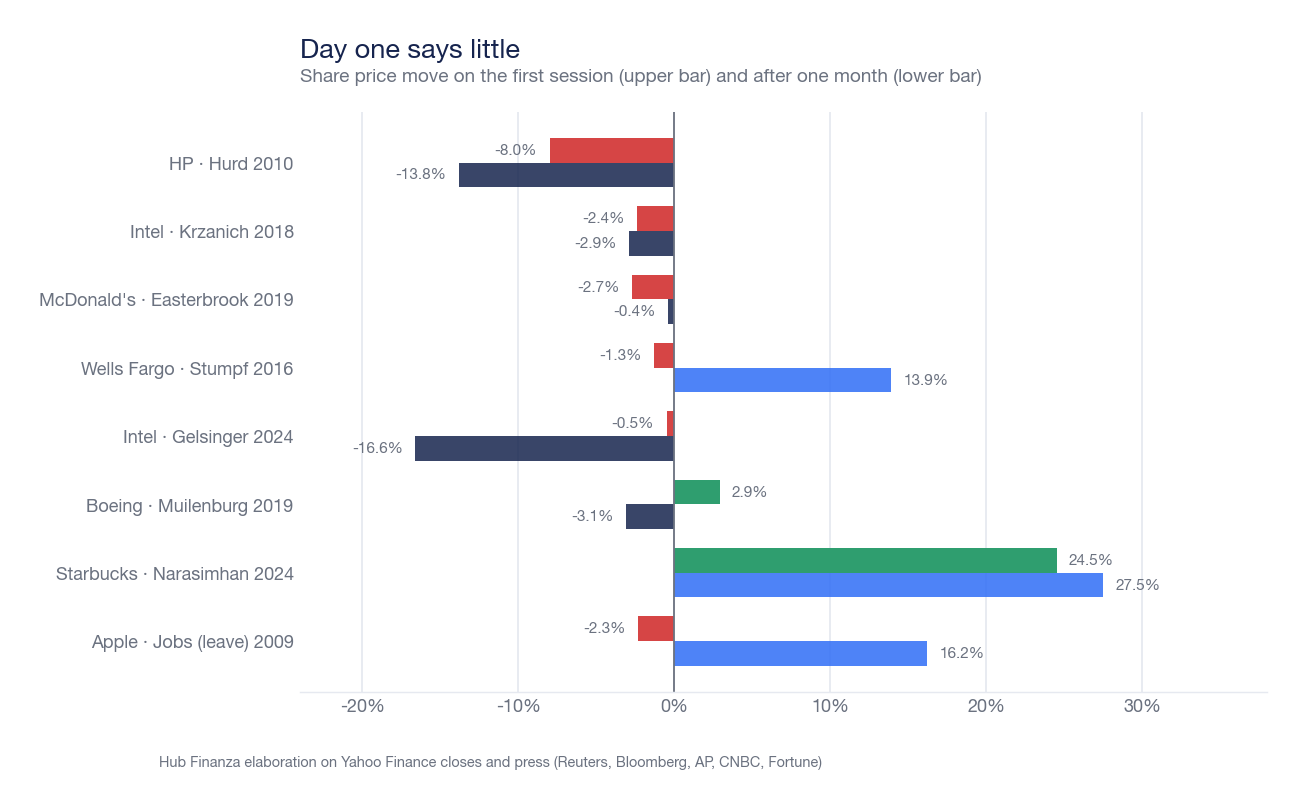
We have compiled a table of cases. The variations are our calculations based on Yahoo Finance's daily closings («1st day» is the first session after the news; «1 month» is 21 sessions from the day before the announcement), compared with press reports where possible.
| Case | Nature | 1st day | 1 month | Return to pre-news price |
|---|---|---|---|---|
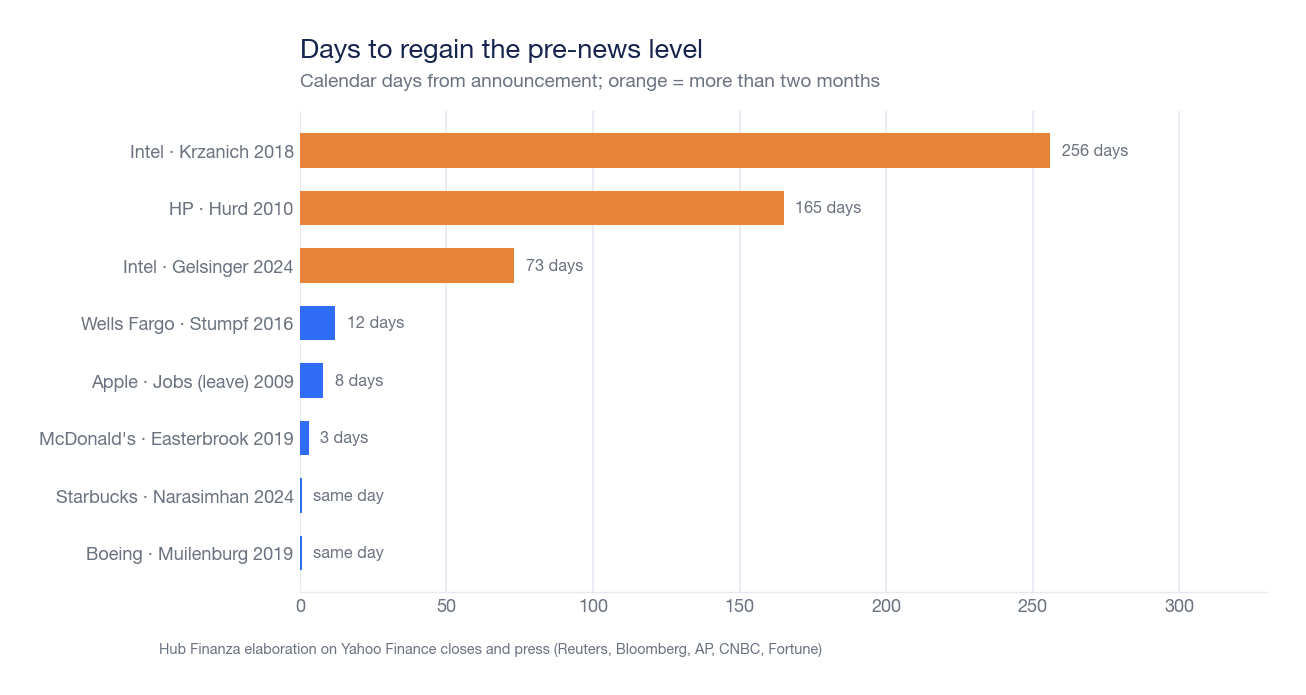
| HP / Mark Hurd (Aug 2010) | Scandal (expenses and relationship with a colleague) | −8.0% | −13.8% | January 18, 2011 (approx. 5 and a half months) |
| Intel / Brian Krzanich (Jun 2018) | Violation of internal rules | −2.4% (Intel raised estimates on the same day) | −2.9% | March 4, 2019 |
| McDonald's / Steve Easterbrook (Nov 2019) | Violation of internal rules | −2.7% | −0.4% | 2 sessions |
| Wells Fargo / John Stumpf (Oct 2016) | Fake accounts scandal | −1.3% | +13.9% (post-election bank rally) | approx. 8 sessions |
| CBS / Les Moonves (Sep 2018) | Harassment allegations | −1.5% (press) | not verified | not verified |
| Intel / Pat Gelsinger (Dec 2024) | Performance, departure presented as «retirement» | −0.5% at close (+4-5% mid-session) | −16.6% | February 13, 2025 |
| Boeing / Dennis Muilenburg (Dec 2019) | 737 MAX crisis | +2.9% | −3.1% | already on day 1 |
| Starbucks / Laxman Narasimhan (Aug 2024) | Performance; successor known | +24.5% | +27.5% | already on day 1 |
| Apple / Steve Jobs, medical leave (Jan 2009) | Health (founder) | −2.3% (after −6/−8% after hours) | +16.2% | January 22, 2009 |
Hub Finanza analysis based on Yahoo Finance closings and press reports (Reuters, Bloomberg, AP, CNBC, Fortune). Differences of a few tenths with other sources depend on adjusted closings and rounding. Uber (June 2017) is not included because it was not listed: Travis Kalanick's departure is measured only by private round prices.
What can be cautiously deduced. First: in cases of personal conduct concerning a non-indispensable CEO, the reaction is brief and small, and the recovery rapid (McDonald's, Wells Fargo, Intel 2018). Second: the closest case in terms of structure is HP, where Hurd was perceived as the company's driving force, and there the stock lost 8% on day one, about 14% in a month, and a maximum of about 18% from the pre-news price; NVIDIA's decline touched −14.3% in the morning, beyond HP's first day, and with the rebound was at −7.1% at 4:01 PM, similar in magnitude to HP's −8.0%: the comparison is only valid with Thursday's closing. Third: the first day says almost nothing about what follows, as Gelsinger shows (opening higher, then −16.6% in a month) or Boeing (+2.9%, then the Covid crisis and the 737 MAX halt). Fourth: Intel in 2018 also entrusted interim leadership to its CFO, Bob Swan, and the stock took about eight and a half months to return to its previous level.
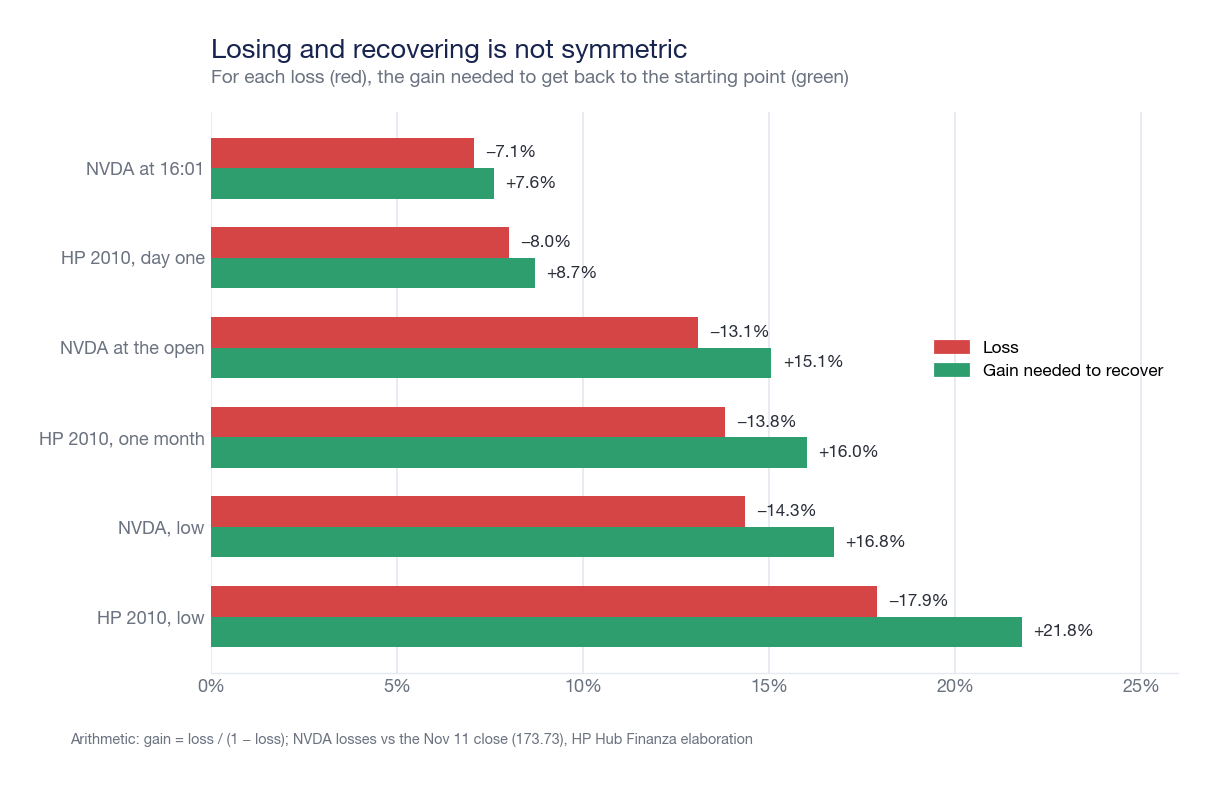
An arithmetic that applies to any stock and any entry point: the loss and the gain needed to recover it are not symmetrical. After an 8% drop, an 8.7% rise is needed to return to the starting point; after the −7.1% at 4:01 PM, +7.6% is needed; after the −14.3% touched Thursday morning, +16.7% is needed; after HP's −13.8% in a month, +16.0% is needed; after HP's −17.9% low, +21.8% is needed. This is one reason why the first day says so little: the damage is measured over the entire path, and that path also depends on factors that the Huang case does not control. With three serious limitations in transferring HP to NVIDIA: the company is many times larger than HP in 2010; the stock's reaction depends much more on earnings, interest rates, and the entire artificial intelligence sector; and in NVIDIA's case, a regulatory risk is added that was not present in past cases.
Three conditional scenarios for the coming weeks
Rapid and credible successor. The board declares it is evaluating internal and external candidates. If a name arrives quickly and the market deems them suitable, precedents treat this scenario better: Starbucks shows how much who arrives matters, not just who leaves. For NVIDIA, the continuity of the technical team and relationships with major customers would be important.
Long search with interim leadership. A CFO also holding the CEO role can ensure continuity of financials, but the market has no timeline. The Intel 2018 example, with an interim and then months of recovery, indicates that uncertainty can last much longer than the first day.
New legal or regulatory developments. The class action, a potential congressional request, export rules, and relations with China do not depend on the board. A new development on any of these fronts would weigh on the stock regardless of the succession.
What an investor can do (without personalized advice)
Here we do not tell you what to do with a stock: we do not know your situation. We tell you what is useful to know to make decisions with a cool head.
- Separate the three questions. The stock today reflects three different things: earnings and artificial intelligence prospects (which the resignation does not inherently change), governance risk, and regulatory risk.
- Know how much it weighs. A very heavy position makes any scenario more painful: the guide to diversification explains why concentration is the true multiplier of risk, regardless of the stock.
- Decide before, not after. Your entry point, the loss you are willing to tolerate, and your time horizon should be set before the news, not while the stock moves ten points.
- Leveraged instruments or options. With high volatility and sudden announcements, leveraged positions can lead to losses exceeding capital.
What to watch, and when
On Tuesday, November 17, NVIDIA presents its Q3 FY2027 earnings: results at 1:20 PM Pacific time (10:20 PM in Italy) and the conference call at 2:00 PM (11:00 PM in Italy). According to previews from MarketBeat, Zacks, and Theta, collected before the resignation (figures to be verified in the statement), the consensus is for approximately 108.8-109 billion dollars in revenue and 2.47-2.49 dollars in EPS, against company guidance of 108 billion, with a 2% tolerance, and a gross margin of 74%. We do not guarantee the accuracy of these data: they are the benchmark against which the results will be read and may be revised after the resignation.
The quarterly report matters for two distinct reasons. The first is that it demonstrates whether or not the business has changed: demand from major customers, margins, prospects for the next quarter, revenues from China. The second is that it will be the first time the leadership speaks to the markets after the resignation, with Kress in the dual role of interim CEO and CFO: questions, answers, and silences on the successor and governance will be part of the reading. Good quarterly results do not cancel governance risk, and a stock can rise on earnings and fall on board news on the same day. The guide how to read a quarterly report explains why results are read against expectations, not in absolute terms.
Beyond earnings, follow: board press releases and 8-K filings on EDGAR, especially concerning the successor search, agreements with Huang, and Kress's terms; the outcome of the Wachtell investigation, for which there is no date; the name of the plaintiff and court for the class action; Form 4 filings on insider transactions. After the earnings, we will publish an article with the results, management statements, and market reaction. This piece should not be read as a forecast: it is a map of what is known, what is unknown, and how similar cases have moved.
Sources: NVIDIA, «NVIDIA Announces CEO Transition» (11/12/2026), «Statement From NVIDIA Board of Directors» (11/08/2026), «A Message to Our Company» (11/08/2026), «Statement From the Independent Members of the NVIDIA Board» (11/10/2026), nvidianews.nvidia.com; SEC EDGAR, Form 8-K dated 11/12/2026 (items 5.02 and 9.01, accession 0001045810-26-000082) and list of NVIDIA filings (CIK 0001045810), consulted 11/12/2026; CNBC, «'A dark day for Nvidia': Here's what analysts are saying…» (11/12/2026); Yahoo Finance, «Nvidia live updates» (11/12/2026); StockTitan, reproduction of the statement and 15-minute delayed quotes (11/12/2026); Reuters (via Investing.com), «Trump says FBI probing Nvidia CEO Huang…» (11/09-10/2026) and «Nvidia board weighs CEO Huang's future…» (11/11-12/2026); CBS News, «Nvidia's board preparing to oust CEO Jensen Huang, sources say» (11/12/2026); Bloomberg and Wall Street Journal, cited as reported by previous sources; Al Jazeera, «Nvidia shares slump amid investigation into CEO Jensen Huang» (11/09/2026); Jenter, Matveyev, and Roth, «Good and Bad CEOs» (working paper, 2016); Warner, Watts, and Wruck, JFE 1988; Huson, Malatesta, and Parrino, JFE 2004; Yahoo Finance (historical series); MarketBeat, Zacks, and Theta (previews and consensus on Q3 earnings 11/17/2026, approximate values); Bloomberg, AP, CNBC, and Fortune for HP, Intel, McDonald's, Wells Fargo, Boeing, Starbucks, and Apple cases. News reported from anonymous sources are indicated as such and not confirmed by NVIDIA at the time of writing.
Disclaimer: the information provided in this article is for informational and educational purposes only and does not constitute personalized financial advice. The corporate cases cited are illustrative examples, not investment recommendations. It is recommended to consult a qualified professional before making any investment decisions.