
As of October 21, 2026, four weeks after the September 24 meeting at the White House, the extension of the truce between the United States and China to January 10, 2027, is announced by both parties, but there is no official act to formalize it: legal deadlines remain on November 9 and 10.
This is the assessment we promised in the pre-summit article. Data is updated as of October 21, 2026, 8:45 PM Italian time; every statement carries its source, and where we could not verify a point against an official document, we state it. Among the meeting documents, we did not find one signed by both: there are two separate texts, one for each side.
What happened on September 23, 24, and 25
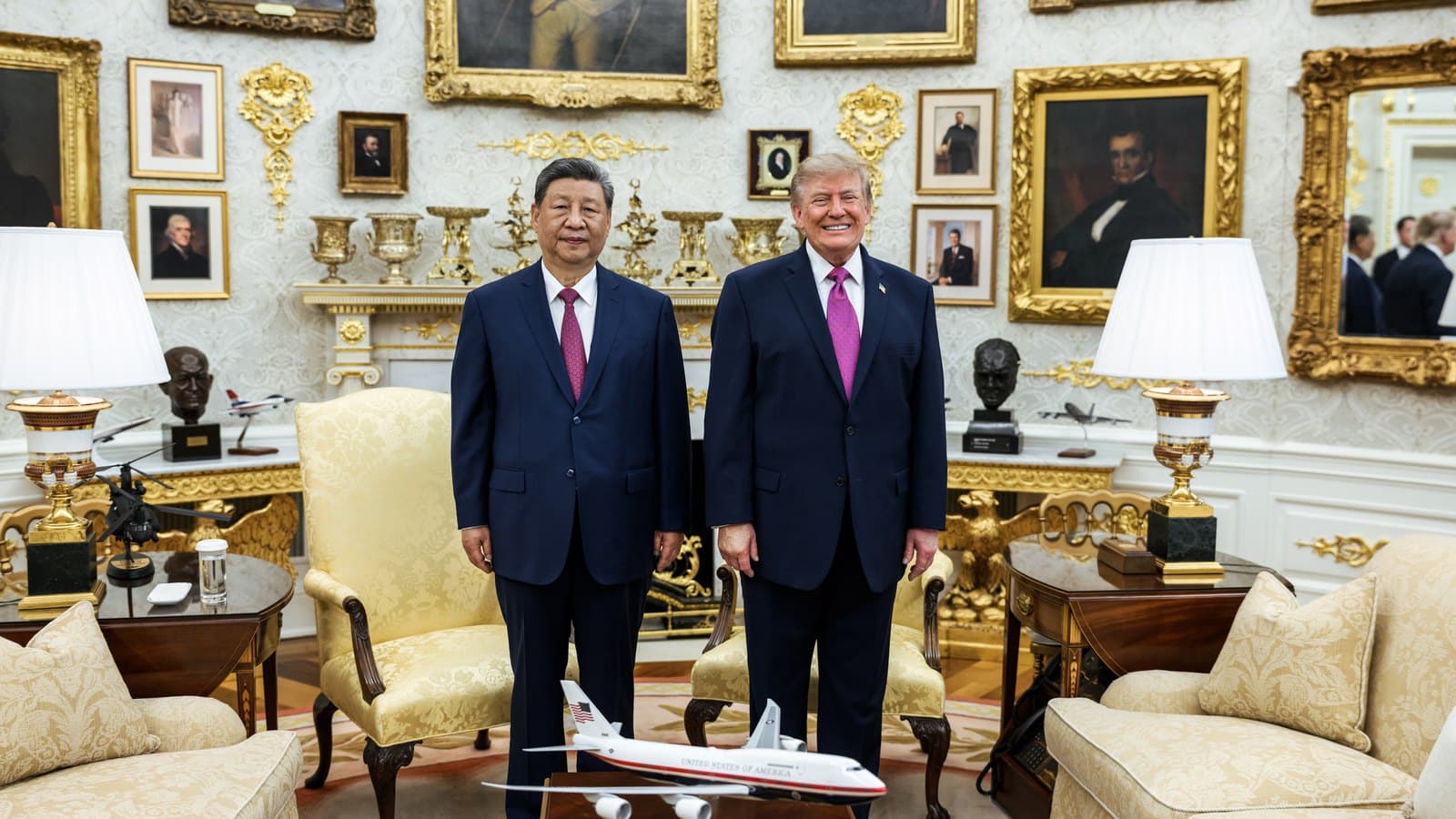
Xi Jinping landed on Wednesday, September 23, at Joint Base Andrews, and Donald Trump went to greet him at the foot of the plane, a gesture the Associated Press described as rare. On Thursday, September 24, there was the arrival ceremony and a bilateral meeting of about ninety minutes behind closed doors, the agency reports; in the evening, the State dinner, with CEOs of technology companies. On Friday, September 25, tea at the White House, a visit to the National Archives, and departure.
The contents are recounted in two separate documents. On September 25, the White House published a fact sheet; on September 26, Xinhua released the "eight outcomes" according to Beijing; on September 28, the Chinese Ministry of Commerce (MOFCOM) added a statement on trade. Sources describe much ceremony and few operational contents.
Announced, implemented, still open
The table separates what was said from what exists as an act. "Implemented" means an operational document, for example, a notice in the Federal Register, the official gazette of the United States, or an announcement from the Chinese ministry; a mere declaration is not enough.
| Element | Announced | Implemented | Still open |
|---|---|---|---|
| Truce extension to January 10, 2027 | Yes: Bessent verbally on September 23, MOFCOM in writing on September 28 | No: no notice in Federal Register; no new MOFCOM announcement found | Legal dates are still November 9 and 10 (USA) and November 10 and 27 (China) |
| Board of Trade, lists on about $30 billion per side | Yes: White House on September 25 and 27, MOFCOM on September 28 | Only operating rules and lists of "recommended" products | Tariff rates, internal procedures, and implementation date |
| US coal: at least 10 million tons per year in 2027 and 2028 | Yes, but only in the US text | No | The Chinese text does not indicate quantities |
| Rare earths | Generic formula in US text: parties "working" to restore shipments to adequate levels | No | No quantified commitment; MOFCOM does not name them in the September 28 statement |
| Artificial intelligence dialogue | Yes, by both parties | First meeting already held, according to MOFCOM | Next session by November |
| Soybeans | Target of 25 million tons in 2026/27, reported by Reuters | First purchases in the week of October 16, about 1.3 million tons | The total for the campaign is about 15 million tons |
| Taiwan arms package of $14 billion | No announcement | Stalled since May 2026 | No notification to Congress or formal cancellation |
Two versions of the same meeting
The two parties do not recount the same summit. In Beijing's account, Xi asks the United States to "oppose Taiwan independence"; the American fact sheet does not mention Taiwan. The eight Chinese outcomes include a military memorandum on crisis management to be concluded "as soon as possible," which does not appear in the US text; an American official reportedly deemed it inaccurate, but the source is an analysis by a think tank that we could not access, and therefore we do not take it as confirmed. The Americans write "super intelligence" for the new dialogue, the Chinese "artificial intelligence." On the point where the two texts coincide, Iran, the agreement is that Tehran cannot have nuclear weapons and that no one imposes tolls on international waterways.
Then there is what no official text contains. Boeing, Nvidia's H200 chips, and TikTok do not appear in any official summit text we accessed, i.e., the White House fact sheet and the reports from MOFCOM, Xinhua, and the Chinese Ministry of Foreign Affairs: we do not report them as outcomes. Regarding Boeing, as we wrote on September 24, citing the Council on Foreign Relations, the announcement of 200 aircraft in the May 17 fact sheet was never confirmed by Beijing.
The truce: what the dates really say
On September 23, Treasury Secretary Scott Bessent announced a two-month extension, from November 10, 2026, to January 10, 2027. On September 28, MOFCOM confirmed it in writing: the parties agreed to extend the Kuala Lumpur agreement to January 10, 2027. This is a step beyond what we wrote on September 24, when Beijing spoke of a consensus without indicating the date.
A declaration, however, does not shift a legal deadline. In the United States, the Department of Commerce rule extending export controls to 50% owned subsidiaries of blacklisted companies, and port tariffs on China-linked ships, remain suspended until November 9; an inquiry of the Federal Register archive, conducted on October 21, shows no notice of extension. In China, the suspension of rare earth controls, announcement 70 of 2025, expires on November 10, and that of announcement 72 on November 27; we have not found a new ministerial announcement shifting these dates. The inquiry covers only documents already published, not those in public consultation on October 21.
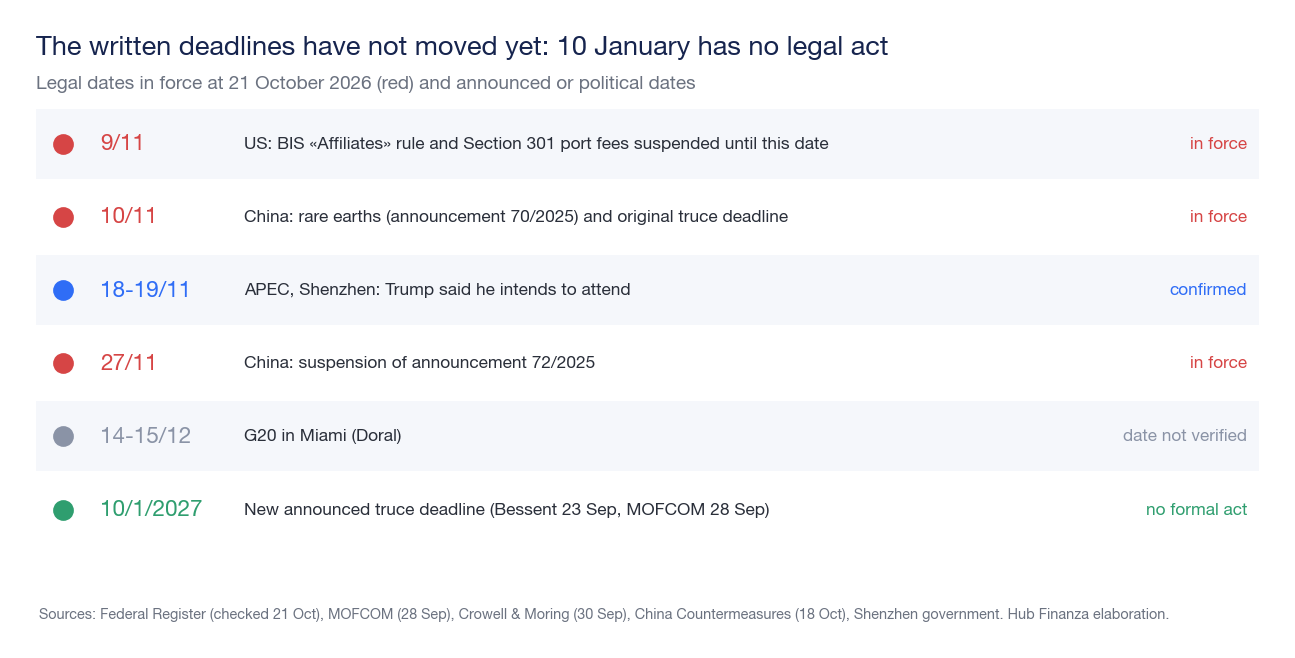
For the markets, the substance is this: until an act appears, January 10 remains a political commitment. If the two governments let November 9 and 10 pass without publishing it, the suspension would expire. This is a scenario, not a forecast; no source we have read suggests it is probable.
The Board of Trade: lists, not cuts
On September 27, the White House published lists of products for which the new Board of Trade recommends reduced tariffs, along with working procedures and its mandate. For MOFCOM, the value is about $30 billion per side, based on 2024 trade; more than 90% of products would return to most-favored-nation rates, without additional tariffs. Implementation, the ministry writes, will be "synchronized" after each party's internal procedures, without a date. The American lists concern toys, home appliances, baby products, and decorations; the Chinese lists include agri-food products, personal care products, medical devices, and coal.
The Covington law firm, on October 5, observes that on the American side, a public consultation process by the Office of the Trade Representative will be needed, which can take months, and suggests among the hypotheses the removal of the 301 tariff for forced labor, at 12.5%. This is an interpretation by a law firm, not an official text, and we could not verify the rate against a primary source. The Federal Register for the period shows no tariff reductions towards China: 301 actions on technology transfer remain in force, and were confirmed on October 7.
Soybeans, rare earths, and Taiwan: what has moved since the summit
Soybeans are the chapter with the most movement. According to the University of Illinois summary on Bloomberg and Reuters, in the week of October 16, China bought the first shipments after the summit, at least twenty, for about 1.3 million tons. The total for the 2026/27 campaign is about 15 million tons, against a White House reported target of 25; the Chinese tariff on American soybeans remains at 13%, according to S&P.
Regarding rare earths, nothing new has emerged for the United States compared to the generic formula of September 25. On October 15, MOFCOM stated that it would continue to facilitate licenses to the European Union and requested reciprocity on dual-use products; when asked if this was linked to negotiations with Washington in January, the response established no such link. The $14 billion Taiwan arms package has been on hold since May 2026, thus before this summit: on September 29, the Taiwanese Defense Minister said he had no notifications of changes to existing sales, and neither notifications to Congress nor formal cancellations have emerged.
Three moves in the opposite direction
In the three subsequent weeks, Washington and Beijing also made decisions that move in a different direction from détente, without necessarily contradicting the summit. On October 7, the Office of the Trade Representative announced, with fourteen other economies, a declaration on excess production capacity; MOFCOM, on October 9, said it opposed the use of the concept as a protectionist pretext and would respond if affected. The list of signatories, and thus Brussels's position, could not be verified: the American page does not open. On October 19, five Chinese entities were added to a US sanctions list for the theft of Google trade secrets, according to the specialized site Sanctions.com. On October 20, the Department of Homeland Security's order excluding DeepSeek products from federal civilian systems was published in the Federal Register; the Chinese Ministry of Foreign Affairs protested against the extension of the national security concept. Between September 25 and October 21, we found no phone calls between Trump and Xi, which does not prove that there were none.
The Chinese and American economies during the period: data prior to the summit, not effects
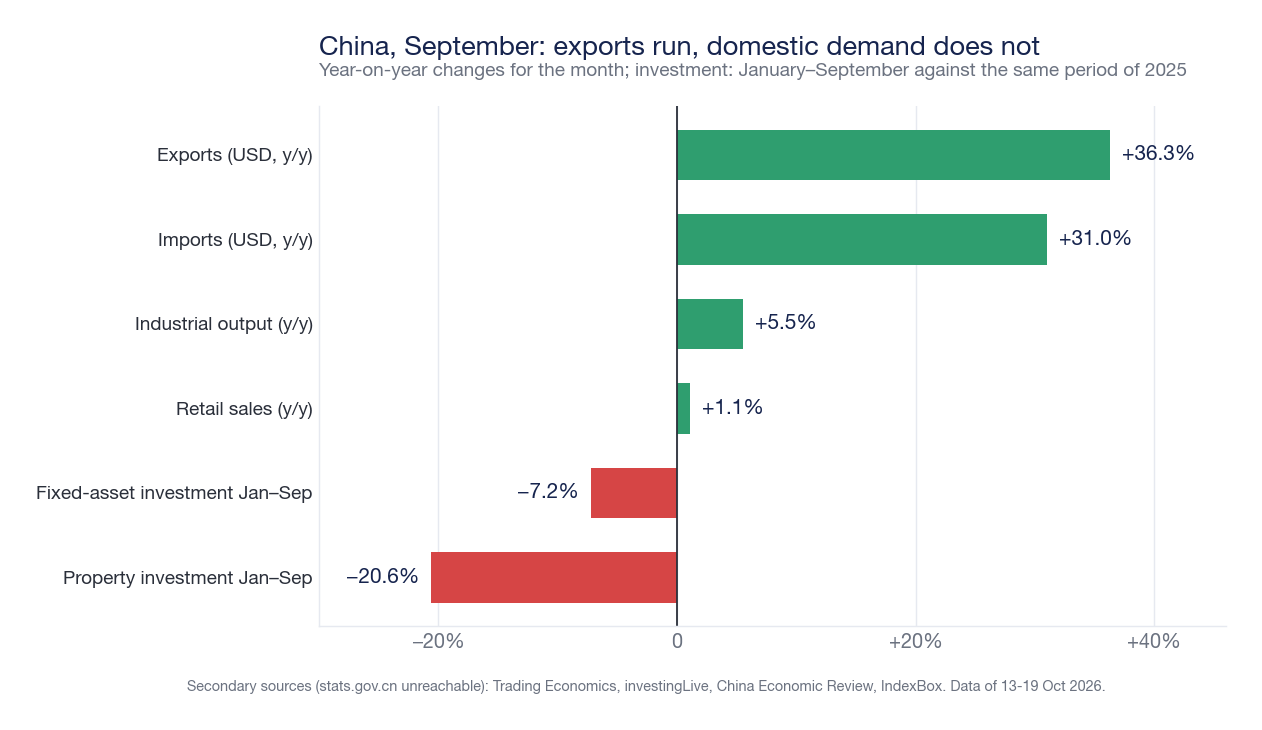
None of the following data measures the effects of the meeting: they relate to previous periods, and we publish them to understand the starting point. China's GDP for the third quarter, released on October 19, grew by 4.5% year-on-year and 1.2% quarter-on-quarter, against 4.3% and 0.9% in the second quarter, and above the 4.4% consensus reported by investingLive. September, however, tells of two economies: exports rose 36.3% in dollars and imports 31%, with a trade surplus of 133.5 billion, according to Trading Economics; industrial production by 5.5%, retail sales by only 1.1%, and between January and September fixed asset investments fell by 7.2% and real estate investments by 20.6%. Consumer prices rose 0.9% year-on-year and producer prices by 5.0%, according to CGTN; on October 20, the People's Bank of China left benchmark interest rates unchanged, at 3.0% for one year and 3.5% for over five years. The sources are secondary because the website of the National Bureau of Statistics is not accessible.
On the American side, September data arrived regularly. The Bureau of Labor Statistics, on October 2, counted 29,000 new jobs and unemployment at 4.2%, with July revised to -10,000 jobs; on October 14, consumer prices recorded +3.7% year-on-year, against 3.4% in August, and a core inflation of 2.6%, above Newsquawk's expectations of 2.5%. Trade with China in August, which the Census published on October 6, shows US imports of $25.4 billion and exports of $9.1 billion, with a deficit of $16.4 billion. For why these numbers matter for rates, see the guide on ECB and Fed: how central banks work.
The yuan and Chinese stock markets: signals, not proof
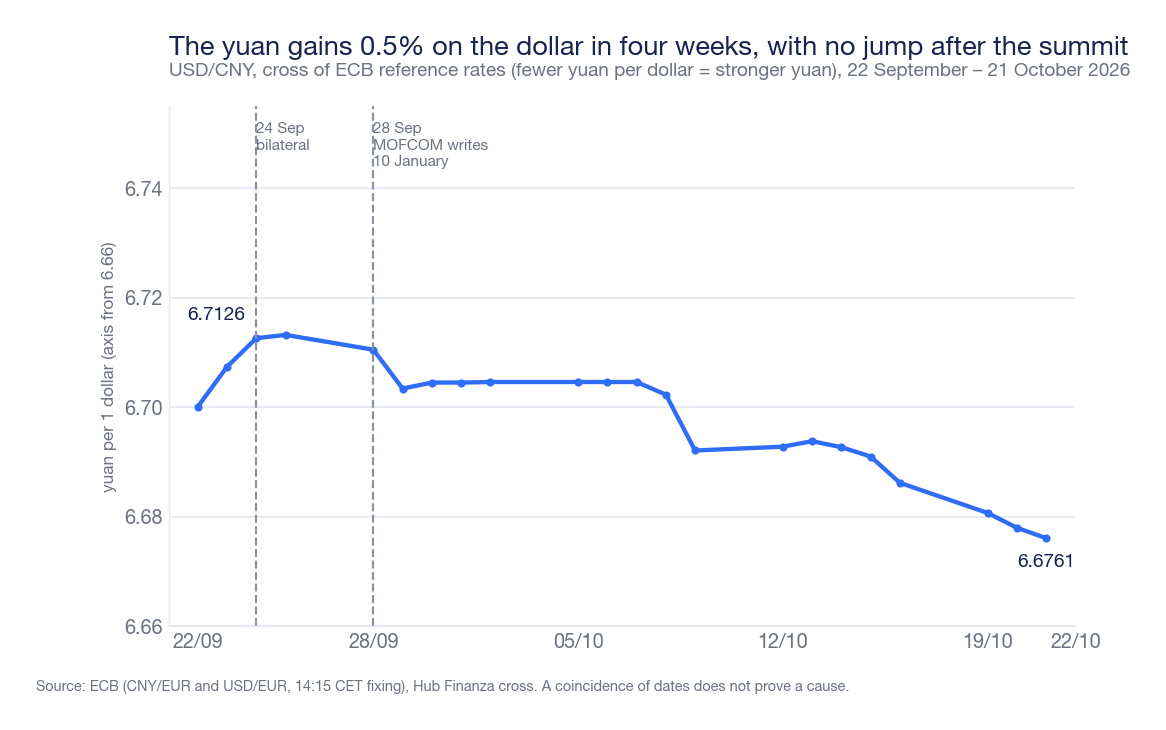
The summit was followed by a slight strengthening of the yuan. According to the cross-reference on ECB benchmark rates, on September 24, 6.7126 yuan were needed for one dollar, on October 21, 6.6761: the yuan gained about 0.5% in four weeks, without a jump in the days of the meeting. A coincidence of dates is not a cause: the movement fits into an already ongoing appreciation trend, as we recalled on September 24. For how the exchange rate enters monetary policy, see the guide Monetary policy: what it is, how it works, and why it moves mortgages, bonds, and currencies.
Chinese stock markets, in the same period, lost ground: from September 24 to October 21, the CSI 300 fell 7.4% and the Hang Seng 4.5%, while the S&P 500 gained 0.7% (closing on October 21). For the markets as a whole, the monthly overview is found in Wall Street rises but chips remain at -7.9%. These are price indices, without dividends, and the data does not prove that the summit moved them. In the pre-summit article, we had proposed testing Bloomberg Intelligence's thesis on the "geopolitical discount" on Chinese dollar credit. In this update, we have not collected the series of Chinese credit spreads: the thesis remains an unverified hypothesis, and we do not use it either for or against.
Repercussions for Europe
The only documented European repercussion is parallel, not a consequence of the summit. On October 9, in Beijing, European Commissioner Maroš Šefčovič and Chinese Commerce Minister Wang Wentao reached, Euronews and Fortune report, a preliminary agreement: China would moderate exports of hybrid and plug-in cars, facilitate licenses for rare earths and magnets, and reduce tariffs on auto parts, olive oil, and footwear, for about four billion euros of European exports and at least 225 million in saved tariffs. It is not definitive: it requires examination by European leaders.
What we can conclude, and what remains open
The facts allow for few conclusions, and this is already an outcome. The summit produced a political framework, the Board of Trade with its lists, a dialogue on artificial intelligence, and a date, January 10, 2027, written by both parties. As of October 21, it did not produce a cut in existing tariffs or an act that shifts the November deadlines; and in the meantime, the United States has taken new measures on Chinese technology, and Beijing has announced its opposition.
The calendar for the coming days shows where to look. The Federal Reserve decides on Wednesday, October 28, at 7:00 PM Italian time, after the September rate hike: you can find it described in The Fed raises rates. On November 9 and 10, US and Chinese suspensions expire, unless an act shifts them; the next meeting of the artificial intelligence dialogue is expected by November; on November 18 and 19, there is APEC in Shenzhen, where, according to the Associated Press, Trump responded "We will" to Xi's invitation. The G20 in Miami is indicated for December 14 and 15 by a non-primary source: the date is unverified. On January 10, 2027, the announced extension expires.
Sources
White House fact sheet of September 25, 2026, and Board of Trade page of September 27; communiqués from the Chinese Ministry of Commerce (MOFCOM) of September 28, October 9, and the press conference of October 15; reports from the Chinese Ministry of Foreign Affairs of September 24-25 and October 20; Xinhua's "eight outcomes" of September 26, in the STCN version; Associated Press report via PBS NewsHour (September 23-25) and Fortune (September 29); Federal Register (October 21 inquiry; Department of Homeland Security order, 2026-21447); Crowell & Moring (September 30) and Covington (October 5), law firms; China Countermeasures (October 18); Farm Policy News of the University of Illinois (October 16); Euronews and Fortune/AP (October 9-10); Shenzhen government on APEC. Chinese data from Xinhua/People's Daily, investingLive, China Economic Review, CGTN, IndexBox, and Trading Economics (secondary sources) and, for rates, People's Bank of China. American data from Bureau of Labor Statistics, Census, and Federal Reserve; exchange rates from the European Central Bank; indices from Yahoo Finance and CNBC. The comparison between the two versions of the meeting, the calculation of variations, and the graphics are editorial elaborations. Information that we could not confirm from open sources is indicated in the text.
This article is for informational purposes only and does not constitute financial advice, investment research, solicitation for public savings, or a personalized recommendation to buy or sell. The evaluations expressed are editorial opinions based on public data as of the publication date and may change without notice. The value of investments can decrease as well as increase, and past performance is not indicative of future results. Before making any investment decision, it is advisable to consult a qualified financial advisor and assess the consistency of the operation with one's objectives, time horizon, and risk tolerance.