


Leonardo Maria Del Vecchio left the presidency of Ray-Ban and the strategic direction of EssilorLuxottica on Tuesday, August 25, 2026, effective from the 31st. He remains a Delfin shareholder with 12.5%. His 10 billion plan to increase his stake in the family's strongbox to 37.5% has been stalled since June.
The letter to the board speaks of corporate culture: a group that has become «distant» and «impersonal». But the calendar tells another story, and the numbers confirm it. Between December 31, 2025, and August 25, 2026, Delfin's listed portfolio decreased from 55.1 to 41.6 billion euros. The 25% that Leonardo Maria had committed to buy for 10 billion was worth 13.8 billion at the end of 2025; today it is worth 10.4 billion. The discount that made the operation financeable — 27% — has shrunk to 4%. The thesis of this article is that the important piece of news is not the personal disagreement with CEO Francesco Milleri, but that arithmetic: a price set in April based on January values, applied to collateral that had in the meantime lost forty percentage points.
What he left, what he kept, and why the date matters
The positions left are two and need to be named, because their nature explains the extent of the departure: the presidency of Ray-Ban, the group's most profitable brand, and the role of chief strategy officer, meaning responsibility for the entire group's strategy. The resignations, communicated on Tuesday, August 25, 2026, with a letter to the board of directors and to Milleri, become effective on August 31. Leonardo Maria Del Vecchio, the founder's fourth son, is 31 years old.
What he did not leave is at least as important. He remains the owner of 12.5% of Delfin, the Luxembourgish holding company that controls 32.4% of EssilorLuxottica and which, after the death of Leonardo Del Vecchio in June 2022, was divided into eight equal shares among the heirs: the founder's six children, his widow Nicoletta Zampillo, and her son Rocco Basilico. In the letter, he commits to exercising his responsibilities as a shareholder «to the fullest». It is an operational farewell, not an exit from the capital — and the distinction is far from formal, because it is precisely as a shareholder that the game is still open.
There is also a precedent: Rocco Basilico had resigned from his positions in the group the year before. In four years, the holding company has not found a structure, and two of the eight heirs have left operational roles in the company controlled by the holding company.
The text of the letter, picked up by Italian newspapers, is cultural in nature and not financial. Del Vecchio writes that «the enthusiasm is not what it once was», that «the sense of belonging is not what it once was», that «the distance is felt», and contrasts the current management with his father's way of being in the factory: «a company is not a sum of functions. It is a pact». The company responded with a note of thanks «for having contributed to the group's growth and the realization of the strategic vision desired by his father», wishing him success in his new entrepreneurial projects.
These are two narratives that do not contradict each other, but neither explains the date: a cultural divergence does not mature on a precise day in late August. What does mature on a precise date is a financial operation that does not close: the closing of the purchase of the siblings' shares was expected by June 27, 2026, the fourth anniversary of their father's death. It did not happen. The resignations come eight weeks later.
The 10 billion plan: why everything depended on a dividend
To understand the stalemate, one must look at the mechanics of the operation, which is typical of a leveraged buyout and has only one fragile point.
In February 2026, Leonardo Maria Del Vecchio announced his intention to acquire the shares of his siblings Luca and Paola: 12.5% each, 25% in total, valued at 5 billion each for a total of 10 billion euros. With that purchase, he would increase his stake from 12.5% to 37.5% and become Delfin's largest relative shareholder. On April 27, 2026, Delfin's assembly, meeting in Luxembourg, approved by majority — with the opposing votes of Claudio Del Vecchio and Rocco Basilico, according to MilanoFinanza's reconstruction — both the transfer of shares and a more generous distribution policy, with the aim of distributing up to 80% of profits in the 2025-2027 three-year period. The financing, reported to be around 11 billion, is organized by a pool with UniCredit, Crédit Agricole, and BNP Paribas, with the Delfin shares pledged to the banks.
The second item on the agenda — dividends — seems technical but is instead the linchpin of everything. Whoever buys a stake on debt that does not produce operating income has only one source to pay interest: the dividends that stake distributes. Delfin's bylaws provide for a minimum distribution equal to 10% of profits, and to go beyond that requires a qualified majority. The banks, to disburse the loan, wanted certainty about that flow. Without the dividend resolution, the debt has no means to service itself.
The same bylaws contain a second constraint worth noting, because it was written precisely to prevent what is happening: shareholders cannot directly use their shares as collateral to obtain loans. This is a clause designed to protect the balance among the heirs, and the practical effect is that anyone who wants to increase their stake within Delfin must find guarantees elsewhere — or have them provided by Delfin itself.
Milleri did not stop the reorganization
This is where the most common reconstruction on Tuesday needs to be corrected, because it overlaps two distinct conflicts.
The banks, to proceed, asked Delfin for a letter of patronage: a commitment from the holding company to support the shareholder's financing. Delfin's board examined it at the meeting on June 25, 2026, and split. According to MilanoFinanza's reconstruction, Francesco Milleri, who is Delfin's chairman, and notary Mario Notari voted in favor; CEO Romolo Bardin and directors Giovanni Giallombardo and Aloyse May voted against. During the discussion, conditions tightened to require unanimity — eight out of eight — where previously simple majorities had been discussed. With two heirs against, unanimity is a closed door.
The detail reverses the narrative: on the operation he cared about, Milleri voted on his side. The disagreement with EssilorLuxottica's CEO, which the letter expresses in terms of corporate culture, is real but it is a different front from the one that blocked Delfin's reorganization. Attributing the stalemate to «Milleri's management» means combining two events that the minutes keep separate.
The assembly on June 30 confirmed the blockage: the financial statements passed, but both the exceeding of the 10% cap on profit distribution and the steps functional to the reorganization remained stalled. Leonardo Maria did not attend and entrusted a letter to denounce «unresolved issues» and an «inert» board.
The evaporated discount: the arithmetic that made the operation difficult to finance
The reason why a board tightens conditions and banks ask for more guarantees is rarely personal. Here it can be measured.
Delfin's listed portfolio consists of five declared holdings: 32.4% of EssilorLuxottica, 10% of Generali, 17.5% of Monte dei Paschi, 2.7% of UniCredit, and 28% of Covivio. Multiplying the closing price for each by the number of shares in circulation and the held stake yields a market value that does not require estimates: 55.1 billion euros on December 31, 2025, 41.6 billion euros on August 25, 2026. This calculation is indirectly confirmed by press reports, which placed the holding company's assets around 55 billion at the beginning of the year and around 40 billion today.
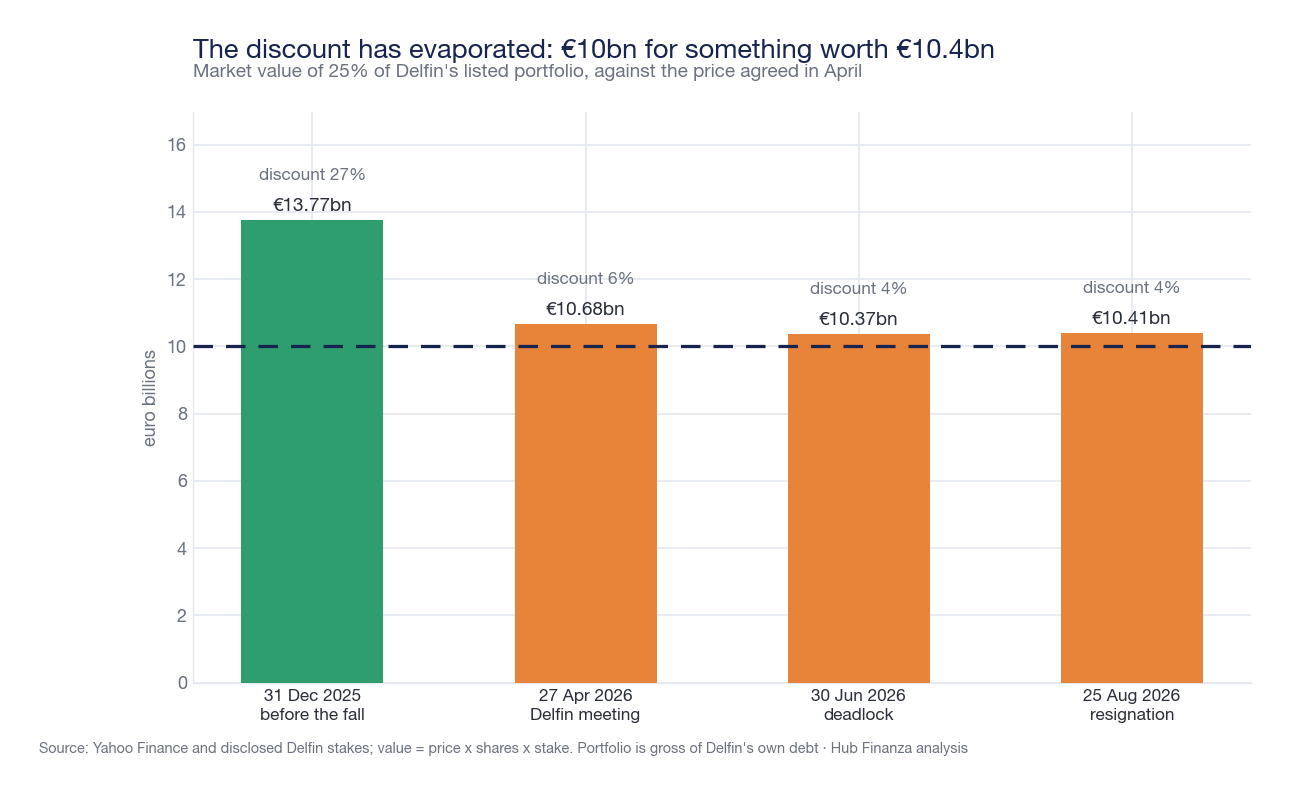
Applying the same measure to the 25% subject of the operation: 13.77 billion euros on December 31, 2025, 10.68 billion on April 27 — the day of the assembly that approved it — 10.37 on June 30, 10.41 on August 25. The agreed price remained fixed at 10 billion.
In other words: at the end of 2025, whoever bought that 25% paid 27% less than the market value of the underlying holdings, a margin that makes a leveraged operation sustainable and reassures lenders. On the very day the assembly approved it, that margin had already dropped to 6%. Today it is 4%. And since the calculation is gross of Delfin's own debts — around 3 billion according to press reports — the price agreed in April is now reasonably above the net value of what it would buy.
No bank refuses an operation because the shareholder is unpleasant. It refuses it, or increases its price in terms of guarantees, when the ratio between the loan and the collateral value worsens by twenty points in four months. From this point of view, the request for a letter of patronage and then for unanimity is not a governance whim: it is how a board reacts when the subject of the resolution has changed beneath its feet compared to when it was deliberated.
Personal debt, and why blocked profits matter more than the debt itself
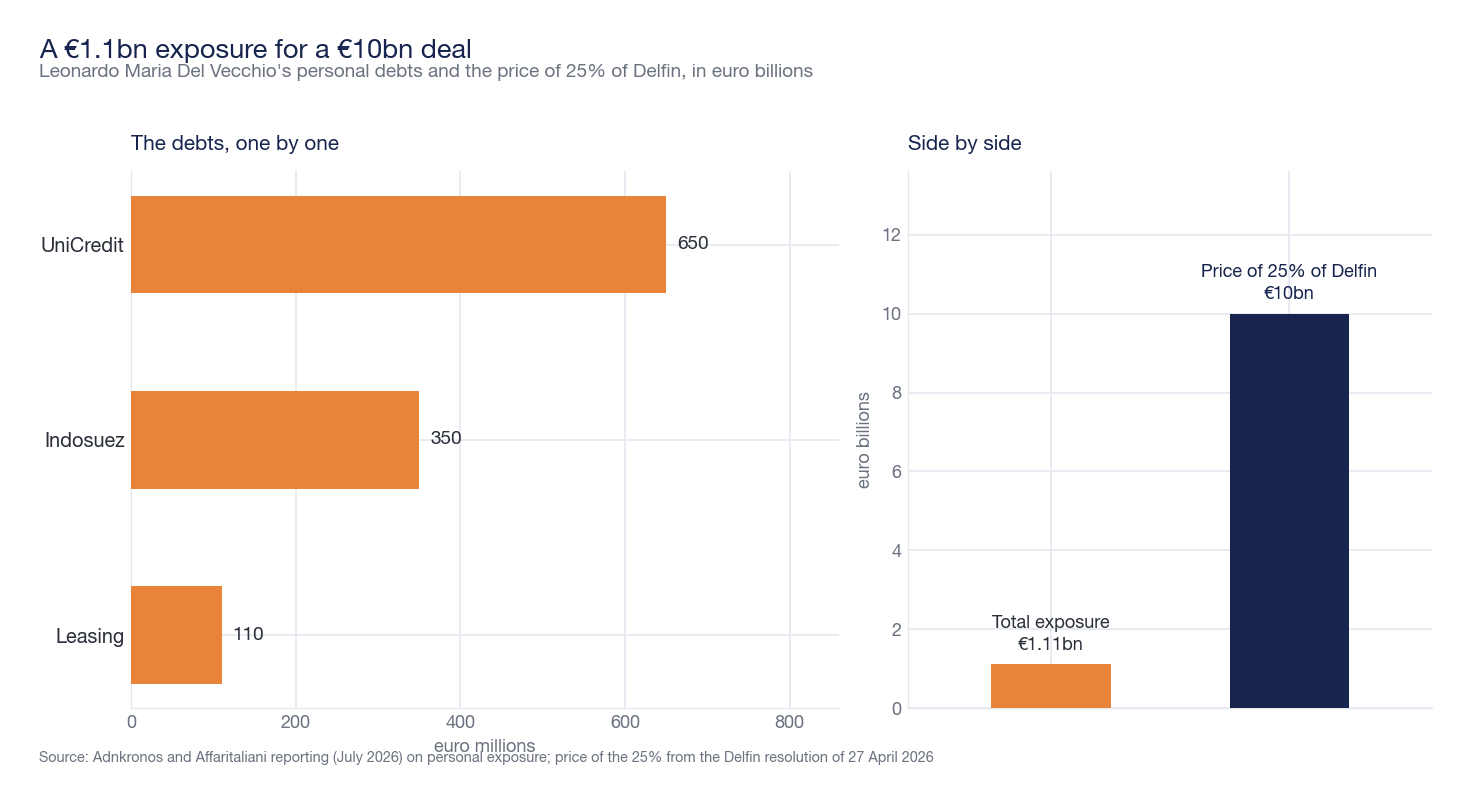
Alongside the 10 billion of the operation, there is a much smaller and much more immediate personal exposure. Adnkronos and Affaritaliani's reconstructions, from July 2026, break it down as follows: 650 million towards UniCredit, 350 million towards Indosuez, and 110 million in leasing, for a total of approximately 1.11 billion euros. On this front, negotiations are underway with the American fund Apollo for a refinancing reported to be around 1.1 billion, for eighteen months and at a rate indicated around 8%: these are conditions reported by the press and not confirmed by the parties, and should be taken as such. The same fund has been attributed with the willingness to extend the commitment up to 10 billion for the purchase of shares, but that second loan has not been reported as signed or disbursed.
A clarification that was lost in Tuesday's news reports should be noted. The 1.3 billion in debts circulated in the headlines are not Delfin's debts: they are the personal exposure of Leonardo Maria Del Vecchio and his vehicles. Delfin, for its part, generates over a billion in profits annually and has its own indebtedness estimated at around 3 billion. Confusing the two levels makes a holding company that is not fragile seem so, and makes a personal plan that depends on a dividend flow that the assembly has not unblocked seem robust.
This is the meaning of the expression «blocked profits»: not a problem of the holding company's profitability, but the fact that the statutory cap of 10% prevents the indebted shareholder from receiving the cash to pay interest. A debt of 1.1 billion at 8% costs approximately 88 million annually in interest alone. This is a modest figure compared to Delfin's profits, and insurmountable if those profits remain within Delfin.
The paradox: record results and stock at −40%
Here we come to the point that makes the story interesting even for those who know nothing about the Del Vecchio family. EssilorLuxottica is doing well and the stock is performing poorly.
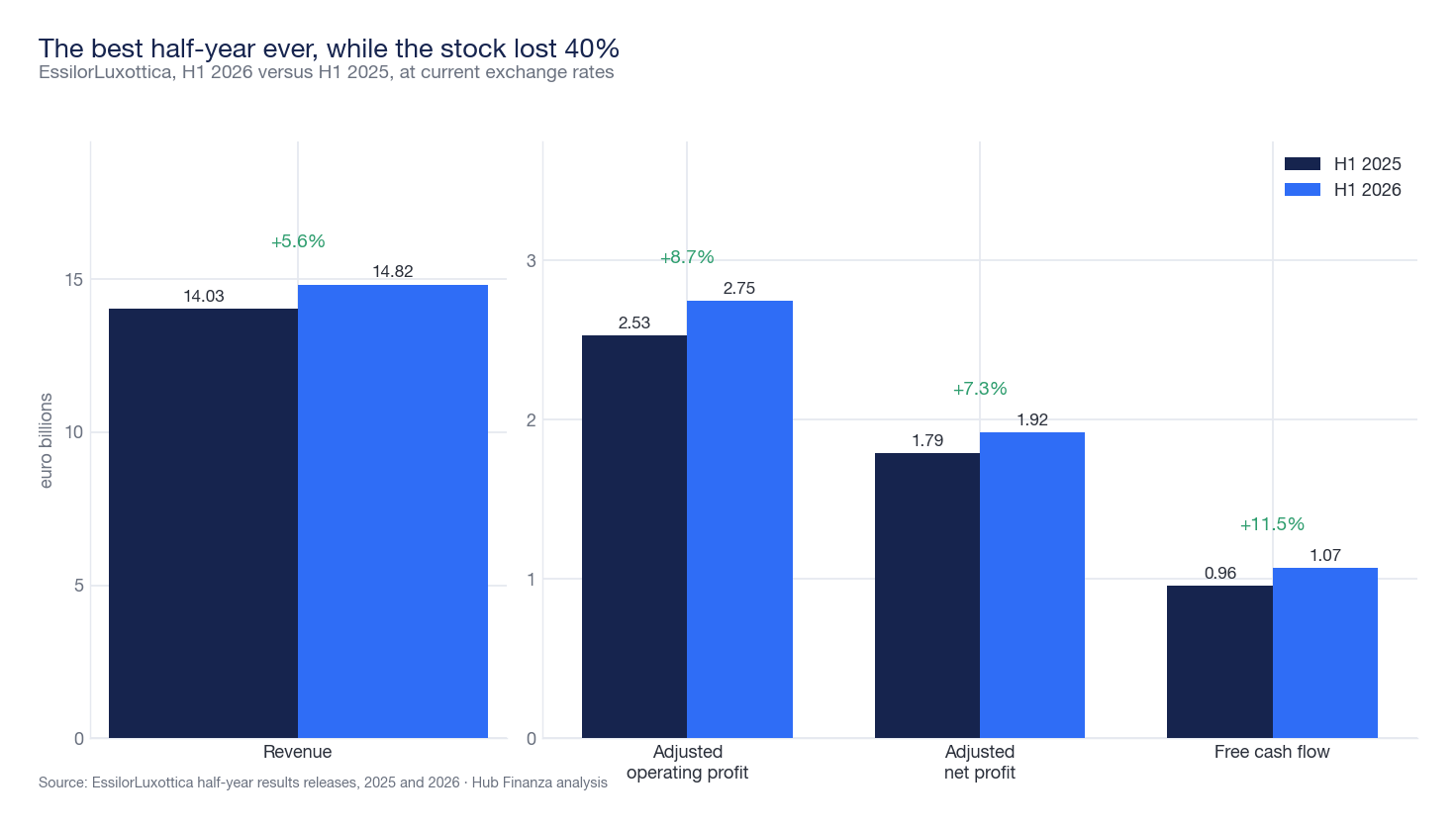
In the semester ended June 30, 2026, and communicated on July 28, revenues rose to 14.82 billion euros from 14.03 billion the previous year — 5.6% at current exchange rates, 9.7% at constant exchange rates. Adjusted operating profit increased from 2.53 to 2.75 billion, adjusted net profit from 1.79 to 1.92 billion, with the margin rising from 12.8% to 13.0% of turnover. Free cash flow grew from 960 million to 1.07 billion. Diluted earnings per share increased from 3.00 to 3.37 euros. These are the best half-year results in the group's history, and operating profit exceeded analysts' average estimate by approximately 310 million.
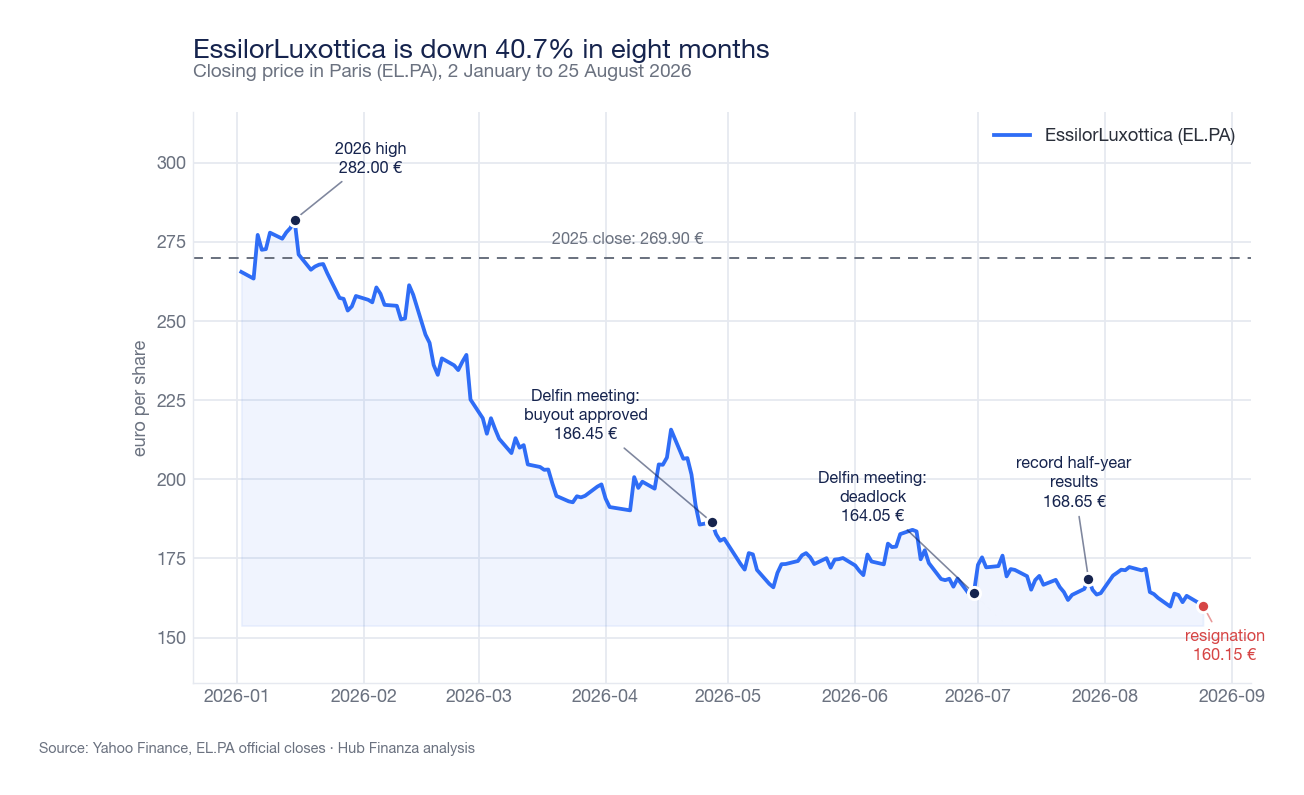
In the same period, the stock fell from 269.90 euros at the close of December 31, 2025, to 160.15 euros on August 25, 2026: a 40.7% decrease. The year's high, 282.00 euros, was on January 15; the low, 159.20 euros, was on August 18. Market capitalization fell to around 74 billion euros.
The reasons indicated by analysts are three and none concern the recently published results: very high expectations for smart glasses, which the market had already priced in when segment revenues almost doubled; downward revisions of organic growth estimates — Goldman Sachs lowered it from 10.8% to 8.5% for 2026, downgrading the stock to neutral; and the effect of American tariffs on margins. To these must be added, and it is not secondary, the dispute among the heirs over the structure of the largest shareholder. This type of discrepancy between results and price — a company that improves and a stock that declines — is the mechanism explained in our guide on how to read a quarterly report and why a stock can collapse despite record profits: the market does not pay for the result, it pays for the gap between the result and what was expected.
The reaction to the resignations, in itself, was modest: on Tuesday, August 25, the stock fluctuated between 160.00 and 163.55 euros, closing the morning with less than a 1% change from the previous session. The market filed away the departure of an executive and continued to look at what it was looking at before.
Delfin depends less on EssilorLuxottica, and that's not good news
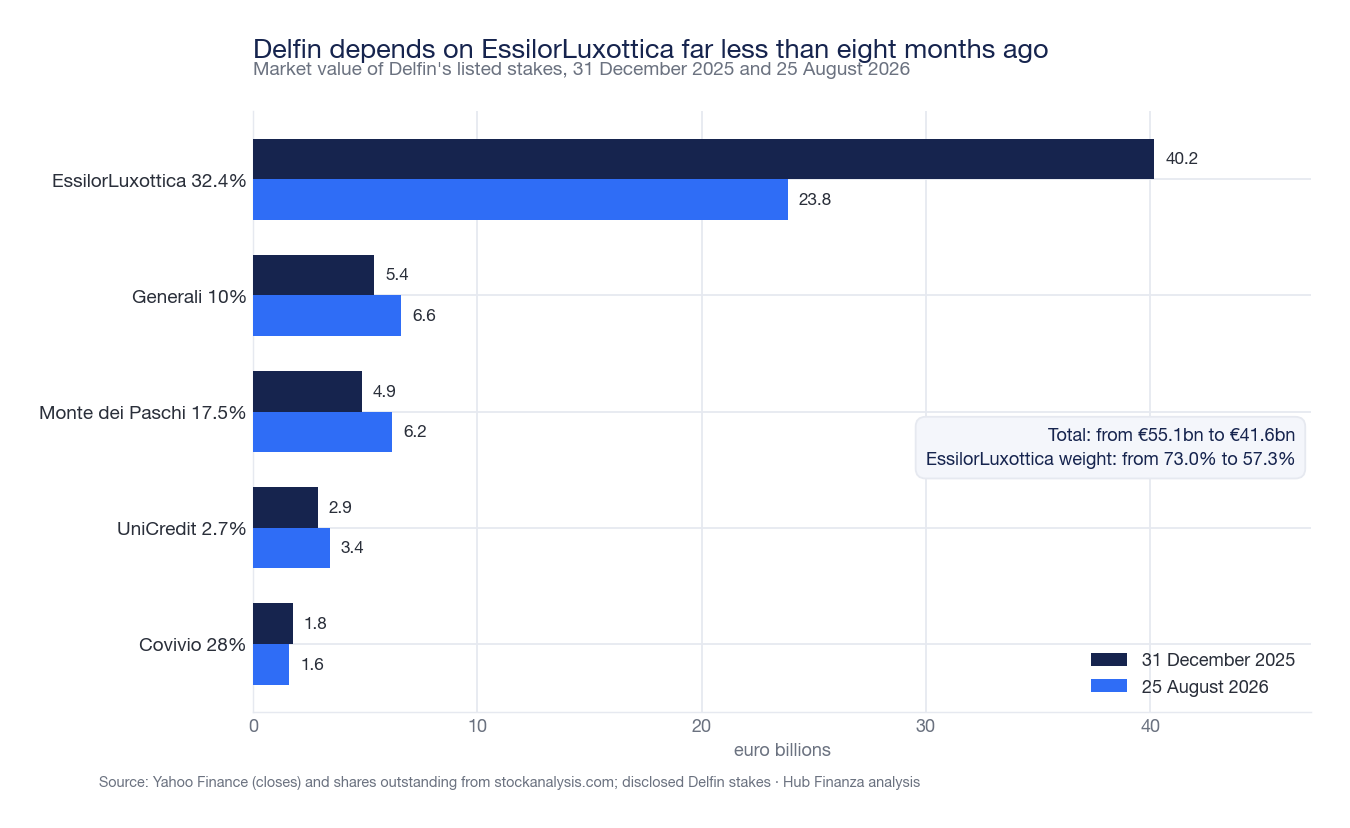
One piece of data, if misinterpreted, might seem positive: EssilorLuxottica's weight in Delfin's portfolio decreased from 73.0% at the end of 2025 to 57.3% today. A holding company less concentrated on a single stock is, in theory, a more solid holding company.
However, diversification did not come through buying: it came through subtraction. The stake in EssilorLuxottica fell from 40.2 to 23.8 billion euros — sixteen and a half billion less — while the four financial and real estate holdings collectively rose from 14.9 to 17.8 billion. Generali went from 5.4 to 6.6 billion, Monte dei Paschi from 4.9 to 6.2, UniCredit from 2.9 to 3.4; Covivio fell from 1.8 to 1.6. The portfolio is less unbalanced because the main leg has shortened, not because the others have grown enough to compensate.
It is the most illustrative possible example of concentration risk, and it applies to a portfolio worth tens of billions just as it does to a 10,000 euro portfolio: when three-quarters of the value are in a single stock, the fate of that stock is the fate of everything else — which is why portfolio diversification is the first rule and not an accessory. The difference is that a saver can sell and a controlling shareholder cannot: the stake that gives industrial control is the same one that makes it impossible to reduce exposure without giving up control.
Three scenarios, and the four dates that distinguish them
From here, one can go in three directions, and for each, there is an observable indicator that tells whether that path is being taken.
The operation unblocks. It requires two things simultaneously: that the assembly resolves a profit distribution beyond the 10% cap, and that someone — the banking pool or Apollo — accepts a much worse loan-to-collateral ratio than in January. The signal to observe is not a declaration, it is an assembly resolution on dividends. Without that, the rest are negotiations.
Delfin splits. This is the hypothesis circulated in July: separating the financial holdings — Generali, Monte dei Paschi, UniCredit, Covivio — into a distinct vehicle, leaving only EssilorLuxottica in Delfin. This would solve the problem at its root, because it would give heirs with different projects different assets to manage, and would free up approximately 17.8 billion in value currently immobilized by the stalemate. This is also the scenario of most interest outside the family: those four stakes weigh on the Italian banking and insurance "risiko", and their shift would not be a private matter.
The stalemate continues. This is the scenario that already occurred on June 30, and Tuesday's resignations do not change it: the one who resigned remains a shareholder, the board remains the same, the bylaws remain as they are. In this case, time becomes the constraint, because the eighteen-month refinancing has a deadline while the stalemate does not.
The risk not to underestimate, in all three cases, is secondary but concrete: EssilorLuxottica is a listed company with 74 billion in market capitalization and approximately 200,000 employees, and its largest shareholder has been stalled for four years on how to govern itself. So far, the dispute has not affected industrial management — the half-year results prove it — but it has just taken away the head of strategy and the president of the most famous brand. For those who want to line up the factors that truly move a stock's price, from governance to results, our guide on what moves stock markets keeps the big picture together.
The appointments that will tell which path is being taken are four, and they have a date.
August 31, 2026: the resignations become effective and EssilorLuxottica will have to indicate how it reassigns the strategic direction and the presidency of Ray-Ban. The choice will tell whether the group treats the departure as an ordinary replacement or as a reorganization.
The next Delfin assembly: the only point that matters is the distribution of profits beyond 10%. This is the prerequisite for everything else, and until it passes, no financing will close.
The closing of the refinancing with Apollo: if it materializes, it measures how much debt currently costs to those who have a stock that has fallen by 40% as collateral. The rate will be the most eloquent information of the entire affair.
The third-quarter results, expected in autumn: they will serve to establish whether the growth of smart glasses keeps pace with expectations or whether the downward revision of estimates was justified. This is the variable that determines the stock price, and therefore also the value of the collateral on which the entire family's game rests.
A final clarification on what this article does not cover: the legal and personal matters concerning Leonardo Maria Del Vecchio, widely reported by the press in recent weeks, do not appear here because they do not affect the corporate and financial facts discussed.
Sources
Resignations, positions, effective date and text of the letter from ANSA, Il Post, Il Fatto Quotidiano, Adnkronos and Borsa Italiana/Teleborsa, August 25, 2026. Reconstruction of the operation on 25% of Delfin, of the assembly on April 27, 2026, and of the board on June 25, 2026, with the split on the letter of patronage from MilanoFinanza and Forbes Italia; outcome of the assembly on June 30, 2026, from ANSA and QN. Personal debt exposure, negotiation with Apollo, and Delfin's statutory constraints from Adnkronos and Affaritaliani, July 2026: these are journalistic reconstructions not confirmed by the parties, and are indicated as such in the text. Half-year results for 2026 and 2025 from EssilorLuxottica press releases dated July 28, 2026, and July 2025, picked up by Teleborsa and Moodie Davitt Report. Quotations and historical series elaborated on data from Yahoo Finance (EL.PA, G.MI, BMPS.MI, UCG.MI, COV.PA), prices on August 25, 2026; shares outstanding from stockanalysis.com. The value of Delfin's holdings is an elaboration by the editorial staff obtained by multiplying closing price, shares outstanding, and held stake, using the method indicated in the text: no value is estimated.
This article is for informational purposes only and does not constitute financial advice, investment research, public solicitation of savings, or a personalized recommendation to buy or sell. The assessments expressed are opinions of the editorial staff based on public data as of the publication date and may change without notice. The value of investments can decrease as well as increase, and past returns are not indicative of future results. Before making any investment decision, it is advisable to consult a licensed financial advisor and evaluate the consistency of the operation with one's objectives, time horizon, and risk tolerance.