On Thursday, September 3, 2026, Moonshot AI confidentially filed for listing in Hong Kong to raise 3 billion dollars. The next day it was learned that Yunxi Technology had done the same. Both present themselves as Chinese artificial intelligence companies: they are valued at 50 billion and 1.27 billion.
It is the distance that matters more than the two news items. An investor who only read the headlines would see two «mega AI IPOs» in the same market in the same week. They would be looking at a marketing software company founded ten years ago and a language model laboratory founded three years ago, which the private market prices thirty-nine times higher. And they are looking at them in a market that has raised record figures while its main index has not moved a single point.

Two listing applications, twenty-four hours apart
Moonshot AI confidentially filed its application on Thursday, September 3, 2026, aiming to raise 3 billion dollars: Reuters reported this, citing three people familiar with the plans, after the Chinese publication LatePost had first revealed the filing. The following day, Bloomberg wrote that the figure could rise to 5 billion. Neither is confirmed by the company, and the two publications do not state the same thing: this is why, in the charts in this article, Moonshot's fundraising appears as a range and not as a single number.
Goldman Sachs, China International Capital Corporation, and Deutsche Bank are working on the operation (Reuters); Bloomberg adds Bank of America as global coordinator. Before filing, Moonshot dismantled its offshore corporate structure to bring its legal domicile back to China — a technical step worth noting, as it is the opposite of what Chinese companies listing in New York did last decade.
Yunxi Technology also submitted a confidential application to the Hong Kong Stock Exchange, as reported by the South China Morning Post on September 4, 2026, citing sources close to the operation. It is working with Bocom International and aims to raise «several hundred million dollars», with the goal of listing by the end of 2026. The sources do not provide a more precise figure, and none is written here: an invented range would be more readable and less true.
Why «little giant» and «AI champion» are not the same company
Yunxi Technology was founded in 2016 in Guangzhou. The Chinese Ministry of Industry and Information Technology has assigned it the label of «little giant», which designates small and medium-sized enterprises considered strategic for the country's technological autonomy. Its business, according to the description reported by the South China Morning Post, is to provide end-to-end digital growth products and tools to large clients in the consumer goods, distribution, real estate, and automotive sectors. It is management and marketing software with artificial intelligence components, sold to businesses. Among its shareholders are Yunfeng Capital, Jack Ma's vehicle, and HSG Capital. The last private round valued it at 10 billion yuan, equivalent to 1.27 billion dollars.
Moonshot AI was founded in 2023 and is one of the laboratories that train frontier language models. Its Kimi K3 model, released in July 2026 with open weights, is what changed the company's trajectory: according to the South China Morning Post, a month before the filing, Moonshot was worth about 30 billion dollars, and the ongoing round brings it up to 50 billion. Reuters also reports that the company is negotiating revenue-sharing agreements with Microsoft, Amazon, and Google that would allow the three American cloud operators to host the model.
They are two companies that do not compete with each other, do not sell to the same client, do not have the same cost structure, and do not run the same risk. The only thing they share is the listing venue and a label.
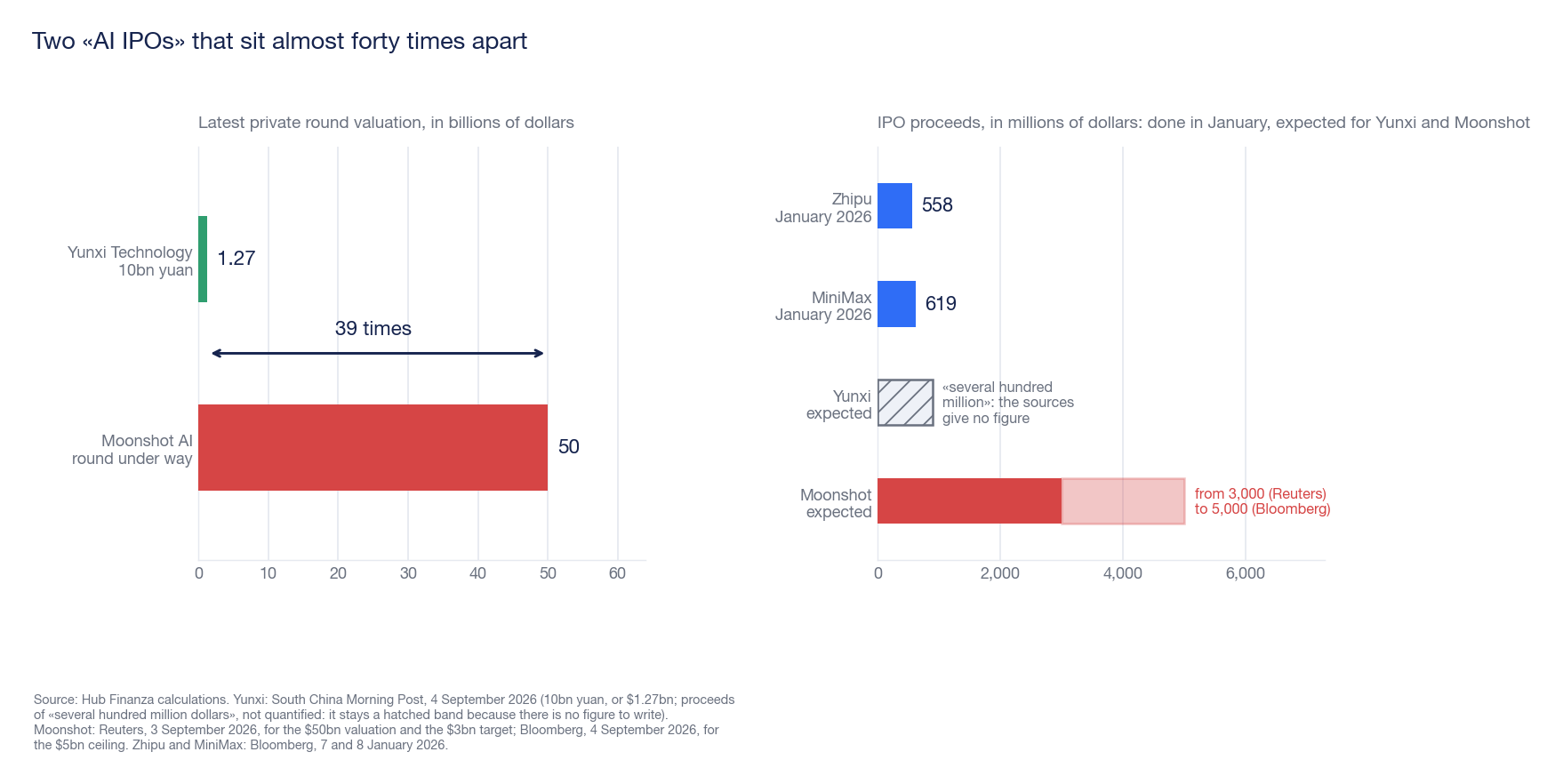
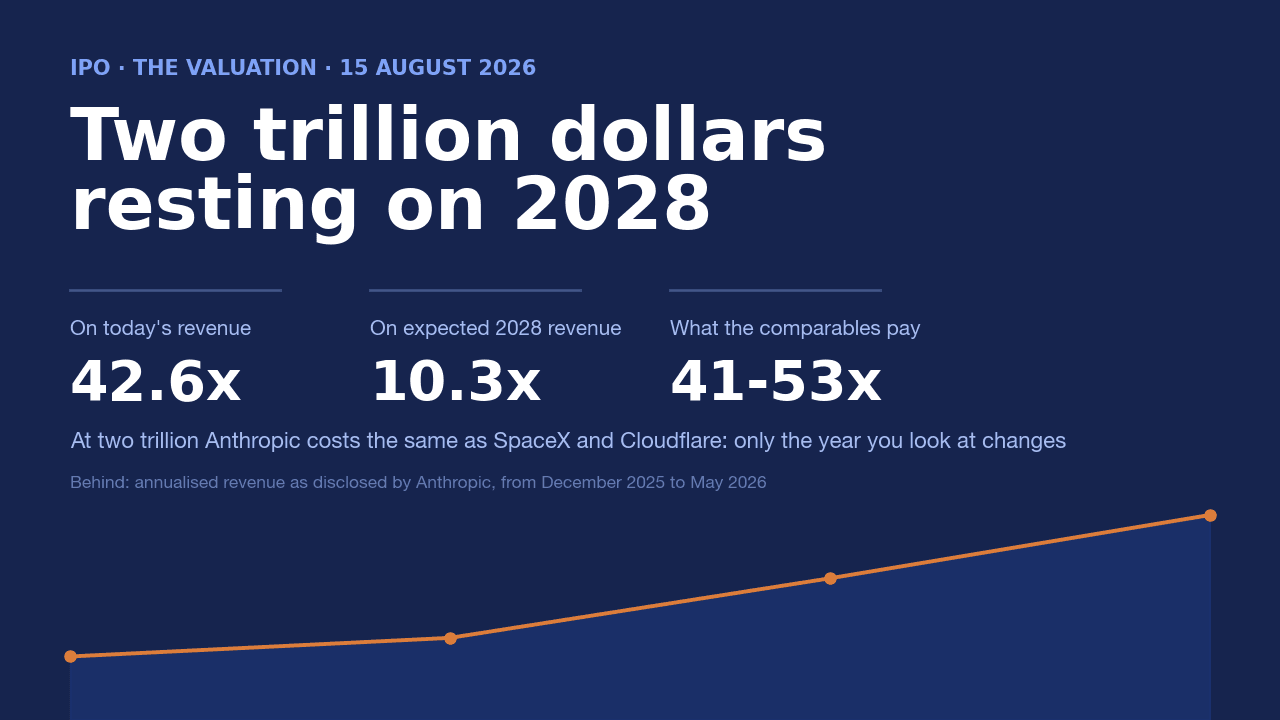
The thirty-nine-fold gap between the two private valuations is a measure of how uninformative that label has become. It does not mean that Yunxi is a worse company: it means that calling them both «artificial intelligence IPOs» does not help in making any decision. Those who wish to understand how a model laboratory can be priced at tens of billions before its financials are known can find the detailed reasoning in our analysis on Anthropic towards IPO: two trillion are worth 42 times today's revenue and 10 times 2028's, where the same problem appears with an even higher order of magnitude.
The market welcoming them: 328 billion in seven months
The context in which the two applications arrive is not a mere detail. In the first seven months of 2026, the Hong Kong Stock Exchange raised 328.2 billion Hong Kong dollars through new listings, equivalent to 41.8 billion US dollars: 154% more than in the same period of 2025, according to official HKEX data. In the first half alone, fundraising was 209.9 billion Hong Kong dollars from 85 listings, compared to 109.3 billion from 42 listings a year earlier — 92% more funds and 102% more operations, according to KPMG China's calculation. It is the best first half in the last five years, and it brought Hong Kong to second place among global exchanges for capital raised, behind only Nasdaq, which hosted SpaceX's 86.3 billion dollar IPO during the same period.
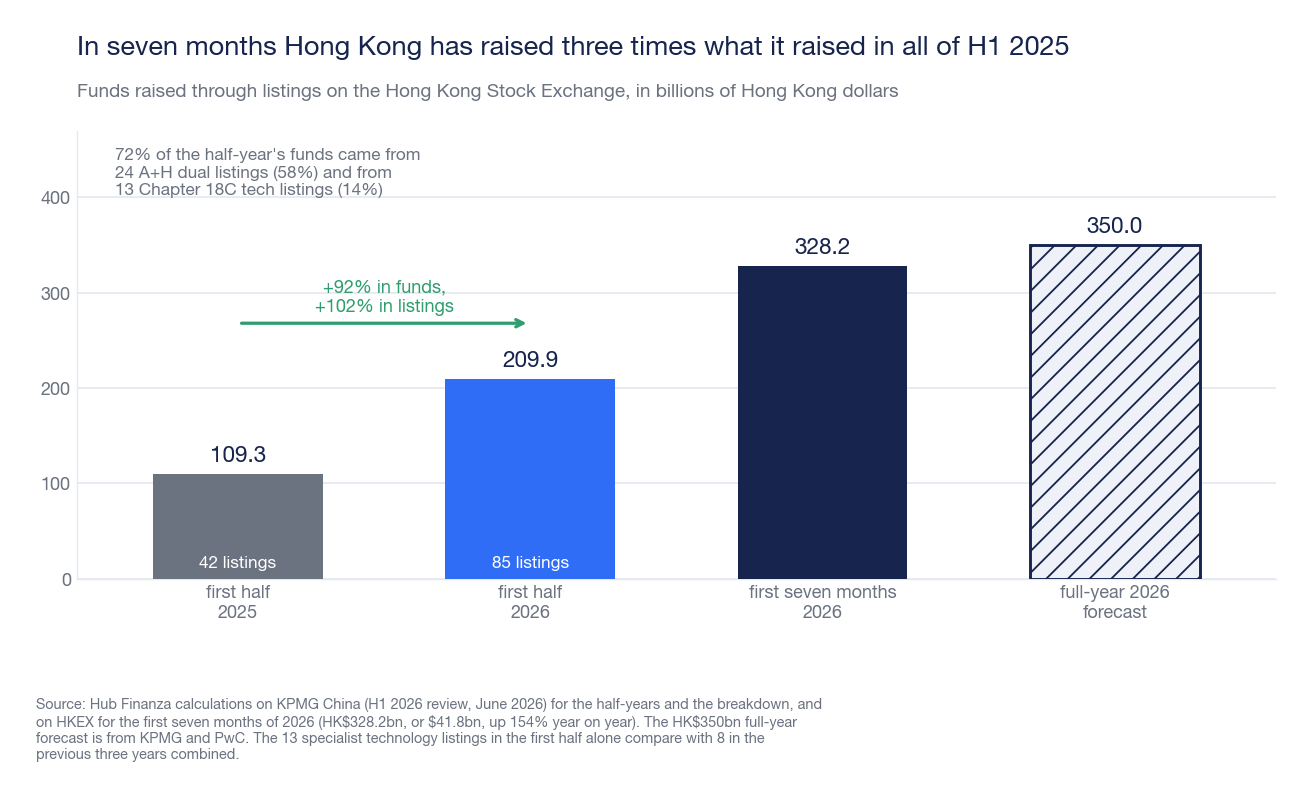
The composition says more than the total. 58% of the funds in the half-year came from 24 A+H dual listings, i.e., companies already listed in mainland China adding a line in Hong Kong, and 14% from 13 specialist technology listings admitted under Chapter 18C of the regulations — a channel created for technology companies without consolidated revenues, which had produced a total of eight operations in the previous three years. Together, these two channels account for more than 70% of the fundraising. The pipeline is long: at mid-year, there were over 500 active listing candidates, of which 443 with public applications and 145 technology companies.
Has money returned to the Hong Kong Stock Exchange, or just to a few names?
Here the narrative of the «boom» must be tested. If capital had truly returned to the Hong Kong market, it would be seen in the index. It is not seen. The Hang Seng Index closed on December 29, 2025, at 25,635.23 points and on September 4, 2026, at 25,650.87: a fifteen-point difference in eight months. The Hang Seng Tech Index, which aggregates technology companies listed in the city, went from 5,515 to 4,569.8 points in the same period, losing about 17%.
The two artificial intelligence companies listed in January took a completely different path. Zhipu, which presents itself to the market as Z.AI, debuted on January 8, 2026, raising 558 million dollars; on September 4, 2026, the stock was worth 1,075.00 Hong Kong dollars, eight times the first close and 9.25 times the offering price. MiniMax, which raised 619 million and is owned by Alibaba and Abu Dhabi's sovereign wealth fund, debuted the following day.
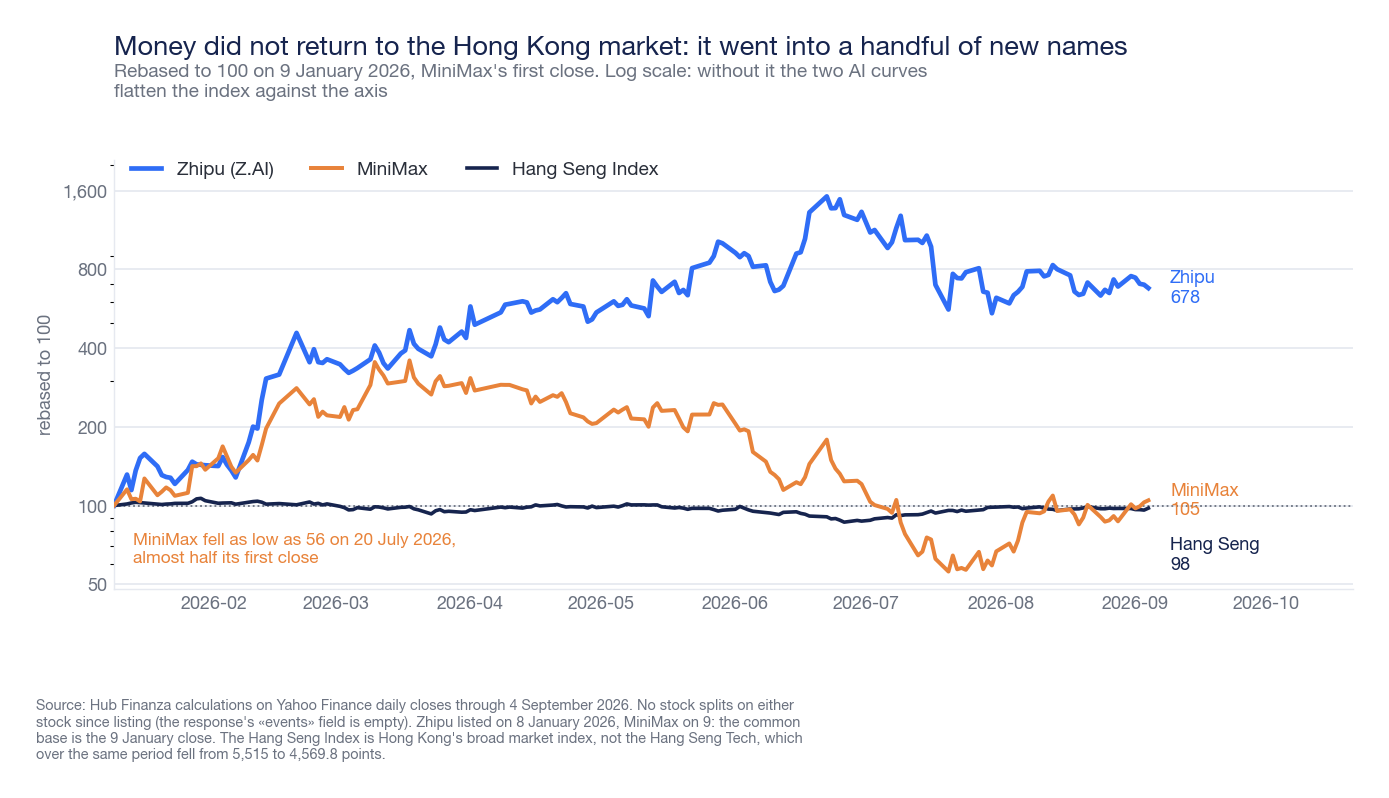
The answer to the question, therefore, is the second: money has not returned to the Hong Kong market, it has gone to a few new names. It is a distinction that changes the meaning of the entire listing season. A rising market also carries mediocre companies; a stagnant market where two out of eighty-five new entrants rise is selecting, and selecting very strictly. The mechanism by which flows matter as much as and more than fundamentals is that described in our guide on What moves stock markets: a guide to truly understand equity markets.
Who gets the shares, and who buys them the next day
The paragraph that in the first draft of this article was the most generic is actually the most concrete, and it is worth reporting it with the numbers it lacked. According to Bloomberg, new listings in Hong Kong recorded an average gain of almost 30% on the first day of trading in 2026. With similar returns, demand is fierce, and issuers have stopped distributing shares according to the traditional order: they reserve quotas for strategic investors, business partners, and other close allies — what is informally called «friends and family» in Hong Kong — leaving some traditional funds without allocation. Obtaining shares in the most sought-after offerings, Bloomberg writes, has become almost an invitation-only affair.
An element that the «invitation-only» framework alone does not convey should be added: since August 2025, HKEX rules impose a ceiling of 50-55% on allocations reserved for cornerstone investors, depending on the mechanism chosen, and maintain a six-month lock-up period for them. It is therefore not a market without distribution rules: it is a market in which, within those rules, the issuer has regained control over who enters.
The practical consequence for external readers is the only one that truly matters. If an allocation at the offering price is not obtained, one buys on the secondary market, almost always after the first-day rally has already occurred. These are two different operations, with two different returns.
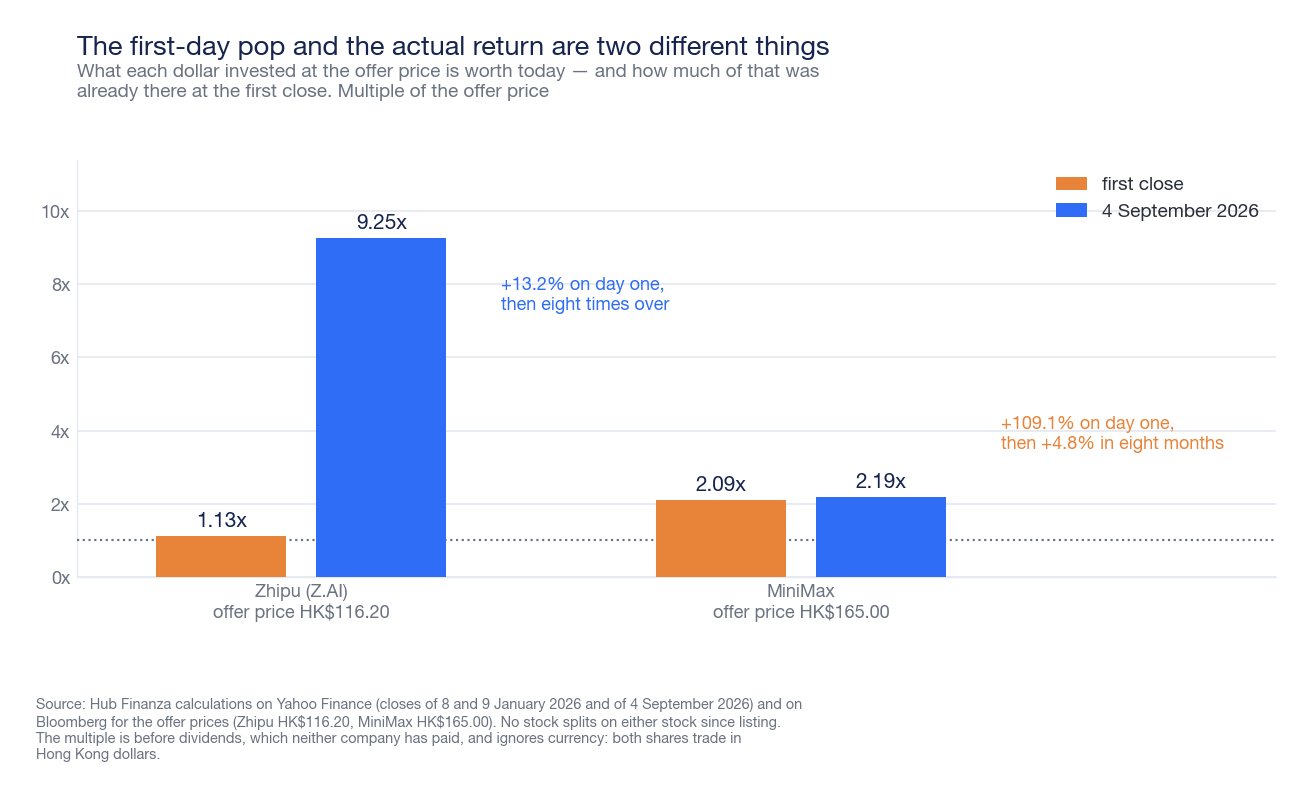
Zhipu was offered at 116.20 Hong Kong dollars and closed the first session at 131.50, just 13.2% above: those who bought on the market on the debut day paid little more than the offering price, and from there the stock multiplied by eight. MiniMax did the opposite. Offered at 165.00 Hong Kong dollars with retail demand equal to 1,830 times the available shares, it closed the first day at 345.00, 109.1% above the offering — and from that point, in eight months, it gained 4.8%. In between, it had fallen to 193.10 Hong Kong dollars on July 20, 2026, almost half of the first close.
The stock that made the most sensational debut is the one that yielded the least to those who entered later. This is exactly the dynamic we examined for another season of large placements in Mega IPOs put to the test: SpaceX, lock-up, and Meta's lesson, where the first day and the first year tell two opposing stories.
What can go wrong
The main risk is not the one usually listed first. It is not the generic market volatility, and it is of little use to write that valuations «could be high»: they are high, and that is a fact, not a fear. The concrete risks of these two operations are four others.
- Moonshot's valuation is not yet finalized. The 50 billion is the target of an ongoing round, not a price paid and settled. A month earlier the reference was 30 billion: a valuation that moves by 67% in four weeks is a fragile number on which to build an IPO price.
- Neither has published its accounts. The confidential filing serves precisely to avoid publishing them until the operation has started. Figures circulating about Moonshot's revenues have not been confirmed by agencies, and for this reason, do not appear in this article. Until the prospectus is public, the valuation does not have a verifiable denominator — and the way to read that denominator, when it arrives, is that described in our guide on how to read a quarterly report.
- Liquidity after debut. If a significant portion of the free float is allocated to strategic investors with time constraints, initial trades occur on a reduced number of shares. The resulting price is true but thin, and at the expiration of the six-month lock-up periods, the number of shares that can enter the market changes abruptly.
- Concentration is reversible. A market where the index is flat and two stocks generate all the return is a market where flows can shift quickly. MiniMax has already shown this: from a high of 1,238.00 Hong Kong dollars on March 18, 2026, to 193.10 on July 20, it lost 84%, without anything comparable happening to the index.
Then there is the fundamental question, which concerns the entire sector and not just these two companies: how long is the market willing to pay in advance for growth that has yet to materialize in the financial statements. This is the issue we addressed in Artificial intelligence: why 2026 is the year of reckoning for the tech sector.
What to watch for, and when
Three appointments, with explicit dates. The first is the closing of Moonshot's round: the company started it in August, and the confirmation of the final valuation — 50 billion, or less — is the first hard data that will arrive. The second is the publication of prospectuses: both companies filed confidentially, so the document will only become public when the operation is launched, presumably in the last quarter of 2026, and that is when revenues, losses, and capital structure will cease to be rumors. The third is July 8, 2027, when the six-month lock-up periods on Zhipu's and MiniMax's cornerstone allocations will expire: this is the date when it will be seen how much of the rally holds up without the scarcity of shares that accompanied it.
For Hong Kong, the annual count is almost done: KPMG and PwC estimate a fundraising of 350 billion Hong Kong dollars for 2026, and 328.2 billion had already been raised by the end of July. The number will be surpassed. It remains to be seen whether 2027 will resemble 2026 or 2025, and the answer will not be given by the number of listings: it will be given by the index, which has remained flat so far.
Sources
Moonshot AI confidential filing, fundraising target of 3 billion dollars, 50 billion valuation in ongoing round, appointed banks (Goldman Sachs, CICC, Deutsche Bank), dismantling of offshore structure, and negotiations with Microsoft, Amazon, and Google from Reuters, September 3, 2026, citing three people familiar with the plans, picked up by RTÉ and Business Standard; the filing was first revealed by LatePost. 5 billion dollar ceiling and Bank of America as global coordinator from Bloomberg, September 4, 2026. Valuation of approximately 30 billion before the ongoing round and release of Kimi K3 in July 2026 from the South China Morning Post. Yunxi Technology confidential application, valuation of 10 billion yuan equivalent to 1.27 billion dollars, founding year, «little giant» label from the Ministry of Industry and Information Technology, business description, shareholders Yunfeng Capital and HSG Capital, appointment of Bocom International and target of «several hundred million dollars» from the South China Morning Post, September 4, 2026. Hong Kong IPO fundraising in the first seven months of 2026 (328.2 billion Hong Kong dollars, +154%) from HKEX, picked up by China Daily Hong Kong; first half 2026 and first half 2025 data, number of listings, A+H and Chapter 18C composition, position among global exchanges, SpaceX IPO of 86.3 billion dollars and candidate pipeline from KPMG China, first half 2026 review; annual estimate of 350 billion from KPMG and PwC. Average first-day gain of almost 30% in 2026, «invitation-only» allocation practice, and reserves for strategic investors and business partners from Bloomberg, September 3, 2026; 50-55% ceiling on cornerstone allocations and six-month lock-up from HKEX rules effective August 2025. Fundraising and offering prices of Zhipu (558 million dollars, 116.20 Hong Kong dollars) and MiniMax (619 million, 165.00 Hong Kong dollars) and retail demand equal to 1,830 times from Bloomberg, January 7 and 8, 2026, and the South China Morning Post. Daily quotes of Zhipu (2513.HK), MiniMax (0100.HK) and the Hang Seng Index from Yahoo Finance, unadjusted series: no stock splits have occurred on either stock since debut. Hang Seng Tech Index levels at end of 2025 and September 4, 2026 from Hang Seng Indexes and Yahoo Finance. Calculations on multiples, percentage variations, valuation ratios, and rebasements to 100 are editorial elaborations on the cited data. Moonshot AI's run rate circulating on some aggregators does not appear in this article because it is not confirmed by news agencies.
Transparency note: this article cites Anthropic and OpenAI as technical benchmarks for Moonshot AI's models, and Anthropic develops the artificial intelligence model used by the Hub Finanza editorial team in text production. All reported data come from external and independent sources — news agencies, financial publications, auditing firms, and market data providers — and have been verified and recalculated by the editorial team according to the ordinary procedure applied to any other article.
This article is for informational purposes only and does not constitute financial advice, investment research, public solicitation of savings, or personalized recommendation to buy or sell. The valuations expressed are opinions of the editorial team based on public data as of the publication date and may change without notice. The value of investments may decrease as well as increase, and past performance is not indicative of future returns. Before any investment decision, it is advisable to consult a qualified financial advisor and evaluate the consistency of the operation with one's objectives, time horizon, and risk tolerance.