

2026 was supposed to be the year artificial intelligence proved its worth. By the end of July, the answer arrived, and it's twofold: demand is real and measurable in financial statements, but the infrastructure cost has exceeded the market's capacity to quietly absorb it.
On July 28, 2026, the PHLX Semiconductor index closed at 11,035.68 points, down 4.49% in one session, while still up 56.27% year-to-date. Five days earlier, on July 23, the seven largest American tech companies shed 797 billion dollars in market capitalization in a single session — their worst day since April 2025 — dragged down by Tesla (around 200 billion, after lower-than-expected earnings) and Alphabet, which had raised its capital expenditure estimate, on a day also marked by rising oil prices and US yields.
It's not the end of the cycle: it's the reckoning. Investors have stopped asking if artificial intelligence works and have started asking how much it costs and how long it takes to pay off.
Demand exists, and it's in the sales data
Before talking about bubbles, it's worth looking at actual revenue. The Semiconductor Industry Association reported on July 6, 2026, that global semiconductor sales for May 2026 were $120.6 billion: 104.1% more than the 59.1 billion in May 2025, a monthly all-time high. In 2025, the industry had generated 791.7 billion in total: for 2026, the SIA itself sees the sector heading towards 1,000 billion.
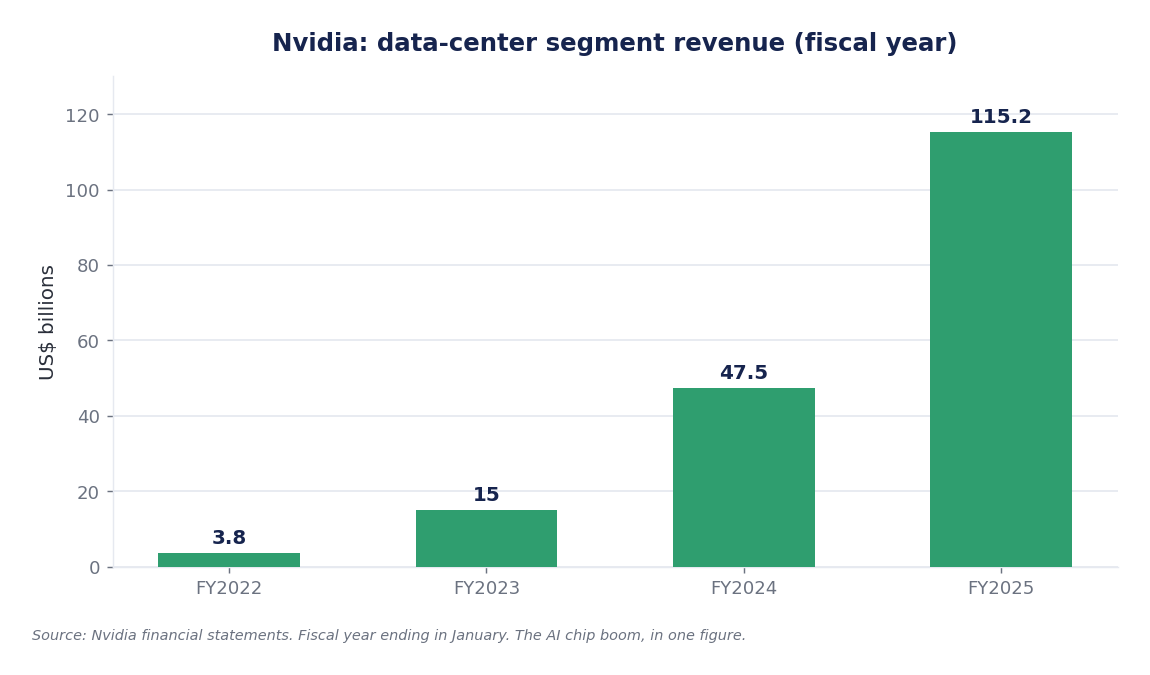
Gartner, on April 8, 2026, estimated revenues over 1,300 billion in 2026 (+64%, the highest growth in twenty years), with AI chips accounting for about 30% of the total. The two central players confirm this: Nvidia closed the first quarter of fiscal year 2027 on May 20, 2026, with 81.6 billion in revenues (+85%), of which 75.2 from the data center segment alone (+92%); TSMC, on July 16, reported 40.2 billion quarterly with a gross margin of 67.7%, raising its expected growth for 2026 to "just over 40%."
| Indicator | Value | Change | Source |
|---|---|---|---|
| Global chip sales, May 2026 | $120.6 bn | +104.1% year-on-year | SIA, 06/07/2026 |
| Global revenues 2026 (forecast) | over $1,300 bn | +64% on 2025 | Gartner, 08/04/2026 |
| Nvidia, data center (Q1 FY 2027) | $75.2 bn | +92% year-on-year | Nvidia, 20/05/2026 |
The cost: spending outpaces revenue growth
The clearest case is Alphabet: on July 22, 2026, it published better-than-expected results — revenues at 119.8 billion (+24%), Google Cloud at 24.8 billion (+82%) — and in the same note raised its capital expenditure for the year to 195-205 billion from the 180-190 billion three months earlier, with 44.9 billion in the quarter alone and free cash flow negative by 5.9 billion. The following day, July 23, the stock lost 7.1%: this is the same session in which the big seven shed 797 billion in market capitalization.
It's not an exception. Consensus estimates collected by S&P Global Market Intelligence in July 2026 put the aggregate spending of large cloud operators from 384 billion in 2025 to approximately 682 billion in 2026 — almost double in twelve months — and 878 billion in 2027. A higher estimate, covering a stated perimeter of five companies (Microsoft, Alphabet, Amazon, Meta, and Oracle), comes from CreditSights, reported by Forbes on June 2, 2026: between 700 and 900 billion already in 2026. Upstream, the pace is also accelerating: TSMC increased its 2026 budget to 60-64 billion from the projected 52-56 billion. When both supplier and customer increase spending, the chain tightens: if final demand slows down, the adjustment falls on already built capacity.
Who finances the gap, and at what price
Until 2025, the answer was the operating cash of large groups. In 2026, that's no longer enough. According to Morgan Stanley estimates reported on July 17, 2026, global AI-related debt issuance is heading towards 570 billion dollars for the year, of which 236 already placed as of May 31: four times the pace of 2025. The same bank estimates that approximately 800 billion of data center financing will be reserved for private credit until 2028, outside of listed balance sheets.
The cooling signal comes from there: according to Apollo, order coverage for bonds issued by large cloud operators — how many times demand exceeds supply in placement — fell from almost 5 times in February 2026 to less than 2 in July. When orders thin out, the cost of debt rises, and in a sector that amortizes plants over five or six years, that cost impacts subsequent financial years.
Sequoia Capital analyst David Cahn quantifies the annual gap between infrastructure spending and AI-attributable revenues at approximately 600 billion; for Allianz Research, the divergence between capex growth and revenue growth is 46%, exceeding the 32% of the telecommunications cycle in 2001 (both reported by Forbes on June 2, 2026). With one difference: back then, fiber was laid that no one used; in 2026, chips are saturated as soon as they are installed.
Memflation: the bill AI presents to everyone else
Producing high-bandwidth memory for accelerators means foregoing the production of conventional memory: capacity is the same, but the destination changes. This is what Gartner calls "memflation", which on April 8, 2026, they quantified as average annual price increases of +125% for DRAM and +234% for NAND flash; according to analyst Rajeev Rajput, memflation "will destroy, or at least postpone" non-AI related demand until 2028.
The peak, however, seems to be behind us: TrendForce, on July 3, 2026, predicts contractual increases of 13-18% for DRAM and 10-15% for NAND in the third quarter, compared to approximately 60% in the second. Multi-year agreements by large cloud operators also freeze prices for those customers and shift the increase to those without such agreements.
The bill reaches the consumer. A Gartner forecast from February 26, 2026, estimates a 130% increase in prices for DRAM and solid-state drives by the end of the year: PC prices +17% and smartphone prices +13% compared to 2025, global PC shipments at −10.4% and smartphone shipments at −8.4%. Part of the cost of the AI boom is paid by those who don't buy AI.
Private capital: 510 billion, and 43% to two companies
In the unlisted market, concentration is even more extreme: according to Crunchbase (July 2, 2026), global startup investments hit a record 510 billion dollars in the first half of 2026, more than the 440 billion for all of 2025. But OpenAI and Anthropic alone absorbed 217 billion, 43% of global venture capital for the half-year, and Anthropic's second-quarter round alone is worth 65 billion; sixteen companies raised rounds over a billion for 108.6 billion, 53% of the quarter.
A market that grows because a dozen operations become enormous is more fragile than one that grows because the number of financed companies increases. And the distance between spending and real adoption remains measurable: according to Eurostat, in 2025, 20.0% of European enterprises with at least ten employees used artificial intelligence technologies (13.5% in 2024), with Denmark at 42.0%, Italy at 16%, and large enterprises at 55.0%.
The two constraints that cannot be bought with capital
Energy
According to the International Energy Agency, in 2024 data centers consumed approximately 415 TWh, 1.5% of global electricity; in the base scenario, the estimate rises to approximately 945 TWh by 2030, just under 3% of the total, and almost half of the increase is attributable to accelerated servers used for AI. In many markets, the constraint is not the chip: it's the electricity grid.
Regulations
The European framework has changed and is still often reported in an outdated way. The Artificial Intelligence Act stipulated obligations for high-risk systems from August 2, 2026; with the "Digital Omnibus" package — a political agreement between the Council and the European Parliament on May 7, 2026, formal endorsement by the Parliament on June 16, and definitive approval by the Council on June 29 — the deadlines are postponed. The text, Regulation (EU) 2026/1744, was published in the Official Journal on July 24, 2026, and entered into force on July 27:
- Autonomous high-risk systems (Annex III): from December 2, 2027.
- AI embedded in already regulated products (Annex I): from August 2, 2028.
- Labelling of generated content: extended to December 2, 2026 for previous models.
- Penalties: up to 15 million euros or 3% of annual worldwide turnover for violation of obligations concerning high-risk systems; up to 35 million or 7% for practices prohibited by Article 5.
How to read the July 2026 market
The most interesting fact of 2026 is not that the AI theme has risen or fallen: it's that it has stopped moving as a single block. State Street, on July 20, 2026, notes that the seven large American tech companies have accumulated a year-to-date lag of 7.6 percentage points against the S&P 500 and that their average three-month correlation has fallen to 0.27, compared to a peak of 0.78 in mid-2025. Internal results diverge: Apple +14.8% and Alphabet +12.4%, versus Microsoft −21.4% and Tesla −11.3%; only three of the seven are among the top ten contributors to the index in 2026, compared to seven in 2024.
During the same period, semiconductors performed much better: also as of July 20, before the index's decline at month-end, the lag of the big seven against the PHLX Semiconductor was almost 80 percentage points. In 2026, the market paid those who sell the infrastructure, not those who buy it. In the background, the Federal Reserve has kept rates at 3.50%-3.75% since December 2025, and the meeting on July 28-29, 2026, was expected to be the fifth consecutive confirmation: with rates stable, a cash flow shifted forward by five years is worth less.
What to watch in the coming months
- The quarterly reports of major buyers. Microsoft and Meta were expected on July 29, 2026, Apple and Amazon on July 30: the number that moves prices is not revenue, but capex relative to cloud revenue growth.
- Nvidia's earnings report on August 26, 2026. Guidance indicated 91 billion in revenue: this is the most direct thermometer of accelerator demand.
- Memory prices in the third quarter. If they remain within the 13-18% range indicated by TrendForce, the most violent phase is behind us; otherwise, the bill for PCs and smartphones extends into 2027.
- The debt market. Order coverage for large cloud operators' bonds, below 2 times in July 2026: credit cools down first, then construction.
2026 did not disprove artificial intelligence: it changed the question asked of it. No longer "does it work?", but "how much does it cost, who pays, and how long until it breaks even?". These are the questions asked of mature industries, not promises: this, ultimately, is the reckoning.
Sources: Semiconductor Industry Association (06/07/2026); Gartner (08/04/2026 and 26/02/2026); TrendForce (03 and 09/07/2026); Nvidia (20/05/2026); TSMC (16/07/2026); Alphabet (22/07/2026) via CNBC and Investing.com; Crunchbase News (02/07/2026); Forbes (02/06/2026 and 17/07/2026, with estimates from Morgan Stanley and Apollo on debt and from David Cahn/Sequoia Capital, Allianz Research, and CreditSights on gap and capex); S&P Global Market Intelligence (07/2026); State Street (20/07/2026); YCharts and Investing.com for the PHLX Semiconductor as of 28-29/07/2026; Bloomberg (23/07/2026); Eurostat (2025 data); International Energy Agency ("Energy and AI"); Council of the European Union (29/06/2026), Regulation (EU) 2026/1744 published in Official Journal on 24/07/2026, Regulation (EU) 2024/1689 art. 99 for penalties, Gibson Dunn and Pinsent Masons for the Digital Omnibus. Forecasts and estimates remain subject to revision; market data refer to the dates indicated.
Disclaimer: the information provided in this article is for informational purposes only and does not constitute personalized financial advice in any way. It is recommended to consult a qualified professional before making any investment decisions.