


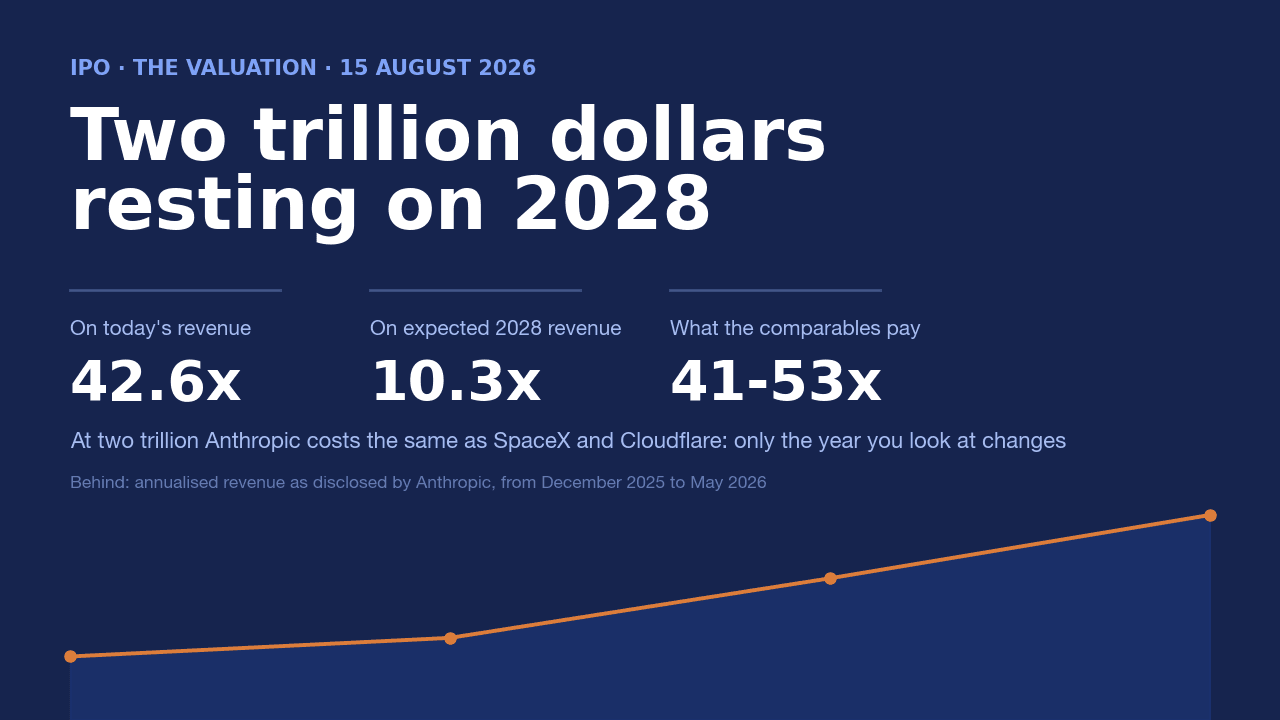
For years it was the most discussed — and most highly valued — private company in the world. On 11 June 2026 SpaceX priced its shares at $135, raising around $75 billion: the largest IPO in history, shattering Saudi Aramco's previous record ($29 billion raised in 2019). The next day, on its Nasdaq debut under the ticker SPCX, the stock closed at $161 (+19%), pushing its market capitalisation above $2 trillion — and it gained a further ~20% in its first full session of trading.
But beyond the spectacle of the rockets, where does the value of the company Elon Musk founded in 2002 really come from? The prospectus (S-1), filed in May 2026, opened the books to the public for the first time. And the answer is surprising on two fronts: the engine of value is in space but not in launches — and the SpaceX listed on the stock market is no longer just a space company.
First surprise: SpaceX today also includes xAI and X
A point many commentators overlooked: in February 2026 SpaceX absorbed xAI, Musk's artificial intelligence company, which in turn includes X (the former Twitter) and the Grok chatbot. The listed company is therefore a conglomerate with three segments — connectivity (Starlink), space operations (launches and NASA contracts) and artificial intelligence — and the accounts presented in the S-1 retroactively combine the three entities. This radically changes how the numbers should be read, as we shall see.
The real engine: Starlink
The economic heart of SpaceX is not the rockets but Starlink, the satellite constellation providing broadband internet access. The prospectus figures speak clearly:
| Figure (source: S-1 filing) | Value |
|---|---|
| Total SpaceX revenue 2025 | $18.7 billion (+33% on 2024) |
| Starlink revenue 2025 | $11.4 billion (+50%), equal to 61% of the total |
| Starlink operating profit 2025 | ≈ $4.4 billion (segment EBITDA: $7.2 billion, 63% margin) |
| Starlink customers | 8.9 million at end-2025; 10.3 million in March 2026, across 164 countries |
| Space segment revenue (launches) 2025 | ≈ $4.1 billion (+8%), with an operating loss of ~$657 million |
| AI segment revenue (xAI/X) 2025 | ≈ $3.2 billion, with an operating loss of ~$6.4 billion |
| Group operating result 2025 | a loss of ~$2.6 billion |
| Group net result 2025 | GAAP loss of $4.9 billion |
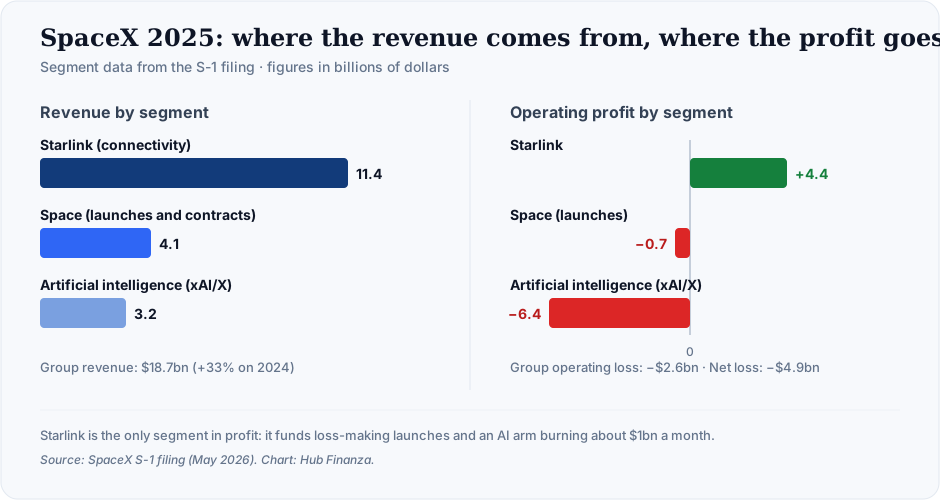
Two details deserve attention. First: the launch business — 170 missions in 2025, roughly 85% of the world market and more than 80% of the mass carried into orbit — is running an operating loss. The rockets are the competitive advantage, not the profit centre: their main purpose is to build and resupply Starlink at costs no competitor can match. Second: the great hole in the accounts is not the rockets but the AI segment, which burns around $1 billion a month on GPUs and infrastructure. In short: Starlink generates the profits, xAI consumes them, and launches are the strategic infrastructure that keeps the advantage standing.
One signal to watch: growth is slowing (from +33% in 2025 to +15% year-on-year in the first quarter of 2026) and average revenue per Starlink user has fallen from $81 to $66 a month, an effect of expansion into markets with lower purchasing power.
The bet on the future: Starship
On 22 May 2026, with Flight 12, SpaceX flew the Starship V3 for the first time: at 124 metres tall, it is the largest and most powerful rocket ever built. The test flight — not without hitches: one engine out at lift-off on the booster and another lost during the ship's ascent — nonetheless achieved its key objective, deploying 22 payloads (20 Starlink satellite simulators and 2 operational test satellites).
This is not merely an engineering milestone. At full capacity, a single Starship launch is designed to deploy up to 60 next-generation Starlink satellites, each with far greater bandwidth capacity than the current ones: an enormous multiplier compared with the Falcon 9. In other words, Starship exists first and foremost to make Starlink even more dominant. The programme costs around $3 billion a year in research and development, has 11 previous test flights behind it and — a detail investors should not forget — still has no paying customers: the first commercial launches are expected in the second half of 2026, while NASA is counting on Starship for the return to the Moon with Artemis 3 (2027).
Opportunities and risks for investors
The opportunities. A near-monopoly position in satellite internet, a fast-growing market; a technological advantage (reusable rockets, satellite manufacturing scale) that no competitor has so far replicated; an order book worth $28.4 billion; and optionality on future scenarios such as orbital data centres for AI.
The risks. The list, set out in the prospectus itself, is long:
- Extreme valuation: a market capitalisation above $2 trillion means more than 100 times the revenue of the last twelve months — a multiple that prices in years of flawless growth, for a company whose revenue is already decelerating.
- Large, structural losses: a $4.9 billion net loss in 2025, with the AI segment absorbing the cash generated by Starlink and capex of more than $20 billion. Debt exceeds $29 billion.
- Concentrated governance: Musk controls roughly 85% of the voting rights through class B shares (10 votes each); the company relies on "controlled company" exemptions and does not plan dividends. His pay package is tied to targets ranging from market capitalisations of up to $7.5 trillion to a self-sustaining colony on Mars.
- Conflicts of interest: the prospectus discloses hundreds of millions in purchases from Tesla (Cybertruck, batteries) and roughly $20 billion in GPU leasing contracts with companies linked to a board member.
- Unproven bets: Starship with no commercial revenue, xAI deep in loss, and X's advertising revenue in decline.
In short
With the IPO, SpaceX has moved from myth to accounting: and the books describe a company whose value today rests almost entirely on Starlink — not on launches, which lose money, nor on AI, which burns a great deal of it. For investors, the key question is not "will they reach Mars?", but rather two others: can Starlink's growth justify one of the highest valuations in market history? And will the profits from connectivity be enough to fund Starship and the artificial intelligence ambitions at the same time? As always, it is the numbers — not the dreams — that should guide the decision.
Disclaimer: this article is purely informational and does not constitute financial advice. Every investment decision should be assessed on the basis of your own circumstances and, if necessary, with a qualified professional.
Main sources: SpaceX S-1 filing (May 2026); CNBC; NPR; Bloomberg; TechCrunch; Via Satellite; Mostly Metrics; The Motley Fool; Space.com; SpaceNews.