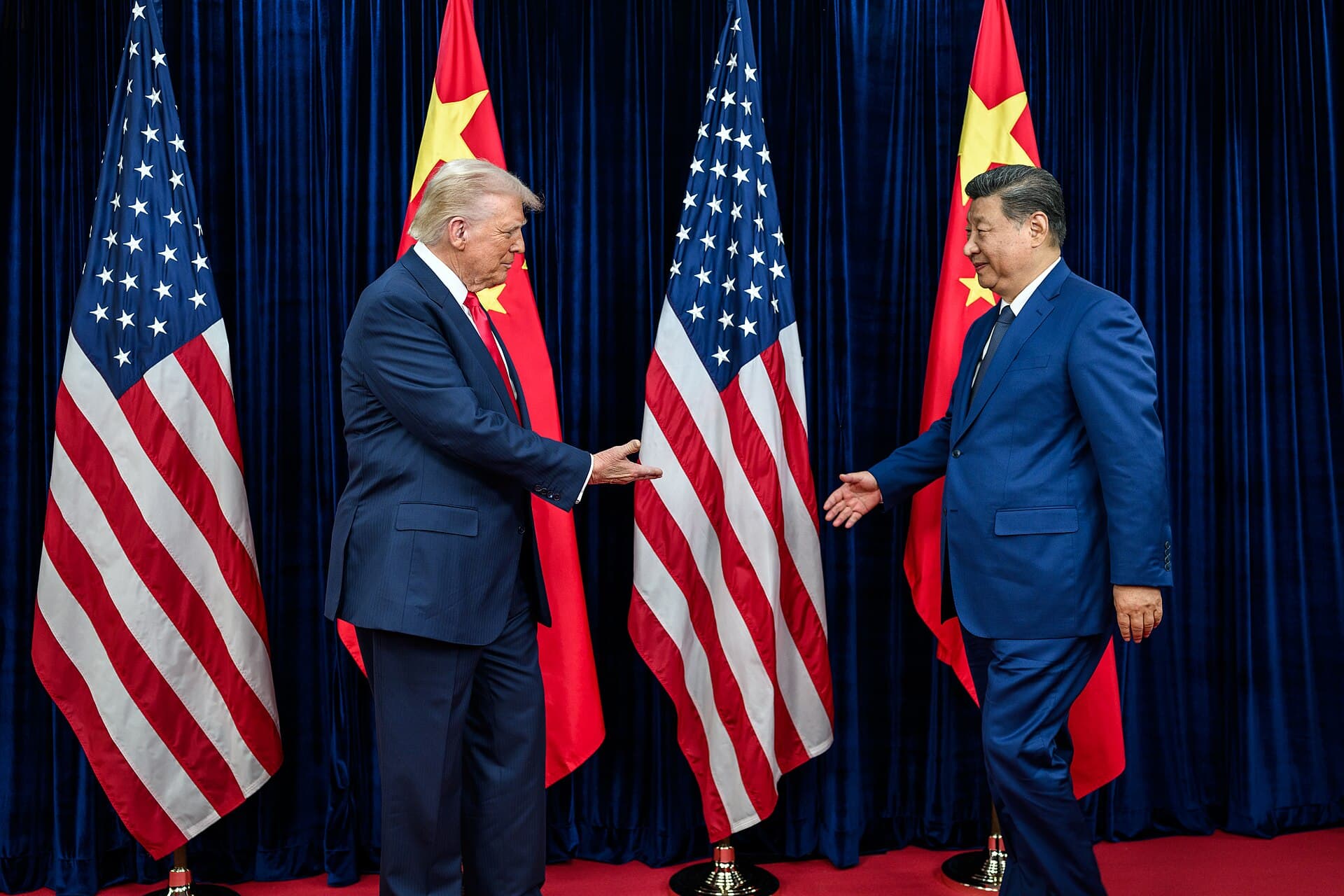
Xi Jinping is in Washington for the first state visit in eleven years. On Thursday, September 24, 2026, he meets Donald Trump at the White House, at 5:30 p.m. Italian time, with the trade truce already extended to January 10. This article, written before the talks, explains what is on the table.
The extension arrived the night before. On Wednesday, September 23, Treasury Secretary Scott Bessent announced that the trade truce signed in Busan, expiring on November 10, will last until January 10, 2027. Beijing spoke of a consensus on the extension, without indicating the date. The summit, therefore, is not aimed at avoiding an imminent deadline: it is meant to decide what to include in the next three and a half months. Markets are following it for three concrete reasons: rare earths, on which Western electronics and defense industries depend; chips for artificial intelligence; and bilateral trade which in 2026 is worth one-third less than two years ago.
Then there's a thesis circulating among market participants. According to a Bloomberg Intelligence note from September 24, the summit is already reducing the «geopolitical discount,» the discount investors apply to Chinese dollar-denominated debt for political risk. It's a hypothesis, not an established fact: we'll test it with data later on.
What is confirmed: two days of ceremonies and only one closed-door meeting
The Chinese Ministry of Foreign Affairs announced the state visit from September 23 to 25 on September 21. On the same day, the White House released the official program: a state ceremony, dinner in the East Room, and, on Friday, tea in the Red Room and a visit to the National Archives, where the Trumps will bid farewell to their guest. The bilateral meeting does not appear in that communiqué, but in the program released to journalists on the morning of the 24th and reported by Nikkei Asia and CBS.
Xi landed at Joint Base Andrews late Wednesday afternoon, September 23, and Trump went to greet him at the foot of the steps, a gesture the Associated Press describes as rare. In the written statement released upon arrival by Xinhua news agency, Xi said that China and the United States «should be partners, not rivals.»
| Washington time | Italian time | What |
|---|---|---|
| Wednesday 23, late afternoon | night between 23 and 24 | Arrival at Joint Base Andrews (occurred) |
| Thursday 24, 10:00-11:00 | 16:00-17:00 | Arrival ceremony, speeches by the two presidents, military review in the Rose Garden |
| Thursday 24, 11:30 | 17:30 | Bilateral meeting in the Oval Office, closed-door |
| Thursday 24, 12:00 | 18:00 | Expanded meeting with delegations in the Cabinet Room, closed-door |
| Thursday 24, 19:55 | Friday 25, 1:55 | Speeches in the East Room, then State Dinner |
| Friday 25 | — | Tea, National Archives, departure (times not published) |
No program includes a press conference or a joint statement, and no source has announced one: the two leaders will speak publicly only in their morning and evening speeches. And the follow-up is already on the calendar. After Trump's visit to Beijing from May 13 to 15, according to the CFR, the two could meet again at APEC in Shenzhen on November 18 and 19, and at the G20 in Miami on December 14 and 15: neither needs to conclude everything in one afternoon.
The truce was extended before even sitting at the table
Bessent announced the extension in an interview with Fox News, after an unscheduled meeting in Washington with Chinese Vice Premier He Lifeng. He said that the Busan agreement, «expiring on November 10,» will be extended «until January 10.» The next day, the Chinese Ministry of Commerce reported a consensus reached, among other things, on the extension of the agreements stemming from the Kuala Lumpur negotiations, but without indicating the date. And no official document, from either party, yet lists the extended measures one by one.
For UBS, cited by Reuters, two months is less than the one-year renewal the market expected, although the extension helps keep the relationship stable. Bessent left two paths open: a broader agreement by January or a simple renewal.
What the truce contains is stated in the White House fact sheet of November 1, 2025. After the Busan summit on October 30, Washington had reduced the fentanyl-related tariff from 20% to 10% and suspended until November 10, 2026, the increase in «reciprocal» tariffs, the rule that extended export controls to blacklisted companies' subsidiaries and port fees on China-linked ships. Beijing had suspended until the same date the export controls on rare earths announced on October 9, 2025, and committed to buying at least 25 million metric tons of American soybeans annually from 2026 to 2028.
Since then, however, the American landscape has changed. On February 20, 2026, the Supreme Court annulled the tariffs imposed under the International Emergency Economic Powers Act (IEEPA): with that ruling, both the fentanyl tariff and the «reciprocal» ones fell, as reconstructed by the Congressional Research Service. Today, Section 301 tariffs introduced since 2018, ranging from 7.5% to 100% depending on the product, Section 232 sectoral tariffs, and the new 12.5% tariff for forced labor in effect since July 24, 2026, remain on Chinese goods, about which we wrote in New Trump tariffs in force: escalation risk with the EU as markets seek stability. The consequence is that the truce deadline matters mainly for what Beijing can reactivate: rare earth controls.
The three-level agenda: what is confirmed, what newspapers report, what analysts hypothesize
Many rumors circulate about the agenda, with varying weight. The table separates them by source.
| Level | Topic | What is known | Source |
|---|---|---|---|
| Confirmed | Dialogue on artificial intelligence | First meeting on September 20 in New York between He Lifeng and Bessent; the two sides will meet again | Chinese Ministry of Commerce, Bessent |
| Confirmed | Trade | Topics discussed: implementation of agreements, reciprocal tariff reductions, advice for trade and investment, truce extension | Chinese Ministry of Commerce |
| Confirmed (US only) | Extension date | January 10, 2027 | Bessent; Beijing does not specify the date |
| Reported | «Board of Trade» | Tariff cuts on approximately 30 billion dollars of non-sensitive goods: Chinese consumer goods, American energy and agricultural products | NBC, Reuters |
| Reported | Soybeans and agriculture | For Washington, China is fulfilling its soybean commitment; other agricultural purchases are behind | Bessent; University of Illinois |
| Reported | Taiwan and Iran | A 14 billion dollar arms package for Taiwan is pending; the issue of satellite images China allegedly provided to Iran is open | ABC News |
| Hypothesis | Expected outcome | Continuation of the truce without major new agreements; much symbolism, little substance | CFR, CSIS |
Among the official documents, the only new point is the dialogue on artificial intelligence. Trump relaunched it on Truth Social on Thursday morning: «superintelligence» will be an important topic, he wrote according to Nikkei Asia, but his intention is to leave things as they are. The rest is reported by newspapers or predicted by analysts. James Lindsay of the Council on Foreign Relations expects a prolonged truce without major new agreements. Edgard Kagan of CSIS foresees a meeting rich in symbols and poor in substance.
Trade has already shrunk by a third, but has risen since spring
The summit comes after two years in which exchanges between the two economies contracted. According to the U.S. Census Bureau, in 2025 the United States imported 308.7 billion dollars worth of goods from China, 29.9% less than the 440.3 billion in 2024. In the first seven months of 2026, imports were 156.4 billion: 19.4% less than the same period in 2025 and 34.6% less than in 2024. American exports to China are flat: 65.2 billion between January and July, compared to 65.1 billion a year earlier.
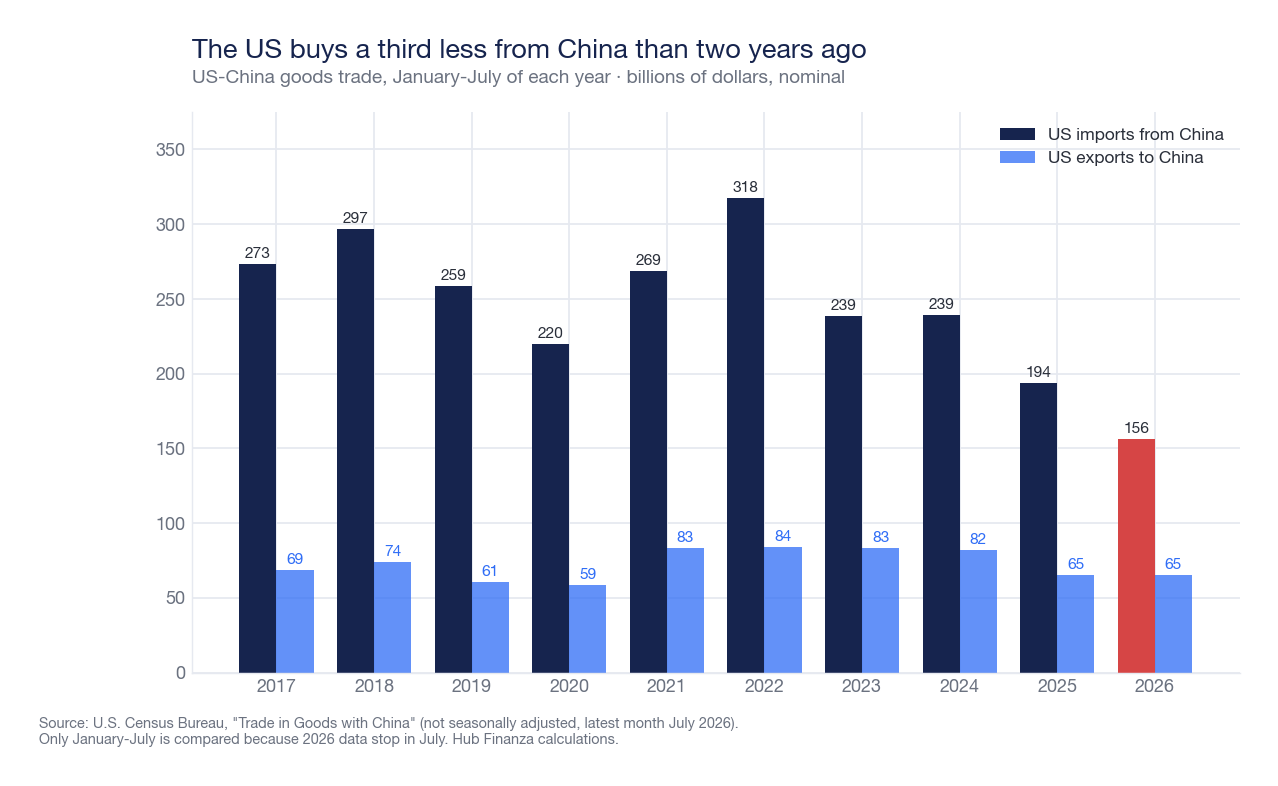
The annual figure, however, hides a reversal. The decline in 2026 is concentrated in the early months, compared with early 2025, when American importers were front-loading purchases to beat tariffs. Since May, the trend has reversed: in June, the United States imported 25.2 billion from China, one-third more than a year earlier, and in July, 27.1 billion, the monthly high for 2026. Chinese customs, cited by the Associated Press on September 8, recorded August exports to the United States of 42.5 billion dollars, 34.4% more than a year earlier, from a low base. The recovery coincides with the fall of IEEPA tariffs after the February ruling.
The sectors at stake: rare earths, chips, soybeans and aircraft
Rare earths and critical minerals. This is Beijing's strongest negotiating point, because the suspension of export controls is the part of the truce that can be revoked most quickly. According to Rush Doshi of the Council on Foreign Relations, citing the Financial Times, China has fulfilled only two-thirds of its rare earth commitments. Asked on September 21 about the November 10 deadline, Chinese Foreign Ministry spokesman Guo Jiakun referred to the «competent authorities.» Whether the extension announced by Bessent also covers these controls is the first detail to look for in official reports.
Semiconductors and artificial intelligence. Washington has already granted licenses to sell Nvidia H200 chips to about ten Chinese companies, but according to the CFR, actual shipments have been very few. Sanjeev Rana of CLSA, cited by Reuters, does not expect a relaxation of American export controls. What the artificial intelligence dialogue will contain today is unknown.
Agriculture, aircraft and energy. Bessent claims that China is fulfilling its soybean commitment for 2026. For other agricultural products, purchases are behind: according to the University of Illinois, in the first seven months of 2026, China bought only 3.9 billion dollars worth, compared to the 17 billion annually announced by the White House after the May visit. The same May 17 fact sheet spoke of an initial purchase of 200 Boeing aircraft, which Beijing, notes the CFR, has never confirmed. American energy, starting with liquefied natural gas, would be among the goods targeted for tariff cuts by the «Board of Trade,» according to NBC and Reuters.
What is the «geopolitical discount» and can it be measured?
Lenders demand compensation for every risk they take. In addition to the risk of not being repaid, there is political risk: sanctions, capital restrictions, a trade war affecting the debtor's revenues. When investors apply this surcharge to an entire country, it is called a geopolitical discount. It is the part of the spread, i.e., the difference in yield compared to a bond considered safe, that the debtor's accounts do not explain. The mechanism is the same as the differential between BTPs and Bunds, explained in the guide BTP-Bund spread: what it is, why it matters and how to read it.
The problem is that this discount has no official measure. The International Monetary Fund, in chapter 2 of the Global Financial Stability Report of April 2025, uses sovereign credit default swaps, contracts that insure against a state's insolvency, as a gauge. The IMF estimates that within one month of a country entering a major military conflict, these premiums increase by about 40 basis points in advanced economies and about 180 in emerging economies. The same report estimates that after US tariff announcements on China, between 2018 and 2024, Chinese companies' shares lost an average of almost 4%. We have not found a specific measure of the discount on Chinese credit published by a bank or rating agency. Only the summary of the Bloomberg Intelligence note is accessible, without figures: the greatest benefits would go to lower-rated bonds, i.e., real estate, local government financing vehicles, and private companies.
Chinese dollar credit was already at low spreads before the summit
To argue that the summit is reducing the geopolitical discount, two things would be needed: a discount yet to be recovered and a price movement attributable to the summit. On the first, the data shows a market that was already very expensive.
- The Chinese state already finances itself at US rates. In the Ministry of Finance's latest dollar issuance, on November 5, 2025, in Hong Kong, China placed 4 billion dollars: three-year bonds at the same yield as Treasuries, five-year bonds with only 2 basis points more, as confirmed by Bloomberg and Crédit Agricole CIB, one of the placement banks. Orders totaled 118.2 billion, according to Bloomberg. On sovereign debt, the room for a discount to recover is almost nil.
- Asian investment grade hit an all-time low in spring. On April 30, 2026, according to Bloomberg, the spread of high-grade Asian dollar bonds fell to about 56 basis points, the lowest level since 2009, the year the index was launched. On September 16, Principal Asset Management still described it as near lows since the financial crisis.
- Even high yield was at lows before the summit. In the week ending September 14, according to Bloomberg, the spread of Asian high-yield bonds hit a historical low. Chinese issuers are the largest component of the index.
- The sovereign credit default swap remains without verifiable data. This is the gauge chosen by the IMF, but its quotes are disseminated by private data providers, and we could not confirm them on two independent sources: therefore, we do not report the level.
None of this data, therefore, shows a tightening that can be measured and attributed to the summit: spreads were at lows before the visit began. And if a tightening did occur, other explanations would not be lacking. For five years, the supply of new Asian dollar bonds has been lower than redemptions, notes Muzinich Asset Management; at the end of June, the Chinese planning agency asked banks not to underwrite dollar issuances with yields above 5%, according to Bloomberg; and for HSBC Asset Management, active Chinese issuers below investment grade have fallen from 136 in 2020 to 22 in 2026. On September 23, according to Reuters, authorities asked banks not to classify loans to developer Vanke as deteriorated. Low supply and high domestic demand keep spreads low, whatever happens at the White House. Bloomberg itself, on September 14, attributed the high-yield record to cheap credit in China and regional growth, not geopolitics.
Then there is a detail that makes any interpretation fragile: the spread measures the distance from Treasuries, and Treasuries have been moving a lot in recent weeks. On September 16, the Federal Reserve raised rates by a quarter point, to 3.75-4%, the first hike since 2023. On September 23, the US 10-year closed at 5.11%, the highest level since July 2007 according to Treasury data, amidst a sell-off of government bonds that has lasted for weeks. When the reference changes so quickly, a few spread points can depend more on the Treasury than on the Chinese debtor. As per the verifiable data on September 24, an effect of the summit on Chinese credit is not visible: Bloomberg Intelligence's thesis remains a hypothesis, not a proven fact. If a recoverable discount still exists, it lies where Bloomberg Intelligence places it, in real estate high yield and local government entities: the segment for which we have not found updated public prices.
Yuan and stock markets send different signals
The most visible signal, before the summit, came from the exchange rate. According to the official Federal Reserve series, on September 18, 6.6975 yuan were needed for one dollar: the yuan had not been this strong since July 2022. From its peak on April 9, 2025, at 7.3499 yuan per dollar, the Chinese currency has appreciated by 9.7%. On September 22, Reuters reported, the People's Bank of China had set the reference exchange rate at stronger levels for ten consecutive sessions: a choice by the central bank, which sets that rate.
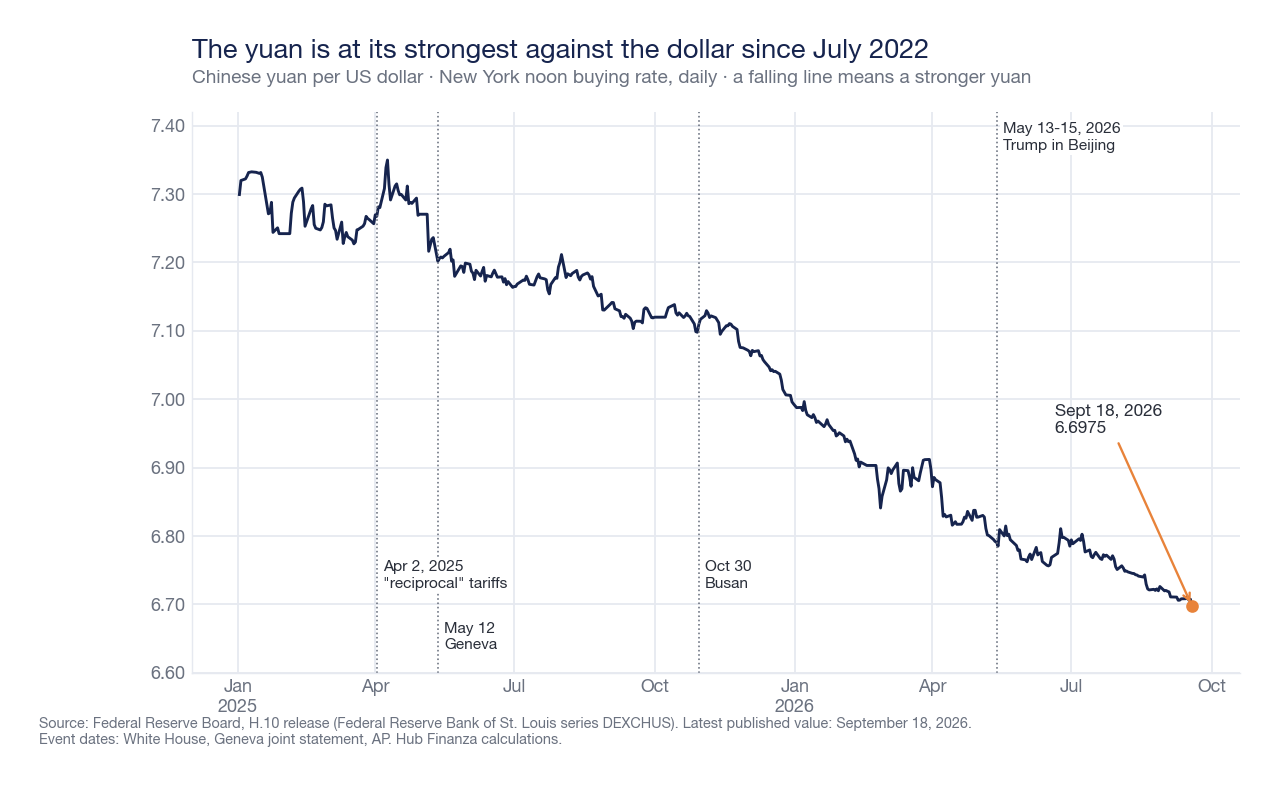
Here too, attribution requires caution. Goldman Sachs, cited by Reuters, observes that a stronger reference rate before a summit is consistent with precedents; OCBC describes it as stability managed by authorities around the summit, not the beginning of a lasting appreciation. The Chinese 10-year yield at 1.67% on September 24, according to Trading Economics and Investing.com, versus the US 5.11%, is a distance that usually weakens the yuan, not strengthens it. The link between rates and exchange rates is explained in the guide Monetary policy: what it is, how it works and why it moves mortgages, bonds and currencies.
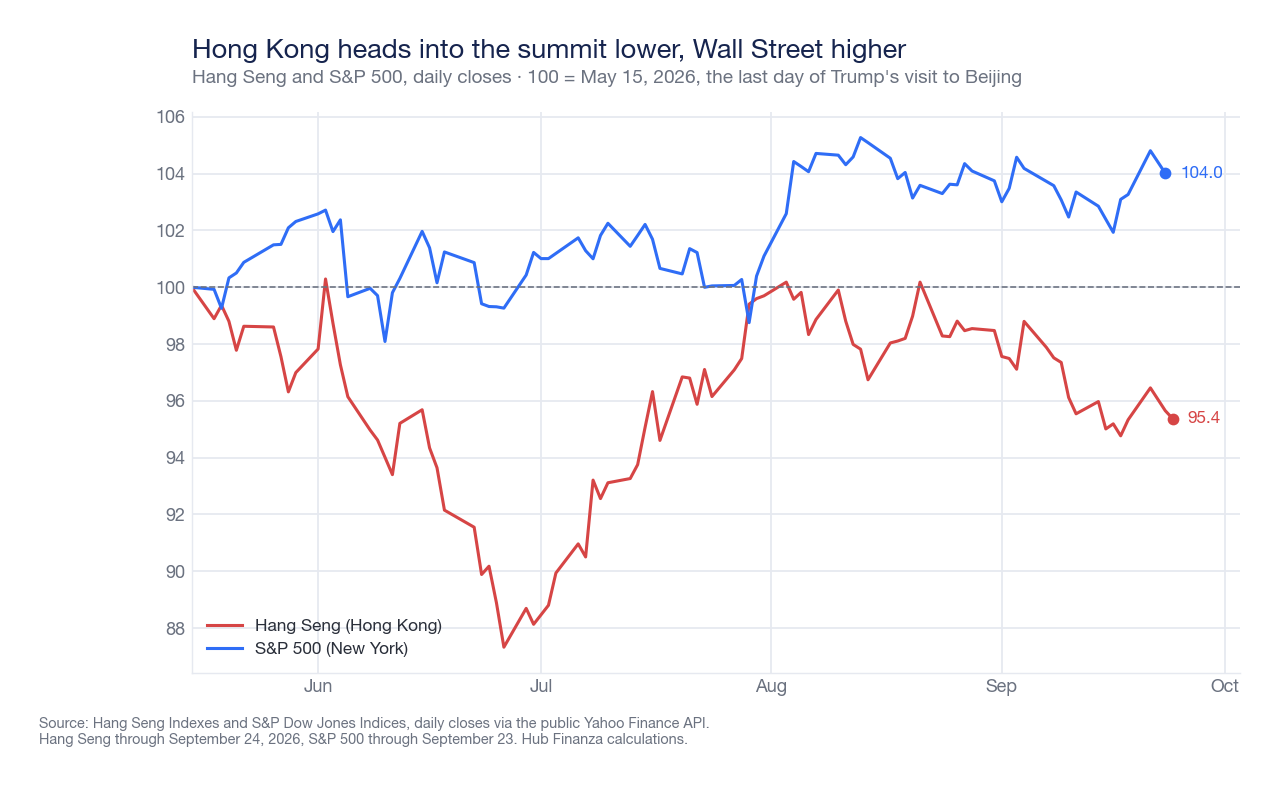
Stock markets, however, did not celebrate. On Thursday, September 24, the Hang Seng closed at 24,761 points, 0.3% less than the day before, and the CSI 300 of the Shanghai and Shenzhen stock exchanges lost 1.7%, to 4,439 points. Reuters attributed the decline to skepticism about possible breakthroughs, the absence of Chinese entrepreneurs Beijing would have liked to bring to Washington, and the weakness of Wall Street, curbed by oil and rising yields. Since May 15, the last day of Trump's visit to Beijing, the Hang Seng has lost 4.6% and the S&P 500 has gained 4%, far from the enthusiasm that in early September accompanied Chinese AI listings in Hong Kong.
What to watch, and when
The summit concludes on Friday, September 25. Without a scheduled press conference, the first indications will come from the speeches at the State Dinner, at 1:55 a.m. Italian time on the night of Thursday to Friday, from the communiqués of the two governments, and from Trump's messages. The points to look for are few and verifiable:
- the January 10 date in writing from Beijing, and the list of extended measures, starting with rare earth controls;
- a list of goods for the «Board of Trade» tariff cuts, with the value of covered trade;
- any reference to chip controls and a second meeting of the artificial intelligence dialogue, expected in Shenzhen;
- Chinese confirmation of purchases announced in May, from Boeing to agricultural products;
- statements on Taiwan, where according to the CFR informal remarks might matter more than official texts, and on Iran.
In the markets, the test of the geopolitical discount hypothesis is simple. If the summit truly reduces perceived risk, real estate high-yield bonds should rise more than high-grade ones, for which improvement margins are now minimal, and the premium on China's credit default swaps should fall. If, instead, spreads move in conjunction with Treasuries, the Federal Reserve, not diplomacy, will have been the deciding factor. Then there are the dates: the Fed meets on October 27 and 28; November 10 was the original truce deadline; APEC in Shenzhen is on November 18 and 19; the G20 in Miami is on December 14 and 15; the extension expires on January 10, 2027.
At the end of the meeting, we will publish a second article with the summit results, the statements of the two leaders, and an analysis of market reactions: from the Hong Kong and Shanghai stock exchanges to the yuan, and Chinese dollar credit spreads. There we will verify, with numbers, whether the geopolitical discount has indeed narrowed.
Sources
Visit program from the press release of the First Lady's office of the White House on September 21, 2026, from the announcement of the Chinese Ministry of Foreign Affairs on the same day, and from the daily White House schedule reported by Nikkei Asia and CBS News on September 24; arrival at Joint Base Andrews from Associated Press (via PBS NewsHour, September 23); Xi Jinping's statement from Xinhua and CGTN; Donald Trump's message on Truth Social from Nikkei Asia. Truce extension from Scott Bessent's statements to Fox News reported by NBC News and CNBC (September 23-24) and from the press conference of the spokesman for the Chinese Ministry of Commerce on September 24; UBS comment and CLSA analysis from Reuters (September 24); Guo Jiakun's statements from the Chinese Ministry of Foreign Affairs website (September 21). Contents of the Busan truce from the White House fact sheet of November 1, 2025; purchases announced after the Beijing visit from the White House fact sheet of May 17, 2026; Supreme Court ruling of February 20, 2026, and tariffs in effect from the Congressional Research Service and the U.S. Trade Representative's notice of July 23, 2026; suspension of Chinese rare earth controls until November 10, 2026, from Chinese Ministry of Commerce announcements summarized by the legal firm Pillsbury. Analysis by Rush Doshi and James Lindsay from the Council on Foreign Relations (September 22) and Edgard Kagan from CSIS; Board of Trade from NBC News and Reuters; agricultural purchases from farmdoc at the University of Illinois (September 2026); Taiwan and Iran from ABC News. US-China goods trade from the «Trade in Goods with China» table of the U.S. Census Bureau (data up to July 2026); Chinese August exports from Chinese customs via Associated Press (September 8). Summary of the Bloomberg Intelligence note of September 24, 2026; Chinese Ministry of Finance dollar issuance of November 5, 2025, from Bloomberg (via Yahoo Finance) and from the Crédit Agricole CIB press release; Asian spreads from Bloomberg (May 1 and September 14, 2026) and from the Principal Asset Management comment reported by KED Global (September 16); bond supply from Muzinich (September 7), Bloomberg via The Edge (June 30) and HSBC Asset Management (April 2026); ratings from Moody's (April 2026); Vanke from Reuters (September 23). Estimates on credit default swap and equity reactions to geopolitical events from chapter 2 of the Global Financial Stability Report of the International Monetary Fund (April 2025). Federal Reserve decision of September 16, 2026, from CNBC and NPR, calendar from the Fed website; US yields from the Daily Treasury Par Yield Curve of the U.S. Department of the Treasury, historical comparison on the DGS10 series of the Federal Reserve Bank of St. Louis; Chinese 10-year yield from Trading Economics and Investing.com. Dollar-yuan exchange rate from H.10 statistics of the Federal Reserve Board; reference exchange rate and comments from Goldman Sachs and OCBC from Reuters (September 21-22). Closings of Hang Seng, CSI 300 and S&P 500 from index providers via Yahoo Finance and the Reuters dispatch of September 24. Dates of APEC and G20 summits from CGTN and the G20 organizing committee. Calculations of variations and comparisons are editorial elaborations on cited data.
This article is for informational purposes only and does not constitute financial advice, investment research, public solicitation of savings, or a personalized recommendation to buy or sell. The assessments expressed are editorial opinions based on public data as of the publication date and may change without notice. The value of investments can decrease as well as increase, and past performance is not indicative of future results. Before making any investment decision, it is advisable to consult a qualified financial advisor and evaluate the consistency of the operation with one's objectives, time horizon, and risk tolerance.