
Global markets went through a Thursday of sharp risk aversion, as the escalating conflict between the United States and Iran spread to the Red Sea and pushed oil above the psychological threshold of $100 a barrel at moments of peak tension. Weighing on European indices, alongside geopolitics, was also a two-sided earnings season: disappointing results in tech (STM above all) and in luxury, solid but coolly received results in banking. The ECB, as expected, left rates unchanged, but rising energy prices are reigniting inflation fears and pushing bond yields higher.
Middle East: the Houthis open the Red Sea front
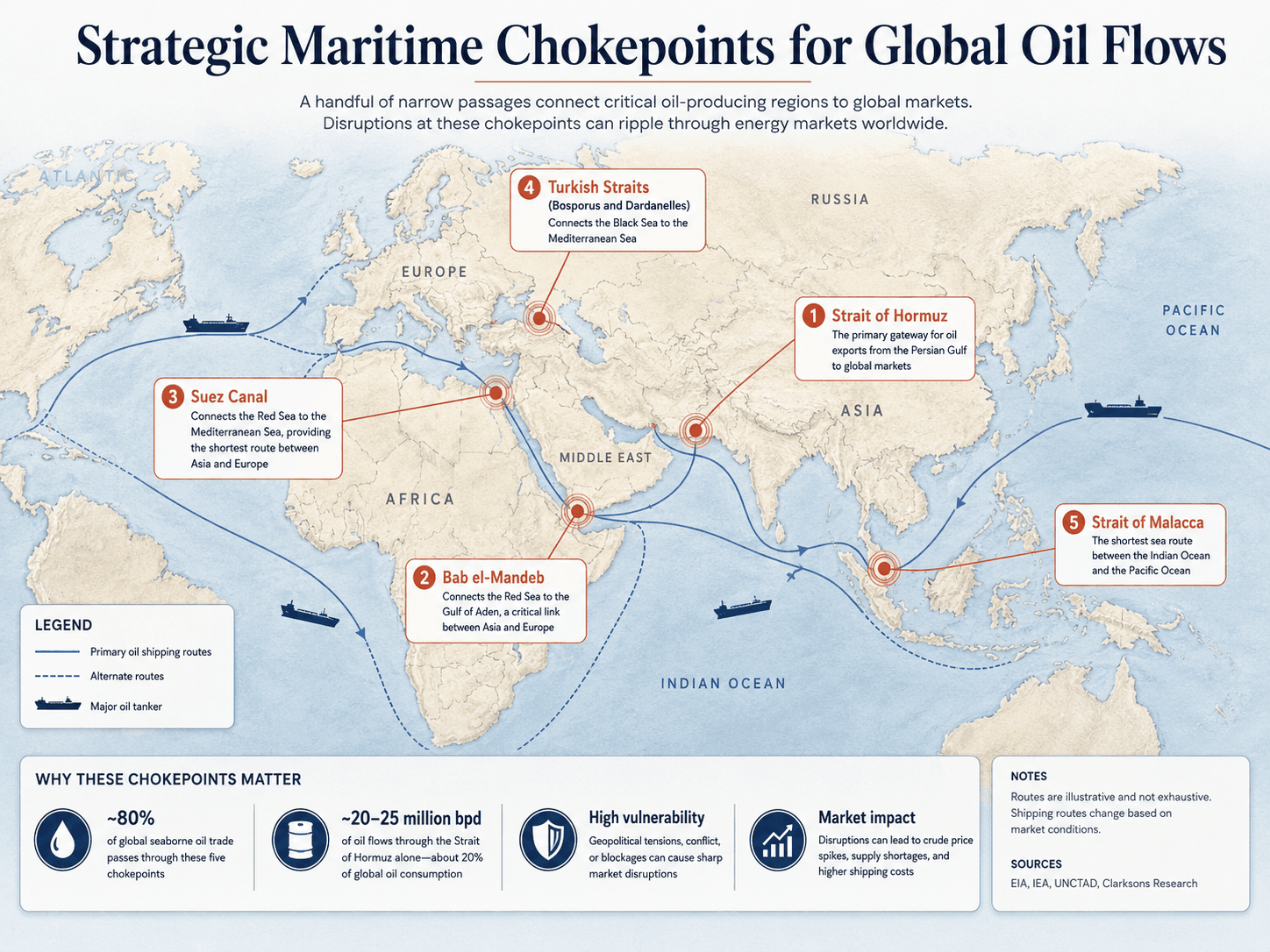
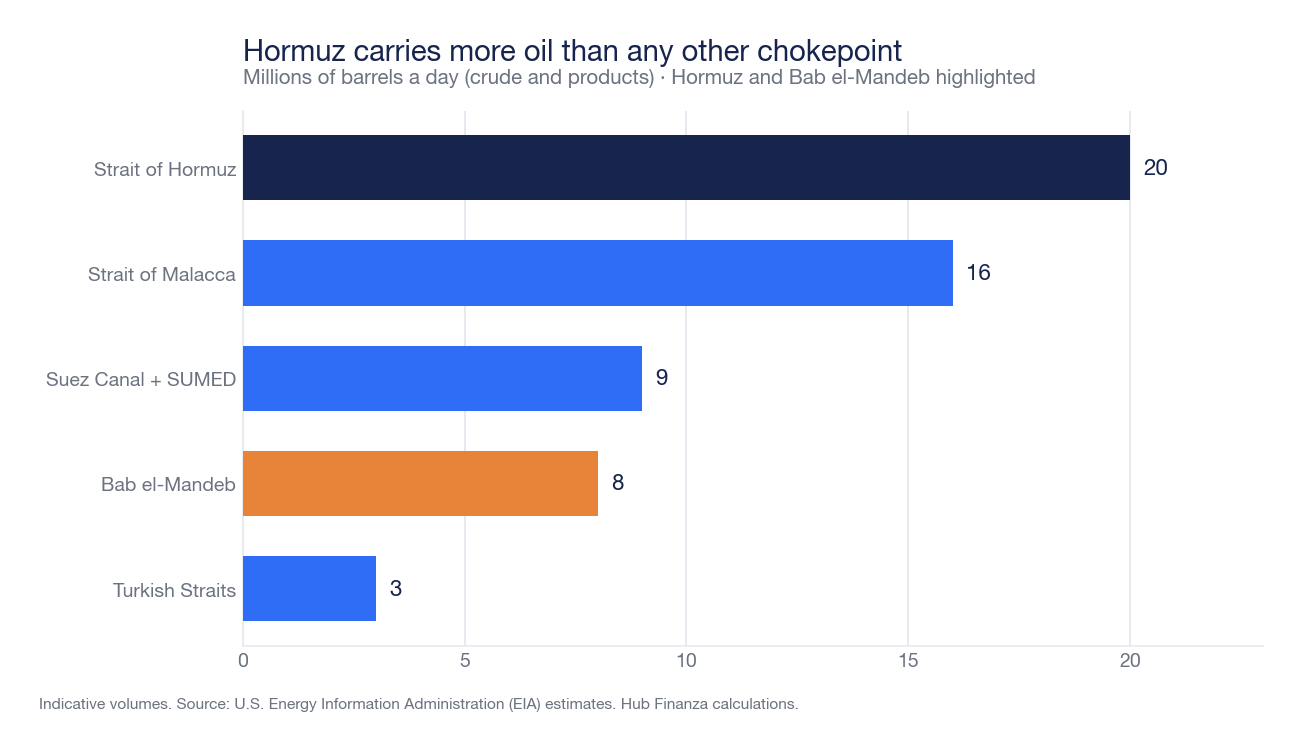
The news that dominated the day came from the Red Sea: Yemen's Houthi rebels, allies of Tehran, claimed responsibility for an attack on two Saudi tankers, effectively opening a new front in the war between the United States and Iran that has been under way for around two weeks. The attack follows the announcement earlier in the week of an outright Houthi maritime embargo against Saudi Arabia, and shifts the spotlight onto Bab el-Mandeb, the strait connecting the Red Sea to the Gulf of Aden: a chokepoint that markets fear could turn into a "second Strait of Hormuz".
The picture was already critical on the Hormuz front, through which roughly 20% of world crude supply passes: commercial traffic through the strait is effectively paralysed after the Revolutionary Guards threatened to "set fire to" any vessel in transit, and Tehran has gone as far as threatening to close it completely. With today's attack in the Red Sea, the alternative route towards Suez also comes under fire.
Washington's response was not long in coming. President Donald Trump threatened "massive military punishment" against the Houthis and stated that the United States will hold Iran directly responsible for the attacks by its Yemeni allies. Domestically, the US House approved a $95 billion appropriation for military operations in the region, while the administration put in place measures to support maritime traffic, including war-risk insurance cover and naval escorts for commercial vessels in the Gulf.
Oil: WTI tops $100 intraday, then settles around $93. Gas under strain
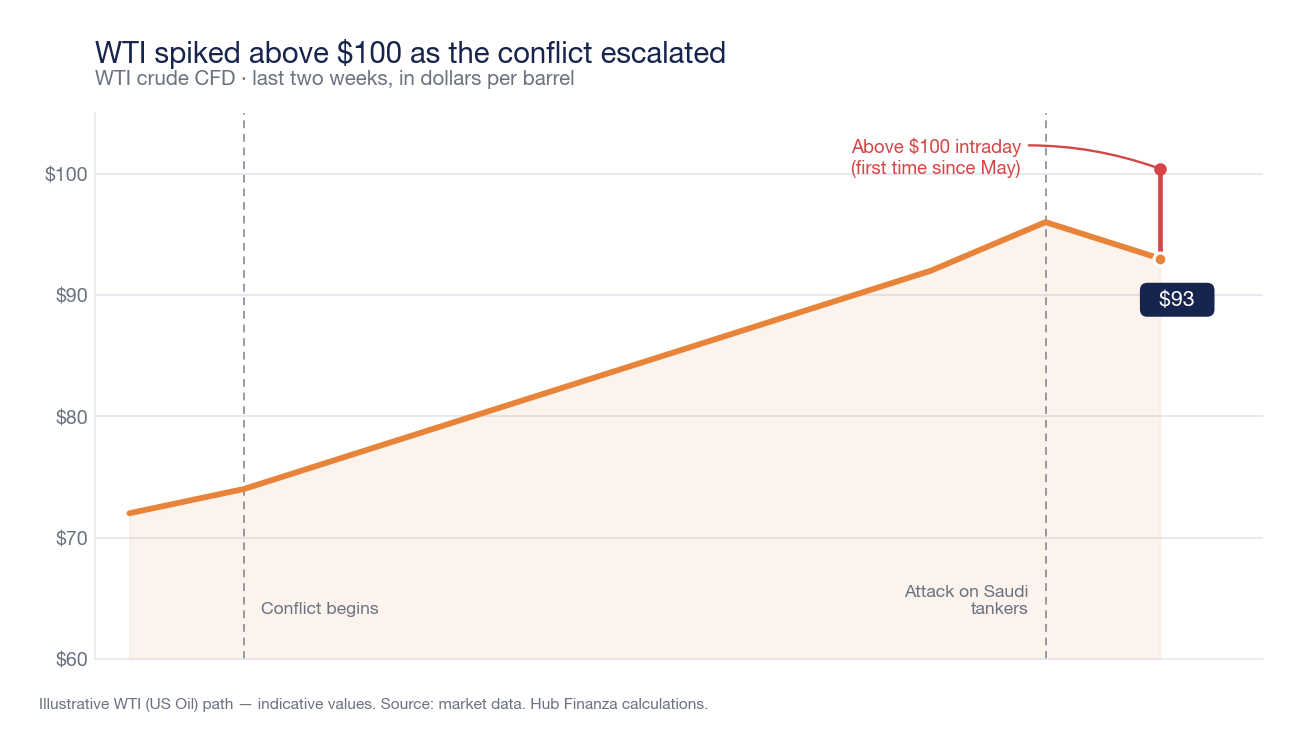
The reaction in energy commodities was immediate. American crude WTI (US Oil) rose above $100 a barrel intraday — a threshold it had not touched since May — before settling around $93, up roughly 8% from the highs since the conflict began. Brent, the international benchmark, followed suit, rising into the $97-100 range. Goldman Sachs warns that a further escalation of the conflict could push crude as high as $120. European natural gas also rose, with the Amsterdam TTF above €63 per megawatt hour.
Gold, by contrast, defied the safe-haven script: after Wednesday's rally, the yellow metal fell back by around 2.5%, returning to the $4,050-4,090 an ounce range, penalised by profit-taking and rising bond yields.
Here is the WTI (US Oil) price in real time, to follow the recent swings closely:
Milan the worst performer: STM collapses, energy and defence hold up
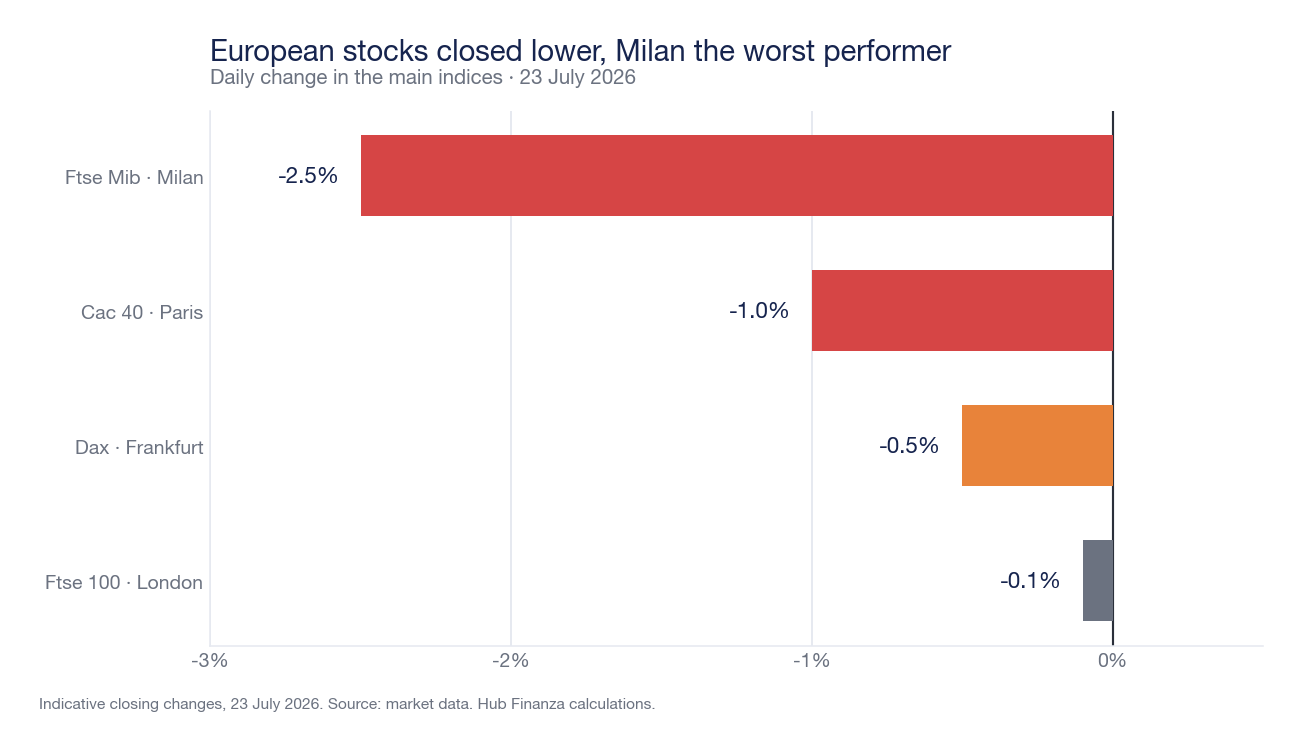
Against this backdrop, European stock markets closed broadly lower, with Milan the worst on the continent. The FTSE MIB, which opened down 1.45% at 51,978 points, progressively accelerated its decline to shed around 2.5% in late trading, around 51,400 points, according to end-of-session updates. Losses were more contained elsewhere: Frankfurt's DAX gave up around half a percentage point, Paris's CAC 40 around 1%, while London's FTSE 100 closed just below the flatline.
It was not only geopolitics weighing on Milan. STMicroelectronics collapsed after its quarterly results, falling more than 15% (with intraday lows close to -17%), undone by guidance the market judged too cautious. Moncler was also heavily hit, down around 8% despite positive half-year results, in a luxury sector under pressure. UniCredit lost ground (between -2% and -4.8% at various points in the session) despite record profits, after chief executive Andrea Orcel cooled expectations on banking consolidation, while not ruling out a Commerzbank move in the final quarter of the year.
Energy and defence stocks bucked the trend, supported respectively by the crude rally and by rearmament: Eni gained as much as 3%, with Leonardo and Saipem also performing well. Amplifon stood out (up around 3%), upgraded to Buy by Citi with a target price of €16.50.
The ECB holds rates, but oil reignites inflation fears
At today's meeting the European Central Bank left rates unchanged, with the deposit rate at 2.25%, confirming a cautious stance in the middle of an energy shock. But the market is already looking further ahead: according to ING analysts a September hike is "likely, especially if oil prices continue to rise". Short-dated yields moved accordingly, with the German 2-year Schatz at 2.87%, its highest since August 2024.
On the Italian front, there was no tension on the spread: the BTP-Bund differential remained stable in the 81-84 basis point range throughout the session, with the Italian 10-year yield around 4%. A picture of substantial calm in sovereign debt, confirming that markets perceive the current crisis as an energy and equity shock, not a eurozone credit crisis.
In currency markets, the euro held steady above 1.14 against the dollar (around 1.142-1.143), with the greenback essentially flat against the main crosses.
US focus: Wall Street in the red at midday, volatility soars
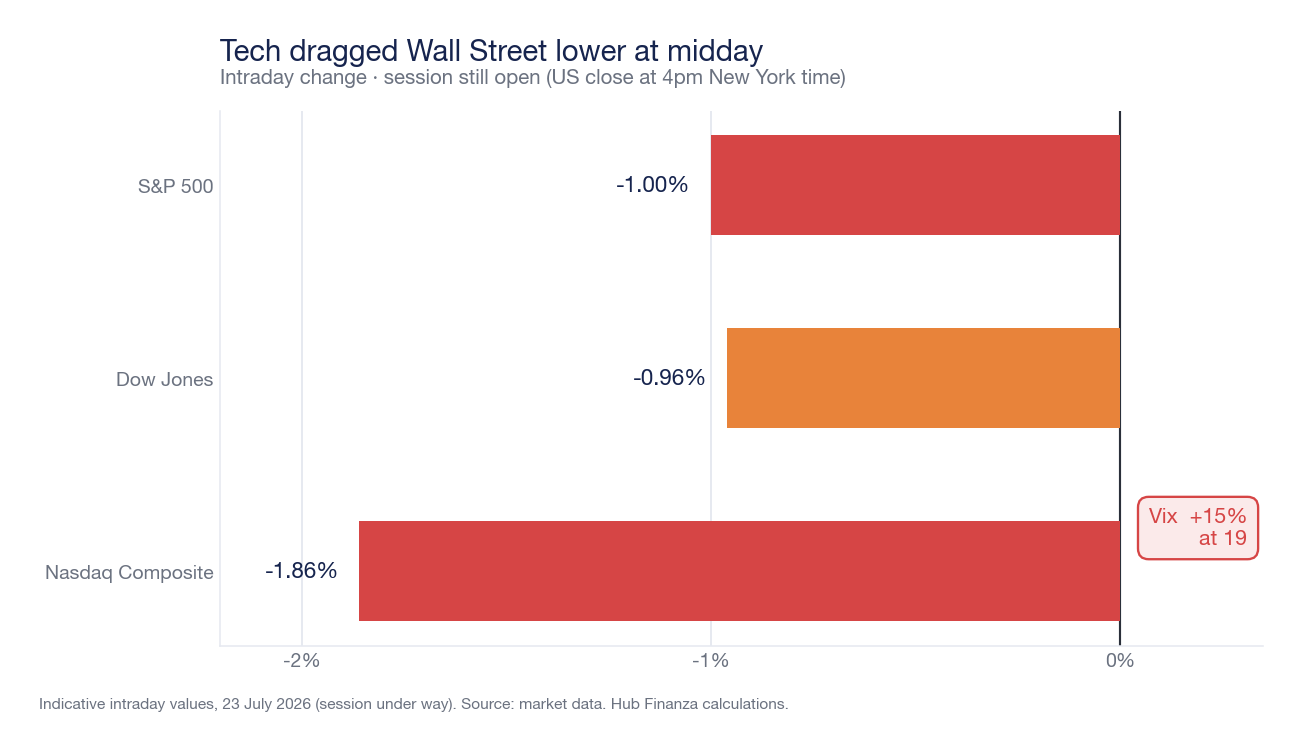
With European markets closed, Wall Street was trading sharply lower, with the session still under way (the US market closes at 22:00 Italian time): the figures reported here are therefore intraday and may change before the closing bell. At midday the S&P 500 was down 1% at 7,424 points, the Dow Jones down 0.96% at 51,715 points and the Nasdaq Composite down 1.86% at 25,212 points, with the Vix fear index up more than 15% above 19. The 10-year Treasury yield rose to its highest in around 18 months, helped by the return of energy-driven inflation fears.
Weighing on the technology index were above all the quarterly results: Tesla was heavily sold after Elon Musk described 2026 as a year of "massive capex" across robotaxis, Optimus robots and data centres, while Alphabet fell despite solid results, on yet another increase in AI infrastructure spending forecasts that is fuelling investor doubts about returns from artificial intelligence. On the macro front, weekly jobless claims came in at 187,000, better than the 210,000 expected.
In Asia, Tokyo's Nikkei had closed against the trend at +0.46% at 66,423 points, supported by the American Big Tech results published on Wednesday evening.
Bitcoin moves sideways: crypto is not (yet) a safe haven
Bitcoin remained essentially stable, down a fractional 0.6% or so at around $65,700, within the $64,000-66,800 range that has contained it for days. The leading cryptocurrency is thus consolidating the 13% recovery from its early-July low of $57,750, without however benefiting from safe-haven demand: in a risk-off environment, investors continue to prefer energy and the dollar.
Data updated to the close of European markets on 23 July 2026 (around 17:45); Wall Street figures refer to a session still under way.
Disclaimer: informational and editorial content, not financial advice. Data comes from public sources and is subject to revision; Hub Finanza charts are for illustrative purposes.