

On Wednesday, July 29, 2026, SK hynix published its second-quarter results and achieved the best performance in its history. The stock closed down 9.61% in Seoul, dragging the Kospi down 5.98% and triggering circuit breakers for the second consecutive day — something that had never happened before on the Korean exchange.
It's not a contradiction: it's the gap between an all-time record and what the market had already priced in.
The numbers: the best quarter ever
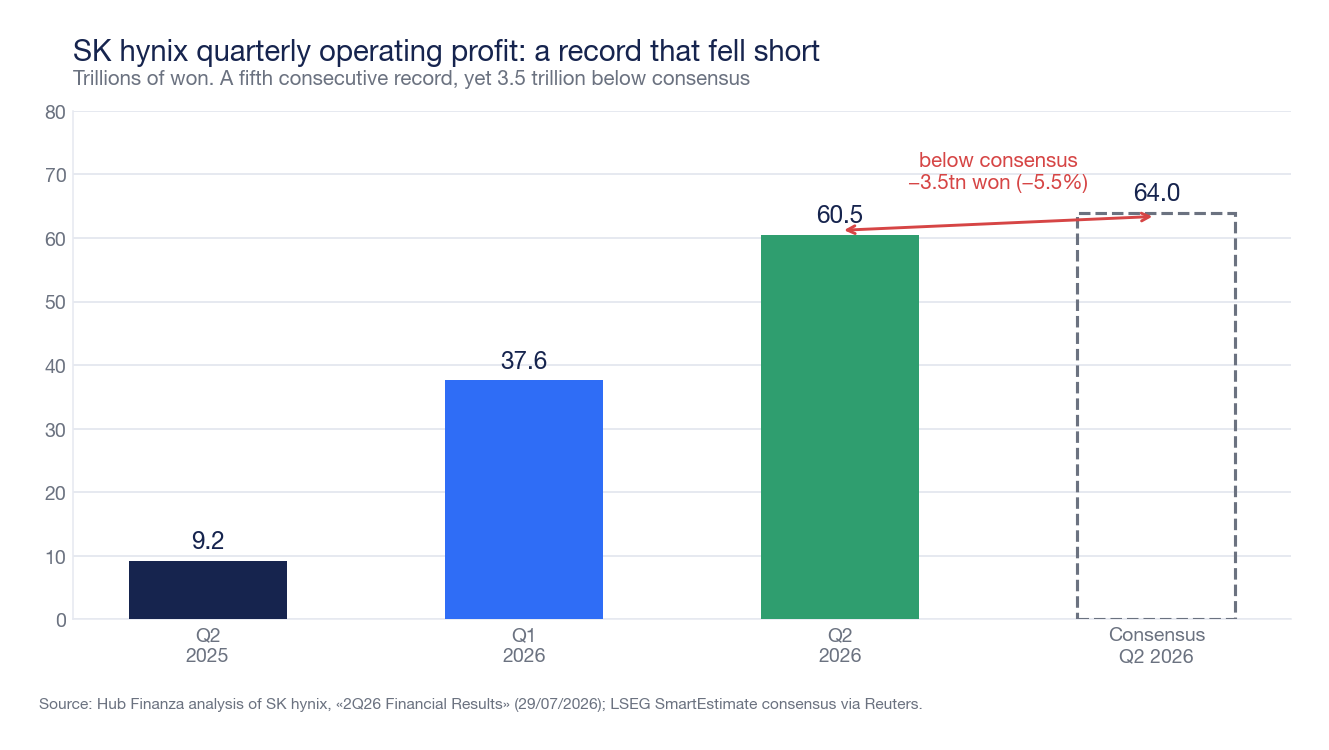
Second-quarter revenues were 79.318.7 billion won, up 257% year-on-year (they were 22.232 billion in Q2 2025) and up 51% from the previous quarter. Operating profit reached 60.542.6 billion won, 557% more year-on-year and 61% more than the first quarter: it is the fifth consecutive quarterly record. The operating margin reached 76%, four points above the previous quarter.
In the first half alone, revenues surpassed the 100.000 billion won threshold for the first time. The financial position is equally solid: 88.000 billion won in cash (33.600 billion more in three months) against 18.600 billion in debt, for a net cash of 69.400 billion.
Behind these numbers is price, not just volume. In the quarter, DRAM shipments grew by a high single-digit percentage and the average selling price rose by about 30%; in NAND, volumes increased by a mid-double-digit percentage and average prices rose by over 50%, with data center SSD revenues doubling in one quarter.
The record that's not enough
The point is that analysts expected more. The LSEG SmartEstimate consensus indicated an operating profit of about 64.000 billion won: the result came in 3.500 billion below, 5.5% less.
The most cited operational reason is the HBM4 delivery schedule, the new generation of high-bandwidth memory for artificial intelligence accelerators: mass shipments began in the quarter, but slower than expected, shifting revenue recognition forward. Production will increase in the second half, while HBM4E completed sample shipments in the first half of the year.
But the disappointment was also financial in nature. Investors were awaiting a detailed plan for shareholder returns — how much of the cash generated by the AI boom would be returned — and did not find one. The structure of multi-year supply agreements also weighs: SK hynix has concluded about ten with key customers, typically for five years. They provide volume visibility but lock in prices and thus limit potential upside if memory prices were to rise further.
Net profit larger than revenue
There's a figure that needs to be read carefully, because taken alone it can be misleading: the quarter's net profit was 93.922.6 billion won, which is higher than revenues. It's neither an error nor an extraordinary industrial performance.
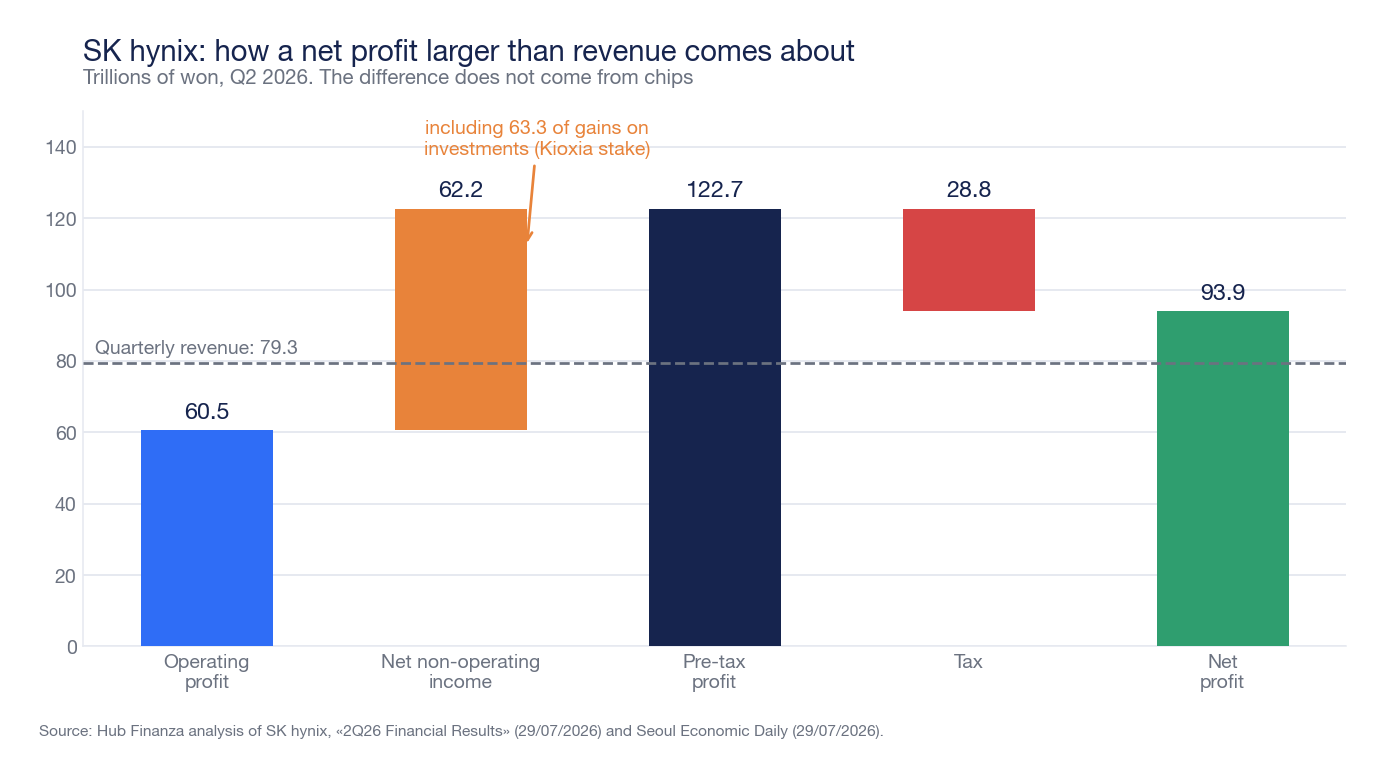
Indeed, 62.170 billion in net non-operating income is added to the operating profit of 60.543 billion, bringing the pre-tax result to 122.708 billion. Within that item are 63.270 billion in investment gains, largely related to the disposal of the stake in Japanese Kioxia, a NAND memory manufacturer that SK hynix had entered years ago alongside Bain Capital. This is a one-off item: it will not be repeated in subsequent quarters and says nothing about the profitability of the chip business. The number to watch for that, remains operating profit.
To put it in perspective: with these accounts, SK hynix more than doubled Samsung Electronics' previous record, which in Q1 2026 recorded 58.828 billion in pre-tax profit and 47.225 billion in net profit.
Seoul session: circuit breakers for two days in a row
The reaction of the Korean stock market was severe. The Kospi closed at 5.663.24 points, down 5.98%: it is the lowest level since April 7, 2026, and is about 40% lower than the June record. In addition to SK hynix (−9.61%), Samsung Electronics (−5.23%) and Kioxia (−13.85%) also declined.
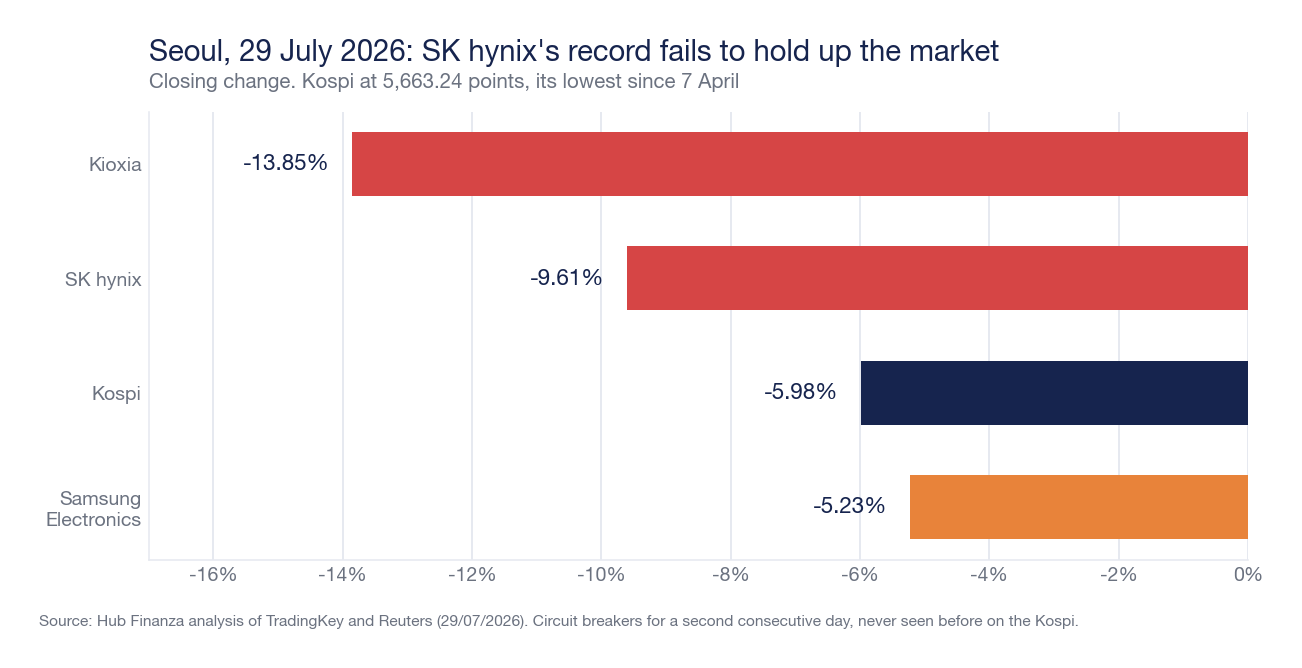
During the session, declines exceeded 12% and circuit breakers, mechanisms that suspend trading to cool the market, were triggered: this is the ninth intervention of 2026 and the first time in Kospi's history that they have been triggered for two consecutive days. The weight of SK hynix and Samsung on the index is such that, as analyst Josh Gilbert observed, the simultaneous collapse of the two stocks made it almost impossible to avoid the hit even for those passively investing in the index.
Demand is not lacking: certainty about who finances it is
Here lies the crux, and it is different from a demand problem. «Key customers continue to demand more memory,» said SK hynix President Song Hyun-jong, and the price numbers confirm this. Investors' fear concerns the next step: that major buyers of artificial intelligence infrastructure will hit the brakes on investments. «There are concerns that tech companies will take a pause in infrastructure spending,» summarized Lee Min-hee of BNK Investment & Securities.
SK hynix, for its part, is accelerating. The 2026 capital expenditure will rise towards the upper end of the 40.000 billion won range (approximately 27.6 billion USD), up from 30.200 billion in 2025: mass production at the M15X plant has been brought forward, and the first cleanroom of the Yongin complex will open in early 2027. On the NAND front, 321-layer products are already the largest production share, and the goal is to bring them to about half of domestic capacity by year-end.
For the third quarter, the company forecasts DRAM shipments to grow by approximately 10% quarter-on-quarter and NAND growth in the low single digits.
What to watch now
Three elements will tell whether July 29 was a valuation correction or the start of a cycle change.
The first is the pace of HBM4 in the second half: if the delay was only calendar-related, the deferred revenues will be seen in the next two quarters; if it reflects production yield difficulties, the problem is different.
The second is the spending plans of major customers. AI memory demand is currently driven by a small number of buyers: if just one of them slows down, the entire chain reprices.
The third is shareholder returns. With 69.400 billion won in net cash and rapidly increasing capital expenditure, the market wants to know how the cycle's bounty will be divided — and it is precisely the absence of this answer that weighed more than the accounts.
In the background, the same day of July 29 saw the Federal Reserve conclude its FOMC meeting, with economists expecting rates to hold steady in the 3.50%-3.75% range for the fifth consecutive meeting: a context that does not help to reprice growth stocks upwards.
Sources: SK hynix, «2Q26 Financial Results» (29/07/2026, company newsroom and PR Newswire, K-IFRS accounting principles); Seoul Economic Daily (29/07/2026) for the breakdown of pre-tax profit and investment gains; Reuters via Yahoo Finance (29/07/2026) for LSEG SmartEstimate consensus, statements, and investment plans; TradingKey (29/07/2026) for Kospi session data and circuit breakers. Figures are expressed in billions of won and, as indicated by the company, are subject to change pending independent audit. Hub Finanza charts are for illustrative purposes.
Disclaimer: the information provided in this article is for informational purposes only and does not constitute personalized financial advice in any way. It is recommended to consult a qualified professional before making any investment decisions.