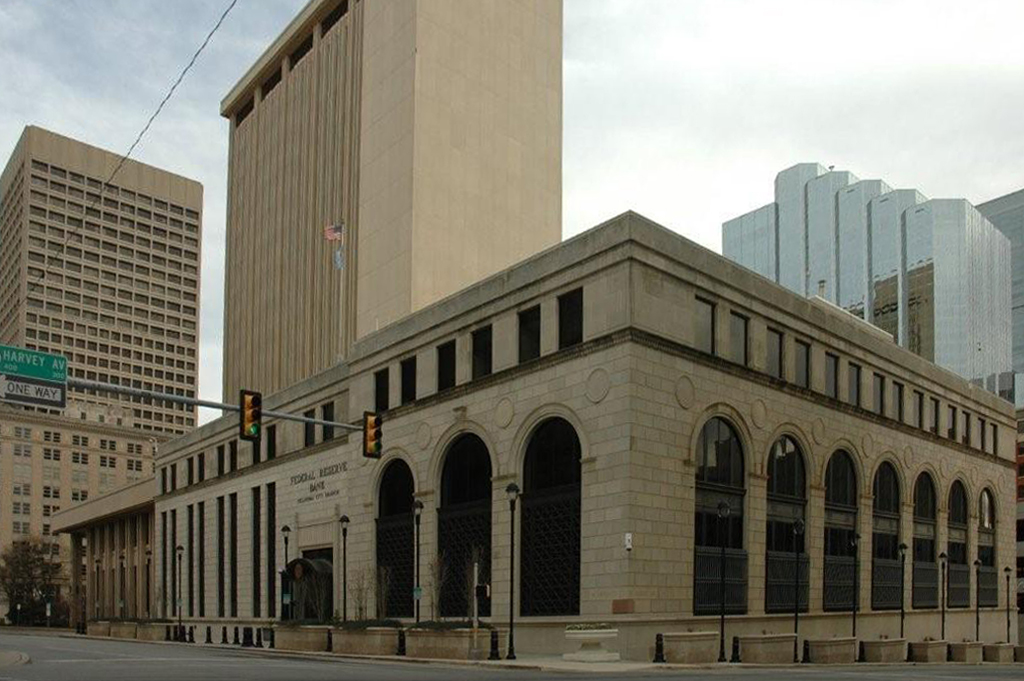
A hike anticipated by markets, but not painless for that reason. On September 16, 2026, the Federal Reserve raised the federal funds target by 25 basis points, effectively initiating a new restrictive cycle after more than three years. In its statement, the FOMC justified the move by the need to ensure a "more timely" return of inflation to 2%, emphasizing that job gains remain solid and the unemployment rate has "changed little." The conclusion of the statement leaves no room for interpretation: «the Committee will ensure price stability».
The rate hike by the US central bank had been anticipated by analysts and market strategists for several days. Even before the official decision, stock indices and bond yields had shown some volatility, with some moments of upside on the bet that the Fed would act forcefully to defend its credibility against inflation, as reported by Bloomberg Markets. Raisah Rasid, Global Market Strategist at JPMorgan, had highlighted how incoming economic data and rising Treasury yields indicated an imminent rate hike.
A unanimous decision, a political message
The most significant data point is not so much the hike itself — widely priced in by markets in the preceding days, as indicated by index volatility and rising Treasury yields — but rather its compactness: the vote was unanime, 12 to 0. It is the first unanimous FOMC decision since May 2025, and it comes at a time of maximum political pressure on the central bank.
Just twelve days before the meeting, President Trump had publicly called for rates «at 1%, or less» and threatened to halt trade with over 50 US partners if the Fed did not cut. The FOMC's response was the exact opposite: not only no cuts, but a hike voted without a single dissenting voice. The already wide gap between the White House and the Federal Reserve is widening — and Jerome Powell's departure has not narrowed it.
The new dot plot: another hike coming
With the decision, the Fed also published the new Summary of Economic Projections. The comparison with June's projections shows an upward revision across the entire horizon:
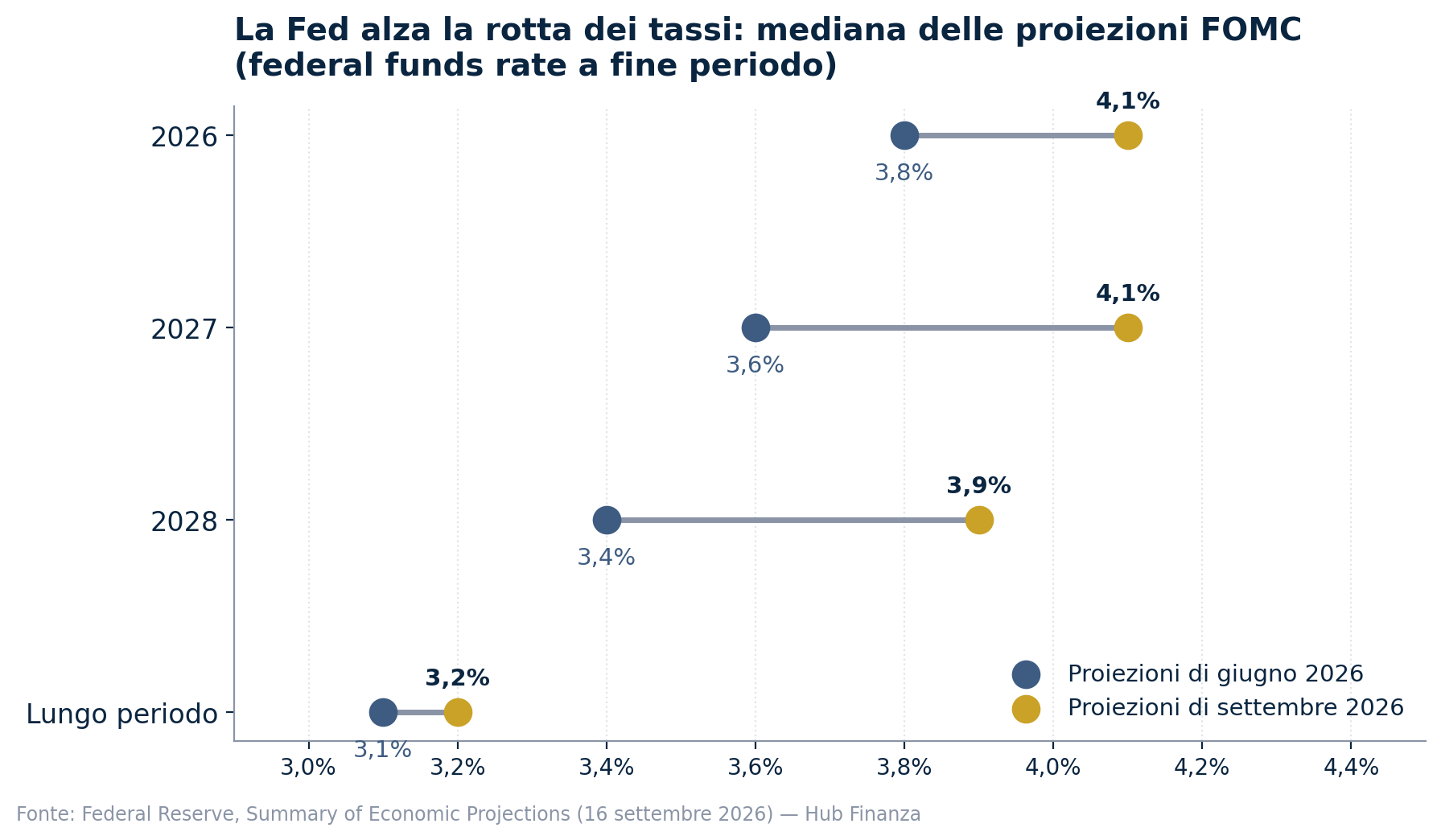
2026: 4.1% (from 3.8% in June) — implies another 25 bp hike by year-end, expected by 12 of the 18 Committee members;
2027: 4.1% (from 3.6%) — no cuts expected for the entire next year;
2028: 3.9% (from 3.4%) — only one reduction over two years;
Long run: 3.2% (from 3.1%).
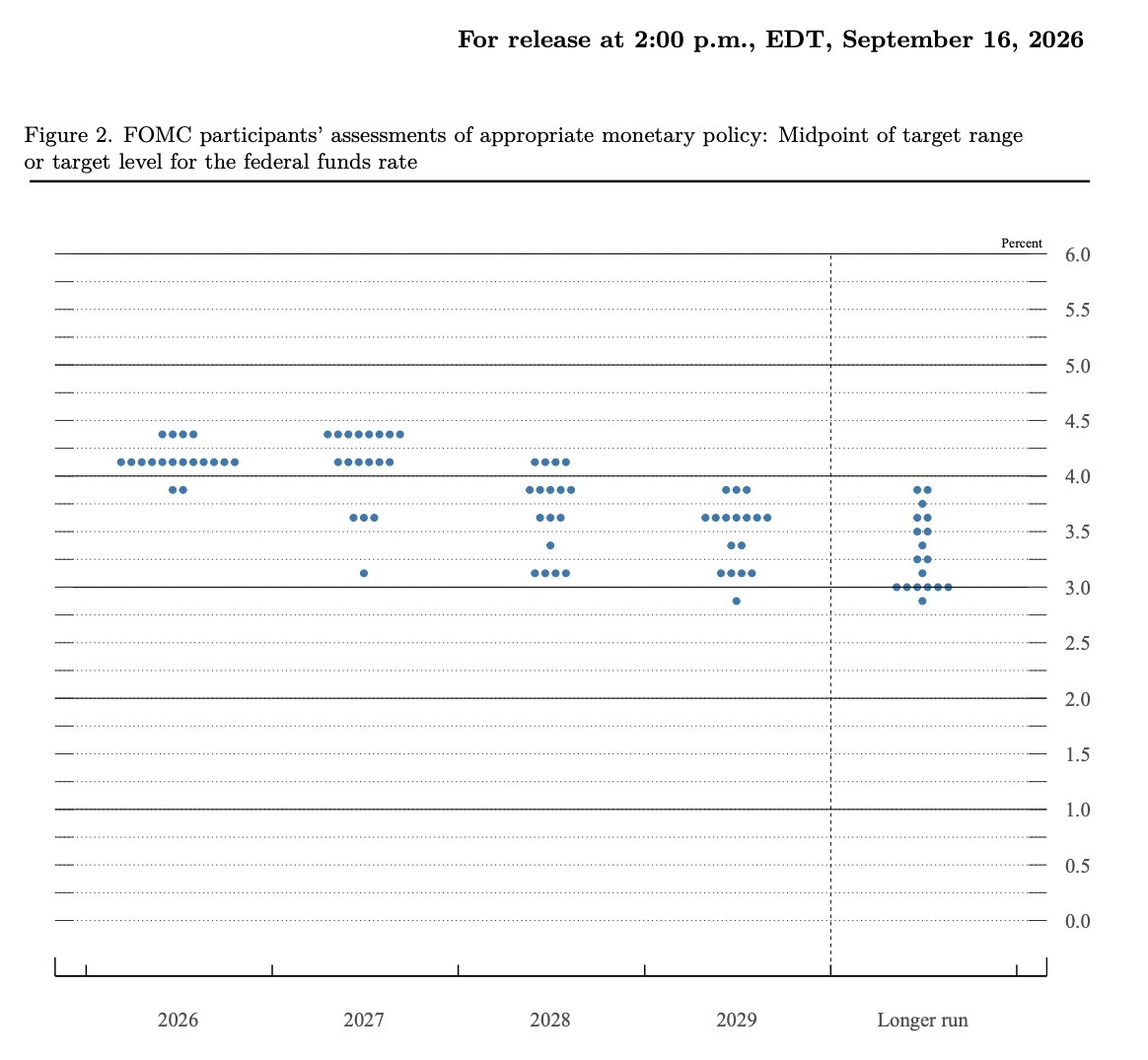
The official dot plot visually conveys the idea: the «dots» for 2026 and 2027 cluster between 4.1% and 4.4%, and the descent towards the long-run rate is slow and gradual. A not insignificant procedural curiosity: Chairman Kevin Warsh stated that he did not include his «dot» in the projections chart.
Wall Street's reaction
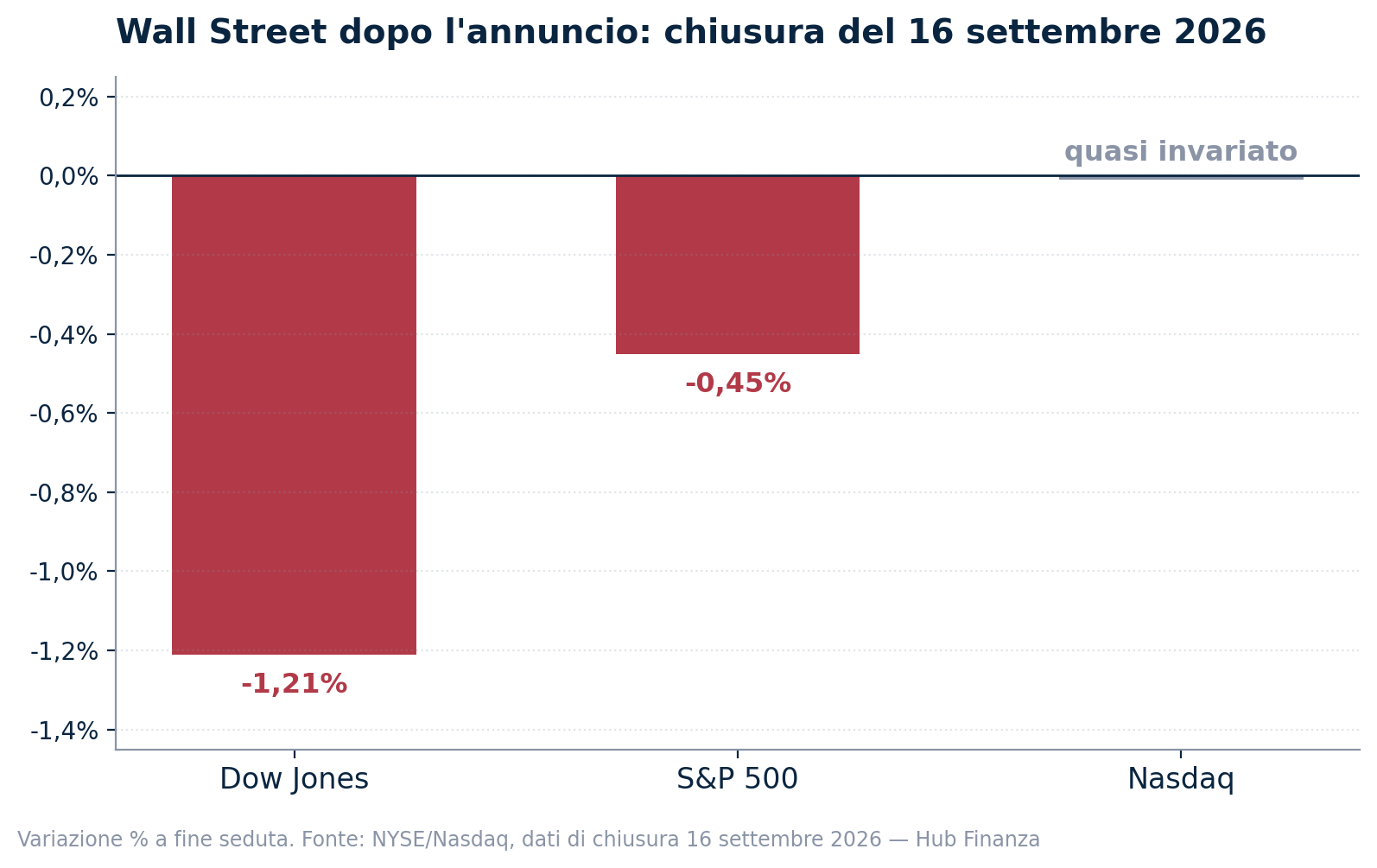
After the announcement, indices reversed their positive tone from the start of the session, with selling intensifying during Warsh's press conference, interpreted by markets as more «hawkish» than expected on inflation. The Dow Jones closed at 51,461.90 points, down by 631.21 points (-1.21%), with Goldman Sachs being the worst performer on the index. The S&P 500 fell 0.45% to 7,551.81 points, while the Nasdaq showed greater resilience, shaving just 0.01% to 25,978.42 points. On the bond front, the ten-year Treasury yield returned above the 5% threshold.
At a sectoral level, the session had two sides. On one hand, banks, which recorded their worst day since February on fears of further hikes, and energy stocks, held back by falling crude oil prices during the session; on the other hand, semiconductors, with Intel rising 4% on rumors of negotiations with SK Hynix to produce chips in the United States — a gain that helped keep the Nasdaq afloat. More generally, the market discounts the impact of higher financing costs on earnings, investments, and consumption.
To better understand how central banks influence the economy, it is useful to consult our guide on monetary policy: what it is, how it works, and why it moves mortgages, bonds, and currencies.
Warsh: «difficult to call financial conditions restrictive»
In his press conference, Kevin Warsh defended the decision with clear arguments. The hike, he explained, comes as the economy is strengthening, and — a key point — he said he was «struggling to call» current financial conditions restrictive, a view he believes is widely shared within the FOMC. Translated: for the Fed, there is room to tighten further without stifling growth.
Warsh reiterated that price stability is the central bank's predominant focus and that the Committee will need to be «confident that inflation is moving toward the 2% objective» before changing course. Market strategists are on the same page: for Raisah Rasid (JPMorgan), attention now shifts to the trajectory of rates over the next 12-18 months and long-term inflation expectations, while Alicia Levine (BNY) observes how higher yields are directly impacting equities.
Nine months that overturned the scenario
To measure the speed of change, just look back to the end of 2025: markets were pricing in three rate cuts in 2026, and oil was trading around 60 dollars per barrel. Today, the picture is reversed: a new hiking cycle has begun, crude oil is trading above 100 dollars, and diesel is at historical highs.
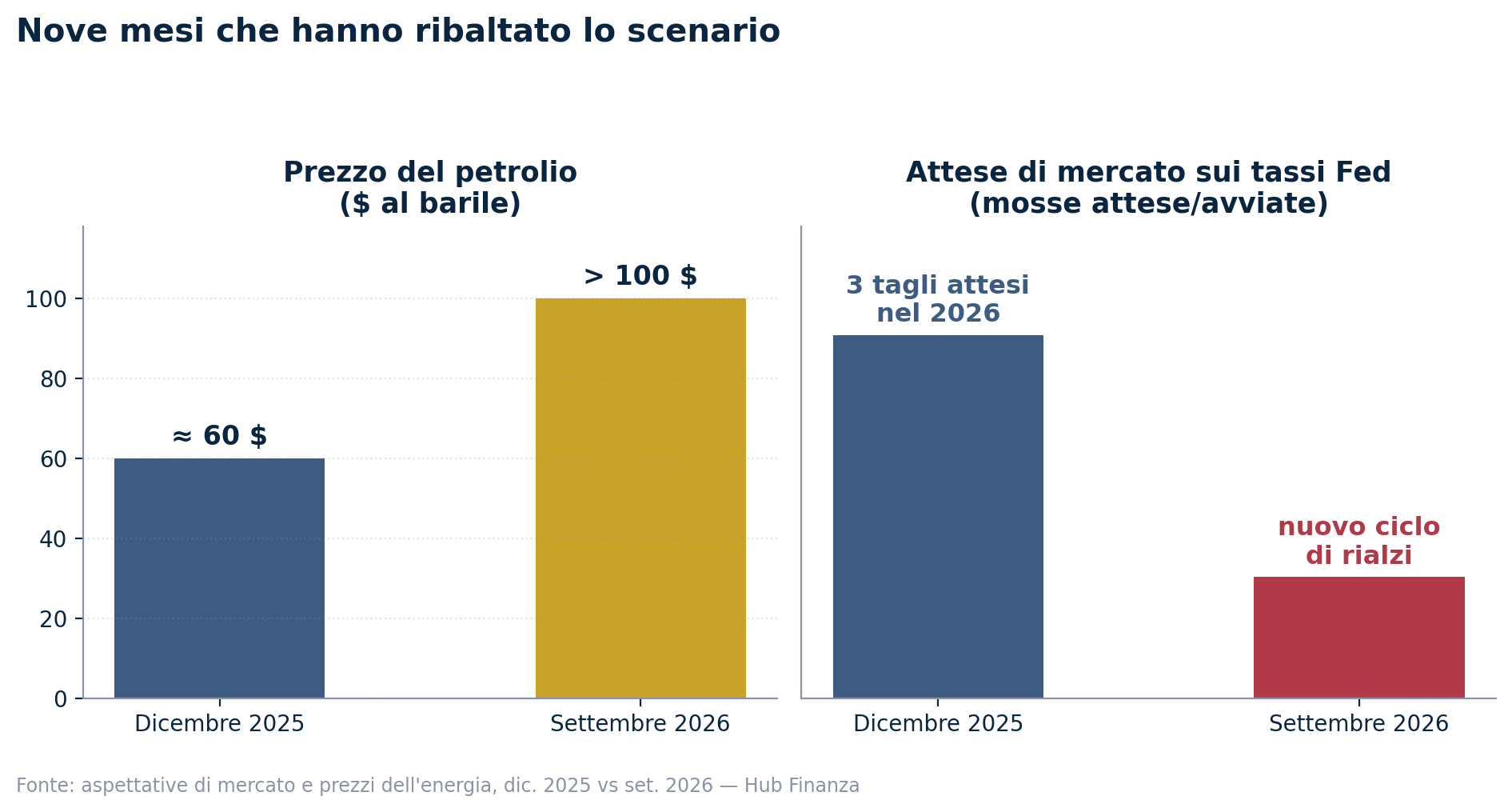
This is where the game is being played: with oil above 100 dollars and inflation above 3.5%, a scenario of rate cuts simply doesn't exist — unless at the cost of a deep recession. Supporting the markets in this context remains primarily the artificial intelligence boom, which continues to provide substantial support to the S&P 500: without the push from AI, the market picture would be much gloomier today. Conversely, a potential resolution of the energy crisis would open up space for the index well beyond 8,000 points. Meanwhile, the Fed's battle against inflation — which began five years ago — continues, and «higher for longer» is back to dictating the agenda.
What changes for households and businesses?
The implications of a tighter monetary policy, and for longer, affect everyone:
Households: mortgages, consumer loans, and financing become more expensive. The typical effect is a dampening of spending and a cooling of the housing market.
Businesses: debt servicing weighs more heavily on balance sheets, compressing investments and expansion capacity. Heavily indebted sectors or those with thin margins are the most exposed.
Markets: higher bond yields and volatility expected to remain elevated for stocks and bonds. This issue intertwines with the trajectory of US public accounts: we discussed it in US public debt surpasses 40 trillion dollars on the same day 30-year Treasury yields hit a 19-year high.
In summary
On September 16, 2026, the Fed not only raised rates: it reaffirmed, with a unanimous vote and unusually direct language, its independence and the absolute priority of price stability. With another hike expected by year-end, no cuts anticipated in 2027, and an increasingly impatient White House, the upcoming inflation and energy data will tell how long — and how bumpy — the road of «higher for longer» will be.
Sources
Official documents
Federal Reserve, Federal Reserve issues FOMC statement, September 16, 2026 — federalreserve.gov/newsevents/pressreleases/monetary20260916a.htm
Federal Reserve, Summary of Economic Projections — September 15-16, 2026 FOMC meeting, September 16, 2026 — federalreserve.gov/monetarypolicy/fomcprojtabl20260916.htm
Federal Reserve, Chairman Warsh's Press Conference (transcript), September 16, 2026 — federalreserve.gov/mediacenter/files/FOMCpresconf20260916.pdf
Federal Reserve, Implementation Note issued September 16, 2026 — federalreserve.gov/newsevents/pressreleases/monetary20260916a1.htm
Press and market data
CNBC, Dow drops 600 points as Fed rate hike and Warsh's inflation talk unnerve investors, September 16, 2026 — cnbc.com
Yahoo Finance, Stock market today: Dow sinks 600 points, S&P 500 and Nasdaq fall as Fed hikes rates, bond yields rise, September 16, 2026 — finance.yahoo.com
TheStreet, Stock Market Today (Sept. 16, 2026): Dow, S&P 500 plummet after Fed hikes, September 16, 2026 — thestreet.com
Associated Press, Wall Street edges higher ahead of the Fed's decision as oil prices and bond yields ease, September 16, 2026 — pressdemocrat.com
Other sources cited in the text
Bloomberg Markets, MarketWatch, The Economic Times — market commentary and statements by Raisah Rasid (JPMorgan) and Alicia Levine (BNY)
Donald J. Trump, post on Truth Social, September 4, 2026