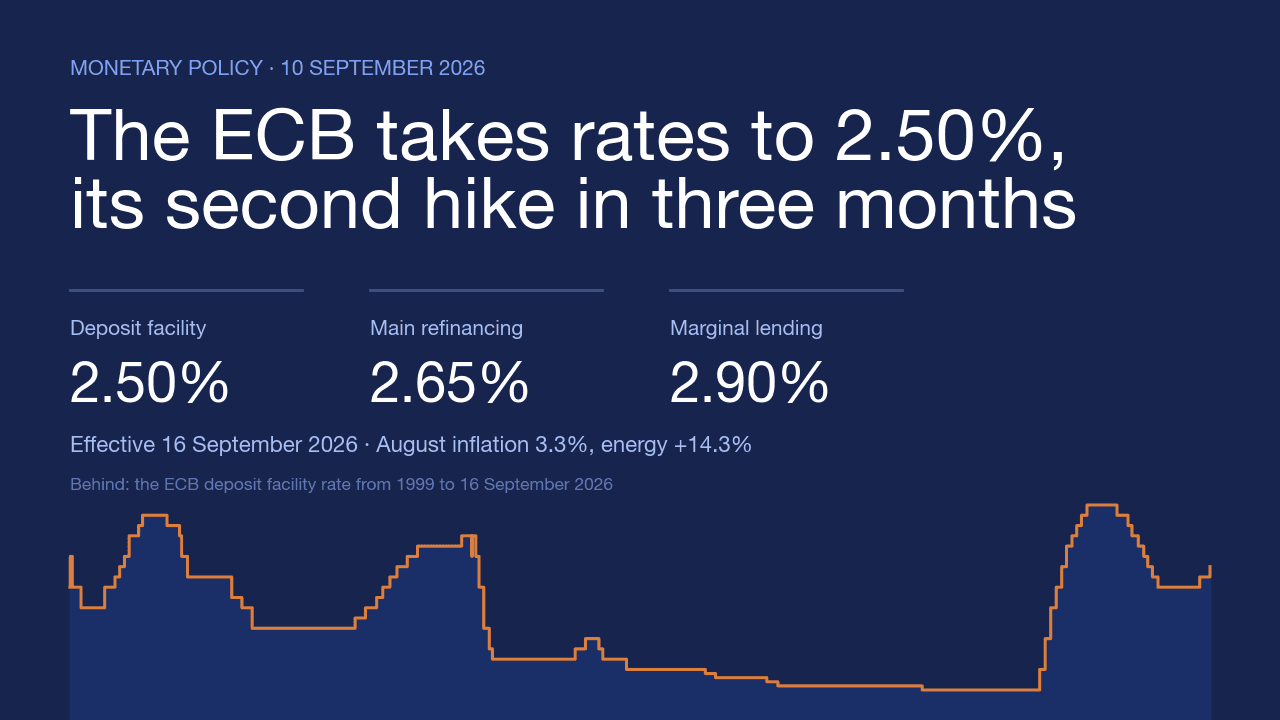

The European Central Bank (ECB) raised its three key interest rates by 25 basis points on Thursday, September 10, 2026: the deposit facility rate rises to 2.50%, the main refinancing operations rate to 2.65%, and the marginal lending facility rate to 2.90%, effective September 16. It is the second hike in three months.
The move surprised no one: all 65 economists surveyed by Reuters between August 31 and September 3 had predicted it, without exception, and the cost of money returns to where it was in spring 2025. The surprise lies elsewhere, and it is twofold.
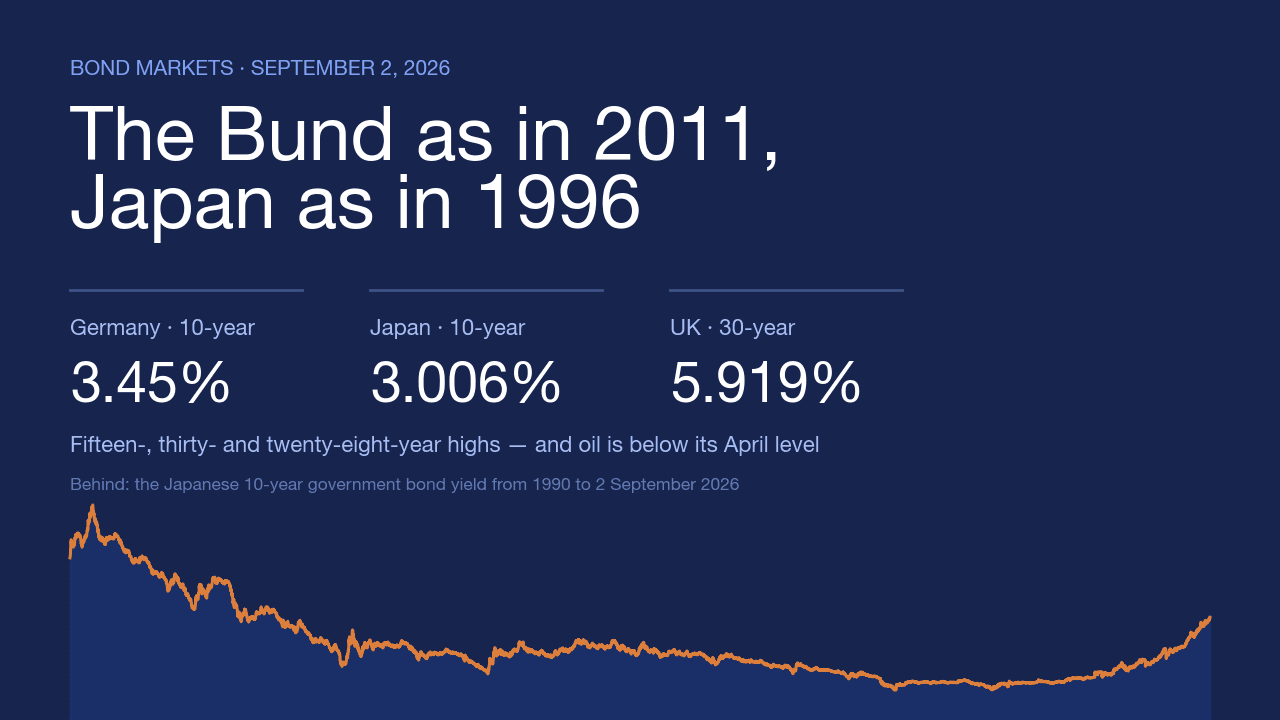
The first is in the projections: ECB experts raised the inflation estimate for 2027 from 2.3% to 2.5% and for 2028 from 2.0% to 2.1%, and simultaneously raised growth. The second is in the reaction: the yield on the 10-year Bund rose to 3.51%, the highest value since April 21, 2011, according to the official Bundesbank series. The market, in other words, did not interpret the statement as the end of something.
The decision, and its sequence
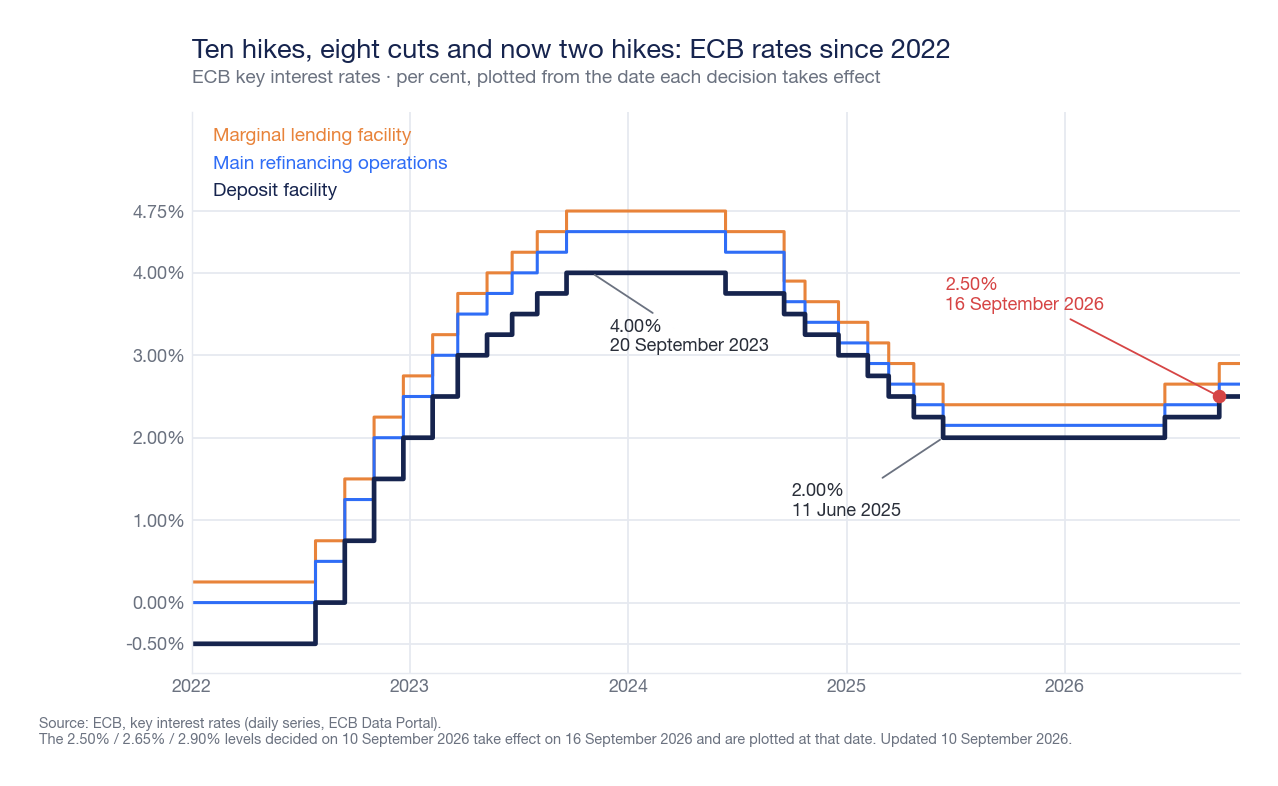
The three rates move from 2.25%, 2.40% and 2.65% — effective June 17, 2026 — to 2.50%, 2.65% and 2.90% from September 16. The deposit facility rate is the return banks get when parking liquidity with the central bank, and from there it propagates to Euribor, variable-rate mortgages, and the cost of credit: it is the rate that matters for the money market. The other two are the rates at which banks borrow from the Eurosystem, for one week and one day.
The full sequence is needed. Between July 2022 and September 2023, the ECB raised rates ten times in a row, bringing the deposit facility rate from minus 0.50% to 4.00%: the highest level ever touched by that rate. Then eight cuts, from June 2024 to June 2025, down to 2.00%. From there, exactly one year of inactivity: on June 11, 2026, twelve months after the last cut, the reversal came. A hike on June 11, a pause on July 23, a hike today.
Other instruments remain unchanged: the portfolios of the Asset Purchase Programme (APP) and Pandemic Emergency Purchase Programme (PEPP) continue to decline «at a measured and predictable pace», because the Eurosystem no longer reinvests maturing securities, and the Transmission Protection Instrument (TPI), the anti-spread shield against «unwarranted and disorderly market dynamics», remains available.
Why raise rates while core inflation is falling?
The official justification is three lines long, and these are the ones that matter: «The conflict in the Middle East continues to generate inflationary pressures, and inflation is set to remain well above target for a prolonged period». The decision, the statement adds, «underscores the Governing Council’s commitment to setting monetary policy in such a way as to ensure that inflation stabilises at the 2% target over the medium term».
Here lies the delicate point, and it needs to be explicitly stated. Euro area inflation in August rose to 3.3% from 2.9% in July: according to the Eurostat series, it is the highest value since September 2023. But the impetus comes almost entirely from one item. Energy increased from an annual rise of 10.3% to 14.3%. In the same month, services fell from 3.3% to 3.0%, food, alcohol, and tobacco remained at 1.2%, and non-energy industrial goods rose from 0.9% to 1.2%. The index net of energy and food — the one central banks look at to understand if inflation is becoming entrenched — fell from 2.5% to 2.4%.
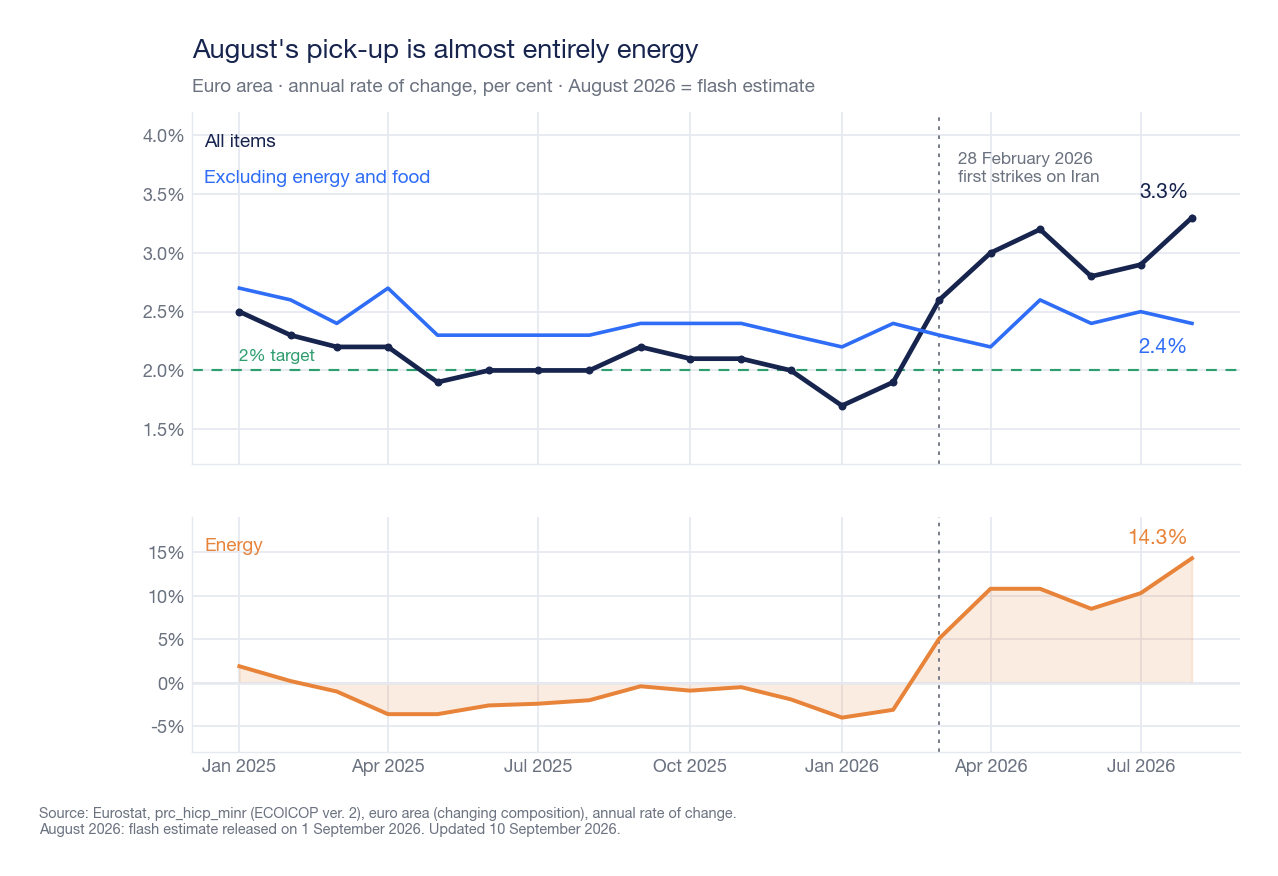
A central bank raises rates to cool demand, and an increase in imported energy is not demand: it is an external cost that compresses demand. The ECB's response is persistence: the longer energy remains expensive, the more likely it is to be passed on to other prices and wage demands. This is the channel of «indirect and second-round effects», which recurs in every paragraph of the statement. How interest rate adjustments reach the real economy is explained in our guide to monetary policy.
A precedent exists, and it is a historical fact, not a forecast. In 2011, with inflation driven by oil and raw materials, the ECB raised the main refinancing rate from 1.00% to 1.25% on April 13 and to 1.50% on July 13; then the sovereign debt crisis overwhelmed Europe and the bank had to reverse, to 1.25% on November 9 and to 1.00% on December 14. Two hikes cancelled in five months.
In March, when asked about the comparison with 2022, Christine Lagarde listed the differences: back then, inflation was already at 6% when the shock arrived, the labour market was overheated, and demand repressed by the pandemic was about to explode; today, the euro area entered the war with inflation at target. With an opposite warning: in 2022, the memory of inflation was very distant; today, it is fresh, and this changes how households and businesses react to price increases.
The President had already rejected the label of «insurance hike» in June: «That is not at all how we conducted our discussions», she said, specifying that the June 11 decision had been «unanimous, without reservations». The record of today's Q&A was not yet published on the ECB's website at the time of writing: the quotes reported here come from the statement and the official introductory remarks.
The numbers the council had on the table
The euro area average hides wide divergences. In August, Spain was at 4.5%, Belgium at 4.2%, Cyprus at 5.2%; Italy at 3.2%, Germany at 2.9%, France at 2.7%, Estonia at 1.3%. Between the most expensive and the most affordable, there are almost four points: the same monetary policy arrives in economies experiencing the energy shock very differently.
On the labour market, the picture is one of resilience, with a crack. July unemployment is at 6.4%, unchanged from June, but a year earlier it was at 6.3%: in twelve months, the number of unemployed in the euro area increased by 175,000, to 11.264 million. The ECB speaks of a «robust» market and forecasts new historical lows by 2028 (6.2%, 6.1%, and 5.9%): this is a forecast, and it should be read alongside the monthly data, which moves in the opposite direction.
Wages, for now, are not chasing energy. Compensation per employee grew by 3.3% in the second quarter, slowing from 3.5% in the first; unit labour costs fell to 2.6% from 3.5%, helped by recovering productivity. Unit profits grew, from 0.3% to 2.2%. The indicator the ECB uses to anticipate contractual renewals — the wage tracker — forecasts negotiated wages at +2.7% for the first half of 2027: an adjustment, not a spiral.
On growth, there is a discrepancy to explain. Today's projections closed data on August 19 and therefore use Eurostat's flash estimate, which put Q2 GDP at +0.4%. On September 7, Eurostat revised that figure to +0.6% quarter-on-quarter and +1.2% year-on-year, after a flat first quarter: the ECB raised growth estimates starting from data that had improved further in the meantime.
However, a part of the European +0.6% is Irish: Ireland's GDP grew by 10.2% in one quarter due to multinationals booking accounts there. It is no coincidence that the ECB also uses a corrected measure, which replaces Irish demand with «modified domestic» demand: on that basis, the quarter is worth +0.3%. Among the major economies, Spain did +0.7%, Germany +0.3%, Italy +0.2%, France zero; Austria is the only one in decline, at −0.1%. Household consumption contributed 0.2 points and net exports 0.9, while inventories subtracted half a point.
On credit, the tightening is visible. In the July bank lending survey, banks reported a net tightening of credit standards for firms (7%), for mortgages (9%), and for consumer credit (12%), with another tightening expected in the third quarter and a more marked tightening in energy-exposed sectors, from automotive to energy-intensive manufacturing. Lending rates to firms rose to 3.8% in June and July from 3.6% in May, bond debt cost 4.0% in July, mortgages remain at 3.5%. However, volumes are not falling: loans to firms at +4.4% annually, mortgages at +3.0%.
The last piece, and for the ECB the decisive one: inflation expectations «at shorter horizons remain at elevated levels», but most long-term measures «are around 2%». This is why the bank can define the shock as temporary and still raise rates: it acts to ensure that «around 2%» remains true.
New projections: more growth, more inflation, three scenarios
The baseline scenario sees average inflation at 3.0% in 2026, 2.5% in 2027, and 2.1% in 2028: compared to June, 2026 is unchanged, 2027 rises by two tenths, and 2028 by one. The index net of energy and food is forecast at 2.5%, 2.6%, and 2.3%. Growth is seen at 0.9%, 1.4%, and 1.5%, revised upwards for the first two years «mainly due to the greater resilience of the euro area economy than expected».
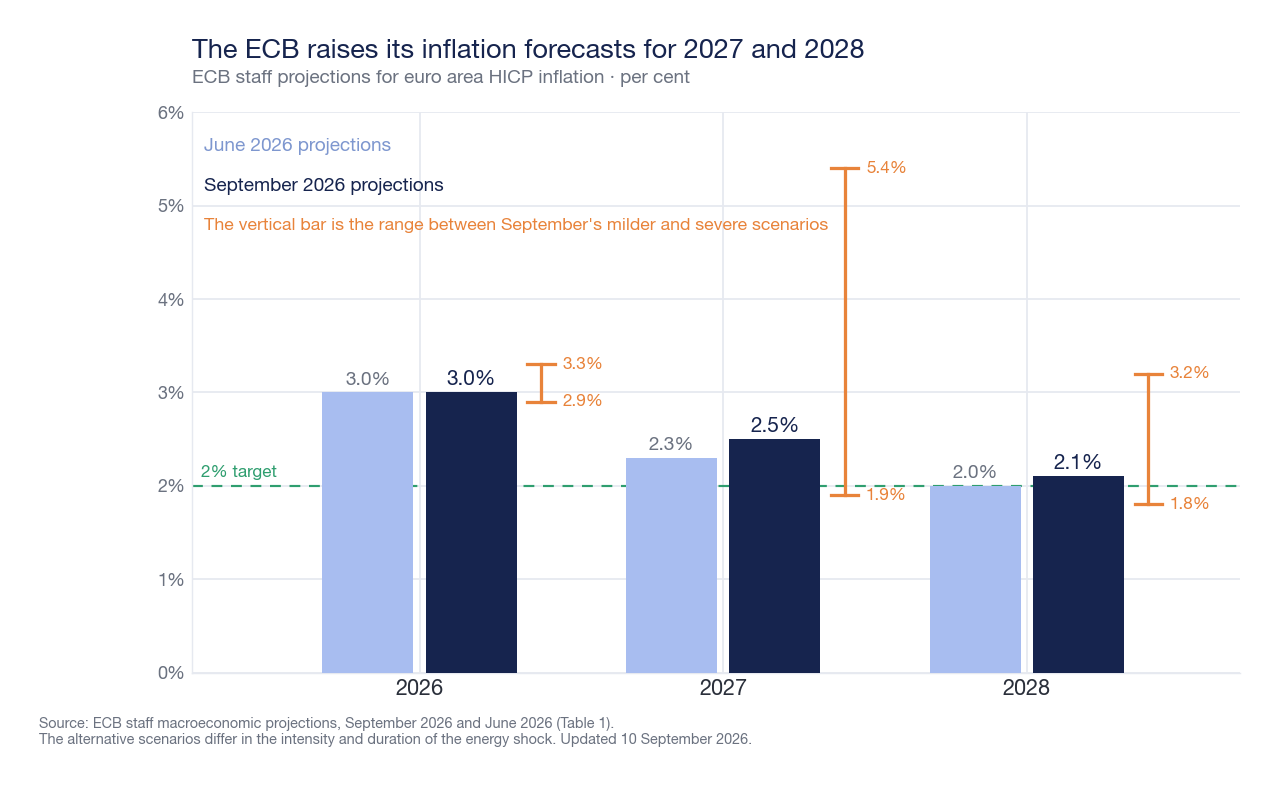
The profile says more than the average: a peak of 3.6% in the fourth quarter of this year, a decline to 2.5% in the second quarter of 2027 — when the energy price increase will exit the annual comparison — then stabilisation near 2%. One detail: in 2028, the European Emissions Trading System for buildings and transport (ETS2) accounts for two tenths of a percentage point. Without it, 2028 inflation would be 1.9% instead of 2.1%.
The technical assumptions on which everything rests were set on August 19 and show how fragile the exercise is: oil at an average of 89.5 dollars per barrel in 2026, gas at 51.0 euros per megawatt-hour (20% more than in June), wholesale electricity at 108.7 euros (50% more for the third quarter alone), exchange rate at 1.16 dollars, three-month Euribor from 2.4% this year to 3.0% in 2027, 10-year sovereign bonds from 3.5% to 4.0% in 2028.
Precisely because energy dominates, alongside the baseline, there are three scenarios. In the mild scenario, oil would fall to around 75 dollars and gas to 50 euros per megawatt-hour in the fourth quarter, and 2027 inflation to 1.9%. In the adverse scenario — 100 dollars and 75 euros — it would rise to 3.2%. In the severe scenario, with a barrel at 130 dollars and gas at 130 euros, it would reach 5.4% and 2027 growth would plummet to 0.4%. The baseline reference for the same quarter is 88 dollars and 60 euros.
The Strait of Hormuz is the real monetary policy body
The chain leading from the war to today's statement is traceable step by step. On February 28, 2026, the United States and Israel struck Iran; since then, traffic through the Strait of Hormuz — about a fifth of the world's consumed oil and almost all Qatari and Emirati liquefied gas — has almost stopped. Brent futures were quoted at 72.48 dollars on February 27, the day before the first raids; it touched 118.35 dollars on March 31; today it trades above 105.
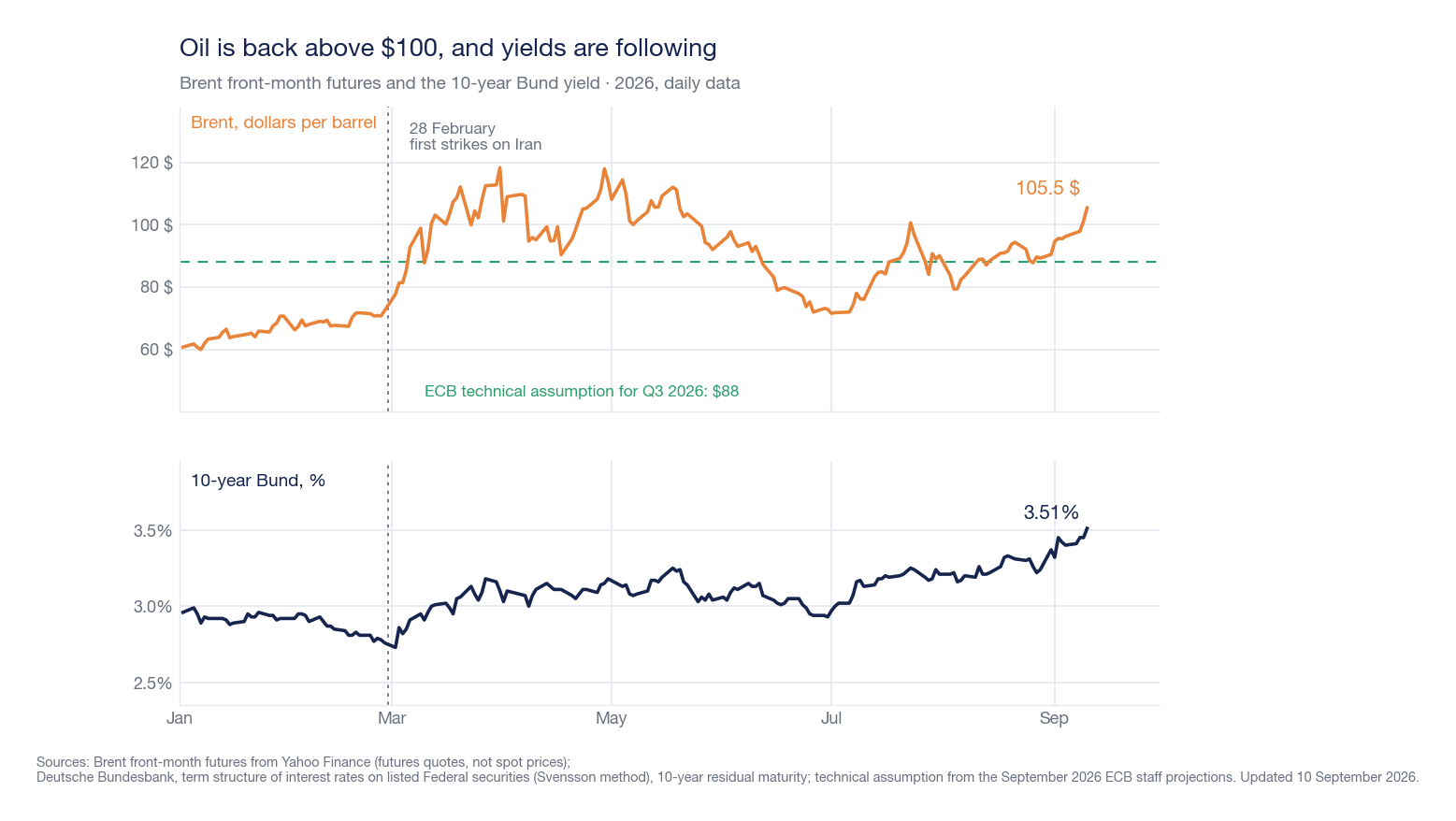
The projections explain why the European bill has risen more than crude oil: the closure of the strait reduced the global supply of refined fuels and caused refining margins to explode, especially for diesel, while Ukrainian attacks on Russian refineries removed further capacity. Low European storage levels and heatwaves also contributed, raising demand for electricity from gas-fired power plants. This is why the electricity assumption was revised upwards by 50% in three months while the oil assumption decreased.
On the exchange rate, however, there isn't much to say, and it's fair to state it. The ECB's reference exchange rate on September 10 is 1.1616 dollars per euro; at the end of January, the euro was at 1.1974, on June 24 at 1.1340. The projections record a depreciation of 1.0% against the dollar compared to June and 0.3% in nominal effective terms. A weak euro makes energy, which is paid in dollars, more expensive; but a substantially stable euro is not, today, an inflation factor.
The rest of the context should be taken for what it is: framework, not cause. The Federal Reserve arrives at the September 15 and 16 meeting stable in the 3.50-3.75% range since December 11, 2025, with markets divided between a pause and a hike after Chairman Kevin Warsh said at Jackson Hole that underlying price trends have not «improved significantly». Trade tensions appear in the statement as a risk — fragmented supply chains, scarcer critical raw materials — not as an already active factor: the ECB does not attribute any part of August's inflation to tariffs, and neither do we.
Market reaction: no one bought the pause
On government bonds, the day was heavy. The yield on the German 10-year bond, according to the maturity structure estimated by the Bundesbank, rose to 3.51% from 3.45% on Wednesday: it is the highest level since April 21, 2011. The two-year bond is at 3.04%. Market surveys reported by askanews showed in the afternoon the benchmark Bund at 3.48%, the 10-year BTP at 4.34% — a three-year high — and the French OAT at 4.39%, with the BTP-Bund spread around 85 basis points, three more than the previous day.
The curve's movement is precise. Since February 27, the eve of the first raids, the German two-year bond has risen by 102 basis points and the 10-year bond by 75: the spread between the two maturities narrowed from 74 to 47 points. When the short end runs faster than the long end, the market is revising expectations about the central bank, not the long-term premium. Today, the relationship reversed for one session — 10-year up six points, two-year up three — and the possible interpretation, which remains an interpretation, is that an inflation risk premium has been added.
On equities, the reaction was more cautious than disruptive: at 5:20 PM, a few minutes before closing, the Euro Stoxx 50 fell 0.59% to 6,274 points, the DAX 0.73% to 25,388, the FTSE MIB 0.02% to 51,862. On the exchange rate, the movement was almost nil: the euro fell from 1.1625 to 1.1604 dollars in the fifteen minutes following the announcement, returning to 1.1633 in the afternoon. When the decision is already priced in, the exchange rate does not react to the announcement: it reacts to what is said afterwards.
And that is where the day's divergence lies. Last week's Reuters survey reported an almost unanimous consensus: 91% of economists saw the deposit facility rate steady at 2.50% at the end of 2026, 78% until at least mid-2027; for Carsten Brzeski of ING, «it is hard to imagine the ECB would be willing to risk a recession to counter what remains a classic supply shock». Interest rate markets think differently: as early as September 9, according to Bloomberg, swaps incorporated about 90 basis points of hikes by December 2027, and after the press conference, the same source gave over 50% probability to an adjustment as early as October 29. These are probabilities implied in market prices: they change hourly and are not an ECB forecast.
What changes for mortgages, businesses, and savers?
On government bonds, the effect has already occurred, and it is the rise in yields described above: higher coupons for those buying today, lower prices for those holding long-term bonds bought when they yielded less. The spread between BTP and Bund remains around 85 basis points, a historically contained level: the pressure on Italian yields comes from the cost of European money and oil, not from an Italy risk premium. The TPI, today, only appears in the customary formula.
For mortgages, the calculation is arithmetic and concerns those with a variable rate, indexed to Euribor. On a residual debt of 150,000 euros over twenty years, half a percentage point more — the two hikes of 2026 combined, if fully passed on — brings the instalment from approximately 870 to approximately 909 euros: 39 euros per month, 468 per year. This is an editorial simulation, all other conditions being equal, not a forecast for bank rates: the average rate on new euro area mortgages has been stable at 3.5% since June, and transmission takes months. Those with a fixed rate are not affected.
For businesses, credit costs more and is harder to obtain: 3.8% is the average bank rate, 4.0% the cost of bond debt, tighter criteria, and increasing rejections across all applicant categories, with the most severe tightening precisely where the shock bites. For banks, the opposite is true: higher rates support the interest margin, but a prolonged cycle increases credit risk. Two opposing effects, arriving at different times.
For households, the picture is two-sided. Energy costs more and inflation erodes purchasing power: the ECB forecasts real disposable income growth of 0.6% and real compensation per employee growth of 0.4% this year. In compensation, liquidity and short-term securities yield more. The saving rate remains at 14.1% of disposable income — the behaviour of those who do not trust the scenario — and is also why consumption grows by only 1.0% while employment holds up. On how to measure the erosion of savings, we have a dedicated guide.
What to watch between now and October 29
The next appointment is the meeting on October 28 and 29 in Frankfurt, without new projections: decisions will be based on data, and the relevant ones already have a date. On September 17, Eurostat publishes the full August data, which will confirm or correct the 3.3% flash estimate; on October 2, the September flash estimate arrives, the first to incorporate oil above 100 dollars. In between, the Federal Reserve decides on the 16th, and the Bank of Japan on the 18th.
Three variables will decide whether 2.50% is an arrival or a stage. The Strait of Hormuz: as long as traffic does not resume, refining margins remain high and energy pushes the index. Gas storage at the start of winter: the ECB explicitly indicates a cold winter with low stocks among the upside risks. And contractual renewals: as long as the wage tracker remains below 3%, the temporary shock thesis holds; if negotiated wages start to chase bills, the problem changes.
Above all, the formula that the ECB repeated twice today remains: no predefined path for rates, meeting-by-meeting decisions, data-dependent. With inflation expected above target until mid-2027 and markets pricing in further hikes while economists see none, that formula is no longer a stylistic caution: it is an admission that not even those who decide know which of the two interpretations is correct. The thread of this story on bond markets can be found in our analysis of the September 3 sell-off.
Sources
Decision, motivations, and quotes from the «Monetary Policy Decisions» statement and the introductory remarks to the European Central Bank press conference on September 10, 2026 (meeting hosted by the Deutsche Bundesbank in Berlin); the Q&A record was not yet published at the time of this article's closing. Levels and effective dates of all key interest rates from the ECB's key interest rates table and daily series from the Data Portal (FM.D.U2.EUR.4F.KR.DFR/MRR_FR/MLFR.LEV), which also provide the 2022-2026 sequence and 2011 precedents. Press releases from the meetings of February 5, March 19, April 30, June 11, and July 23, 2026 for previous decisions and Christine Lagarde's statements in March and June. Macroeconomic projections by ECB experts in September 2026 (tables 1, 2, and 3, technical assumptions with data cut-off on August 19, 2026, alternative scenarios) and comparison with June 2026 projections. Euro area bank lending survey in July 2026 (159 banks, 100% response rate). Euro area inflation and individual country data from Eurostat's flash estimate of September 1, 2026, and table prc_hicp_minr (ECOICOP version 2, variable composition euro area); unemployment from Eurostat's press release of September 1, 2026; Q2 GDP and employment from Eurostat's press release of September 7, 2026, which revises the July 30 flash estimate of 0.4% to 0.6%. Euro-dollar exchange rate from official ECB reference rates, recorded at 2:10 PM CET. German yields from the Deutsche Bundesbank daily series on the maturity structure of listed federal securities (Svensson method, two and ten-year residual maturity): this is an estimate of the curve, not the quote of the benchmark bond, and therefore differs by a few basis points from market readings. BTP and OAT yields, spread, and intraday levels of the benchmark Bund from askanews and QuiFinanza (September 10, 2026). Brent futures quotes, equity indices, and intraday exchange rate from the public interface of Yahoo Finance (recording at 5:20 PM on September 10, 2026). Economists' survey, consensus expectations, and Carsten Brzeski's statement from Reuters, reprinted by RTÉ (September 3, 2026). Implied prices in euro area interest rate swaps from Bloomberg (September 9 and 10, 2026). Federal Reserve rate, calendar, and Kevin Warsh's statements from official FOMC press releases and reports by CNBC and Reuters. Context on the conflict and the Strait of Hormuz from the International Energy Agency, the International Monetary Fund, and Bruegel (March-September 2026). The mortgage instalment calculation, percentage changes, differentials, and distances from highs are editorial analyses based on the cited data.
This article is for informational purposes only and does not constitute financial advice, investment research, a public offering, or a personalized recommendation to buy or sell. The assessments expressed are editorial opinions based on public data as of the publication date and may change without notice. The value of investments can decrease as well as increase, and past performance is not indicative of future results. Before making any investment decision, it is advisable to consult a qualified financial advisor and evaluate the consistency of the operation with your objectives, time horizon, and risk tolerance.