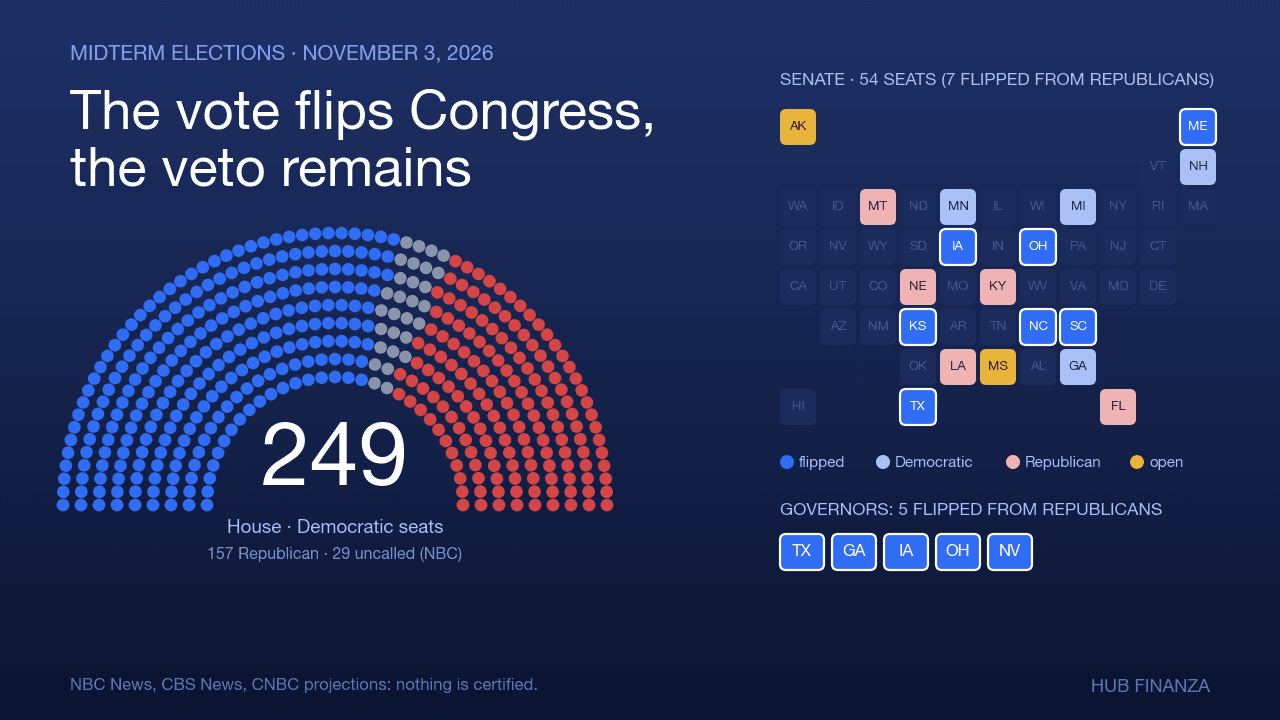



Democrats won the House and Senate in the midterm elections on November 3, 2026: 249 seats already assigned in the House (CBS estimate: 256), 54 in the Senate, five governorships taken from Republicans. But without Trump's signature and without two-thirds of Congress, powers remain limited.
This analysis reconstructs who won and by what margins, whether the result justifies the definition of «blue wave,» and what the new balance can truly change regarding the budget, tariffs, artificial intelligence, and healthcare. Methodological note: no results are certified. The figures are projections or unofficial counts from NBC News, CBS News, and CNBC, and some will change; Associated Press websites were not accessible to our reading tool, so AP data is secondhand. Every uncertain figure is declared as such.
What the polls decided, and what is still open
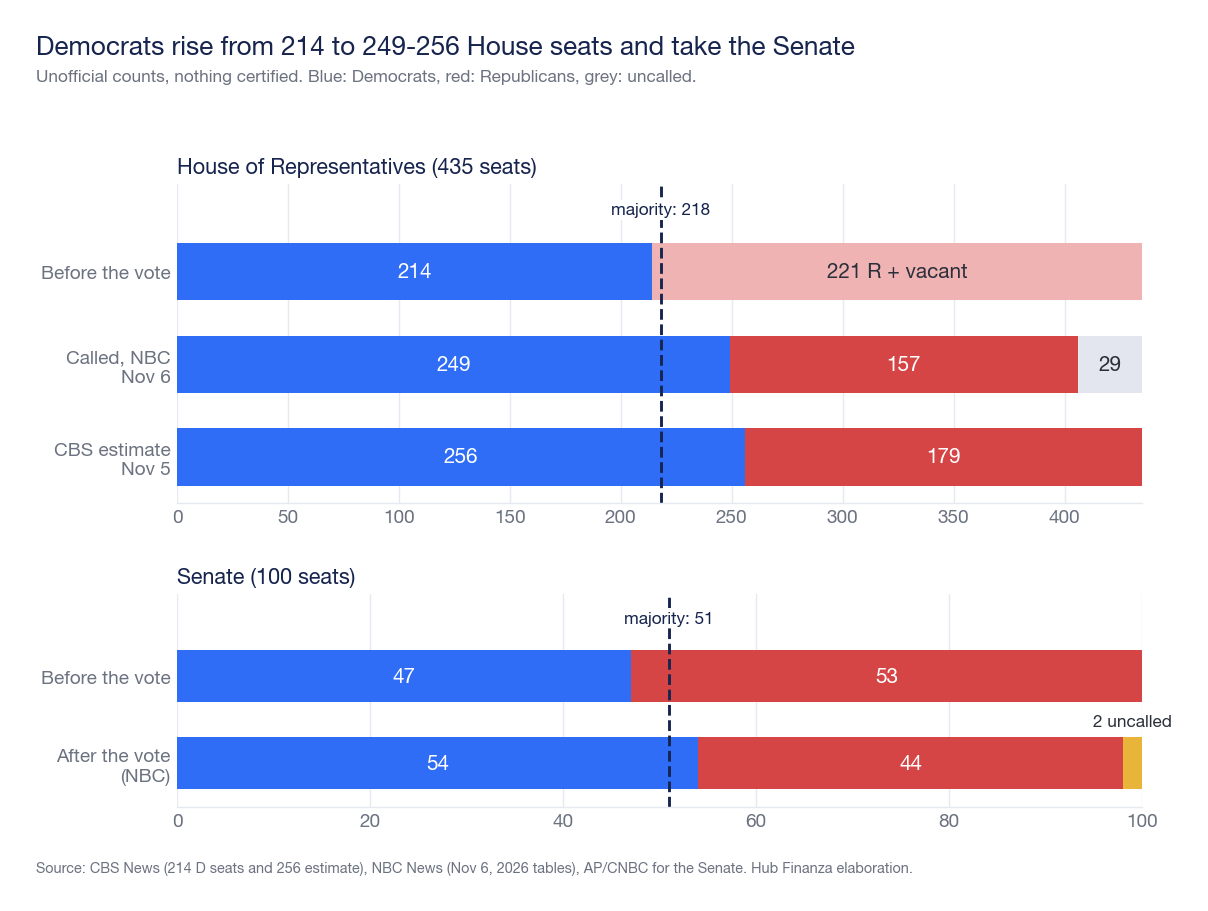
House. Democrats had 214 seats before the vote (CBS News). In the early hours of Friday, November 6, NBC News' table showed 249 assigned to Democrats, 157 to Republicans, and 29 still to be assigned, with an estimate of 259 for Democrats; CBS News, on November 5, estimated 256, including seats not yet projected; Hakeem Jeffries speaks of at least 255. The balance of seat changes in the NBC count is 42 seats taken from Republicans and two gained by them: according to CBS News, these are Texas 32 and Tennessee 9, both districts affected by redistricting. This results in a net gain of about 40 seats, in line with the +41 in 2018. Counts differ because they refer to different times: the only certainty is the direction.
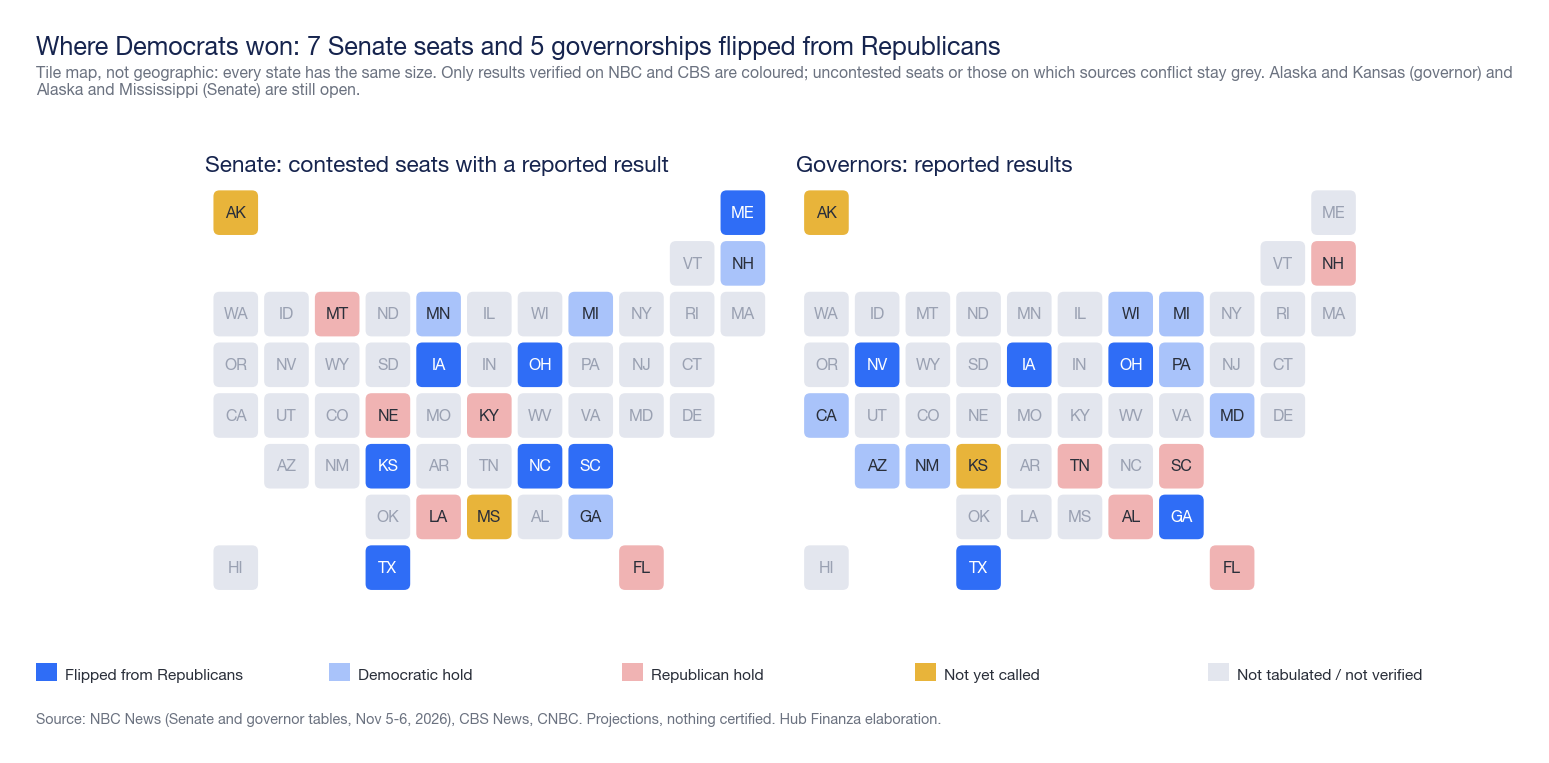
Senate. Republicans started with 53 seats against 47. NBC News now gives 54 seats to Democrats and 44 to Republicans, with two races still open. In Alaska, Mary Peltola is ahead by just over 600 votes (626 on November 4 according to Alaska's News Source) with about 74% of ballots counted: early votes counting begins on November 10 and ranked-choice tabulation is scheduled for the 18th. In Mississippi, Scott Colom leads Cindy Hyde-Smith by 1,813 votes (49.0% vs. 48.9%, 95.7% counted, according to MS NOW and NBC News); approximately 3,600 mail-in ballots remain to be counted according to the Secretary of State, while Colom's campaign estimates 15,000 and the Republican party chairman 20,000. Mail-in ballots postmarked by election day and received up to five business days later count thanks to the Supreme Court ruling in June; provisional ballots are counted until November 10, counties certify on the 13th according to The Hill, and Mississippi is the state without a recount law. If Democrats win both open races, they would reach 56 seats. The figure «54 against 42» appearing in some election night reports is a minimum for Republicans, not a sum: the one hundred seats return with 54 Democrats, 44 Republicans assigned, and two seats still open.
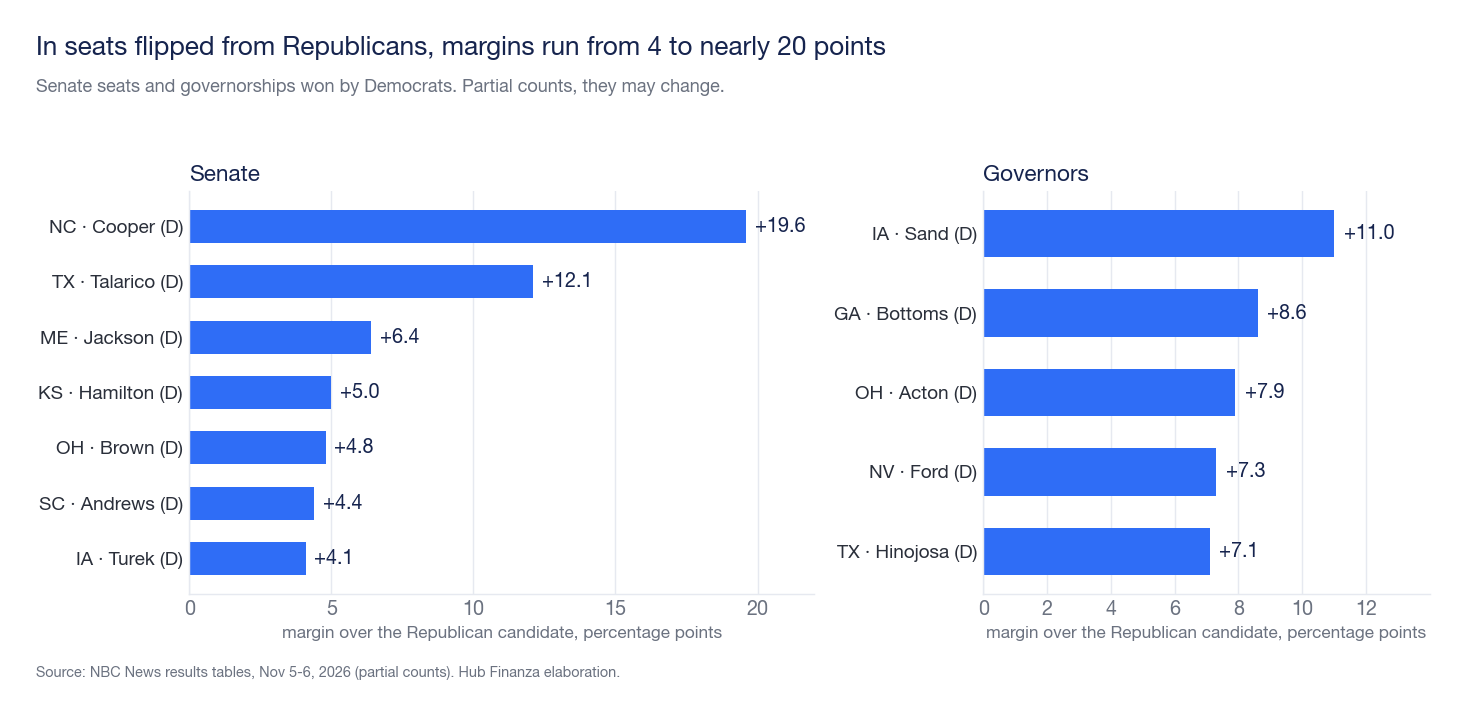
The seven seats that went to Democrats are: Texas (James Talarico 55.1% vs. Ken Paxton 43.0%), North Carolina (Roy Cooper 58.7% vs. Michael Whatley 39.1%), Ohio, special election (Sherrod Brown 50.0% vs. Jon Husted 45.2%), Maine (Troy Jackson 53.2% vs. Susan Collins 46.8%), Iowa (Turek 50.5% vs. Ashley Hinson 46.4%), Kansas (Hamilton 51.0% vs. Marshall 46.0%; according to Axios and Daily Caller, this is the first Democrat elected to the Senate from Kansas since 1932) and South Carolina (Annie Andrews 51.1% vs. Graham 46.7%). The percentages are from NBC News, with vote counts between 93% (Maine) and 99%.
Governors. Votes were cast in 36 states. According to NBC News, Democrats led in 24 and Republicans in 12, with five states changing hands: Texas (Gina Hinojosa 52.8% vs. incumbent Governor Greg Abbott 45.7%), Georgia (Keisha Lance Bottoms 54.3% to 45.7%), Iowa (Sand 55.5% to 44.5%), Ohio (Amy Acton 52.3% vs. Vivek Ramaswamy 44.4%), and Nevada (Aaron Ford 51.5% vs. Joe Lombardo 44.2%, with 92% of votes counted). CNBC writes that these victories bring Democrats to at least 28 governorships and a majority of governors for the first time since 2010, with at least 17 women leading a state (up from 14). Kansas (Holscher, Democrat, ahead 50.3% to 49.7%, about 7,000 votes, which would be a confirmation) and Alaska (Kreiss-Tomkins ahead with 74% of the count, which would be a sixth change of hands) remain open.
Is it really a blue wave?
It depends on the metric. In terms of House seats, the outcome is on par with 2018 (+41 net) and above predictions: the Cook Political Report indicated a scenario of up to 240 Democratic seats in late October, and Sabato's Crystal Ball assigned at least 239 among «leans» and more (the two original pages were not accessible: values come from press summaries). The already assigned result, 249, exceeds those estimates by at least nine seats. Forecasting markets also viewed it as a «normal» vote: Kalshi gave between 93% and 94% to the Democratic takeover of the House. In the popular vote, according to NBC News analysis, with counting still underway, Democrats are ahead by about 12 points (55.3% vs. 43.3%), a margin that would be the second widest in the last fifty years; in 2018, it was 8.6 points.
The definition «blue wave» appears in CNBC's headlines and live coverage. The most solid supporting data is the Senate, where the president's party lost seven seats, including Texas, Kansas, Iowa, and South Carolina. Equally significant is the governors' landscape: CNBC notes that all five changes of hand occurred in states won by Trump in 2024. A technical fact argues against a uniform wave interpretation: in this cycle, many maps were redrawn in the middle of the decade and partly overturned the intentions of those who drew them. In Texas, according to CBS News, Democrats go from 13 to 14 seats (Republicans remain at 24), and according to ABC, the Republican map aimed at five Democratic districts; in Ohio, Democrats go from five to eight seats and Republicans from ten to seven; in California, where Proposition 50 was approved by a large margin, Democrats rise from 43 to 44 already assigned seats, with four more likely, and Republicans fall from nine to two, with two more likely. Overall, ABC writes, Republicans had redrawn 15 districts to take them from Democrats and are projected to lose more than two-thirds of them.
Who voted how. According to the NBC/SSRS exit poll, which is provisional and will be reweighted with actual votes, 37% of voters approve of Trump and 63% disapprove (for CBS, approval is 38%, less than in 2018). Democrats prevailed among women (59 to 40), among under-30s (73 to 25), among Latinos (64 to 34), among independents (58 to 38), and in suburbs (59 to 40); Republicans remain ahead in small towns and rural areas (57 to 41) and among those with at most a high school diploma (54 to 44). Men are almost evenly split (50 to 48 for Democrats) and whites are tied (49 to 49). The main issue is the economy, indicated by 39% (52 to 46 for Democrats), followed by democracy (33%, 79 to 20) and immigration (14%, 10 to 89 for Republicans). For CBS, 89% of voters consider the cost of living an important or decisive factor. National turnout does not appear in any consulted source: we do not write it.
Geography. According to NBC News' analysis, in the 21 swing races out of 28 with at least 95% of votes counted, the margin shifted by an average of almost 17 points towards Democrats compared to the 2024 presidential vote. For the 2028 presidential election, what matters is not the number of seats but their location: Texas, Georgia, North Carolina, Ohio, Iowa, and Nevada chose Democrats at the state level. This remains a hypothesis, not a fact: an electorate that votes against the incumbent president in a midterm is not necessarily the same one that will choose the Democratic candidate in two years.
What can truly change in Washington, and what cannot
The outgoing Congress remains in office until January 3, 2027, the day the new Congress is sworn in and the House elects its Speaker, according to the Twentieth Amendment. Jeffries announced his candidacy for Speaker in a letter to colleagues on November 4. The same day, Mike Johnson informed staff that he will not remain Republican leader in the new Congress (NBC News, citing four sources); Steve Scalise and Jim Jordan announced their candidacy to lead the group, and Republicans vote on November 10. Democrats elect their leaders on November 18 and 19, according to Bloomberg Government, citing two informed individuals. Donald Trump told the New York Times, in an interview on election night, that he is absolutely willing to accept the results. On Fox News, on the evening of November 3, he said that Democrats will send crazy bills and that he will veto them; the next day, he told reporters that he would get along with them unless they intend to be disruptive, adding that he has the veto. He told CNBC that he can work with Democrats on many more things than people think.
This last sentence is worth more than any prediction. With 54 senators and a majority in the House, Democrats can use oversight powers (investigations, subpoenas, hearings) and the power of the purse, because spending bills pass through the House. They cannot pass a bill without the president's signature, nor can they override a veto: two-thirds of the votes are needed in both Chambers, meaning 67 senators, and to block a bill in the Senate, a minority of 41 is still enough (60-vote threshold to end debate). JPMorgan Asset Management recalled in the hours following the vote that the veto is the main constraint, and that Trump retains leverage on trade and tariffs.
| Topic | Who holds power today | What is already on the table | What remains hypothetical |
|---|---|---|---|
| Budget and deficit | Congress, with the president's signature | Law 119-103, signed September 2, 2026, extends federal funding at FY2026 levels until December 11, 2026. The FY2026 deficit, closed September 30, is $1.992 trillion vs. $1.775 trillion in 2025 (+12%, Final Monthly Treasury Statement), with net interest spending of $1.052 trillion | A partial government shutdown, if no new law is passed by December 11. The debt ceiling was raised by $5 trillion, to $41.1 trillion, with Law 119-21; total debt was $40.550 trillion on November 4 (Treasury) and, according to external estimates cited by the Congressional Research Service, the limit would be reached between early and mid-2027, with extraordinary measures shifting the effective blockage by a few months |
| Tariffs | With the February 20, 2026 ruling (Learning Resources v. Trump, six votes to three), the Supreme Court ruled that IEEPA does not authorize the president to impose tariffs. Today, tariffs rely on other rules (sections 232 and 301), which Congress can only change with a law subject to veto | Since February 24, a 10% tax under section 122, which expired July 24 due to the 150-day limit (a May 7 ruling by the Court of International Trade was suspended on appeal); since July 24, 10% or 12.5% tariffs on 60 economies under section 301, challenged in court. Effective rate at 7.1% in August (Penn Wharton: tariffs collected on import value); of the $166 billion in IEEPA tariffs collected, approximately $126 billion were certified for refund by customs as of October 2 | In the November 4 letter announcing his speakership candidacy, Jeffries lists the elimination of Trump's tariffs among the actions for the first 100 days of the Democratic House, along with Medicaid, SNAP, and ACA tax credits. No vote is scheduled, and the president's signature would still be needed |
| China | The president | The Busan truce extended until January 10 (Bessent); no new agreements on tariffs, chips, or rare earths since the September summit | Next meetings: APEC in Shenzhen and G20 in Miami |
| Artificial intelligence and data centers | Mainly states and municipalities: there is no federal preemption law in Washington | With Executive Order 14365 of December 11, 2025, the government created a Department of Justice task force to challenge state AI laws; state laws remain in force. The June 2, 2026 order concerns AI cybersecurity. Sanders calls for a national moratorium; Texas Governor-elect Hinojosa has promised to halt state authorizations | A federal moratorium: Goldman Sachs judges it unlikely under any election outcome; JPMorgan believes that restrictive laws would not pass a veto |
| Banks | Regulatory authorities and Congress | Most concrete risk for banks: limits on credit card interest rates, which Evercore ISI signals as a risk for consumer-facing issuers | Slowdown in deregulation (LPL Research) |
| Healthcare | Congress | The enhanced Affordable Care Act tax credits expired on December 31, 2025. KFF had estimated a doubling (+114%) of premiums paid by subsidized enrollees for the same plan; 2026 data show instead an average increase of 58% in net monthly premium (from $113 to $178) and a sharp decline in enrollments | A reinstatement of credits: requires the president's signature. Morgan Stanley estimates that a targeted deferral of Medicaid and SNAP cuts would add 0.1 percentage points to real consumer growth in 2027 and up to 0.4 points for complete cancellation (estimate reported by Seeking Alpha; original note was not readable) |
| Energy and climate | Congress and Treasury | The 2025 law (OBBBA) accelerated the phase-out of wind and solar incentives | A repeal: would require presidential consent |
| Federal Reserve | The central bank, with Chair Kevin Warsh (confirmed 54 to 45 on May 13, 2026) | Rates at 3.75-4.00% after the September 16 hike (12 to 0 vote); on October 28, rates remained unchanged with a 10 to 2 vote: Lisa Cook and Beth Hammack would have raised by a quarter point | The vote does not change the composition of the board. Jerome Powell remained on the board as a governor (his term expires January 31, 2028) and on April 29 said he would not leave until the investigation into the Fed headquarters is closed |
On relations with Europe and NATO, the sources consulted do not report new positions from the newly elected Congress: we do not invent them. On immigration, the economic effect already underway is on the labor market. According to the Federal Reserve Bank of St. Louis (Alexander Bick, March 24, 2026), between 15,000 and 87,000 new jobs per month are needed to keep unemployment stable in 2026, depending on immigration assumptions; the Federal Reserve Bank of Dallas estimates that this threshold has dropped to near zero, about minus 3,000 per month on average from August to December 2025. The September figure (+29,000 jobs, BLS) therefore falls within that range, which makes the signal on labor demand less clear.
On the fiscal and trade fronts, therefore, the vote changes tones more than numbers. To understand what Kevin Warsh's Federal Reserve can do, and why the September hike still weighs on markets, one can reread our guide to the ECB and Fed and the chronicle of the September 16 hike; on debt, the analysis of the exceeding of $40 trillion; on China, the reconstruction of the post-Trump-Xi summit.
What to watch in the coming weeks
The political calendar dictates more than comments. On November 10, House Republicans vote for their leaders, and in Alaska, early votes begin to be counted. On November 13, according to The Hill, Mississippi counties certify the vote: the state has no recount law. On November 18, Alaska tabulates ranked choices, and on the 18th and 19th, House Democrats elect their leaders. On December 11, federal funding provided by Law 119-103 expires, with a Congress still Republican-majority. On January 3, 2027, the new Congress is sworn in and the House elects its Speaker. On January 10, the trade truce with China expires. These are the dates when it will be seen whether the new balance produces laws, vetoes, or simple clashes.
What about the markets? The vote alone is not enough to explain them
The day after the elections, Wall Street rose: on Wednesday, November 4, the S&P 500 gained 1.58%. On Thursday, November 5, it lost 4.36%, its worst session since April 2025. Before the vote, JPMorgan estimated a largely neutral effect for the S&P 500 (between -0.25% and +0.5%) in its most probable scenario, and Goldman Sachs and JPMorgan judged drastic measures against data centers unlikely, as the presidential veto would stop them. What truly caused the November 5 session, and what could happen to different markets, we analyze in a separate piece, which can be read independently of this one.
What we were unable to verify
- No results are certified; counts from NBC News, CBS News, and CNBC differ and refer to different times. The NBC/SSRS exit poll is provisional and will be reweighted with actual votes.
- The original pages of the Cook Political Report (Washington Post) and Sabato's Crystal Ball, the CNN article on the popular vote, and the Associated Press were not accessible to our reading tool: values for Cook and Sabato come from press summaries, the popular vote from NBC News analysis. National turnout does not appear in any consulted source.
- Some entries rely on secondary sources: Kansas's record (first Democrat elected to the Senate since 1932, according to Axios and Daily Caller), Mississippi's certification date (The Hill), dates of Democratic internal elections (Bloomberg Government, from informed persons), Morgan Stanley's estimate on consumption (reported by Seeking Alpha).
- On tile maps, seats without verified outcomes from multiple sources remain gray: they are not absent, they are unconfirmed.
Sources
Election results from tables and live blogs of NBC News (House, Senate, governors, NBC/SSRS exit poll, popular vote analysis), CBS News (projections and estimates, November 4-6, 2026), CNBC (Election Desk, November 3-5), ABC News (redrawn maps), MS NOW and Alaska's News Source (Mississippi and Alaska), Northeastern University, PBS NewsHour. Calendar and leaders' statements from Hakeem Jeffries' letter of November 4, 2026 (democraticleader.house.gov), from NBC News, Bloomberg Government, and CNBC. Budget: Law 119-103 (govinfo.gov), Law 119-21 and Congressional Research Service fact sheet on the debt ceiling, Final Monthly Treasury Statement for September 2026 and Fiscal Data of the Treasury. Monetary policy from Federal Reserve communiqués of September 16 and October 28, 2026, and Jerome Powell's official biography; Kevin Warsh's confirmation vote from CNBC. Tariffs: Learning Resources v. Trump ruling (text on Cornell LII), analysis by Holland & Knight and Reason on sections 122 and 301, Penn Wharton Budget Model (October 14, 2026). Artificial intelligence: Executive Order 14365 and June 2, 2026 fact sheet on whitehouse.gov. Healthcare: KFF analysis of September 30, 2025, and May 19, 2026. Labor: Federal Reserve Bank of St. Louis (March 24, 2026) and of Dallas (March 31, 2026), BLS and BEA communiqués. Analyst positions from Reuters (via Yahoo Finance), CNBC, and LPL Research (via Finwire). Comparisons with 2018 and with predictions are editorial elaborations based on cited data. Map and graphs: scripts/gen_midterm_2026_charts.py.
This article is for informational purposes only and does not constitute financial advice, investment research, public solicitation for savings, or a personalized recommendation for purchase or sale. The evaluations expressed are editorial opinions based on public data as of the publication date and may change without notice. The value of investments can decrease as well as increase, and past performance is not indicative of future returns. Before any investment decision, it is advisable to consult a licensed financial advisor and evaluate the consistency of the operation with one's objectives, time horizon, and risk tolerance.