

There's a question running through all of this week's earnings reports, from Alphabet's 127 billion in revenue to Biogen's 2.8: what is growth worth when it requires unprecedented investments to achieve it? The market has given brutal and seemingly contradictory answers: it punished Alphabet despite its best growth quarter since 2021, rewarded Microsoft for the exact same capex, and wiped out ServiceNow for 250 basis points of deceleration on an accounting metric. In between, more traditional stories — Coca-Cola and Biogen — reminded us that a market still exists, built on margins, guidance, and execution.
All this while the Federal Reserve, on Wednesday evening, left interest rates unchanged at 3.75-4.00% with a 10-2 vote and a detail that did not go unnoticed: the two dissents — Lisa Cook and Beth Hammack — called for a hike, not a cut. With a statement defining inflation as «still elevated» and the economy «expanding at a solid pace», the message for markets is clear: the cost of capital will not come down soon, and multiples will have to be earned through profits.
Alphabet: the best quarter ever, paid at a high price
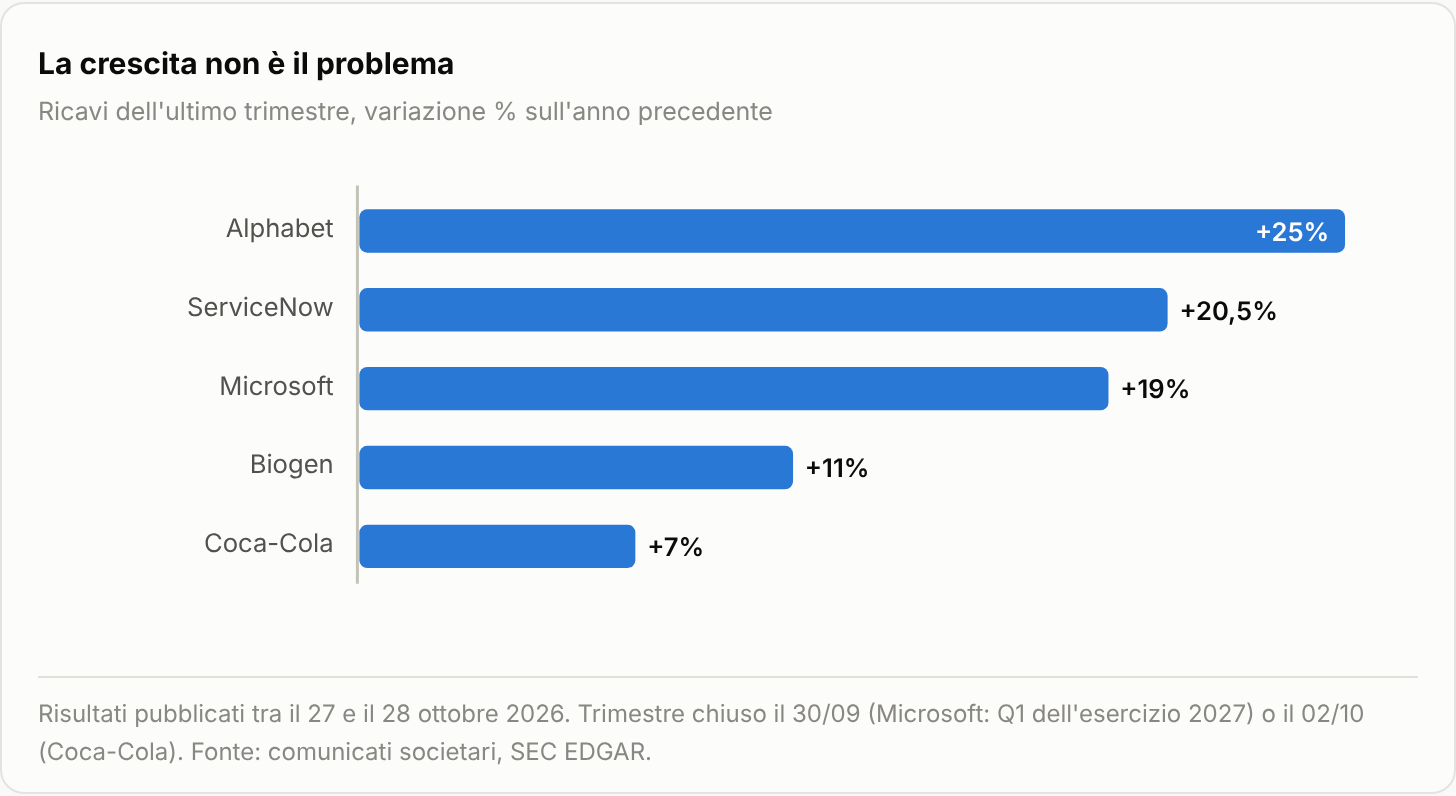
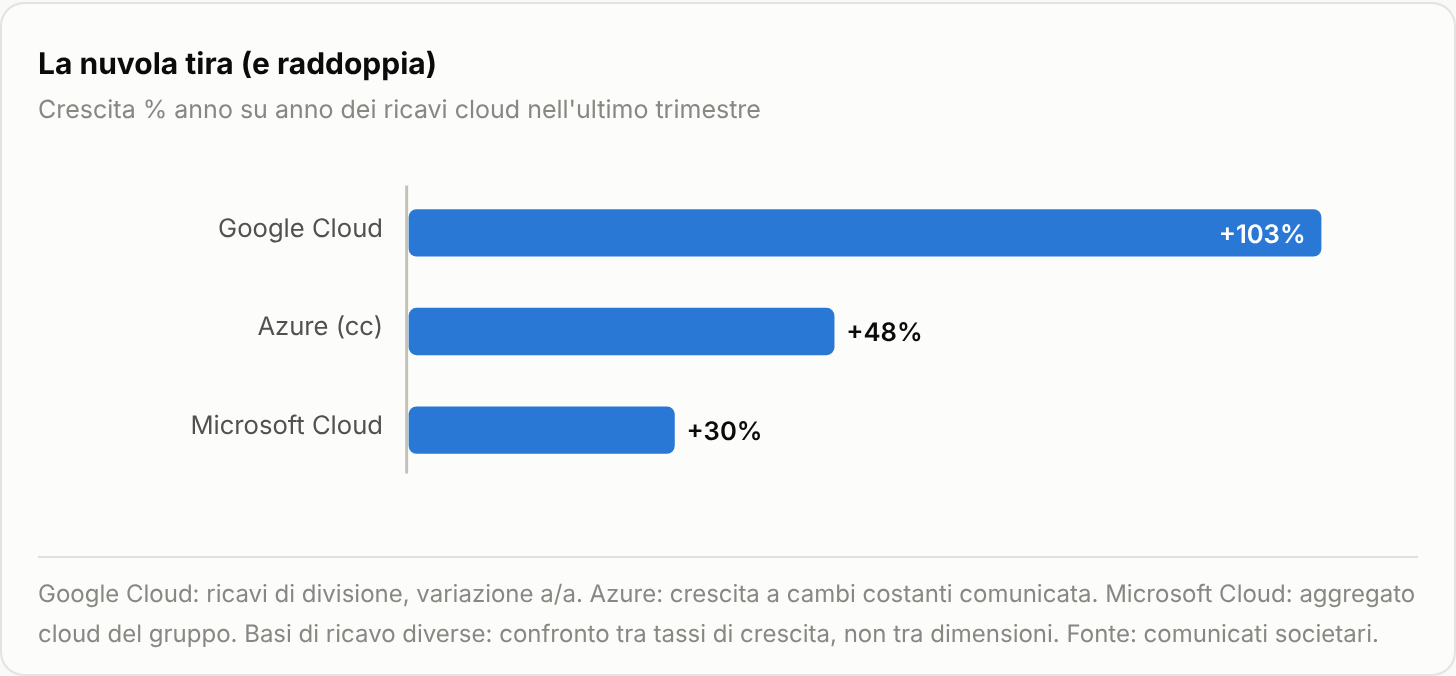
On paper, it's a textbook quarter: revenue at 127.6 billion dollars, +25% — the highest growth in recent years — with Search up +12% (and a query growth rate «at a five-year high», in Sundar Pichai's words), YouTube up +9%, and above all, Google Cloud doubling: +103% to 30.7 billion, with the division's operating margin jumping from 23.7% to 36.2%. The group is now operating at a run-rate of 500 billion dollars a year, and the Gemini app has reached one billion users.
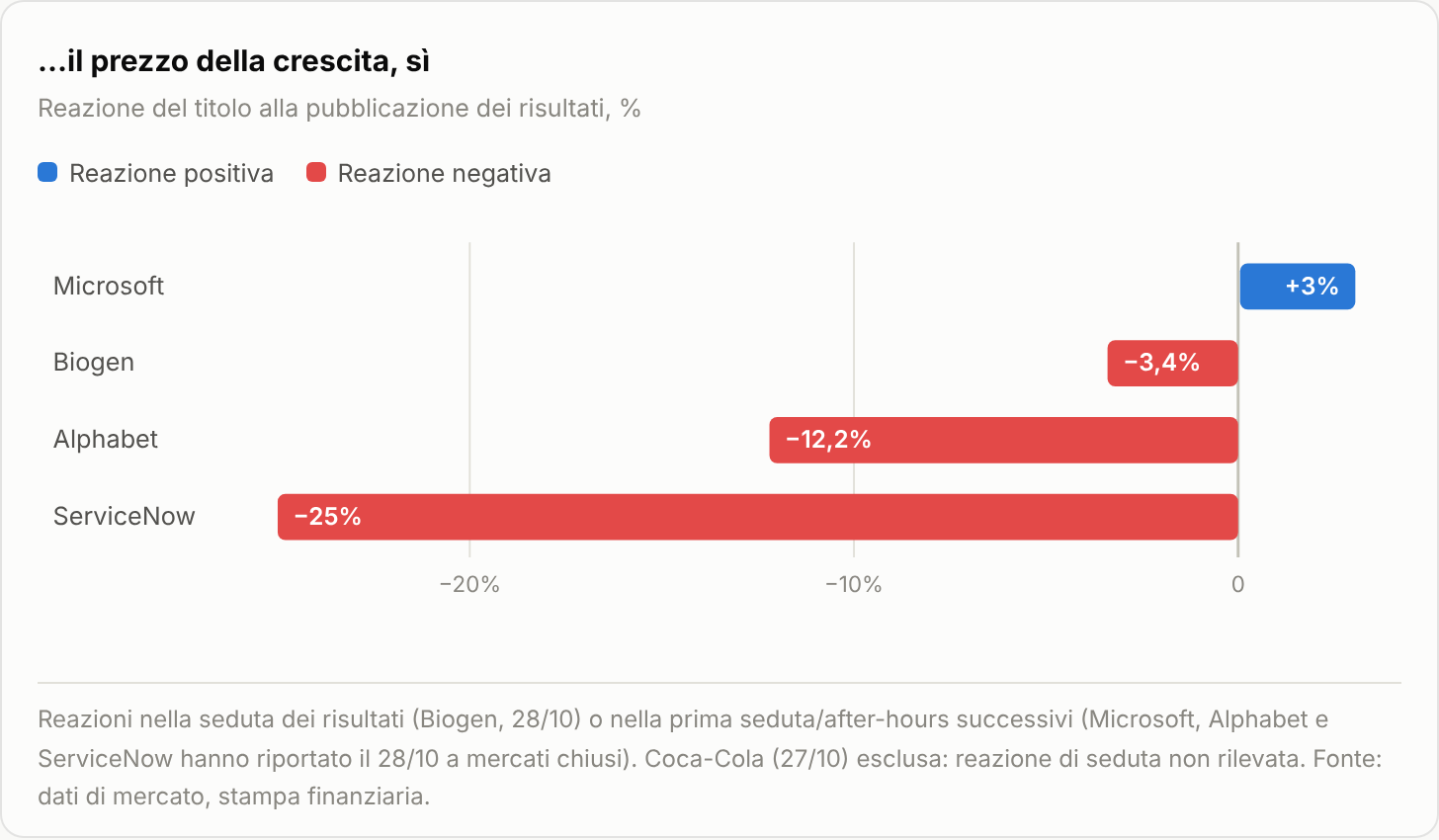
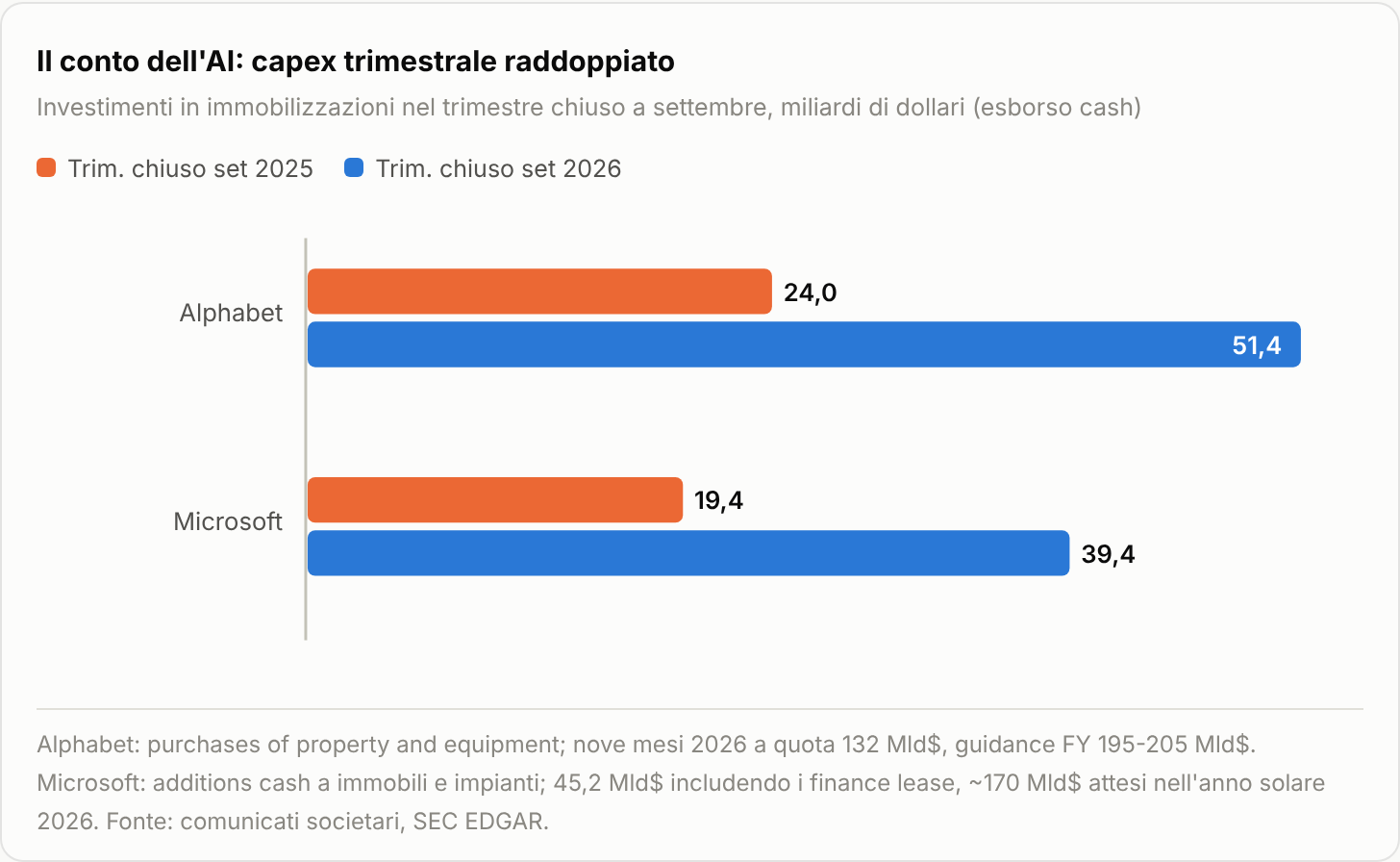
So why did the stock open on October 29 down over 12%? Three numbers, all below the revenue line. First: the GAAP EPS of 2.12 dollars, down 26% and well below the consensus of 3.01 — weighed down by an accounting loss of 8.7 billion on investments (the mark-to-market of the SpaceX stake, −0.55 dollars per share), mirroring the capital gains that had inflated the second quarter. Second: capex, 51.4 billion in a single quarter (+114%), which for the first time pushed quarterly free cash flow into negative territory (−9.1 billion); the 2026 guidance remains at 195-205 billion, with 2027 announced as «significantly increasing». Third, the most unpalatable for shareholders: buybacks stopped at zero — a year ago they were 11.5 billion per quarter — while the company issued shares for 12.4 billion and debt for almost 29, bringing long-term debt from 46 to 125 billion in ten months.
The interpretation is almost philosophical: Alphabet is ceasing to be a cash machine to become a leveraged investor in AI infrastructure. The growth is there, and TPUs (for which Pichai expects «the vast majority of revenue» in 2027, with an OpenAI agreement reported by the press) could become the second monetization engine. But in the meantime, the market did what it always does when benchmarks are missed: it removed the benefit of the doubt.
Microsoft: the same capex, the other side of the coin
That the problem is not investments themselves is demonstrated by Microsoft, which spent 45 billion in the quarter (and promises over 50 billion in the next, within a plan of approximately 170 billion for the calendar year) and was rewarded with a solid +3% in after-hours trading. The difference is made by the income statement: revenue at 92.3 billion, +19% and above expectations, operating profit up +21% with a record margin of 49.8% — increasing, despite the heaviest investment cycle in the company's history.
The engine is still the same: Azure, +48% at constant currency, above expectations and with guidance that even indicates acceleration to 49-50% in the current quarter. Microsoft Cloud as a whole is now worth 63.9 billion per quarter (+30%), and the commercial order book (RPO) has risen 73% to 677 billion dollars. An accounting curiosity that says a lot about 2026: the investment in OpenAI, which a year ago subtracted 3.1 billion from profit, this quarter added 207 million — and the filing reveals approximately 10 billion in quarterly revenue from commercial agreements with Sam Altman's company, almost 11% of the total.
The flaws are not absent: free cash flow decreased by 27% (18.6 billion, margin from 33% to 20%), Windows OEM retreats by 22%, and that concentration on a single leveraged client-partner is a risk that sooner or later the market will want to price in. But as long as growth accelerates with margins at 50%, the market has decided which side to be on.
ServiceNow: anatomy of a −25%
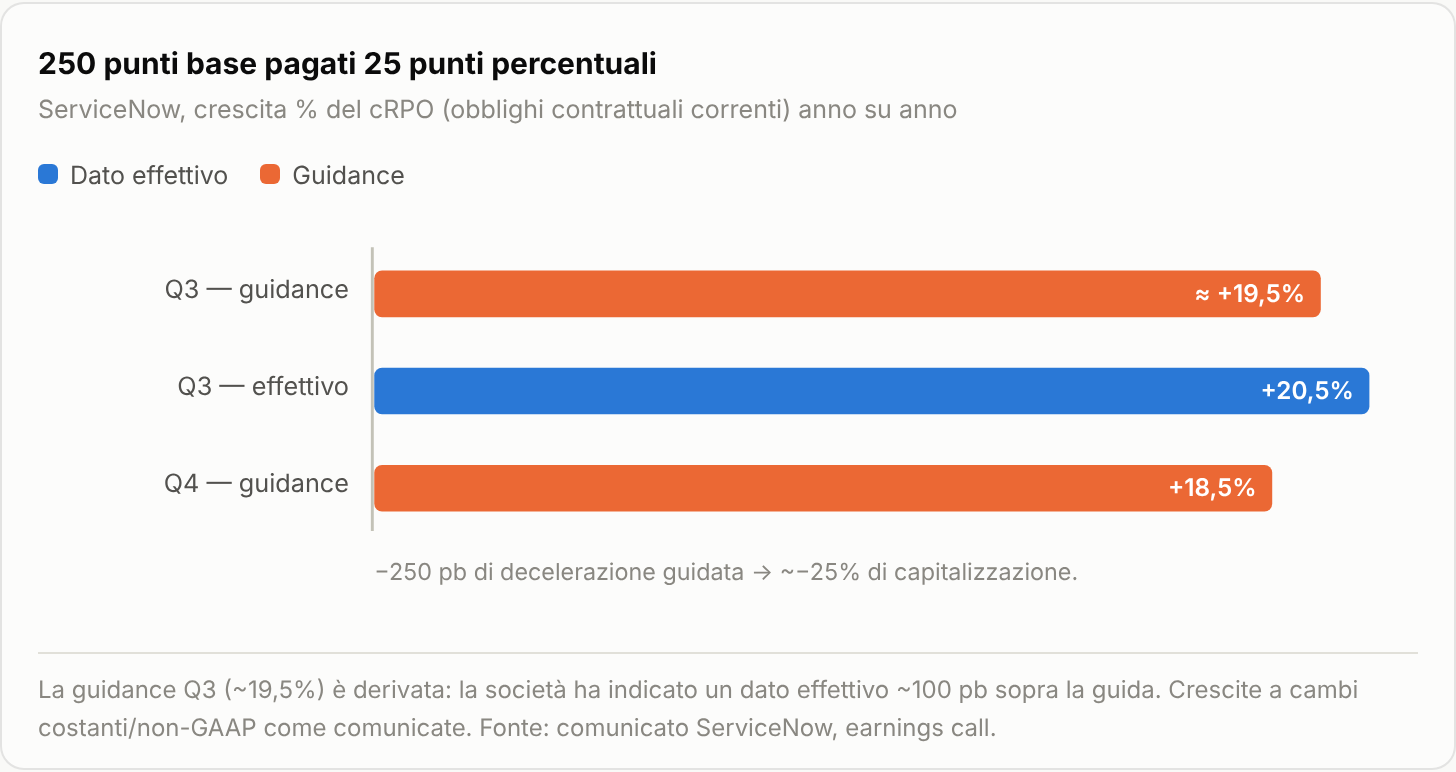
The paradox of the week. ServiceNow beat expectations on revenue (4.1 billion, +20.5%) and on cRPO — current contractual obligations, the most observed future demand metric in software — which grew 20.5%, approximately 100 basis points above guidance. It even raised annual targets for revenue, margins (31.5% non-GAAP operating), and free cash flow (margin at 36%), and doubled the AI-related new annual contract target in one year, now at least 1.7 billion (+65% growth in the quarter). Result: −17% in after-hours, approximately −25% the next day.
Two triggers. The non-GAAP profit of 1.00 dollar missed consensus by two cents — a venial sin. The serious one, in the market's eyes, is the Q4 cRPO guidance: +18.5%, a deceleration of approximately 250 basis points which the CFO attributed to early renewals, on-premise mix, and accounting tails («cRPO is a very nuanced metric»). When a stock trades at perpetual growth multiples, 250 basis points of doubt are worth a quarter of the capitalization: it is the clearest snapshot of the nervousness with which the market today views software, caught between the promise of agentic AI and the fear that it will erode its license consumption model. Note for those looking at GAAP numbers: accounting profit (0.27 dollars) is depressed by the 7.75 billion Armis acquisition — amortization, integration costs, and interest on debt issued to finance it — not by the business.
Coca-Cola: the boredom that pays
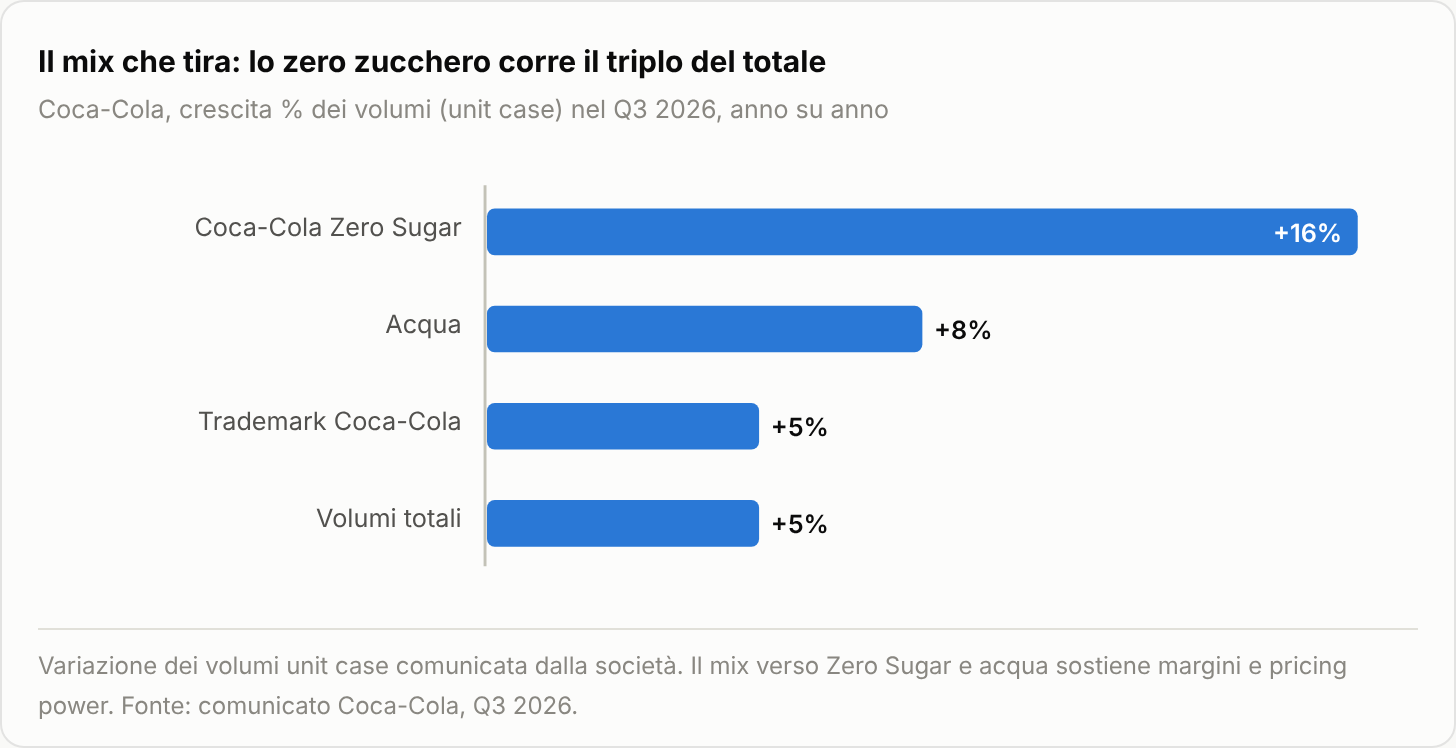
While technology was dancing, Coca-Cola did what it has done for 140 years, but better than usual: revenue at 13.4 billion, +7% organic with volumes up +5% — driven by India, China, Mexico, and Brazil — and a textbook product mix, with Coca-Cola Zero Sugar up +16% and water up +8%. Operating margins increased by over a point (33.4% for accounting) and comparable earnings per share grew 11% to 0.91 dollars.
Above all, Atlanta raised its guidance for the second time this year: organic growth «at least 5%», comparable EPS «at least +11%» (from +9/10%) and free cash flow at «at least 13 billion». Two matters that will shape 2027 remain on the agenda: the divestment of the African bottler CCBA, expected to close by year-end — which will remove approximately 8 points of optical revenue next year, returning them in margins and capital returns — and the appellate court ruling on the tax dispute with the IRS, which the CFO expects «in the coming months». A dossier worth potential billions that the market, for now, prefers not to price in.
Biogen: the quarter with two faces (and a verdict in December)
Anyone who stopped at the first line of the GAAP income statement — a loss of 14 cents per share — would have understood exactly the opposite of what happened. Biogen's quarter was strong: revenue +11% to 2.8 billion (6 points above consensus), adjusted profit of 2.62 dollars against the 1.98 expected, and the low-end of annual guidance tweaked upwards. The accounting red is the mechanical effect of the ongoing transformation: amortization and inventory revaluations from the Apellis acquisition, 284 million in in-process research costs for the RayThera operation, restructurings.
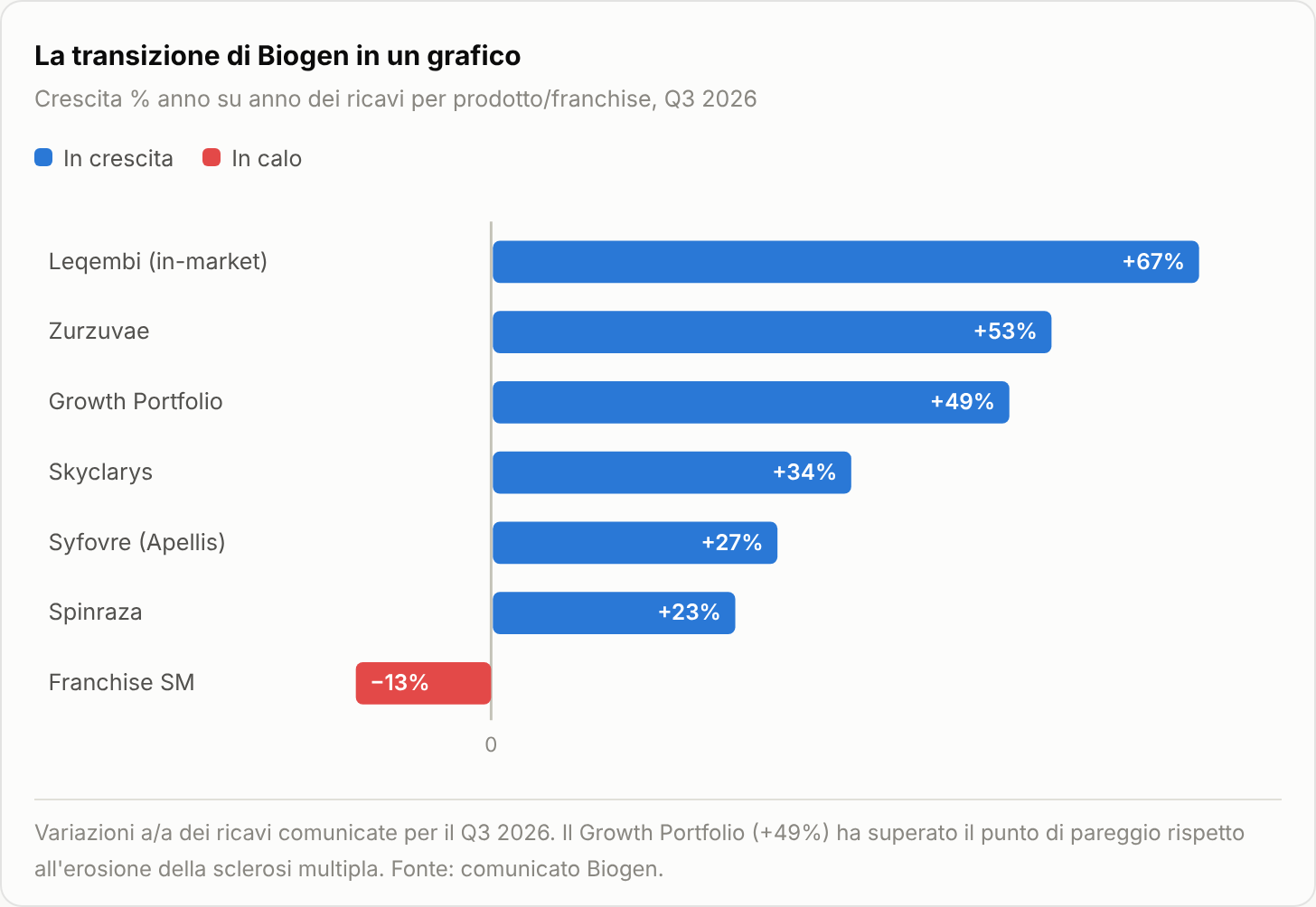
The substance is that the transition beyond the old multiple sclerosis franchise (−13% in the quarter, as expected) is working: the growth portfolio now accounts for 63% of core pharmaceutical revenues and has risen 49%, with the anti-Alzheimer drug Leqembi up +67%, Skyclarys up +34%, Zurzuvae up +53%, and Apellis products already in double digits. The real turning point, however, is on the calendar: early December will bring Phase 3 data for litifilimab in lupus — a binary event that could reshape, one way or another, the company's profile over the next five years.
The overall picture
Company | Revenue (Y/Y Δ) | EPS vs. consensus | Reaction | In a nutshell |
|---|---|---|---|---|
Alphabet | 127.6 B$ (+25%) | Below (GAAP, one-off) | ≈ −12% | Record growth, but negative FCF and zero buybacks: capex scares market |
Microsoft | 92.3 B$ (+19%) | Above | ≈ +3% | Azure accelerates, record margins: capex not scary here |
ServiceNow | 4.1 B$ (+20.5%) | −2% (non-GAAP) | ≈ −25% | Quarter above expectations, cRPO guidance below: exemplary punishment |
Coca-Cola | 13.4 B$ (+7%) | Above | 1.80% | Organic +7%, guidance raised twice this year |
Biogen | 2.8 B$ (+11%) | Above (+32% non-GAAP) | ≈ −3.4% | GAAP in the red due to acquisitions, business accelerating |
Reactions: first trading session or after-hours after results.
The common thread
This week delivers a simple rule: the market is not selling AI; it is selling those who cannot (yet) demonstrate they can get paid for it. Microsoft invests as much as Alphabet but shows expanding margins and an accelerating cloud: rewarded. Alphabet grows more than anyone but burns cash and suspends buybacks: punished. ServiceNow monetizes AI better than almost anyone in software, but a single decelerating contractual metric is enough to wipe out a quarter of its value. With a steady Fed — and two members even pushing for rate hikes — the multiple is no longer an acquired right: it must be earned every quarter, in cash.
The lesson of the week is twofold. The first: within the word «tech», opposing risk profiles now coexist, and the movements of October 28-29 certified this with a 28 percentage point dispersion between the best and the worst performer. The second: away from the AI spotlight, the season is delivering stories of operational quality — from Coca-Cola's (twice) raised guidance to Biogen's transition — which the market views with much less indulgence than before, but also with much less euphoria. And it is often there, in the middle ground between enthusiasm and disinterest, that the returns of the coming years are built.
Sources: company press releases and filings (SEC EDGAR: 10-Q and 8-K of Alphabet, Microsoft, Coca-Cola, Biogen, ServiceNow), issuer press releases, FOMC statement of October 28, 2026, market data, and international financial press. Data as of October 29, 2026.
Disclaimer: This article is for informational purposes only and does not constitute financial advice, personalized recommendations, or a solicitation to invest. Although data is drawn from sources believed to be reliable, it may contain inaccuracies; past performance is not indicative of future results. Before making any investment decision, it is advisable to consult a qualified advisor.