

On Monday 27 July 2026 global financial markets opened the week with a clear signal of relief, reacting to a significant de-escalation of geopolitical tensions. The announcement of a pause in clashes between the United States and Iran, which came over the weekend, triggered an immediate reaction: oil sharply lower and equity futures higher, with investors reshaping their expectations ahead of a week packed with crucial economic events.
The US-Iran truce calms markets
The event that dominated the early hours of Monday is the suspension of clashes between Washington and Tehran: the United States has paused its air campaign — which lasted almost two weeks — to make room for diplomacy, and a senior Iranian official confirmed that Iran will halt retaliation for as long as the truce holds. It is a significant easing in a region that is key to global stability and, above all, to the flow of energy commodities: geopolitical uncertainty has always been a powerful driver of volatility, and its easing — however temporary — gave markets a positive push.

Oil slumps and equity futures rally
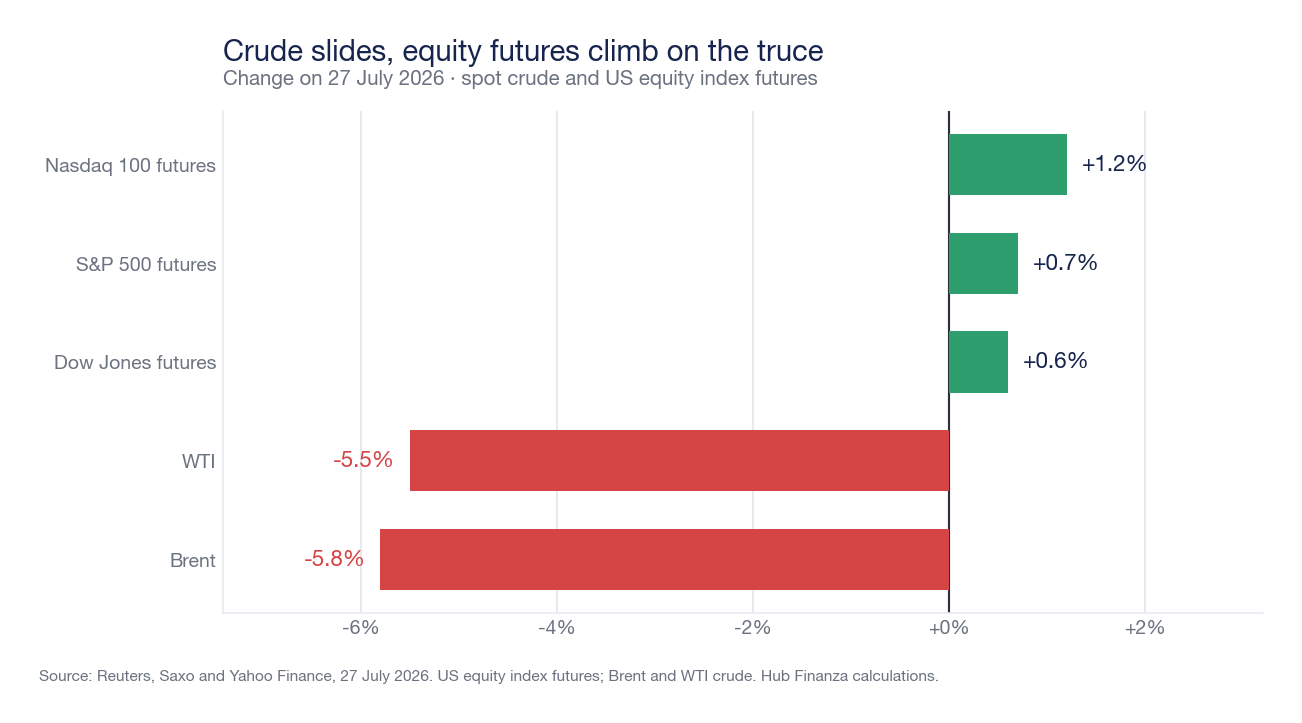
The sharpest reaction came from the crude market. Brent fell by around 5.8%, towards $91.20 a barrel, having dropped as much as 7% at the open and slipped below $90; WTI lost roughly 5.5%, around the $84 mark. It is a decisive step back from the near-$100 reached during the conflict, when fears over supplies through the Strait of Hormuz and tensions in the Red Sea had pushed prices higher. The logic is straightforward: lower geopolitical risk in the Middle East reduces the likelihood of supply disruptions, and therefore prices.
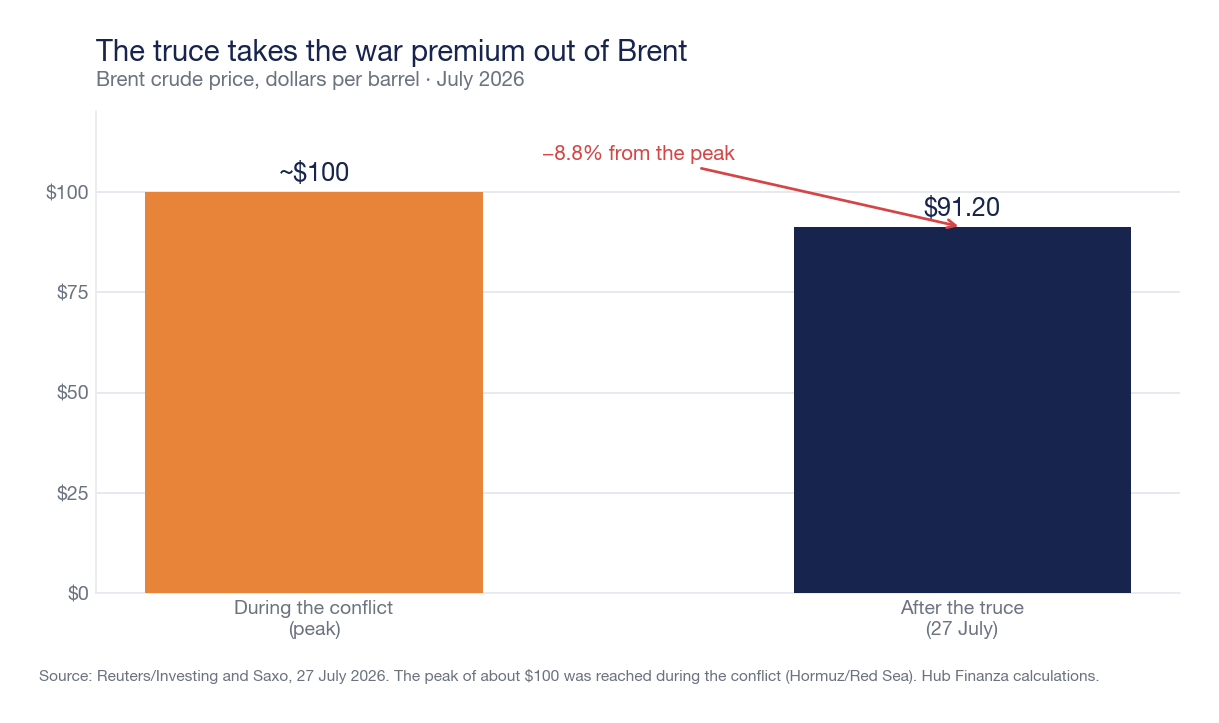
On the equity side, the renewed optimism lifted indices. Wall Street futures opened higher — S&P 500 +0.7%, Nasdaq 100 +1.2% and Dow Jones +0.6% (around 294 points) — while in Europe the FTSE 100 gained 0.5%, the CAC 40 0.86% and the DAX 1.2%. Consistent with a "risk-on" backdrop, gold also rose by around 0.9% towards $4,090 an ounce, with the dollar weakening against the main currencies. The perception of more contained global risk encouraged investors to bet on a more constructive sentiment for the week ahead.
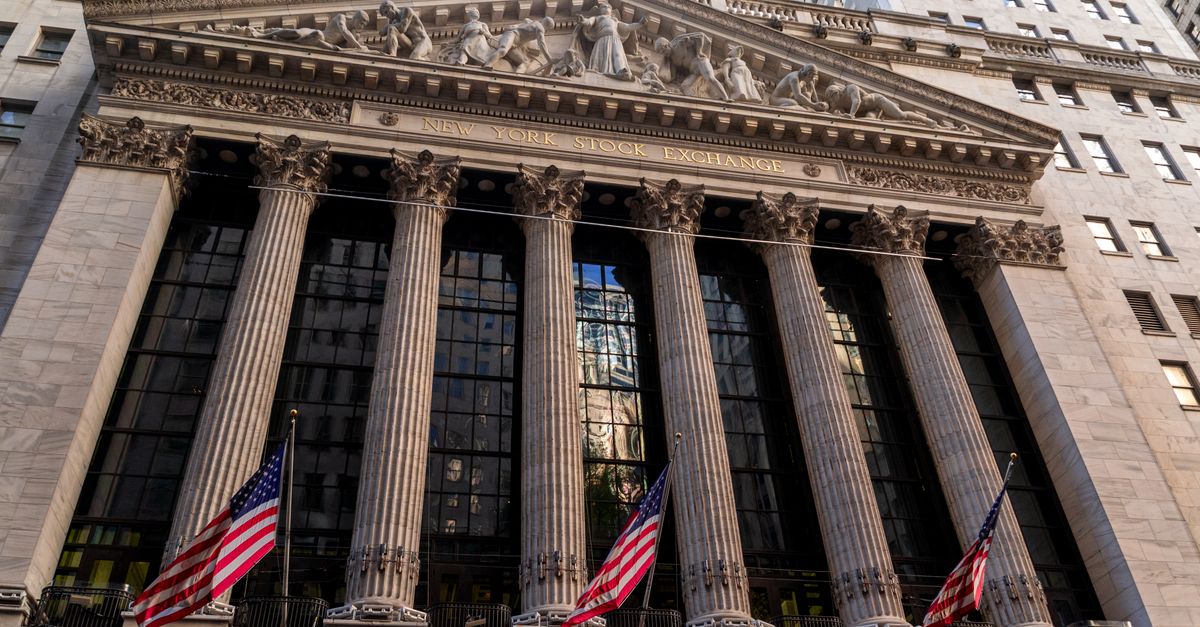
The backdrop to an intense week
The geopolitical easing arrives at a particularly delicate moment. Wall Street is preparing for the busiest week of the quarter, with two events capable of moving the market:
- The Federal Reserve. The FOMC meets on 28-29 July and will announce its decision on Wednesday 29. Traders expect rates to be held in the 3.50%-3.75% range; the earlier jump in oil above $100 had, however, fuelled bets on a possible hike by year-end, which is why the retreat in prices is being welcomed.
- Big tech earnings. Four of the "Magnificent 7" report within 48 hours: Microsoft and Meta on Wednesday 29 July, Apple and Amazon on Thursday 30. Investor attention is focused above all on capital spending (particularly on artificial intelligence) and on whether margins hold up.
The truce has provided a cushion of confidence, but from here on it will be the fundamentals — inflation, monetary policy and corporate results — that set the direction.
Future scenarios and latent risks
Today's relief is significant, but how long it lasts will depend on several factors. The US-Iran easing, however welcome, is described as a "pause" rather than a definitive settlement: geopolitical risk, though reduced, can resurface quickly. Likewise, the fall in crude — positive for consumers and energy-intensive businesses — has more complex implications for producing countries. Meanwhile, big tech results and guidance from the Fed will provide the next catalysts, testing the durability of the rally. The ability of markets to balance geopolitical news against economic fundamentals will be the key to reading the coming weeks.
Market data refers to 27 July 2026, compiled by Hub Finanza from public sources (Reuters/Investing, CNBC, Saxo, Yahoo Finance, MarketWatch, Bloomberg) and subject to revision. Hub Finanza charts are for illustrative purposes.
Disclaimer: the information provided in this article is purely informational and does not constitute personalised financial advice in any way. We recommend consulting a professional before making any investment decision.