There are quarterly reports judged by the number of units sold. The one Ferrari published on Thursday, July 30, 2026 is not one of them. In the second quarter, the Maranello-based company delivered 3,366 cars, 128 fewer than in the same period of 2025, and collected an additional 151 million euros. Net revenues at 1,938 million (+8.4%, +10.6% at constant exchange rates) with volumes down by 3.7%: a twelve percentage point gap between what leaves the gates and what enters the cash register. That gap entirely encapsulates the business model that the market pays thirty-five times earnings for.
The company raised its 2026 guidance for the second time this year and confirmed an order backlog covering the entire year 2027. The stock reacted well but without euphoria: in New York, RACE closed on Monday, August 3, at 401.43 dollars (+1.9%), in Milan at 346.65 euros, the highest close since November 17, 2025. However, two questions remain that the numbers alone do not answer, and which we address at the end of this analysis: how much of this quality is already priced in, and what happens when the earnings per share growth promised by the plan stalls below 5% annually.
The quarterly income statement, line by line
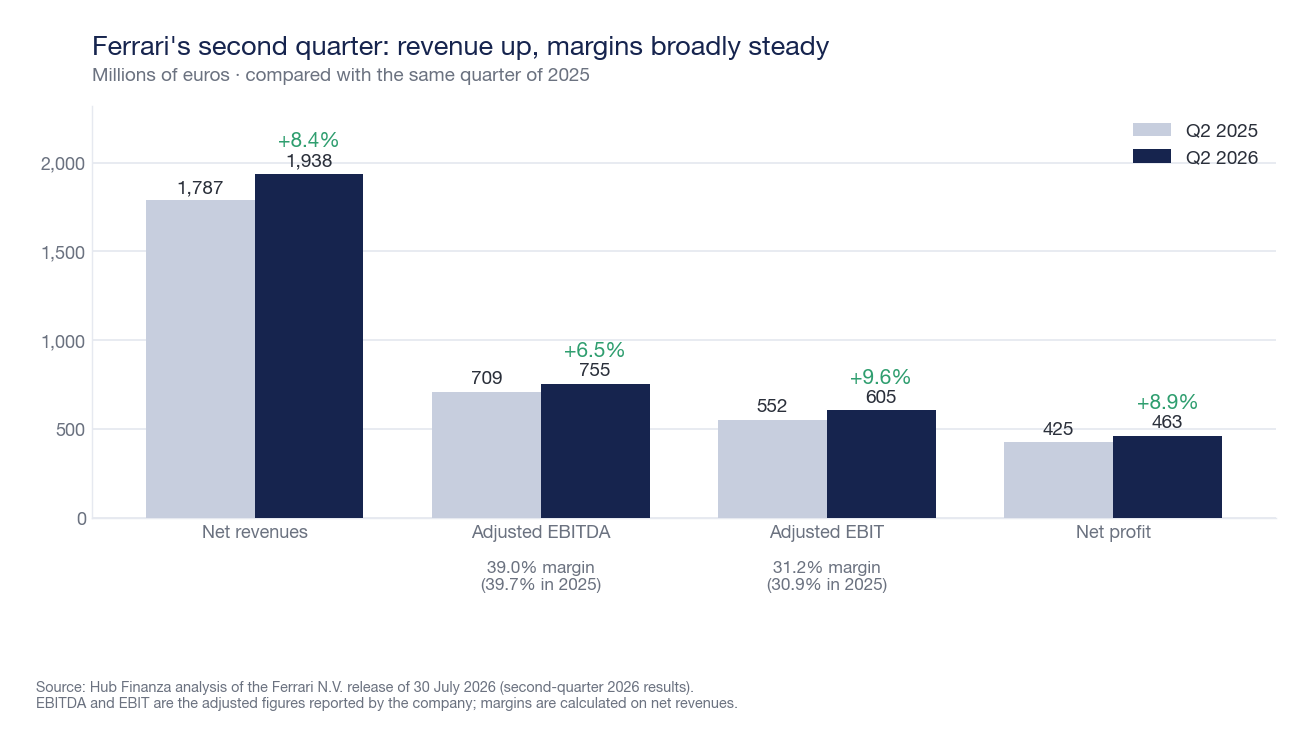
The four key numbers, compared to the second quarter of 2025:
Net revenues: 1,938 million (from 1,787), +8.4% and +10.6% at constant exchange rates. The difference between the two figures measures the impact of exchange rates: the dollar and yen shaved off just over two points of growth.
Adjusted EBITDA: 755 million (from 709), +6.5%, with a margin of 39.0% compared to 39.7% a year earlier.
Adjusted EBIT: 605 million (from 552), +9.6%, with a margin of 31.2% compared to 30.9%.
Net income: 463 million (from 425), +8.9%. Adjusted diluted earnings per share increased to 2.62 euros from 2.38.
It is worth pausing on the apparent contradiction between the two margins: EBITDA decreases by seven tenths, while EBIT increases by three. This is not an error. The gross industrial margin suffers from increased production, marketing, and Formula 1 costs; the operating margin recovers them thanks to temporarily lower depreciation, consistent with the model change phase. This is an accounting compensation destined to reverse, and the company explicitly states this by indicating depreciation above 700 million for the full year 2026.
Fewer cars, more value: where volume truly declined
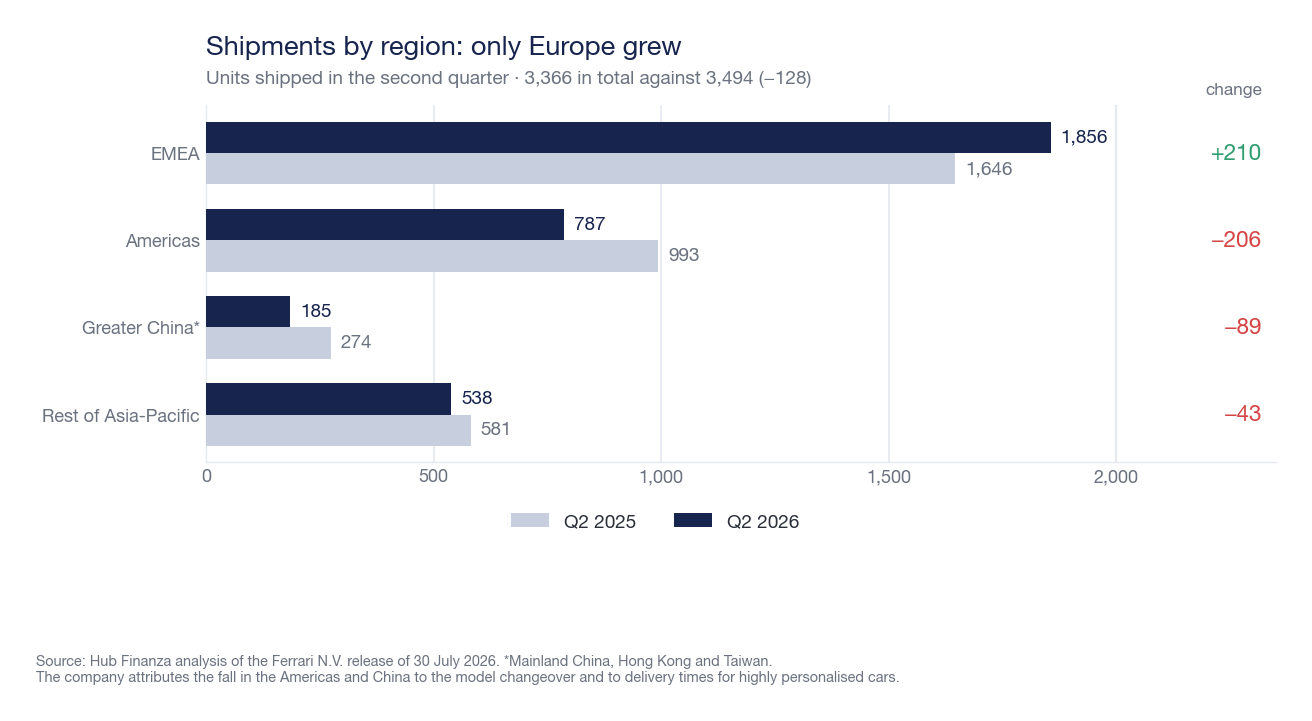
The decline in deliveries is not distributed; it is concentrated. Europe, Middle East, and Africa grew by 210 units (from 1,646 to 1,856) and is the only area showing an increase. The Americas lost 206 units (from 993 to 787, -20.7%), Greater China 89 (from 274 to 185, -32.5%), and the rest of Asia-Pacific 43.
Management addressed the point in the conference call. CEO Benedetto Vigna ruled out supply chain issues and attributed the American decline to "significant model changes" and a "high degree of personalization," which extends construction and thus delivery times. This is a plausible explanation — and consistent with growing revenues — but it needs to be monitored: two consecutive quarters of decline in the Americas with the same justification would be a different story.
The mix tells the rest of the story. In the quarter, 83% of deliveries came from the range, 16% from special series, and 1% from supercars; by powertrain, 70% combustion and 30% hybrid. But the real driver is elsewhere: customizations exceeded 20% of car and spare parts revenues, and CFO Antonio Picca Piccon explained that customers are choosing increasingly expensive options — carbon fiber, special paints, fine leathers — raising the average value per car.
The EBIT breakdown published by the company demonstrates this in two figures: volume subtracted 13 million, while mix and price added 122 million. Mix is worth almost ten times what volume subtracts. For revenues, the picture is the same: 1,629 million from cars and spare parts, 209 million from sponsorships, commercial activities, and brand, 100 million from other items.
Cash, debt, and shareholder returns
Cash generation is the part of the balance sheet where Ferrari resembles a luxury house more than a car manufacturer. In the quarter, free industrial cash flow was 276 million, up 39% year-on-year; in the first half, 929 million, against investments of 489 million (236 million in the second quarter alone, primarily for product development and the new paint shop).
As of June 30, 2026, net industrial debt was 131 million — virtually nothing for a company worth over 60 billion — with total available liquidity of approximately 2.0 billion between cash (1.5 billion) and credit lines (550 million). The shift from a net cash position to minimal debt is explained by what was returned to shareholders in the quarter: approximately 800 million, of which 599 million in dividends and 209 million in share buybacks.
The dividend for the 2025 financial year, approved by the shareholders' meeting, was 3.615 euros per share, totaling approximately 640 million. The buyback program is multi-year: approximately 3.5 billion to be executed by 2030; between January 5 and July 30, 2026, the company purchased 1,624,441 treasury shares for 483.4 million. This figure is more significant than it seems, and we will return to it when discussing earnings per share.
2026 guidance, raised for the second time
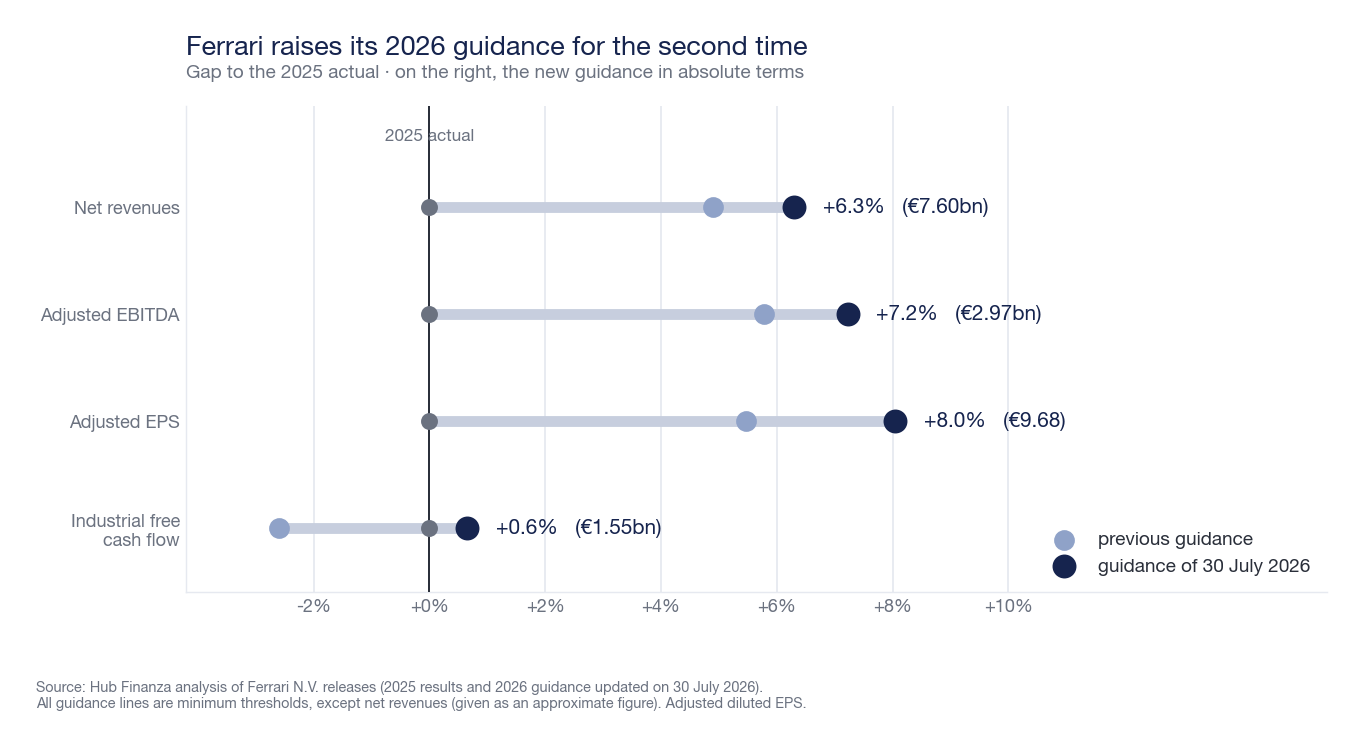
On July 30, Ferrari revised upwards all items for the year:
Net revenues: approximately 7.60 billion (from approximately 7.50), compared to 7.15 billion in 2025.
Adjusted EBITDA: at least 2.97 billion (from at least 2.93), with a margin of at least 39.0%.
Adjusted EBIT: at least 2.26 billion (from at least 2.22), with a margin of at least 29.5%.
Adjusted diluted earnings per share: at least 9.68 euros (from at least 9.45), compared to 8.96 in 2025.
Free industrial cash flow: at least 1.55 billion (from at least 1.50).
The revision, the company explains, reflects two things: stronger-than-expected customizations and a less unfavorable currency environment than anticipated, net of hedging. Declared assumptions include a euro-dollar exchange rate around 1.16 with 8% covered, depreciation above 700 million, and — a non-trivial detail for costs — first place in the Formula 1 championship, which entails higher staff bonuses.
What it implies for the second half
Here, arithmetic says more than the press release. With 3,786 million in revenues already on the balance sheet in the first half, the guidance implies a second half of around 3,814 million: a 6.7% growth compared to the same period in 2025, but essentially in line with the just-closed half. On margins, the message is clearer: adjusted EBIT for the first half was 1,153 million at 30.5%; to meet the 2.26 billion threshold, the second half must generate at least 1,107 million, meaning a margin of around 29.0%.
In other words, the guidance already incorporates a less profitable second half than the first. This is not an alarm: it is exactly the cost calendar that management described — depreciation, general expenses, research and development, and Formula 1 all increasing in the second half of the year. But it is useful to know this beforehand, so as not to interpret a declining quarterly margin in November as a disappointment, when it was already indicated in the July figures.
The product: the Luce, halved electric target, and the 2030 plan
2026 is the year Ferrari launches its first all-electric vehicle. The Ferrari Luce, unveiled in Rome on May 25, 2026, is a four-door, five-seater with four electric motors and over a thousand horsepower, with a starting price of around 550,000 euros. The first deliveries are expected in Europe from October 2026, and in the United States from the second quarter of 2027.
The debut was divisive aesthetically — Vigna, when asked about the reception, replied that he "wouldn't change anything" — but the commercial data is unequivocal: the 2026 allocation was sold out in less than two months from the presentation, and Chinese orders have already slipped into 2027. In the conference call, the CEO added that orders are coming from both regular customers and people who have never owned a Ferrari: if confirmed over time, this is the true strategic value of the model, namely broadening the customer base without diluting the brand.
On the long-term outlook, however, the most important development of the last twelve months must be remembered. At the Capital Markets Day on October 9, 2025, Ferrari halved its electric target for 2030, bringing it from 40% to 20% of the range: the projected mix is 40% internal combustion, 40% hybrid, 20% electric. This was a correction based on realism — and the market punished it severely at the time — but it also brought the plan back to defensible assumptions. The financial targets for 2030 declared then remain the benchmark for judging the next four years: revenues of around 9.0 billion (compound annual growth of approximately 5%), adjusted EBITDA of at least 3.6 billion with a margin of at least 40%, adjusted EBIT of at least 2.75 billion, adjusted earnings per share of at least 11.50 euros, cumulative industrial cash of approximately 8.0 billion over the five-year period 2026-2030 against investments of approximately 4.7 billion. The plan foresees an average of four new models per year, the opening of Tailor Made centers in Tokyo and Los Angeles and the new paint shop in 2027, and shareholder remuneration of approximately 7.0 billion divided equally between dividends and buybacks, with the payout ratio raised from 35% to 40% of adjusted net income.
The stock's reaction
The market bought the news, but with moderation. On July 30, the day of the publication, RACE closed in New York at 397.73 dollars (+3.12%); in Milan, it touched 356.20 euros intraday before closing at 343.65, more than three points below the intraday high. On July 31, the stock gave up 1% on Wall Street, then recovered on August 3 with a close at 401.43 dollars (+1.9%) and 346.65 euros on the Milan listing.
The period context helps to gauge the enthusiasm: on the Milan market, the stock gained 9.6% year-to-date and 19.1% in the last three months, but it is still down 8.4% over twelve months and is approximately 29% below its historical closing high of 487.90 euros, reached on February 17, 2025. The recovery, in short, is real but starts from very low levels: the closing low of 2026 was 273.80 euros on March 20.
Fundamental analysis: what the market is paying for
At the close of August 3, with approximately 177 million shares, Ferrari's market capitalization is just over 61 billion euros. From this, the multiples are derived, calculated on the company's official data:
Price/earnings 2026: approximately 35.8 times the guidance of 9.68 euros per share (38.7 times the 2025 actuals).
Enterprise value/EBITDA 2026: approximately 20.7 times, considering net industrial debt of 131 million — practically irrelevant for the calculation.
Free cash flow yield: approximately 2.5% on the guidance of 1.55 billion.
Dividend yield: approximately 1.0% on the 3.615 euros distributed for the 2025 financial year.
These are multiples for a luxury good, not an automobile, and the accounts partly justify them: an operating margin of 31.2% is a level that simply does not exist in the auto sector, and should be compared with major luxury brands rather than generalist manufacturers. Added to this are zero debt, an order book covering the entire year 2027, and demand that the company deliberately rations — "our North Star has been, is, and always will be scarcity and exclusivity," said Vigna.
The delicate point is another, and it is growth. The plan projects earnings per share from 9.68 euros in 2026 to at least 11.50 in 2030: a compound annual growth of 4.4%. This means that, buying today at 346.65 euros, one pays 30.1 times the earnings the company has committed to produce four years from now. A multiple of that type is not justified by growth. It is justified by longevity, that is, by the conviction that this margin and pricing power will endure for decades, not just one cycle.
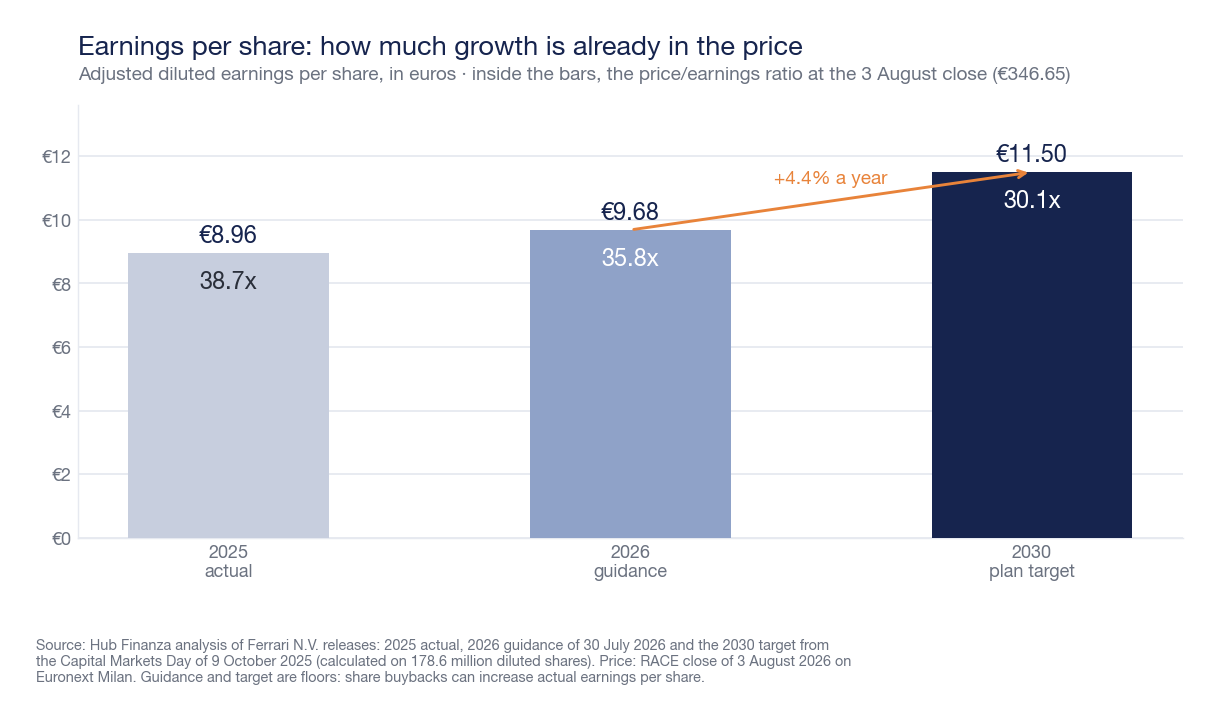
Two clarifications are necessary. First: the 2030 target is a minimum threshold, not a precise forecast, and is calculated on 178.6 million diluted shares. Second, which points in the same direction: the 3.5 billion in buybacks planned by 2030 are worth, at current prices, approximately 6% of the capital. If executed, they mechanically raise earnings per share beyond the declared target. Summing dividends and buybacks, the total remuneration of approximately 7.0 billion is equivalent to just over 11% of today's market capitalization distributed over the plan period, or about 2.3% per year.
Technical analysis: where the stock stands
The chart picture turned positive a few trading sessions before the earnings, and this is a chronological detail worth noting. On July 27, 2026, the 50-day moving average moved back above the 200-day moving average: this crossover, traditionally read as confirmation of a medium-term trend change, occurred with the stock at 331.80 euros, three sessions before the quarterly report.
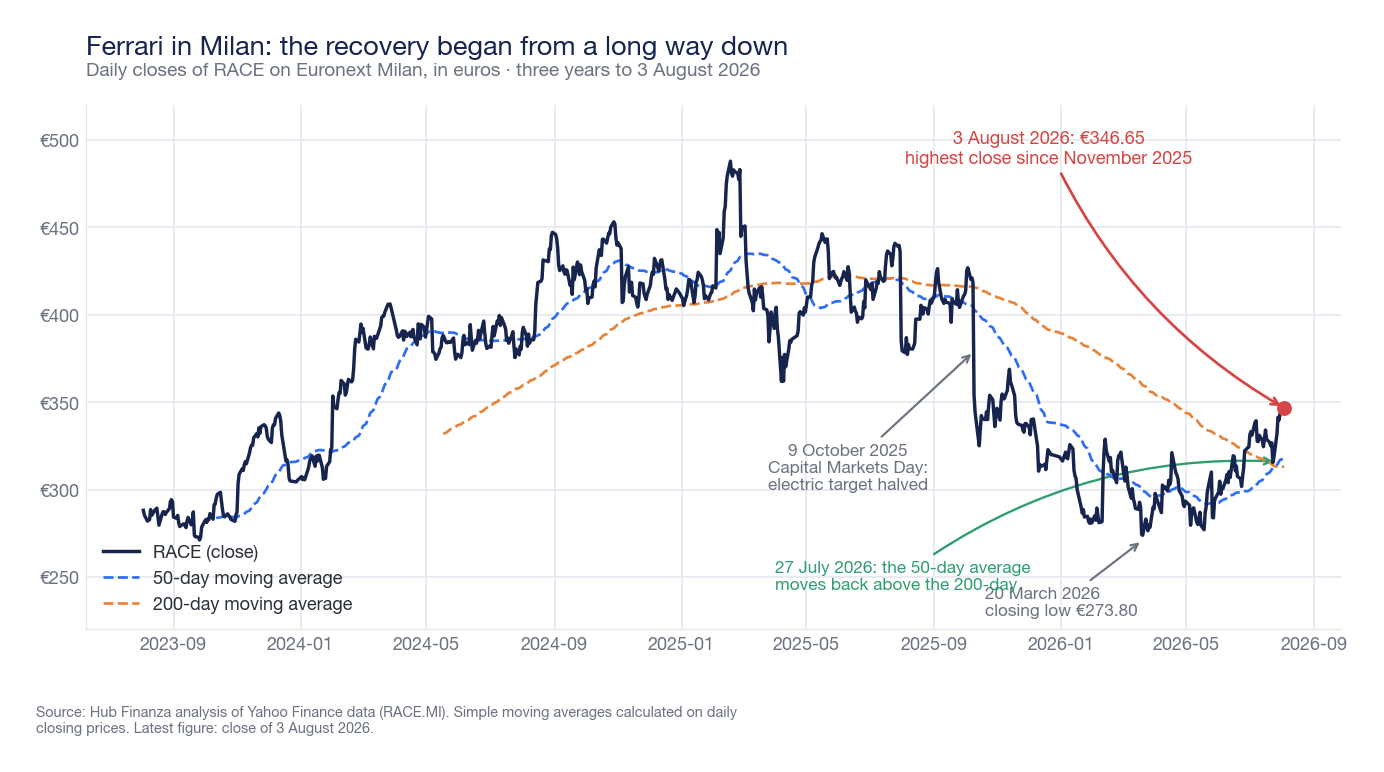
At the close of August 3, the configuration is orderly to the upside: the price of 346.65 euros is above all major averages — 331.19 euros at 20 sessions, 317.85 at 50, 313.10 at 200 — and the sequence is that of an intact uptrend. The 14-session RSI is at 64.8: clear strength, but not yet overbought. The volumes on August 3 (705,928 shares in Milan) were about one-fifth higher than the average of the last sixty sessions, and on earnings day had exceeded one million: the movement is well-participated, it is not a thin rebound.
The levels to watch, all based on Euronext Milan closing prices:
Immediate resistance 354-356 euros, the area of the intraday highs on July 30 (356.20) and August 3 (354.75): twice the stock pushed there and twice it closed below. This is the threshold that indicates whether the movement still has fuel.
Next resistance around 377 euros, the November 2025 high, and then 431 euros, the twelve-month high touched on October 3, 2025, six days before Capital Markets Day.
First support 331 euros (20-session moving average), then the 313-318 range where the 50-day and 200-day moving averages both pass: a drop below that area would call into question the July 27 crossover.
Structural support 273.80 euros, the 2026 closing low.
It must be clearly stated that technical analysis describes where the price is and which thresholds matter, not where it will go. A stock that has gained 19% in three months reaches these levels with less margin for error than it had in March.
Our sentiment, and why
Hub Finanza does not publish buy or sell recommendations, and this analysis contains none. However, we can clearly state what the numbers, read together, tell us — and where we believe the risk lies.
What is convincing. Ferrari has demonstrated, in a quarter with declining volumes, its ability to grow revenues, profit, and cash without affecting the operating margin. This is the most difficult test for a luxury goods company, and it passed. Net industrial debt is irrelevant, order coverage extends to 2027, pricing power is documented by a single number — mix and price contributing 122 million against 13 million subtracted by volume — and the Luce sold out its first year's allocation in less than two months, also attracting new customers. In short, industrial quality is not in question.
What advises caution. The price. At 35.8 times 2026 earnings and 30.1 times the 2030 target, the stock already incorporates the execution of the plan and a competitive advantage duration measured in decades. With a promised earnings per share growth of 4.4% per year, the expected return from here depends much more on the multiple holding steady than on profits: if the market were to re-price Ferrari even to just 28-30 times current earnings, years of growth would be needed to compensate. To this are added three concrete elements to monitor: the second half already indicated as decelerating on margins by the guidance itself, the decline in the Americas and China — currently explained by the model calendar, and this explanation needs to be verified in the third quarter — and exchange rate exposure, only 8% hedged on the euro-dollar assumption of 1.16.
In summary. Our judgment on the company is decidedly positive; that on the stock at current prices is constructive but cautious. Ferrari is not a growth story: it is a story of quality and longevity, and that is how it should be evaluated. Those who hold it in their portfolio own an industrial activity of rare solidity, but it trades at multiples that leave little room for execution errors. Those considering an entry are looking at a stock that has returned to nine-month highs after a 19% rally in a quarter: the technical timing is favorable, the entry point is not discounted. The next important appointment is the third-quarter earnings, in autumn: that's when it will be seen whether the Americas issue was a calendar problem or something more.
Sources
Financial and economic data from Ferrari N.V.'s press release on second quarter 2026 results (July 30, 2026, disseminated via GlobeNewswire and filed with the SEC as Form 6-K), from the analyst presentation, and from the conference call transcript. Long-term targets and remuneration policy from the Capital Markets Day press release of October 9, 2025. Share buybacks from the weekly communication filed with the SEC on July 31, 2026. News and statements on Ferrari Luce from CNBC. Quotations, moving averages, RSI, and volumes elaborated from Yahoo Finance data (RACE on NYSE and RACE.MI on Euronext Milan), closing of August 3, 2026. Multiples and implications for the second half are editorial elaborations on the cited official data, using the calculation method indicated in the text.
This article is for informational purposes only and does not constitute financial advice, investment research, a solicitation for public savings, or a personalized recommendation to buy or sell. The assessments expressed are editorial opinions based on public data as of the publication date and may change without notice. The value of investments can decrease as well as increase, and past performance is not indicative of future returns. Before any investment decision, it is advisable to consult a qualified financial advisor and evaluate the consistency of the operation with one's objectives, time horizon, and risk tolerance.