
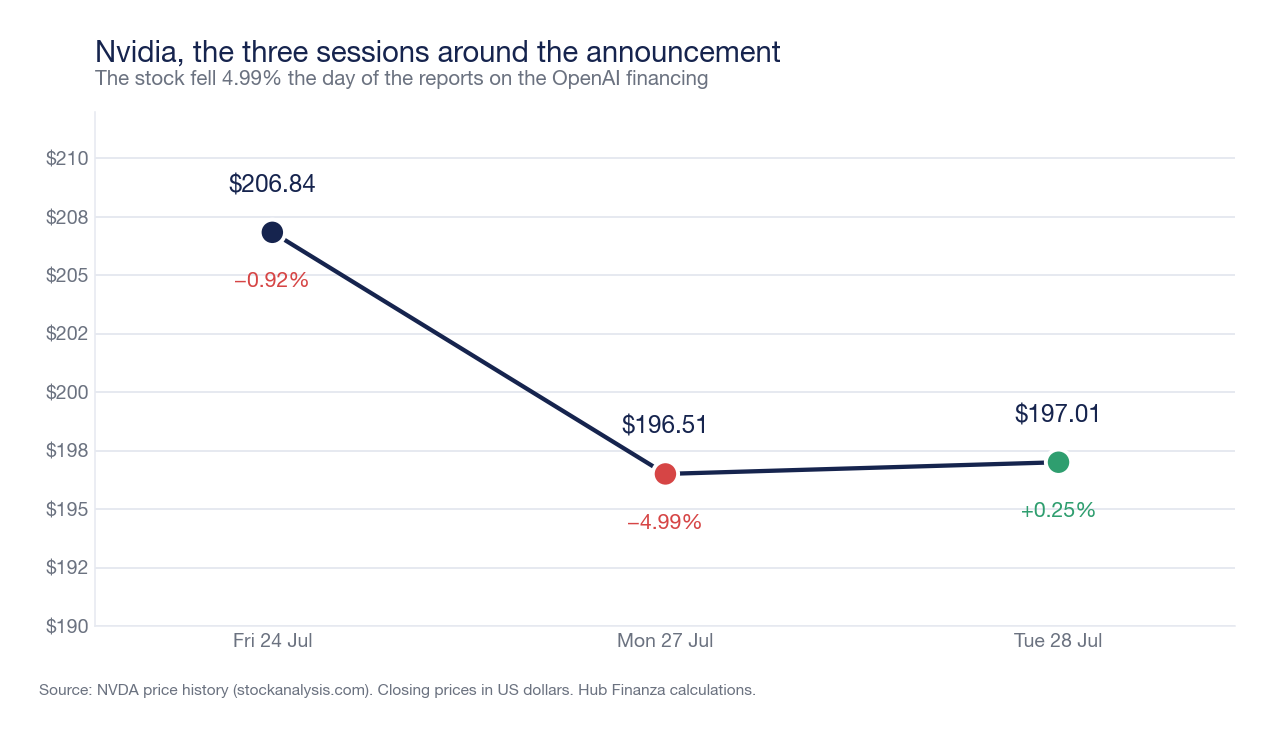
On Monday 27 July 2026 Nvidia fell 4.99% on the stock market, burning roughly $250 billion of market value. Not because of disappointing quarterly results nor a warning on demand: for precisely the opposite reason. According to reports by Axios and Bloomberg, the group is weighing whether to guarantee up to $250 billion of debt for a huge data centre intended for OpenAI, and in parallel to finance the purchase of $350 billion of its own chips by OpenAI itself.
Put another way: the company selling the graphics cards would put its signature on the debt of those who have to buy them. It is the mechanism the market has learned to call "circular financing", and for the first time it was not the stock market that reacted first, but the credit market.
What is being discussed, in figures
The transaction concerns a $500 billion, 10 gigawatt data centre hub in Ohio, intended to house OpenAI's computing capacity. Reports point to two distinct commitments by Nvidia: a debt guarantee of up to $250 billion and $350 billion of financing for chip purchases, for total potential involvement of around $600 billion.
It is worth repeating clearly, because it is the part headlines tend to skip: these are early-stage negotiations, which may not conclude or may change structure. Neither company has confirmed the terms.
The credit market moves first
The most significant reaction did not come from the equity market. The five-year credit default swap on Nvidia — essentially the price of insurance against a default — rose on 27 July by 14 basis points in a single session, to 82 basis points. It is the largest daily increase since the contract began trading actively, in November 2025.
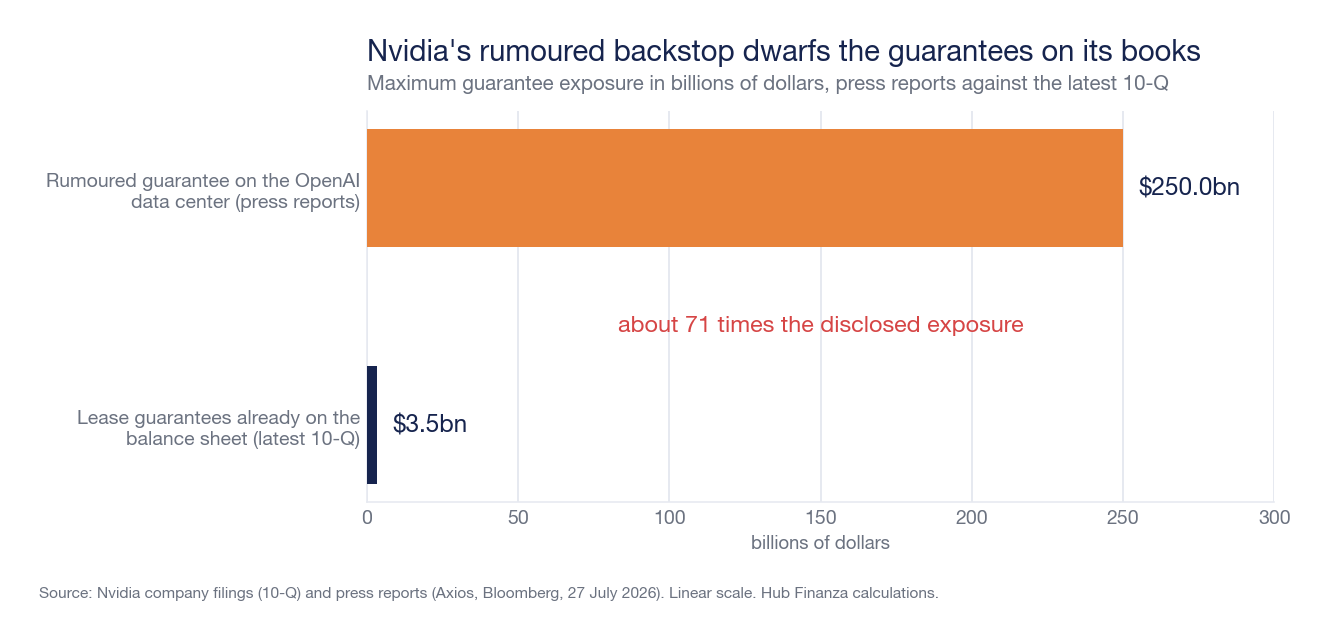
Credit looks at something equities tend to postpone: contingent liabilities. A guarantee does not appear as a cost until it is called, but it exists. And the comparison with what Nvidia currently reports in its accounts is unforgiving: in its latest 10-Q the company states a maximum aggregate exposure of $3.5 billion across all guarantees relating to lease agreements. The guarantee under discussion for the Ohio data centre would, on its own, be around 71 times that figure.
Why it is called "circular"
The term is not an accounting definition: it describes a structure. Nvidia finances — or takes stakes in — companies that then become among its main customers. The resulting revenue is real, but part of the demand generating it has been set up by the seller itself.
"Capital is increasingly being used to finance the future customers of AI and the build-out of infrastructure," observed Gary Tan, a portfolio manager at Allspring Global Investments. For Billy Leung, a strategist at Global X Management, transactions of this kind deepen a form of vendor financing that is "already under scrutiny".
The risk is not that the chips will go unsold: it is that demand will look more solid than it is, because it is supported by the supplier. Should expectations around AI be scaled back, the losses would not stop at forgone revenue — they would extend to the guarantees provided.
Not an isolated case
In 2026 alone Nvidia has announced more than $540 billion of similar transactions, not counting any new agreements with OpenAI. Among them is a partnership worth over $500 billion with the South Korean group SK (owner of SK Hynix) for data centres and chip purchases on the Korean peninsula, on which chief executive Jensen Huang commented: "This is the golden age for Korea. Their semiconductor industry is booming."
The phenomenon can also be read in the bond market. Since the start of 2026 a group of companies including Amazon, Google, Nvidia, Meta, Oracle and SpaceX has placed $182 billion of investment grade bonds, an increase of 1,300% on the previous year: roughly 15% of all high-grade corporate issuance in the United States.
What the institutions actually say
On this point it is worth being precise, because public debate tends to attribute to central banks warnings they have not issued.
The most detailed warning came from the International Monetary Fund. In June 2026, speaking at the ECB's annual forum, Tobias Adrian, director of the Fund's Monetary and Capital Markets Department, flagged a problem of maturity mismatch: large cloud service providers are increasing leverage by issuing medium- and long-term bonds to buy chips and build data centres, but the useful life of that infrastructure is far shorter than the maturity of the debt financing it. Long-dated debt for machines that age fast. In the World Economic Outlook the Fund also observed that the fact that large AI companies invest in one another while securing future orders makes ownership structures opaque and companies harder to value.
The ECB, by contrast, at its meeting on 23 July 2026 left its three key rates unchanged — deposit rate at 2.25%, main refinancing operations at 2.40%, marginal lending at 2.65% — by unanimous decision, but its stated concern is a different one: energy. "Although energy price inflation eased in June, its increase since the start of the conflict — and its impact on food, goods and services inflation — is set to keep inflation well above target until the first half of 2027," said President Christine Lagarde. On growth: "Forward-looking indicators suggest economic growth will remain modest in the near term, weighed down by the energy shock and the related uncertainties."
The July monetary policy statement contains no dedicated assessment of asset valuations or sector concentration.
The macroeconomic backdrop, for what it is
The idea that inflation is "under control" deserves some caution. In the euro area the harmonised index of consumer prices stood at 2.8% year on year in June 2026, down from 3.2% in May, but with energy at +8.5% and services at 3.2%. In the United States consumer inflation in June is reported at around 3.8%, down from 4.2% in May, with the core component at 2.6%.
The Federal Reserve is holding the federal funds rate in the 3.50%-3.75% range, unchanged since December 2025 and confirmed unanimously (12 votes to 0) at the meeting of 17 June, the first chaired by Kevin Warsh. The FOMC met on 28 and 29 July — Warsh's second meeting as chair — with the decision announced on Wednesday 29: on the eve, the consensus among economists pointed to rates being held once again.
What to watch now
Three indicators will tell whether 27 July was an isolated reaction or the start of a deeper reassessment.
The first is Nvidia's cost of credit: if credit default swaps stay at the new levels even without fresh reports, it means the market has structurally repriced the risk of the guarantees, rather than simply reacting to a news story.
The second is confirmation or denial of the terms by Nvidia and OpenAI. As long as they remain reports, they remain reports.
The third is the accounting treatment: how and when guarantees of this size would appear in company filings. A contingent liability that is not visible in the accounts is not a liability that does not exist — it is simply one investors struggle to measure, and that is exactly the point raised by the IMF.
Data refers to the sessions of 24, 27 and 28 July 2026 and was compiled by Hub Finanza from public sources (Axios, Bloomberg, Yahoo Finance, stockanalysis.com, International Monetary Fund, European Central Bank, Eurostat, Federal Reserve). The amounts relating to the agreements between Nvidia and OpenAI derive from press reports not confirmed by the companies. Hub Finanza charts are for illustrative purposes.
Disclaimer: the information provided in this article is purely informational and does not constitute personalised financial advice in any way. We recommend consulting a professional before making any investment decision.