A week to rewrite the narrative. After a nightmare July for everything revolving around artificial intelligence — with the Nasdaq entering correction, the Philadelphia Semiconductor Index down 28.6% from its June 22 peak, and the Magnificent 7 burning almost 800 billion dollars in market capitalization in just a few sessions — the earnings reports from Microsoft, Meta, Amazon, and Apple brought the market exactly where it wanted to be: looking at the numbers, wondering if the largest capex bet in history is finally yielding returns.
The answer, for once, was not unambiguous. And it is precisely this divergence that tells the story of the market's new regime.
Where the market came from: the summer of distrust
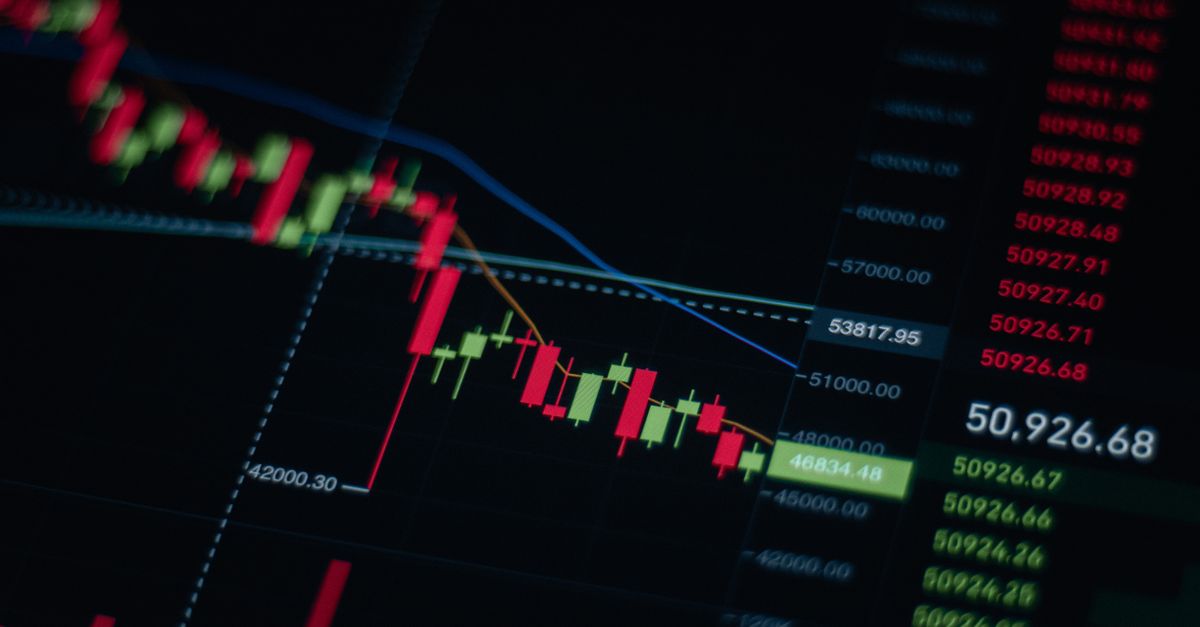
To understand the violence of this week's movements, one must start with the context. Microsoft approached its earnings report with the stock down almost 30% from its October 2025 highs (555 dollars), pressured by fears of the so-called "SaaSpocalypse" and an investment plan estimated at about 190 billion dollars for the current year, without the market seeing tangible returns. The dominant theme had become a single one: hyperscalers are spending — collectively over 850 billion dollars in build-out — like no industry has ever done in history, and investors had stopped granting trust on word alone.
The paradox is that the best performing stock in the group was Apple, +23% year-to-date precisely thanks to the opposite strategy: no massive capex, only partnerships with model developers. The market rewarded those who didn't spend.
Microsoft: the session that goes down in history
Then came Wednesday, July 29. Microsoft closed its fourth fiscal quarter with revenues of 90.0 billion dollars against expectations of 87.6, non-GAAP EPS of 4.74 dollars against the estimated 4.24, and notably, Azure's growth of 43% at constant currency, above the expected 40% and accelerating, with guidance at 45% for the current quarter. Azure surpassed 100 billion in revenue for the first time in fiscal year 2026, and Microsoft 365 Copilot seats exceeded 30 million.
The result: on Thursday, July 30, the stock closed up +15.5%, its best session since October 2008, adding about 450 billion dollars in market capitalization in a single day — the largest absolute increase in value ever recorded by a single stock in one session. Crucial, beyond the numbers, was what Microsoft didn't do: no massive capex increase; instead, an accounting change (data center useful life extended from 15 to 25 years) that will ease spending figures on the balance sheet.
The boost was immediate: S&P 500 +1.7%, Nasdaq +2.8% after dropping almost 10% below June's highs the day before, Nasdaq 100 +3.4%.
Meta: the opposite side of the coin
On the same evening as Microsoft, Meta reminded the market what happens when spending does not translate into profits. Revenues slightly above expectations, but profits below consensus and growing concerns about the deterioration of free cash flow linked to the industry's most aggressive capex relative to revenue: the stock dropped almost 9%, with about 51 dollars lost per share within an hour of the earnings release.
The market's implicit message is crystal clear: tolerance for "blind" capex is over. Those who spend must show monetization, immediately.
Amazon and Apple: a repeat of the script, with reversed roles
On Thursday evening, it was Amazon's and Apple's turn, and the script played out almost identically. Amazon closed the second quarter with revenues of 200.6 billion dollars (+20% y/y) and EPS of 5.75 dollars, but the real news was AWS: +36.7% to 42.2 billion, its fastest growth in 18 quarters, with 16.6 billion in operating income. Andy Jassy revealed that both AWS's AI business and its proprietary Trainium chips each surpassed an annualized run rate of 25 billion dollars, and he raised the 2026 capex guidance from 200 to 220 billion — this time with the market on its side, because declared demand exceeds supply. The stock jumped almost 9% in after-hours trading, in the 250-dollar range.
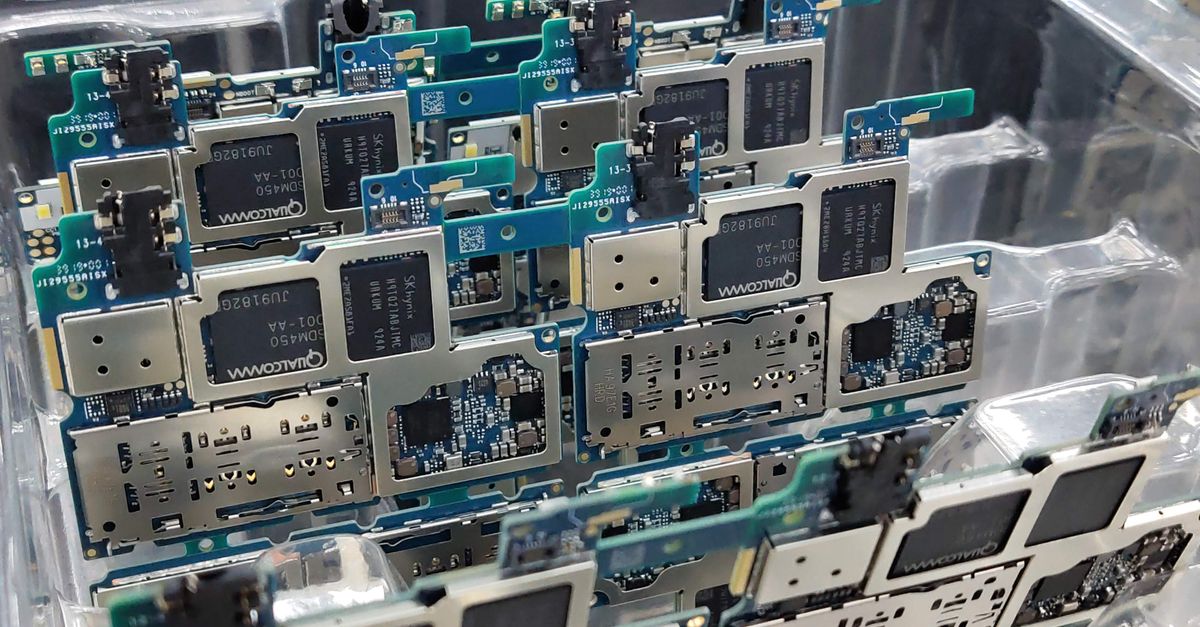
Apple, conversely, beat estimates (revenues at 109.4 billion, EPS 2.02 dollars, iPhone +21.7% for the best third quarter ever for the line) but plunged 8% in after-hours trading on disappointing guidance: expected growth of 9-11% against 12% consensus, with the added burden of rising memory costs — precisely those memories whose scarcity is enriching Korean manufacturers — which are compressing device margins. Ironically: the last quarter of the Tim Cook era ends with the best performing stock of 2026 punished for the same asset-light strategy that the market celebrated up until two weeks ago.
The Aschenbrenner case: when leverage meets drawdown
In the midst of this week, the most spectacular epilogue of July's sell-off also unfolded: the forced liquidation of Situational Awareness, Leopold Aschenbrenner's hedge fund. The former OpenAI researcher — a Columbia valedictorian at 19 — had transformed his celebrated 2024 essay on the imminent arrival of AGI into a monolithic investment thesis: long on all AI infrastructure (SK Hynix, Micron, Sandisk, Nebius, CoreWeave), short on traditional software, all with leverage of approximately 4x.
The results had been spectacular: +439% net of fees in the first half of 2026, assets growing to a peak of around 45 billion dollars from a starting point of 225 million. Then July presented the bill: longs down 35-47%, shorts on software (Adobe above all) moving in the wrong direction, and the three prime brokers — Goldman Sachs, JPMorgan, and Bank of America — issuing margin calls. On July 24, Aschenbrenner wrote to investors describing the sell-off as one of the best entry opportunities since 2025 and requesting fresh capital by August 1. The capital did not arrive: on Thursday, July 30, the entire listed equity portfolio was sold in block to Ken Griffin's Citadel. The fund, now reduced to approximately 10 billion in assets, essentially retains its private stake in Anthropic, valued at about 5 billion.
The final irony: many of the liquidated stocks violently rebounded precisely on the day of surrender, with IREN up +26% and memory manufacturers in double digits. A textbook lesson that a right thesis with the wrong leverage remains a lost thesis.
KOSPI: collapse and resurrection in four sessions
If New York experienced an extreme week, Seoul experienced an entire month on a roller coaster. The KOSPI, dominated by Samsung Electronics and SK Hynix, had more than doubled in the first half of the year on the wave of the memory super-cycle, only to collapse by over 30% in July alone, with a -17% concentrated in the last three sessions amidst fears of an AI bubble, Chinese chip competition, and — not least — the forced liquidations of leveraged funds exposed to SK Hynix.
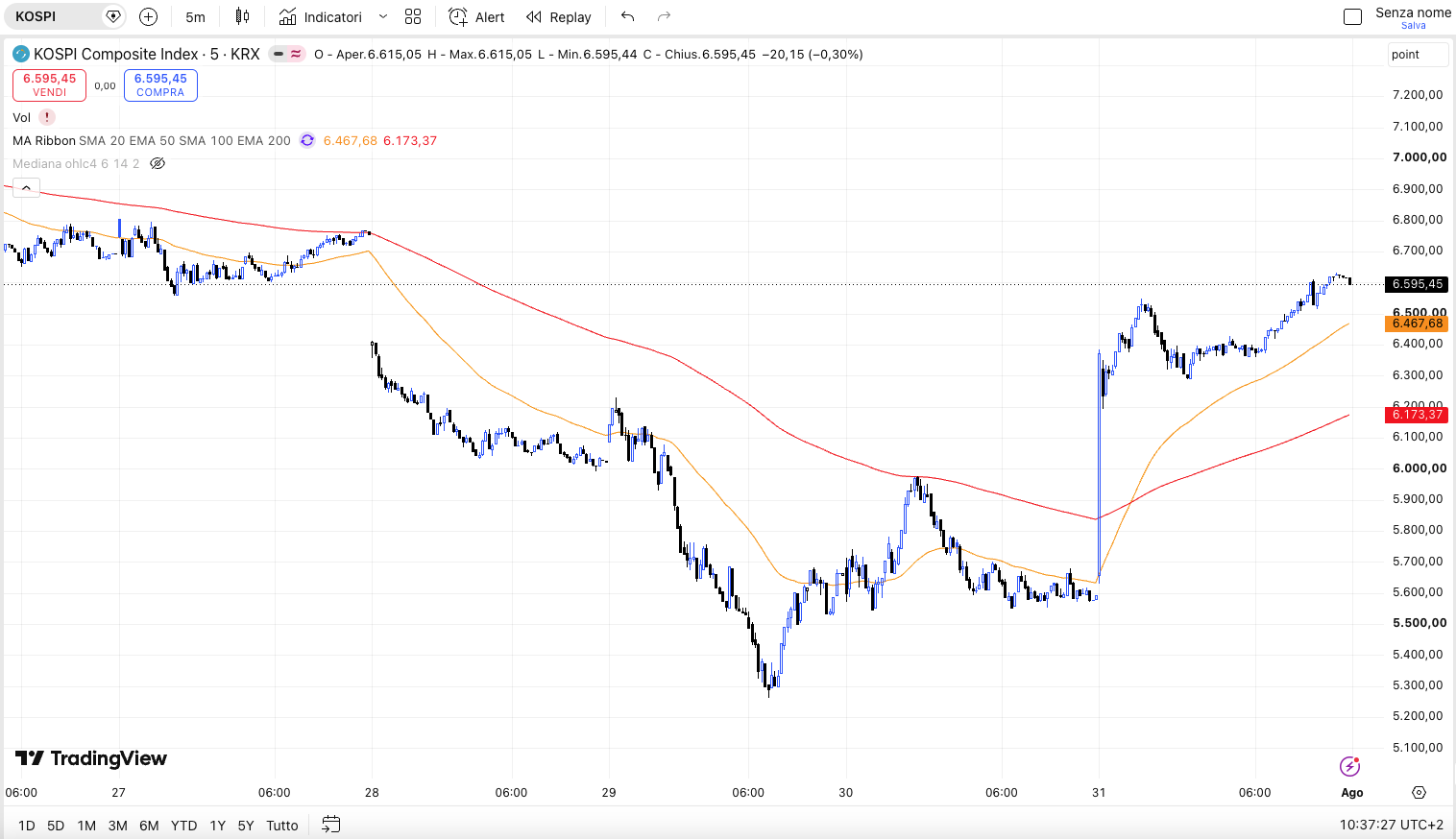
Friday, July 31, brought the resurrection: the KOSPI closed at approximately +17.9% in the 6,595 point range, its largest daily rise in history, complete with a "sidecar" mechanism triggered at the open to temporarily suspend programmed orders. Samsung Electronics gained over 20% and SK Hynix up to 25-30% intraday, driven by three factors: the overnight rally in US semiconductors (SOXX +8%, best session since April; Micron +15.7%, AMD +12.7%), Samsung's statements on the global memory shortage expected to worsen in 2027, and personal purchases of SK Hynix shares by SK Group chairman Chey Tae-won. Short covering and mechanical rebalancing of leveraged ETFs amplified everything — the same fuel that had driven the collapse, burning in reverse.
What remains of this week
Three operational conclusions. First: the market has stopped treating the Magnificent 7 as a single block. Within the same earnings season, Microsoft and Amazon were rewarded for demonstrated AI monetization, Meta punished for spending without visible returns, Apple punished for prudence. The trade is no longer "AI yes or no," but "who collects and who pays."
Second: leverage remains the true systemic risk of this cycle. The Situational Awareness case demonstrates that July's volatility did not arise solely from fundamentals, but from the mechanics of positioning — and that the same flows can reverse in 48 hours, as the KOSPI just certified with its historic rebound record.
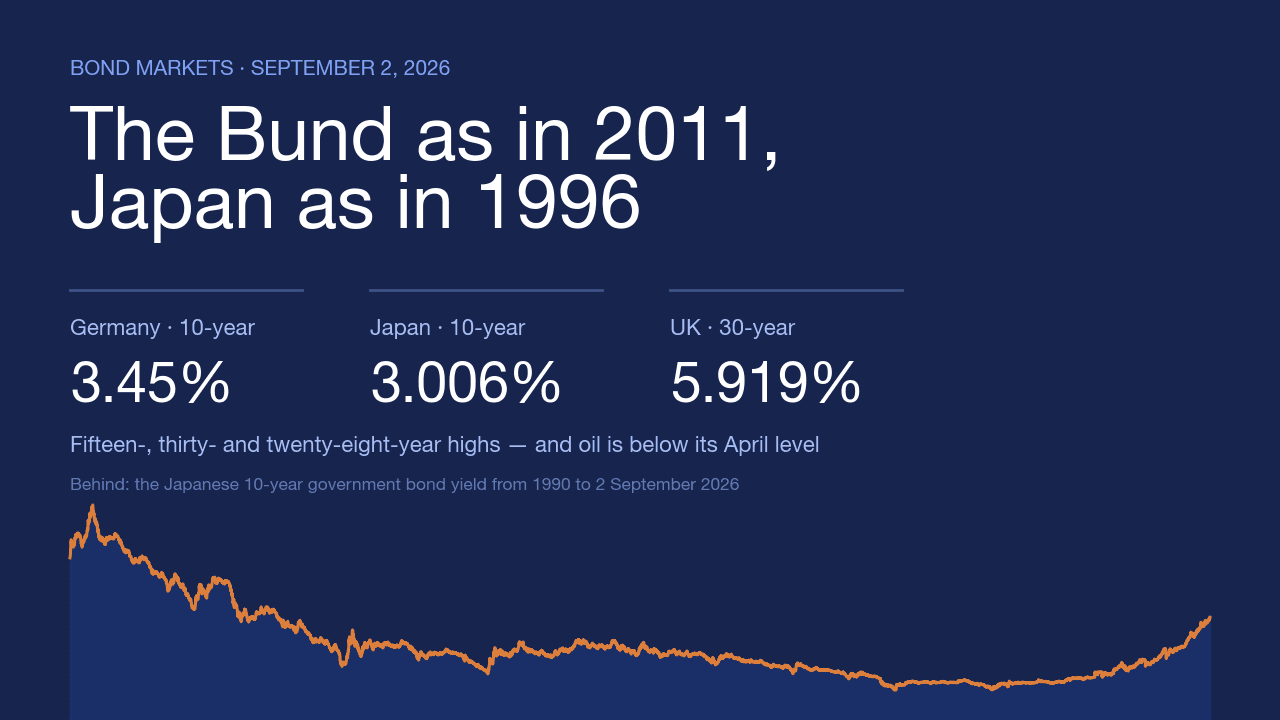
Third: in the background remain interest rates. The US 10-year at 4.67% and the 30-year above 5.20% remind us that the bond market continues to price in persistent inflation, and that the cost of capital to finance 850 billion of AI infrastructure has never been so relevant.
The Magnificent 7 are back. But the entry ticket, now, is paid in demonstrated profits — not in promises.
Sources: market data and earnings reports as of 07/31/2026 (AP, Bloomberg, CNBC, Fortune, Financial Times, Korea JoongAng Daily, Motley Fool).