Unilever published its first-half results on Tuesday 28 July 2026, and the number that moved the market was neither a margin nor a profit: it was the quantity of product leaving the shelves. In the second quarter volumes grew by 5.5%, the best quarter in sixteen years, and organic sales growth reached 5.8% against the 4.3% analysts expected. The group raised its guidance for the full year. In London the shares rose as much as 6.8%, touching £49.43, the highest level since 6 March and the best session in two years.
The difference from previous years comes down to one word: prices. In the quarter they contributed just 0.2%. This time, growth came because consumers bought more products, not because they paid more for them.
The best quarter in sixteen years
In the second quarter, organic growth of 5.8% breaks down into 5.5% from volumes and 0.2% from prices. Over the full half-year the picture is more moderate but of the same nature: organic growth of 4.8%, of which 4.2% from volumes and 0.6% from prices.
It is a reversal of the three years of inflation, when Unilever — like almost the entire consumer goods sector — defended revenue by raising list prices, with the side effect of pushing part of its customer base towards private labels and cheaper products. A volume increase of this size means that shift has stopped, at least for one quarter.
Where the growth came from
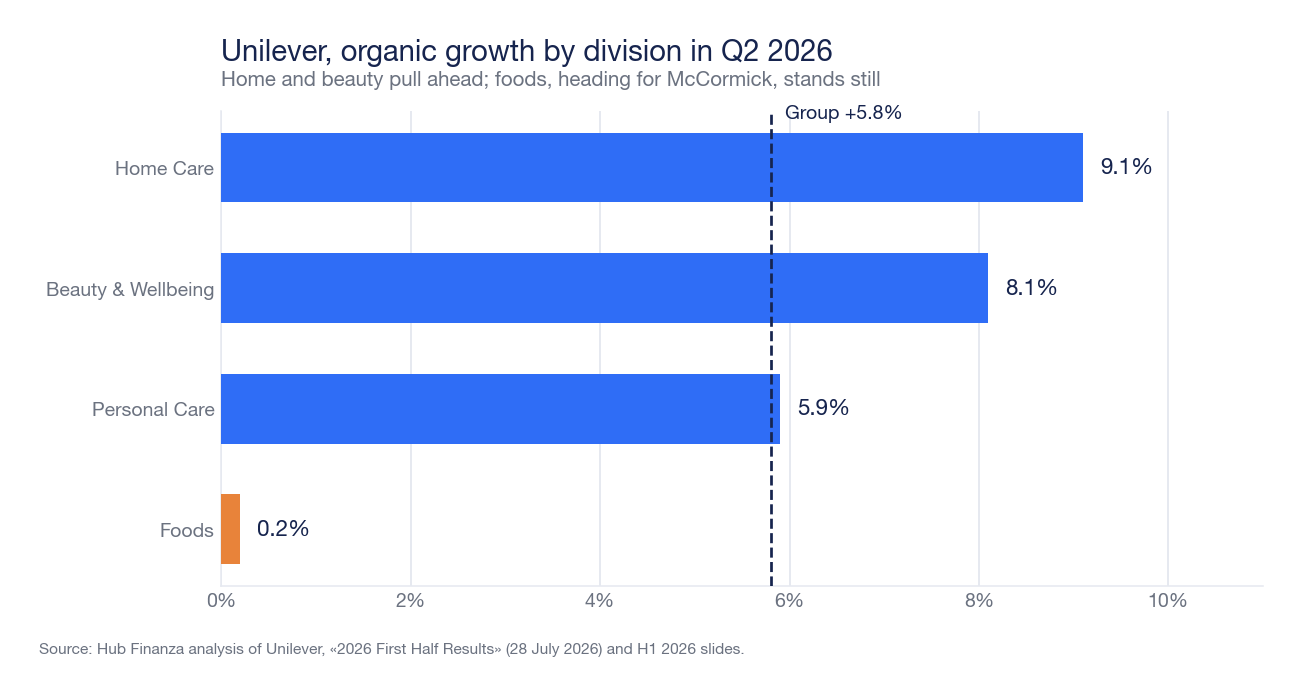
The pull came from three divisions out of four. Home Care posted organic growth of 9.1% in the quarter, Beauty & Wellbeing 8.1% and Personal Care 5.9%. These are the areas on which chief executive Fernando Fernandez, who has led the group since March 2025, has concentrated investment and marketing spend, behind brands such as Dove, Rexona, Axe, Vaseline and Cif.
Geographically, the push came from emerging markets — India, Indonesia and Latin America — where campaigns tied to the 2026 football World Cup also played a part. It is a detail worth keeping in mind: part of the quarter's growth is linked to an event that does not repeat.
Food is flat, and on its way out
The fourth division tells a different story. Foods closed the quarter with organic growth of 0.2% and volumes slightly down (−0.1%), with particular weakness in condiments in the United States, where competition in the premium segment has become more aggressive.
It is a drag Unilever has already decided to shed. In March 2026 the group announced an agreement to combine its food division with McCormick, a transaction expected to close by mid-2027. It is not the first pruning: on 6 December 2025 the separation of the ice cream business was completed, today The Magnum Ice Cream Company. At the end of this process, Unilever will be a group focused essentially on home care, personal care and beauty — precisely the three divisions that ran in the quarter.
In euros you see much less
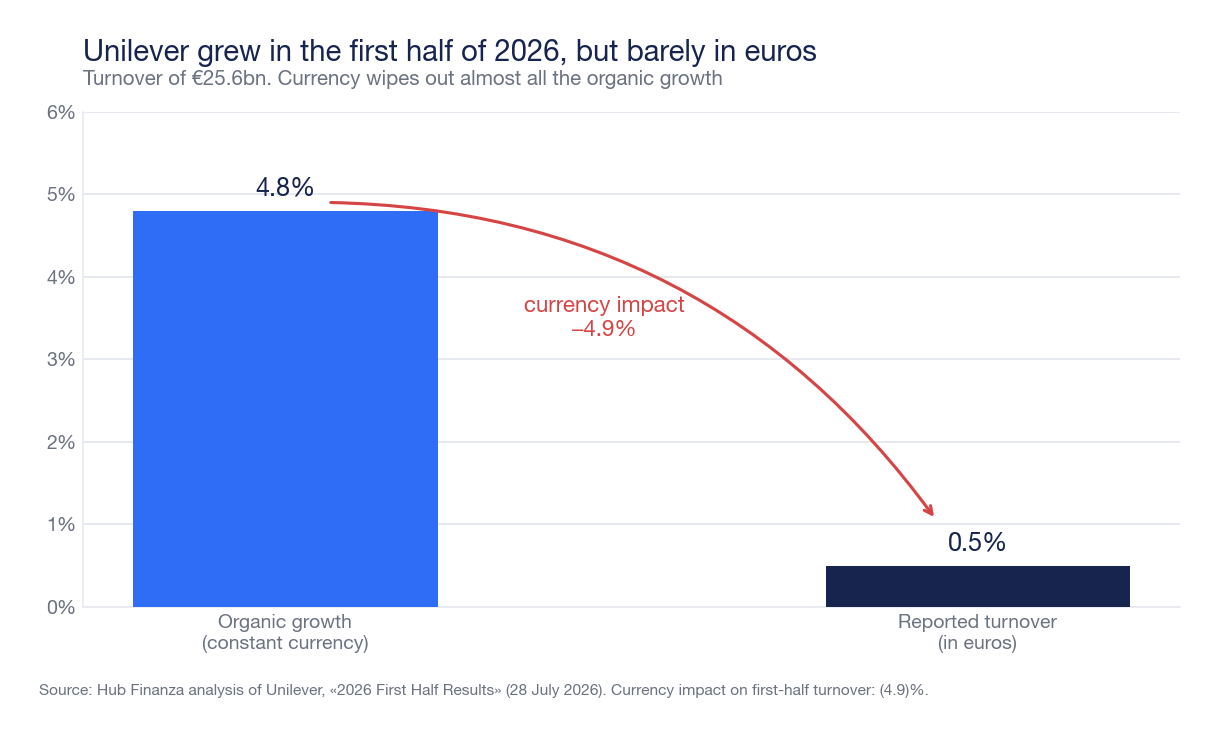
Here the story changes tone. Organic growth is measured at constant exchange rates; the accounts, however, are in euros. And over the half-year currency worked against the group: a negative effect of 4.9% on turnover. The result: €25.6 billion of revenue, up by just 0.5%. Almost five points of organic growth evaporated in the currency conversion.
The same friction shows up in profits. Underlying operating profit rose by 0.9%, to €5.2 billion, with a margin of 20.3%, an improvement of 10 basis points. Diluted earnings per share, by contrast, fell by 2.5%, to €1.38, while underlying earnings per share grew by 2.4% to €1.61.
On the cash front the half-year is more solid: free cash flow went from €1.1 billion to €1.5 billion, with net debt at €26.0 billion as at 30 June and leverage of around 2 times the ratio of net debt to underlying gross profit. The quarterly dividend rises by 3%, to €0.4664 per share.
Europe is still lagging
One area in particular is not joining the party. In Europe organic growth for the half-year was negative at 0.9%, with volumes at −0.2%; in the second quarter alone organic sales fell by 1.3%, albeit with volumes recovering slightly (+0.3%). It is the exact opposite of the emerging markets dynamic, and no surprise on a continent where consumption remains subdued.
Guidance rises, but the second half changes engine
Unilever raised its guidance on both fronts: organic growth for the whole of 2026 is now expected within the 4-6% range (previously it was indicated at the lower end) and volume growth at around 3%, against the previous "at least 2%". On the underlying operating margin the group expects a modest improvement over the year.
There is, however, one detail in the guidance worth more than many lines of commentary: for the second half Unilever expects organic growth of 4-5%, driven by prices. The engine, in other words, would go back to being the old one. The expected currency effect for the full year is around 3%.
"We delivered a strong volume-driven performance in the first half, with a clear step up in the second quarter: the best volume quarter at Unilever in over a decade," chief executive Fernando Fernandez said in the statement accompanying the results.
What to watch from here
Three elements will tell whether the second quarter was a turning point or a parenthesis. The first is whether volumes hold up without the World Cup effect, that is from September onwards. The second is the quality of earnings: growing in volume costs money in marketing, and as long as currency and raw materials erode almost all the benefit downstream, growth remains a commercial fact rather than a financial one. The third is the execution of the McCormick transaction, which by mid-2027 will redraw the group's perimeter.
For Europe, finally, there are still no signs of a turnaround: it is the only major region where Unilever sold less over the half-year.
Data refers to Unilever's "2026 First Half Results" announcement of 28 July 2026 and was compiled by Hub Finanza from public sources (Unilever, Investegate, Investing.com, Euronext, Bloomberg). Organic growth percentages are at constant exchange rates; turnover is in euros. Hub Finanza charts are for illustrative purposes.
Disclaimer: the information provided in this article is purely informational and does not constitute personalised financial advice in any way. We recommend consulting a professional before making any investment decision.