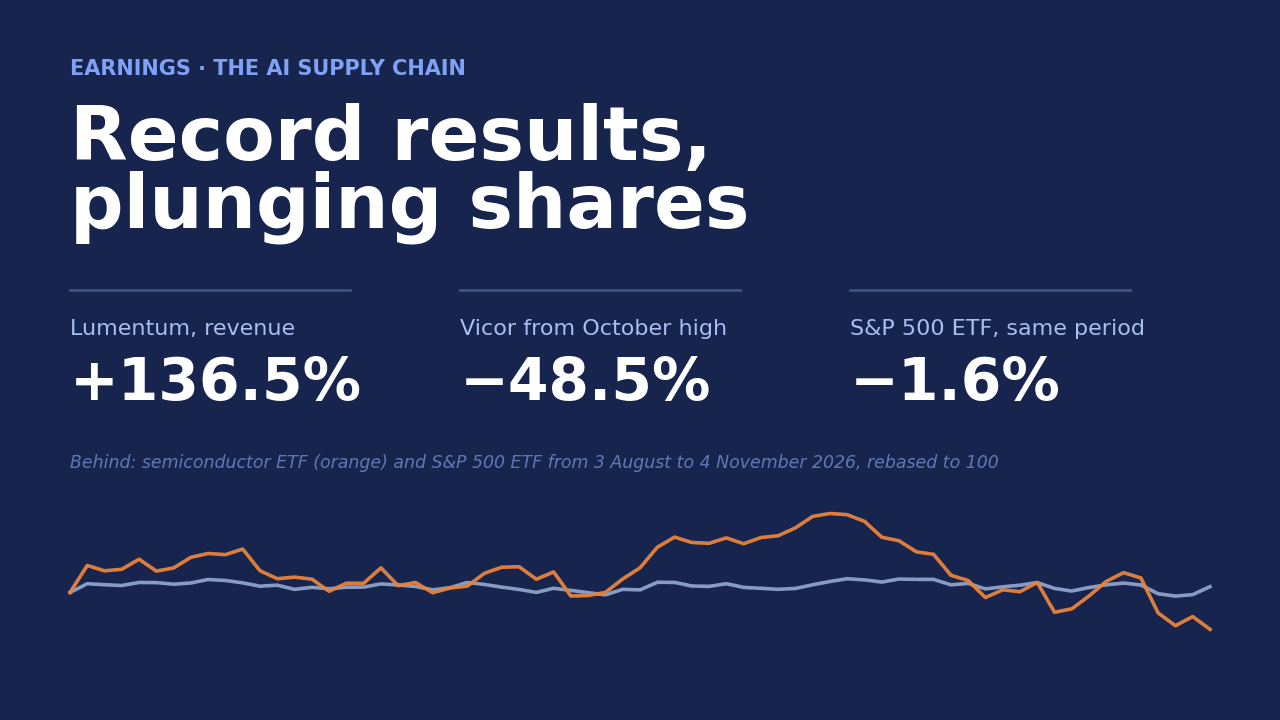


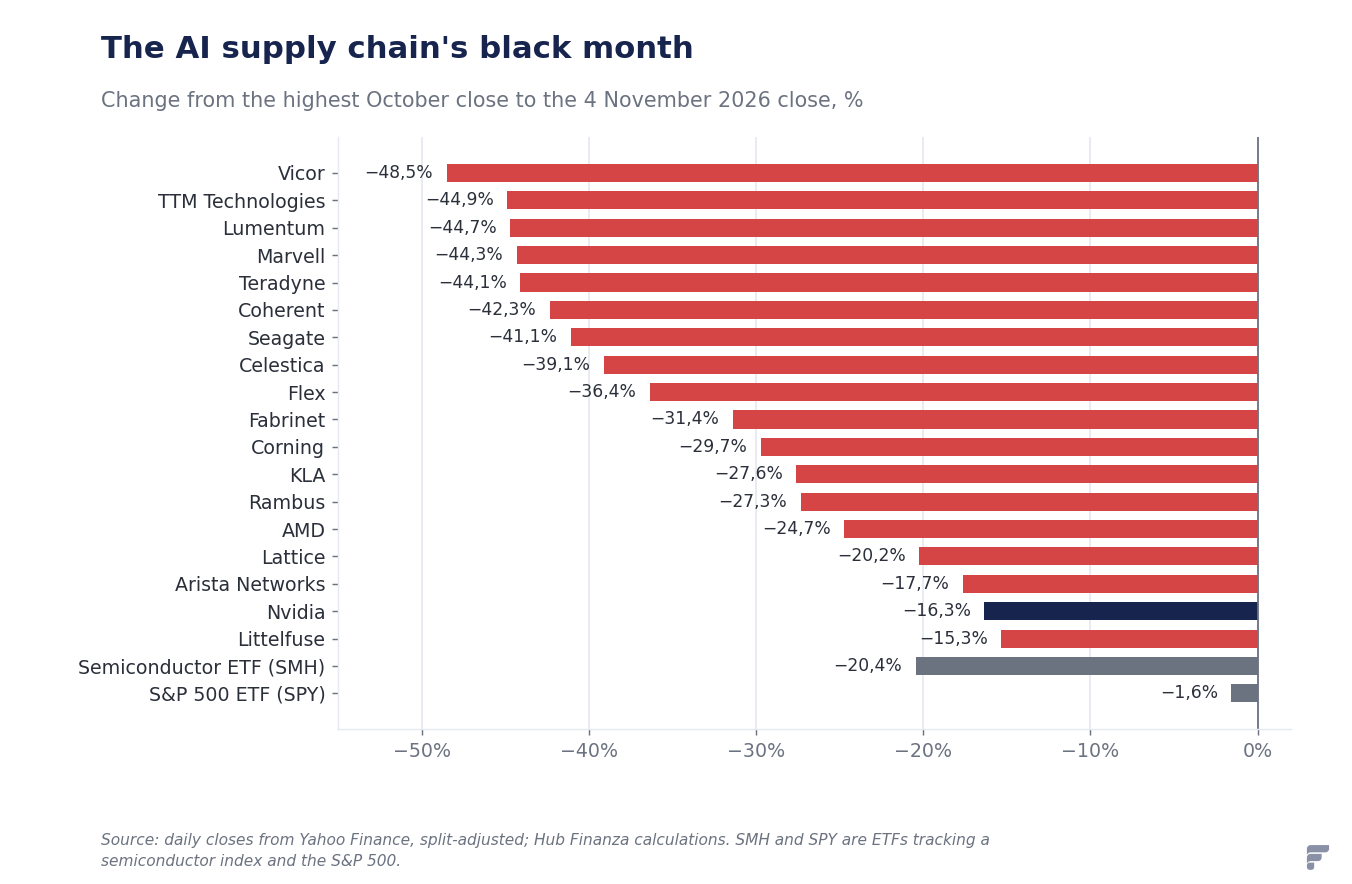
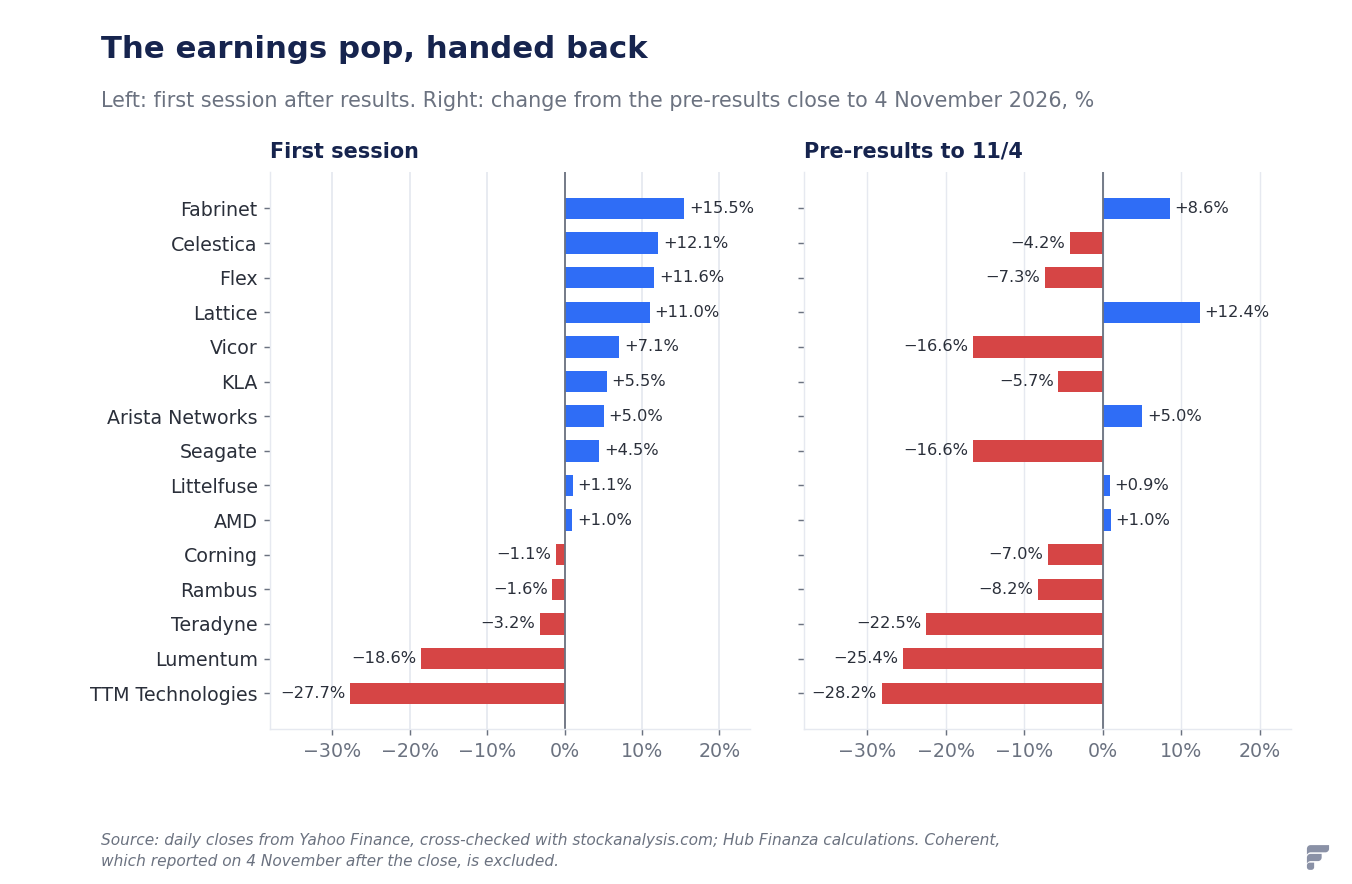
Between October 20 and November 4, 2026, sixteen companies in the artificial intelligence hardware supply chain published their results: almost all beat estimates or raised guidance. On the stock market, from October's high to November 4, they lost between 15% and 48%.
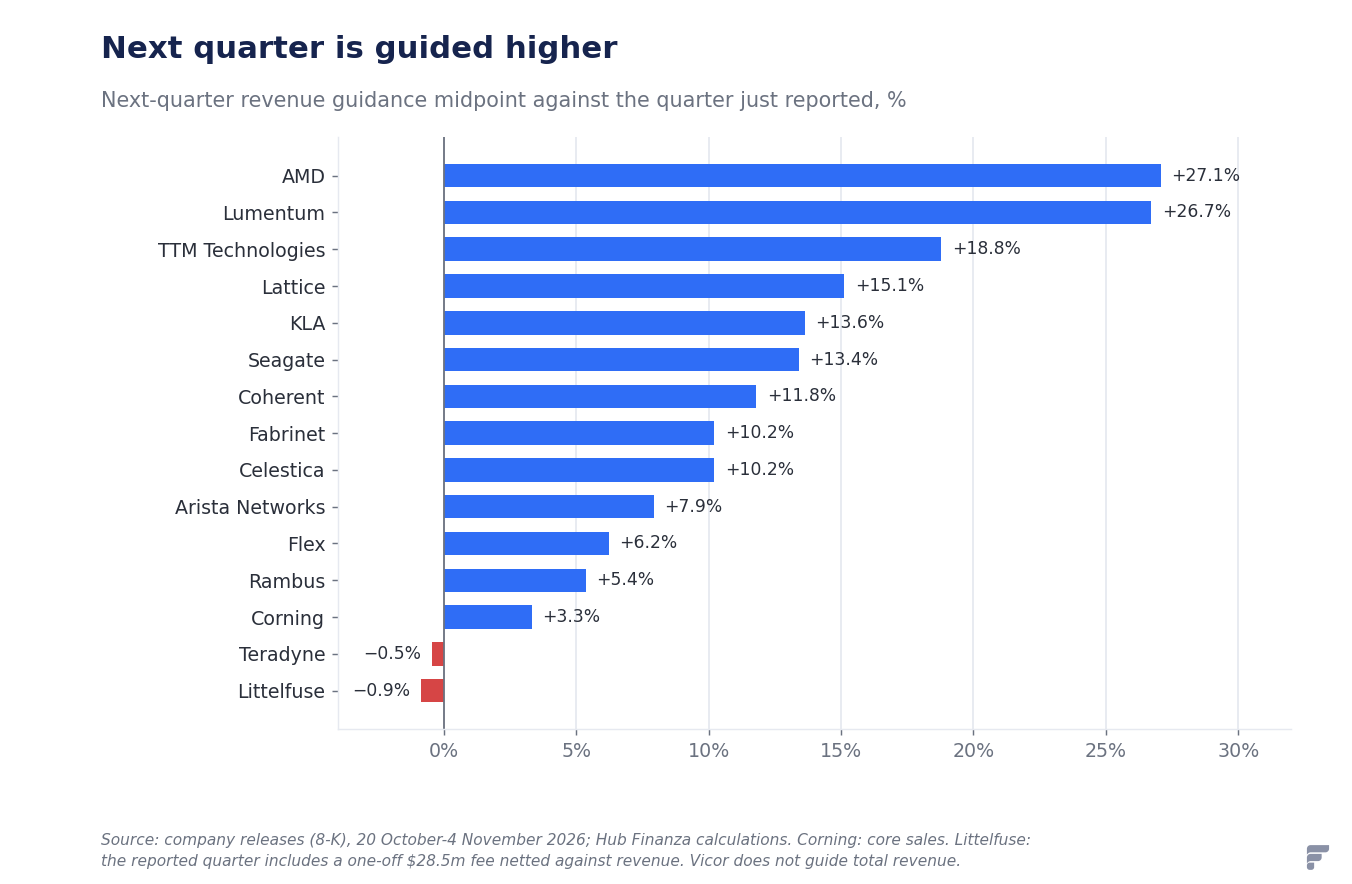
In the same period, the ETF replicating the S&P 500 dropped just 1.6% from its October high, the semiconductor ETF fell 20.4%, and Nvidia lost 16.3%. But the suppliers of suppliers suffered the most: those who make optical components that connect chips (Coherent −42.3%, Lumentum −44.7%), those who assemble servers for large cloud operators (Celestica −39.1%, TTM Technologies −44.9%), and those who produce power for racks (Vicor −48.5%). For seven of these stocks, the year's high was already behind them, between May and June: October's decline is the second wave of a downtrend that began in summer, and from the 2026 peak, declines range between 50% and 67%. Meanwhile, results show revenues growing up to 136% and almost all guidance higher than the just-ended quarter.
Why is the AI supply chain declining while results are rising?
Because the market is not doubting today's demand, but who will pay for it tomorrow. The causes that the financial press — CNBC in particular — has indicated day by day are about funding and rates, not orders: in mid-October, reports openly spoke of fears about AI funding. On October 14, US inflation for September at 3.7%, above expectations, reignited fears of a rate hike, which the Federal Reserve excluded only by majority on October 28, with two votes in favor of a tightening. On October 30, the day after Amazon's results, where it confirmed investments of approximately 220 billion in 2026 with free cash flow turning negative, the Nasdaq Composite lost 2.9%.
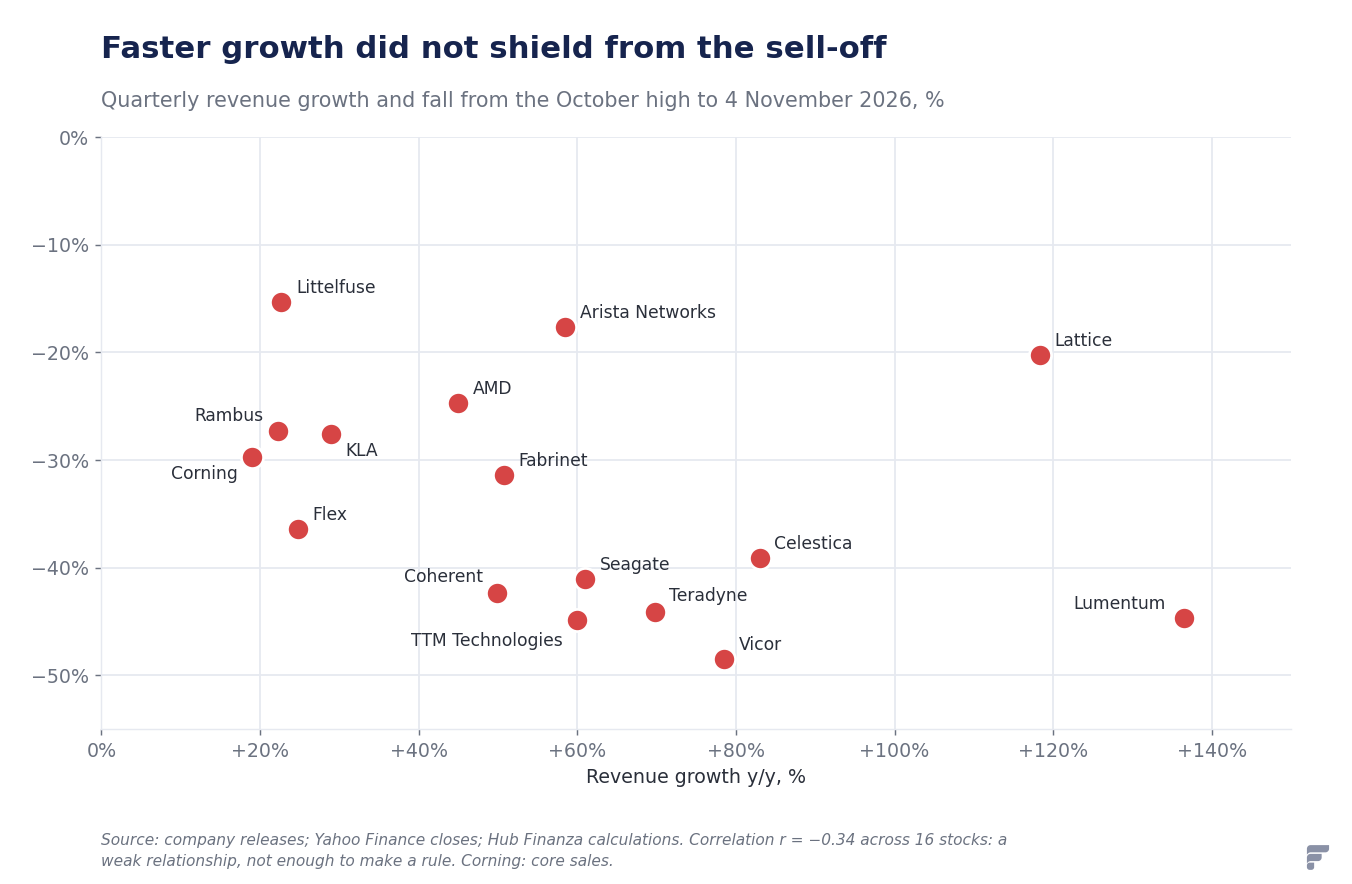
The thread is the same one we followed in the October 29 quarterly reports review, when Alphabet was penalized for investments and Microsoft rewarded: hyperscalers are spending like never before, but a growing part of that spending is debt-financed, and the supply chain that collects it is worth as much as the confidence that such spending will continue. It is the same value chain reconstructed in our guide on artificial intelligence put to the test. Smaller stocks and those more concentrated on a few clients were the first to pay. The chart below shows that, at least this season, higher growth did not protect against the downturn: between revenue growth and the decline from October's high, there is a negative but weak relationship (r = −0.34 on sixteen stocks), which is not enough to form a rule.
Optics: Coherent, Fabrinet, and the merger that changed Lumentum
Optical components — lasers, transceivers, modules that convert electrical signals into light to connect thousands of processors — are the most cited bottleneck in new data centers. Coherent published on Wednesday, November 4, after markets closed, revenues of 2,370 million dollars, +49.9%, with the data center and communications division at 1,952 million (+79% year-on-year, +21% quarter-on-quarter) and the industrial division down 15%. Adjusted earnings of 2.09 dollars exceeded FactSet's consensus of 1.99 reported by CNBC, and current quarter guidance (2.55-2.75 billion) is above expectations; the company aims for a 3 billion dollar quarter by year-end and a gross margin over 45% by 2028. During the session, the stock had lost 6%, hitting −41.5% from October 5; after closing, it recovered about 7%.
Fabrinet, which contract manufactures optical components for many competitors, closed the September quarter with revenues of 1,474.5 million (+50.7%), above its own range, with data center at 777 million (+78%) and record adjusted earnings of 4.34 dollars. Guidance (1.60-1.65 billion) indicates further acceleration, while free cash flow is negative by 137 million due to investments in new capacity. In the month before results, the stock had lost 32.1%; on November 3, it rose 15.5%, its best day in the group.
Lumentum had the strongest quarter of all and the worst reaction. On Monday, November 2, before the open, it announced revenues of 1,262.6 million, +136.5%, an adjusted operating margin of 42.3%, and guidance of 1,575-1,625 million, along with a second large contract for integrated optics in chips with purchasing commitments exceeding 5 billion. On the same day, it announced the merger with Marvell: 4.5 Marvell shares for every Lumentum share, all in stock, for an enterprise value of 115 billion, with closing expected in the first half of 2028. The official premium was 23.9% on October 28 prices, but on October 29, Marvell had already lost 13.2% on Bloomberg's rumors, and at October 30 prices, the premium had fallen to around 5%. On November 2, Lumentum lost 18.6% and Marvell 12.7%. From that day, Lumentum's price mostly followed Marvell's: as of November 4, 4.5 Marvell shares were worth 719 dollars against 626.75 for one Lumentum share, a gap of about 15% measuring the market's doubts about the transaction's closing.
Data center assemblers: Celestica, Flex, and TTM give back gains
Celestica published an extraordinary quarter on Monday, October 26: revenues of 5.83 billion (+83%) against guidance of 5.25-5.55 billion, the hyperscaler-serving division doubled to 4.87 billion, adjusted earnings more than doubled to 3.30 dollars. For 2027, the company indicates 40 billion in revenues (+90%) and 21.50 dollars in earnings per share, but cut its 2026 free cash flow estimate to 460 million (from 600 million) to finance working capital for growth, after raising 3.45 billion with a capital increase in August. The stock rose up to 18% after hours and closed on October 27 at +12.1%; on November 4, it lost 9% to 236.41 dollars, 39.1% below its October 6 high and half of its June high.
Flex followed the same trajectory: on October 28, revenues at 8.49 billion (+24.8%), the cloud and energy division at 2.5 billion (+54%), record adjusted earnings of 1.18 dollars (+49%) and annual guidance raised to 34.9-35.9 billion in revenues; the stock rose 11.6% in the session, but on November 4, after a −12.3%, it was already below the previous day's price. TTM Technologies, which produces printed circuit boards for data centers and defense, is the extreme case: on October 22, it reported record revenues of 1,203.9 million (+60%), an order-to-bill ratio of 2.13 and a defense portfolio of 2 billion, but guidance only in line with consensus and debt at 2.8 times EBITDA after acquisitions. The stock lost 27.7% in one day when the Nasdaq Composite fell 2.6%, recovered 8.4% the next day, and on November 4 was below its October 22 low: −67% from its June high, the largest decline in the supply chain.
Chips and the machines to make them: AMD, KLA, Teradyne, Lattice, and Rambus
AMD published on Tuesday, November 3, revenues of 13.38 billion (+45%), above the LSEG consensus of 13.09, with the data center almost doubled to 8.55 billion (+97%) thanks to the first Helios rack systems, already in use at Anthropic, Meta, Microsoft, OpenAI, and Oracle. Guidance for the fourth quarter is approximately 17 billion (+66%), well above expectations, and management sees 2027 revenues growing over 80%. The results are impacted by 1,097 million in non-cash charges related to warrants granted to OpenAI and Meta with supply contracts, and free cash flow decreased to 554 million due to an increase in inventory to 11.5 billion. The stock rose over 7% after closing, but on November 4 closed only at +1.0%.
KLA, the leader in process control machines for chip factories, closed the September quarter with record revenues of 4.14 billion (+29%) and an adjusted operating margin of 46.1%, the highest in its history; earnings per share, 1.22 dollars, are calculated after the 10:1 split on June 11. The crucial data for the entire sector is the forecast for worldwide spending on semiconductor machinery: around 155 billion in 2026 and over 200 billion in 2027. The stock rose 5.5% on October 29 and lost 5.7% the next day. Teradyne, which manufactures chip testing systems, almost doubled revenues (1,306 million, +69.8%) and brought its adjusted operating margin to 31.6% from 20.4%, with robotics returning to profit; but guidance indicates a flat fourth quarter, and on October 28, the stock opened at −6.5% and closed at −3.2%, then fell 22.5% from the day before to November 4.
Lattice Semiconductor more than doubled revenues to 291 million (+118%, above its own guidance's high), partly due to the acquisition of AMI, which accounts for 13% of the quarter; the CEO indicated growth of at least 60% in 2027, specifying that he does not see room to go beyond that. The stock rose 11% on November 3 and is the only one, along with Fabrinet, to be well above the previous day. Rambus, which sells interface chips for server memory, closed with record revenues of 218.3 million (+22.3%) and guidance above expectations, but the stock lost 1.6% on October 27 after a 5.5% rise in the previous session.
Networks, disks, fiber, and power: Arista, Seagate, Corning, Vicor, and Littelfuse
Arista Networks had its highest growth since its IPO: revenues of 3.66 billion (+58.5%) against a consensus of 3.33 billion, adjusted operating margin of 49.1%, and in the conference call, a forecast for 2027 of approximately 18.5 billion, 38-40% higher, while consensus was around 16.4-16.75 billion. Purchase commitments with suppliers rose to 11.4 billion to secure components. After closing on November 3, the stock rose up to 12%, and on November 4 closed at +5.1%. Seagate closed the September quarter with revenues of 4.23 billion (+61%) and a gross margin of 57.8%, 510 basis points higher in just one quarter: most data center capacity is already sold with multi-year contracts up to 2028, some up to 2030, and prices are fixed until 2027. The stock fell up to 8% after closing on October 27, closed the next day at +4.5%, and by November 4 was 41% below its October high.
Corning saw optical fiber sales reach 2.38 billion (+44%), with enterprise networks at +84% and generative AI products more than doubled, and signed four multi-billion dollar multi-year agreements, including with Verizon and AT&T; the stock closed on October 27 at −1.1%, after a daily low of −4.7%. Vicor, which designs power converters for AI processors, published on October 20 revenues of 197.1 million (+78.5%), an order book almost tripled to 406 million, and the first license of its patents to an AI system builder; however, a portion of the quarter's royalties was one-off. The stock rose 7.1% that day and then lost 48.5% from its October high, the largest decline in the initial chart. Littelfuse, an electronic components company less exposed to AI, had record revenues of 766.7 million (+22.7%) despite a one-off commission of 28.5 million, and is the stock that held up best: −15.3% from its October high.
The overall picture
Company | Revenues (Δ Y/Y) | First session | From October high to 11/4 |
|---|---|---|---|
Lumentum | 1,262.6 Mln$ (+136.5%) | −18.6% | −44.7% |
Lattice | 291 Mln$ (+118%) | +11.0% | −20.2% |
Celestica | 5.83 Bld$ (+83%) | +12.1% | −39.1% |
Vicor | 197.1 Mln$ (+78.5%) | +7.1% | −48.5% |
Teradyne | 1,306 Mln$ (+69.8%) | −3.2% | −44.1% |
Seagate | 4.23 Bld$ (+61%) | +4.5% | −41.1% |
TTM Technologies | 1,203.9 Mln$ (+60%) | −27.7% | −44.9% |
Arista Networks | 3.66 Bld$ (+58.5%) | +5.1% | −17.7% |
Fabrinet | 1,474.5 Mln$ (+50.7%) | +15.5% | −31.4% |
Coherent | 2,370 Mln$ (+49.9%) | ≈ +7% (after-hours) | −42.3% |
AMD | 13.38 Bld$ (+45%) | +1.0% | −24.7% |
KLA | 4.14 Bld$ (+29%) | +5.5% | −27.6% |
Flex | 8.49 Bld$ (+24.8%) | +11.6% | −36.4% |
Littelfuse | 766.7 Mln$ (+22.7%) | +1.1% | −15.3% |
Rambus | 218.3 Mln$ (+22.3%) | −1.6% | −27.3% |
Corning | 5.08 Bld$ core (+19%) | −1.1% | −29.7% |
Lined up, the supply chain reveals a divergence rarely seen so clearly: numbers improve with every line, prices worsen with every week. This is not a paradox, but a different choice of horizon. The results measure what hyperscalers have already ordered; prices try to understand how long they can continue to order, with what debt and at what rates. The market paid on results day and gave back the gains in subsequent weeks, a sign that the problem does not lie in any of the sixteen quarterly reports. This is an interpretation, not a forecast: sixteen companies in fifteen days do not tell whether the second wave of decline has ended.
For those who want to review why a stock can crash precisely on its best results, and how to read guidance, our guide on how to read a quarterly report explains the mechanism with examples from the archive.
What to watch in the coming months
Thursday, November 5 — Coherent. The first full trading session after results will tell if the evening recovery holds.
Hyperscaler 2027 investment guidance. Amazon has already said it will spend "significantly more": exact figures will come with fourth-quarter results, between late January and February 2027, and are the data on which the supply chain depends.
Spending on chip machinery. KLA's forecast of over 200 billion in 2027 will be tested by chip manufacturers' investment plans for next year.
Marvell and Lumentum. Shareholder meetings and antitrust approvals: the gap between Lumentum's price and the value of 4.5 Marvell shares will measure, day by day, confidence in closing by the first half of 2028.
Sources
Results releases and related SEC filings (8-K with exhibit 99.1, 10-Q) from AMD, Arista Networks, KLA, Teradyne, Lattice Semiconductor, Rambus, Seagate, Corning, Vicor, Coherent, Fabrinet, Lumentum, Celestica, Flex, TTM Technologies, and Littelfuse; joint Marvell-Lumentum release of November 2, 2026; Celestica stock offering prospectus (August 2026); conference call transcripts; CNBC for LSEG and FactSet consensus, after-hours trading, and decline chronology. Closing prices: Yahoo Finance, cross-referenced with stockanalysis.com; variations and correlation calculated by Hub Finanza. Data as of November 4, 2026.
Disclaimer: this article is for informational purposes only and does not constitute financial advice. Any investment decision should be evaluated based on one's own situation and, if necessary, with a qualified professional.