

On 21 October 2026, Eurostat published the data that Istat notified to Brussels: in 2025, the Italian deficit is 69.7 billion euros, 3.1% of GDP (3.4% in 2024), and debt rises to 136.7% of GDP, from 134.3%. Eurostat expressed no reservations about Italy.
The 3.1% is one decimal above the reference value of 3% and one above the euro area average, which Eurostat indicates at 3.0%. Debt, on the other hand, remains forty-nine points higher than that of the euro area (87.7%). The figures that follow come from the Eurostat press release of 21 October and from the Ministry of Economy's Public Finance Planning Document (DPFP), approved on 2 October; where they are forecasts, we state so.
The notification numbers
These are the four numbers to keep in mind for 2025, in the October notified version:
- Net borrowing (deficit): 69,736 million euros, 3.1% of GDP. In 2024 it was 74,835 million, 3.4%: the decrease is 5.1 billion.
- Primary balance (deficit excluding interest): positive for 17,422 million, 0.8% of GDP, according to the Ministry of Economy's DPFP.
- Interest expenditure: 87,158 million, 3.8% of GDP, compared to 3.9% in 2024 (85,475 million). According to Teleborsa, the figure does not include the effect of swaps.
- General government debt: 3,097,093 million euros, 136.7% of GDP, compared to 134.3% in 2024 (2,967,833 million).
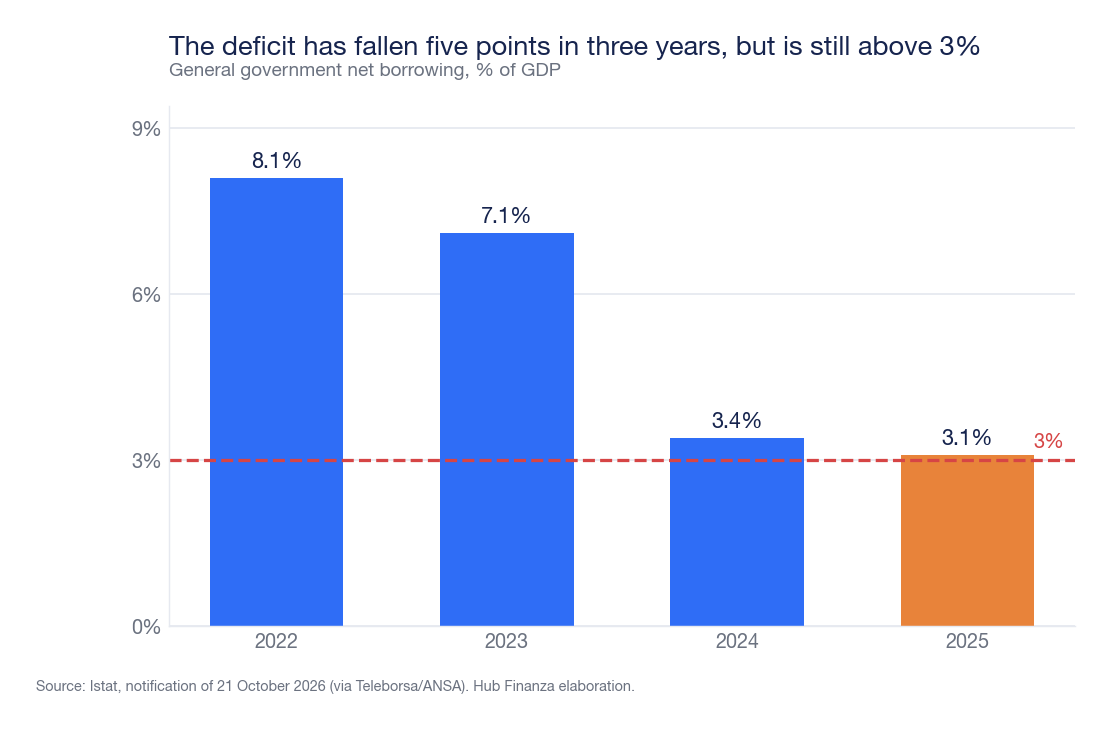
The series shows the distance covered: from 8.1% in 2022 to 7.1% in 2023, then the jump to 3.4% in 2024 and 3.1% in 2025. Five GDP points in three years; still one decimal missing to fall below 3%.
Why does deficit fall and debt rise?
The two figures seem contradictory but are not. The deficit measures how much more the State spends than it collects in a year; debt is the stock of all years combined, and also changes due to operations that do not pass through the deficit. In 2025, it increased by 129,260 million euros, 5.7% of GDP: 69,736 million is the deficit, the other 59,524 million, 2.6% of GDP, is what the accounts call the stock-flow adjustment. In 2024, the increase was 97,560 million, 4.4% of GDP, of which 22,725 million, about 1.0%, was adjustment: a value we calculated from Eurostat data. The DPFP reports 2.6% for 2025 without detailing its composition.
The debt-to-GDP ratio rises by 2.5 points, and no more, because nominal GDP in the denominator also grows: 2,265,003 million in 2025, 2.5% more than the 2,210,595 million in 2024, while debt grows by 4.4%. For why GDP matters so much, see the guide on GDP and the labor market.
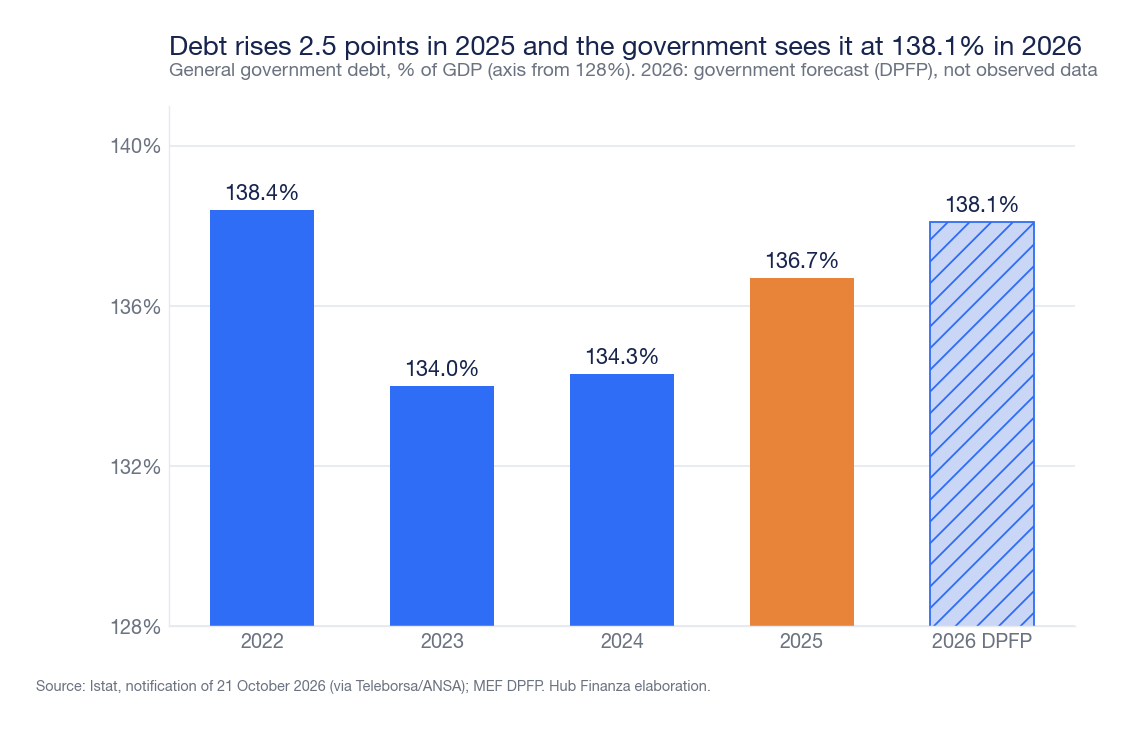
In 2026 the ratio does not fall. The DPFP estimates debt at 138.1% of GDP in 2026, and the same quarterly Eurostat data, published on 21 October, indicates 139.9% for Italy at the end of June against 138.6% at the end of March: a quarterly measure, which should not be compared with the annual one, but which goes in the same direction. These are different forecasts and surveys: the first is from the government, the second is from Eurostat.
What has changed compared to April
The October notification confirms 3.1%, but does not repeat the April figures. In April, according to the Public Finance Document of 22 April and the Eurostat press release of the same month, the 2025 deficit was 69,381 million (3.1% of GDP), that of 2024 was 73,779 million, interest expenditure was 87,146 million (3.9% of GDP) and debt was 3,095,888 million, 137.1% of GDP. Today the 2025 deficit is 355 million higher and that of 2024 is 1,056 million higher; the decrease from 2024 goes from 4.4 to 5.1 billion.
Debt in euros rises by 1,205 million, but the ratio falls by 0.4 points, from 137.1% to 136.7%. The reason, the DPFP explains, is the denominator: the revision of national accounts published by Istat on 22 September raised nominal GDP 2025 from 2,258,049 to 2,265,003 million, about 0.3% more. This is based on new sources on corporate accounts for 2024-2025 and methodological innovations related to Eurostat's reservations on gross national income. The ratio has therefore fallen because GDP was revised upwards, not because debt fell. We were unable to open the Istat press release of October: the explanation is that of the Ministry of Economy.
Italy compared to the euro area and major countries
With homogeneous definitions and periods, those of the same Eurostat notification, the comparison for 2025 is as follows. The euro area, within the twenty-country scope that Eurostat comments on for data up to 2025, has a deficit of 3.0% (2.9% in the April notification) and debt of 87.7% (87.8% in April). Germany has a deficit of 2.9% and debt of 62.8%; France of 5.1% and 115.7%; Spain of 2.4% and 100.5%. Eleven Member States of the Union closed 2025 with a deficit equal to or greater than 3%.
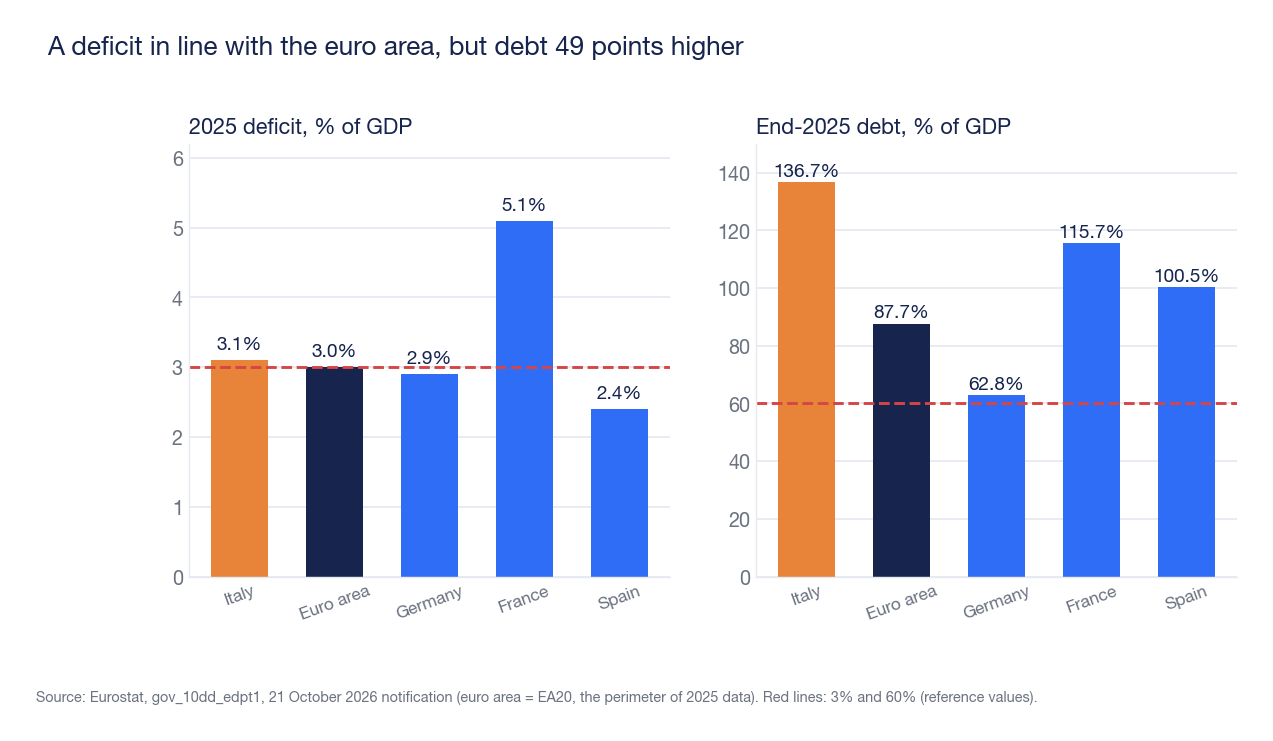
The interpretation is twofold. On the deficit, Italy is no longer an exception: 3.1% against 3.0% for the euro area, and much better than France. On debt, it remains the most indebted country among those considered, 49 points from the euro area average and 21 from France. Growth also helps little: in 2025, Italy's real GDP grew by 0.6%, that of the euro area by 1.2%, according to Eurostat data. In the first two quarters of 2026, Italy achieved +0.3% and +0.2% on the previous quarter.
Above 3%: the European procedure and the DPFP
Italy has been in an excessive deficit procedure since July 2024. On 3 June 2026, in the spring package of the European Semester, the Commission acknowledged, Teleborsa reports, that the country had taken effective measures and left the procedure pending, without closing it. Net expenditure in 2025 exceeded the recommended limits, but only marginally in cumulative terms.
The DPFP of 2 October indicates a programmatic deficit of 2.9% in 2026, 3.4% in 2027, 3.2% in 2028 and 2.3% in 2029: the increase in 2027-2028 derives from the national safeguard clause for defense and energy, 0.3% plus 0.3% of GDP per year. Without the clause, the trend is 2.9% in 2026 and 2027, 2.7% in 2028 and 2.2% in 2029. For debt, the programmatic target is 138.1% in 2026, 138.5% in 2027, 137.9% in 2028 and 136.6% in 2029. According to the Ministry, the procedure could be abrogated based on the 2026 outturn data, if the Commission's spring 2027 forecasts confirm it. These are government forecasts, not observed data.
What this means for households and businesses
The most concrete figure is interest expenditure: 87.2 billion euros in 2025, five times the primary surplus of 17.4 billion. In other words, the State collects, net of interest, more than it spends, but the result is not enough to cover the cost of debt, and the final balance is a deficit of 69.7 billion.
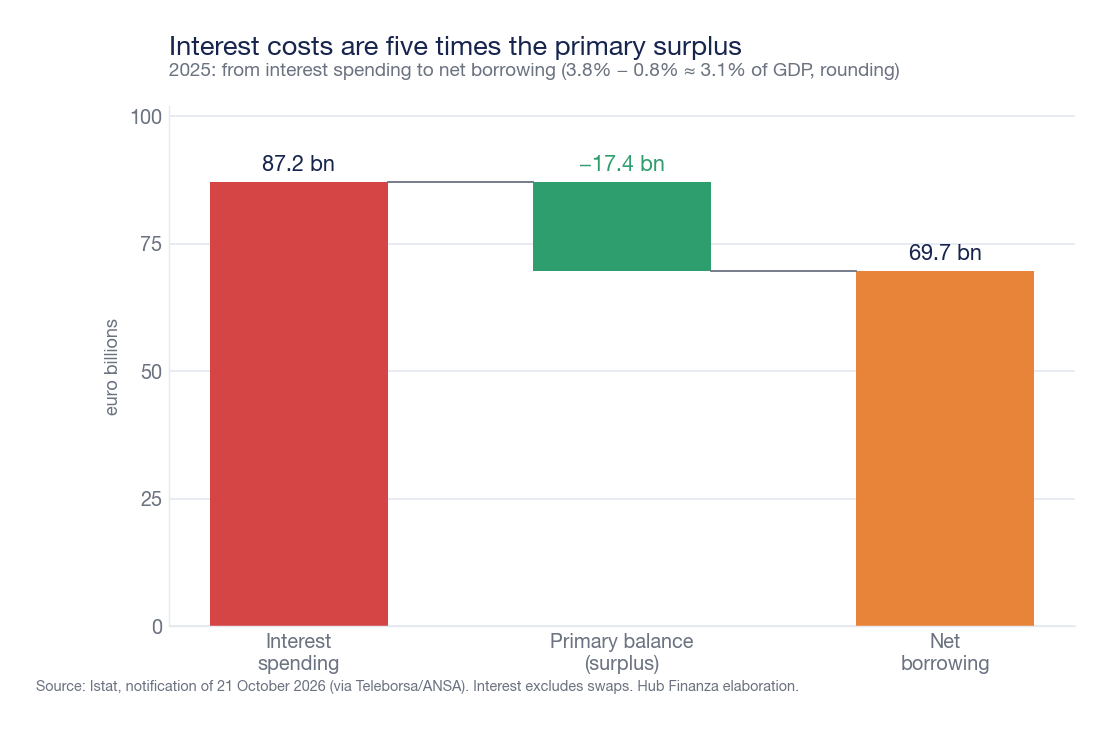
This is the editorial team's interpretation, not an Istat figure: as long as such a large share of the budget is used to pay interest, the margin for reducing taxes or increasing spending remains narrow. For savers or mortgage holders, the channel is indirect but exists: what investors demand to hold Italian bonds is measured in the BTP-Bund spread, and rising debt and a deficit still above 3% are among the elements that fuel its interpretation. The 3.1% is no surprise: it was the figure in April too.
What to watch in the coming months
Three appointments will tell if the deficit reduction holds. On 30 October, Eurostat publishes the flash estimate of euro area GDP for the third quarter; the date is confirmed by its calendar. Then there are the Commission's Spring 2027 Forecasts, the step on which the government bases its request to exit the procedure; and the Spring 2027 notification, which will cover 2026 and will state whether the deficit has fallen below 3%. The date for the Commission's Autumn Forecasts, however, has not yet been indicated. We will follow each stage with official data.
Sources
Eurostat, press release «Provision of deficit and debt data for 2025 – second notification» of 21 October 2026 and dataset gov_10dd_edpt1 (deficit, debt, calculated stock-flow adjustment, euro area, Germany, France, Spain, reservations); Eurostat press release of 21 October on quarterly debt for the second quarter of 2026; GDP and growth from Eurostat (nama_10_gdp, namq_10_gdp). Public Finance Planning Document 2026 of the Ministry of Economy and Finance, approved on 2 October 2026, and Public Finance Document of 22 April 2026: primary balance, GDP revision, targets and forecasts. Istat notification of 21 October 2026 in the text reported by ANSA and Teleborsa (interest and swaps, Commission decision of 3 June 2026). European Commission Spring 2026 Forecasts for Italy, 21 May 2026. The differences compared to April, the calculation of the stock-flow adjustment, the ratio between interest and primary balance, and the charts are editorial elaborations based on the cited data.
This article is for informational purposes only and does not constitute financial advice, investment research, solicitation of public savings, or a personalized recommendation for purchase or sale. The assessments expressed are opinions of the editorial team based on public data as of the publication date and may change without notice. The value of investments may decrease as well as increase, and past performance is not indicative of future returns. Before any investment decision, it is advisable to consult a qualified financial advisor and evaluate the consistency of the operation with one's objectives, time horizon, and risk tolerance.