Between October 28 and November 4, 2026, thirteen pharmaceutical and healthcare companies published their earnings: ten reported growing or stable revenues, nine a decline in GAAP earnings per share. The most frequent cause is the price of acquisitions, which also weighs on "adjusted" earnings.
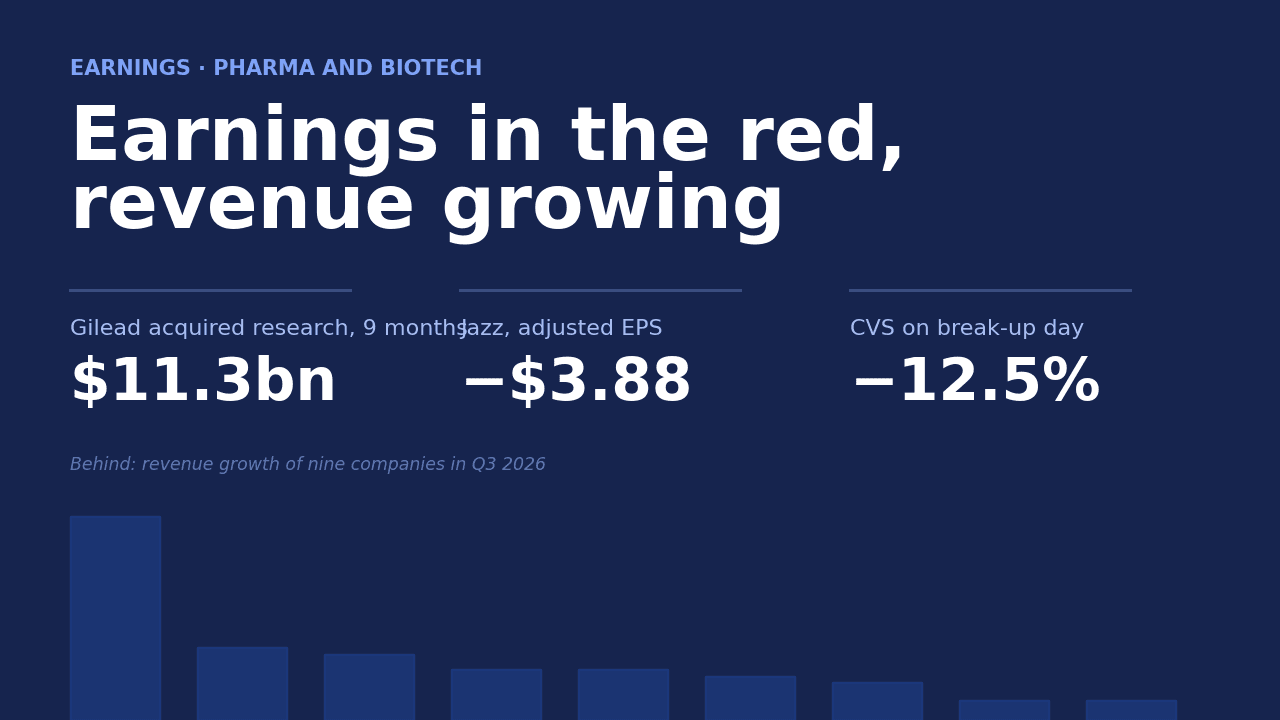
The most extreme case is Gilead, which in the first nine months of the year expensed 11.3 billion dollars in acquired research and will close 2026 at a loss even by its own "adjusted" measure. Jazz Pharmaceuticals reported record revenues and negative adjusted earnings of 3.88 dollars per share. Bristol Myers Squibb, AbbVie, Pfizer, Vertex, Neurocrine, and United Therapeutics all, to varying degrees, bear the mark of a recent operation. Those who only look at the earnings line see a sector in difficulty; those who look at revenues see the opposite. The market, which reacted with trading sessions ranging from Neurocrine's +13.4% to CVS Health's −12.5%, mainly looked at other factors: guidance, launches, and a calendar of regulatory verdicts that begins on November 30.
Why can a growing pharmaceutical company close the quarter at a loss?
Due to an accounting rule that weighs more heavily in this sector than elsewhere. When a company buys another company — or the license for a drug — that has not yet approved molecules, the portion of the price attributed to that research is called IPR&D (in-process research and development). If the operation is an asset acquisition rather than a functioning business, according to American accounting principles, that value is not amortized over the years: it is recorded as an expense all at once, in the quarter in which the deal closes. A billion-dollar acquisition can thus wipe out a quarter's profit without an additional dollar being spent from ordinary operations.
The detail that confuses many is the second step. One would expect "adjusted" earnings — what companies build by removing extraordinary items, and what analysts use for consensus — to clean up the accounts of these charges. This quarter, for five of the seven large companies we examined, this is not the case: AbbVie, Bristol Myers, Gilead, Pfizer, and Jazz also leave acquired research within the adjusted figure, which is depressed to the same extent. The items that truly separate the two numbers are others: amortization of acquired intangible assets, impairments, and integration costs. The result is that, this season, neither GAAP earnings nor adjusted earnings alone tell the story of how the business is performing. Revenues tell that story — and that's why our guide on how to read a quarterly report starts there, before earnings.
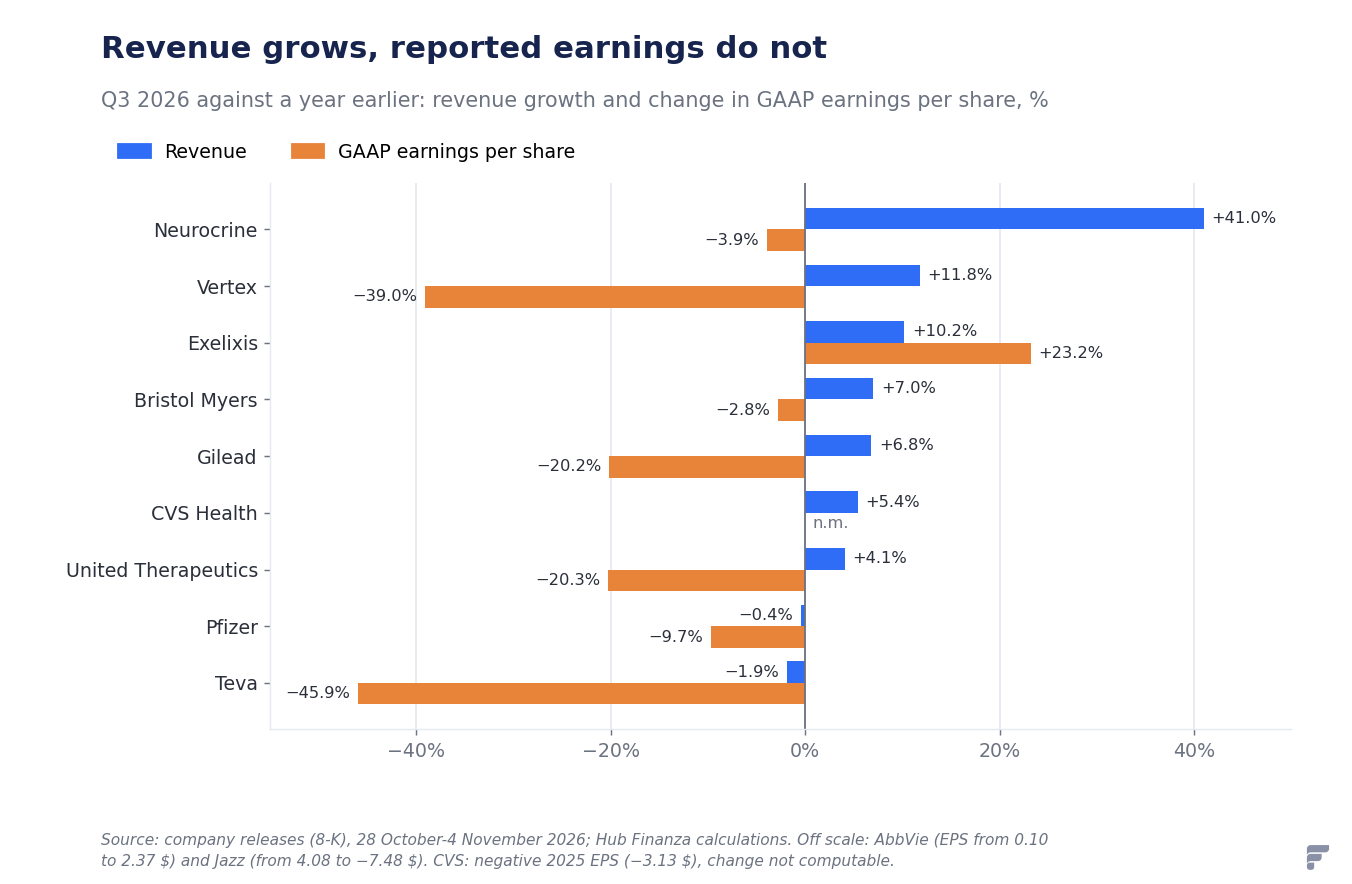
Gilead, Jazz and Bristol: the cost of bought research
Gilead Sciences published its quarterly report on Thursday, October 29, after markets closed, which its CEO Daniel O'Day called the quarter of "the strongest year-over-year core business growth in over a decade." Total revenues rose 7% to 8.30 billion, but the comparison is skewed by a one-time payment last year: product sales alone grew 13%, and 16% excluding the now residual antiviral Veklury (86 million, −69%). HIV sales were 6.25 billion (+18%), with Biktarvy at 4.06 billion and Descovy at 1.05 billion (+49%); HIV prevention sales nearly doubled thanks to Yeztugo (305 million versus 39). GAAP earnings per share for the quarter were 1.94 dollars, down from 2.43 due to losses on securities in the portfolio. The deals' impact is in the full year: between Arcellx, Tubulis, Ouro Medicines, and PepStar (the latter not yet closed), Gilead expects 12.4 billion in acquired research in 2026, equivalent to 9.88 dollars per share, plus 1.75 billion in impairments. Product sales guidance was raised to 31.0-31.3 billion (from 30.1-30.4), adjusted earnings guidance is now a loss between 1.20 and 0.85 dollars per share. The stock closed on October 30 at +3.1%.
Jazz Pharmaceuticals is a textbook case. On Monday, November 2, it reported record revenues of 1,243 million (+10.4%), with the sleep drug Xywav at 483 million (+12%, approximately 17,550 patients) and the oncology drug Ziihera more than doubled to 20.6 million after August approval in gastroesophageal cancer. Earnings per share were negative at 7.48 GAAP dollars and 3.88 adjusted dollars. The reason is a single item: 754.2 million in acquired research from Actio Biosciences, bought with an 820 million upfront payment, which accounts for 11.03 dollars per share in the adjusted figure. Without that item, adjusted earnings would be approximately 7.15 dollars — a calculation the company itself allows, and which is still 12% below the 8.13 dollars from a year prior. 2026 revenue guidance was raised to 4,775-4,850 million (from 4,600-4,750) and the stock closed on November 3 at +7.1%.
Bristol Myers Squibb did the same, on a smaller scale: adjusted earnings of 1.35 dollars (against an LSEG consensus of 1.14, according to Reuters) include 0.58 dollars in acquired research. Revenues rose 7% to 13.08 billion, with the "growth portfolio" at 7.66 billion (+12%): the cardiology drug Camzyos +42%, cell therapy Breyanzi +46%, Reblozyl +22%. The anticoagulant Eliquis, which alone accounts for 4.69 billion (+25%), is also the big risk: its exclusivity expires, and the company raised 2026 revenue guidance to 49.75-50.25 billion while the market is already looking ahead. The stock rose 1.35% on October 29; the next milestone is milvexian, the new anticoagulant whose secondary stroke study (Librexia STROKE) has results expected by 2026, while the atrial fibrillation study has been delayed to the first quarter of 2027.
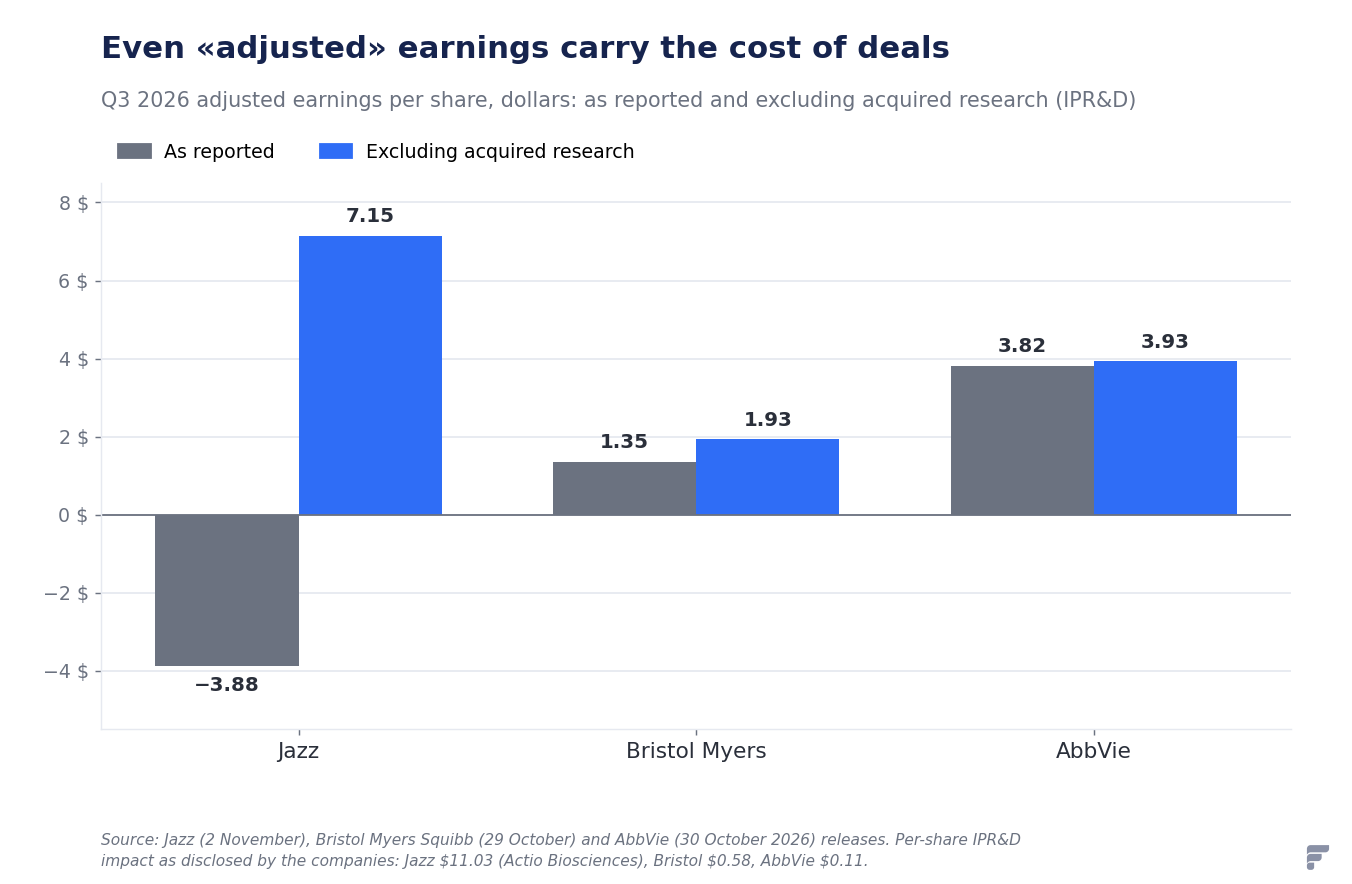
AbbVie, Pfizer and Teva: three transitions readable in revenues
AbbVie concluded its post-Humira transition. On Friday, October 30, it reported revenues of 17.40 billion (+10.3%), with Skyrizi at 5.78 billion (+22.7%) and Rinvoq at 2.71 billion (+23.9%) largely offsetting Humira's decline, now at 683 million (−31.2%), and with neuroscience at 3.39 billion. Adjusted earnings rose from 1.86 to 3.82 dollars, but the comparison should be read carefully: a year ago, the third quarter was weighed down by 2.68 billion in acquired research, so the 105% growth is largely a base effect. The difference between GAAP earnings (2.37 dollars) and adjusted earnings comes from amortization (0.79 dollars), the revaluation of future payments related to acquisitions (0.46 dollars, 829 million), and integration costs. 2026 adjusted earnings guidance was raised to 13.95-13.99 dollars, the quarterly dividend increased 5.2% to 1.82 dollars, and the stock closed on October 30 at a record high of 294.89 dollars (+1.4%).
Pfizer reported flat revenues (16.58 billion) but, excluding COVID products, operational growth of 7%; recent launches and acquisitions grew 32%, and the oncology drug Padcev grew 55%. Here too, acquired research — 650 million for the agreement with Innovent — remains in adjusted earnings, which stand at 0.87 dollars, the same as a year ago. Guidance was raised for revenues (62-64 billion, from 60.5-62.5) and adjusted earnings (2.95-3.05 dollars, from 2.80-3.00), and for obesity, the company is conducting ten Phase 3 studies on berobenatide, the molecule acquired with Metsera, with a first launch targeted for 2028. This was not enough for the market: −2.2% on Tuesday, November 3.
Teva represents the most complete transition in the group. Revenues fell 2% to 4,395 million because generics in the United States plummeted 39% with the entry of competition for lenalidomide, but branded drugs grew 33% at constant currencies: Austedo 751 million (+21%), Ajovy 269 million (+61%), Uzedy 85 million (+96%). GAAP earnings of 0.20 dollars became 0.86 adjusted dollars after 780 million net adjustments, including impairments (228 million), legal accruals (201), and the loss on early debt repayment (224), refinanced for approximately 4.9 billion. This is the item that says the most: in 2026, Teva returned to investment grade by all three major rating agencies. Revenue guidance was raised to 16.7-17.0 billion and Austedo guidance to 2.55-2.65 billion; the stock closed on November 3 at +3.0% and is up 34% year-to-date.
Neurocrine, Vertex and United Therapeutics: when acquisition costs are removed, and when they are not
In mid-sized biotechs, the accounting for deals works differently, and the comparison is instructive. Neurocrine Biosciences had the strongest quarter in the group: revenues at 1,122.7 million, +41%, with Ingrezza at 801 million (+17%, including approximately 20 million in order prepayments that will reverse in the fourth quarter), Crenessity more than doubled to 211 million, and Vykat XR, acquired with Soleno, at 107 million. Here, the costs of the operation are excluded from the non-GAAP figure (3.29 dollars versus 1.96 GAAP), but they account for only part of the difference — approximately 0.57 dollars per share: the rest are stock-based compensation and an unrealized loss on an investment. The stock closed on November 3 at +13.4%, the best session in the group, with Ingrezza guidance raised to 2,900-2,925 million. However, the company has already warned that Ingrezza volumes will grow by double digits in 2027 with a "mid-to-high single-digit" net price concession.
Vertex removes 502 million in costs related to the Crinetics acquisition from the non-GAAP figure, which alone account for approximately 1.97 dollars of the 2.20 difference between GAAP earnings (2.56) and non-GAAP earnings (4.76, in line with consensus). Revenues grew 12% to 3.44 billion while the cystic fibrosis franchise undergoes a transformation: Trikafta fell to 2.44 billion (−8%) as patients switch to Alyftrek, which rose to 706 million, and the new non-opioid analgesic Journavx surpassed 750,000 prescriptions in the quarter. The stock lost 4.0% on November 3, the day after earnings. The next examination has a date: on November 30, the FDA must decide on povetacicept in IgA nephropathy.
United Therapeutics does not publish adjusted earnings, which is why on Wednesday, November 4, several sources reported a "missed target" comparing GAAP earnings of 5.71 dollars with a consensus built on different bases. The quarter includes 133.6 million in acquired research from Thymmune, which is not tax-deductible — by our calculation approximately 2.95 dollars per share — and, conversely, the release of a legal accrual of 66.5 million after the settlement of the lawsuit with Sandoz. Revenues were a record 832.5 million (+4.1%), with Tyvaso at 503.8 million and over a thousand new therapy requests in October, the highest monthly total in the company's history. The fourth quarter will also bring a deal-related charge: on November 3, the company paid 525 million to Arena, now part of Pfizer, to eliminate future royalties on ralinepag. And it is ralinepag that faces the most concrete risk: the sole supplier of the active pharmaceutical ingredient received a negative classification from the FDA after an inspection, and the company states that alternative suppliers will likely not be ready by the decision date of June 24, 2027. The stock opened on November 4 at −2.9% and closed at +1.2%.
The useful contrast is Exelixis, the only one in the group with an accountably clean quarter: no acquisitions, the non-GAAP figure only removes stock-based compensation. Revenues +10.2% to 658.7 million, Cabometyx at 603 million with a 49% share among targeted oral therapies in its segment (from 46%), GAAP earnings per share +23% to 0.85 dollars. 2026 guidance is confirmed at 2.50-2.55 billion, and the FDA's decision on zanzalintinib in previously treated colorectal cancer has been postponed by three months, to March 3, 2027. The stock rose 4.8% on October 30.
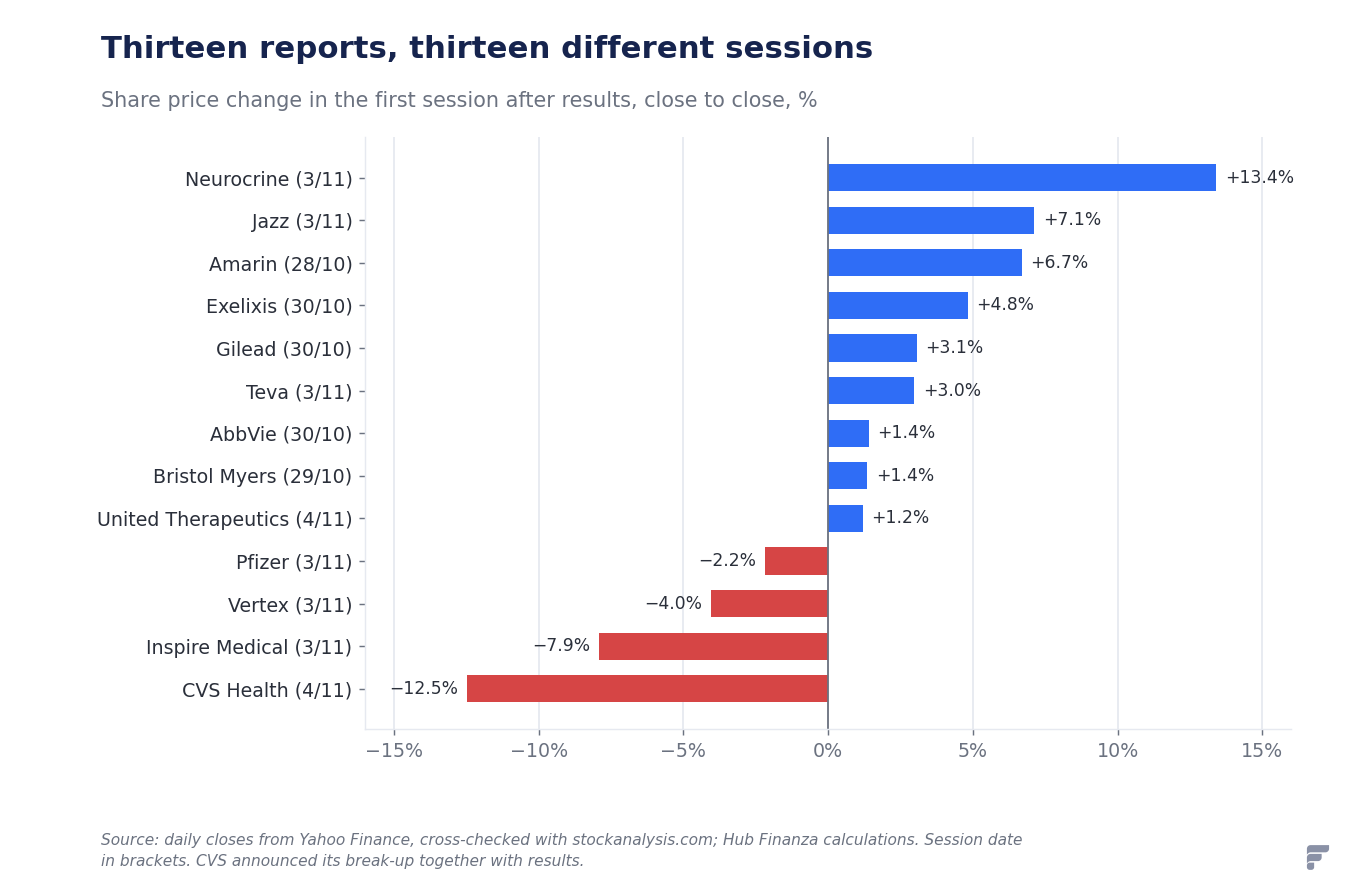
CVS, Inspire and Amarin: three stories where accounting is not relevant
CVS Health delivered a better-than-expected quarter on Wednesday, November 4 — revenues at 108.4 billion (+5.4%), adjusted earnings at 2.09 dollars versus 1.60, the Aetna insurance medical loss ratio decreased to 91.3% from 92.8% — and raised its 2026 adjusted earnings guidance to at least 8.20 dollars. Along with the earnings, it announced the spin-off into two publicly traded companies by the first half of 2028: on one side CVS Health, with Aetna, the pharmacy benefit manager Caremark, CVS Specialty, Oak Street Health, and Signify Health; on the other CVS Pharmacy, with approximately 9,000 pharmacies, mail-order pharmacy, and MinuteClinic. The stock closed at −12.5%, at 79.96 dollars, erasing almost all of the year's gains in one session: it is now +0.8% year-to-date for 2026. Among the causes, Investing.com cited the deterioration of Aetna's 2027 Medicare Advantage plan star ratings and the execution risk of such a complex operation.
Inspire Medical Systems, which manufactures an implantable device for sleep apnea, is the only case in the group where revenues genuinely fell (−7.9% to 206.7 million) for operational reasons: changes in reimbursements and procedure coding cost it approximately 30 million in the quarter and about 120 million for the year. The extraordinary charges here are for restructuring and litigation, not acquisitions. The stock rose 1.8% after the earnings release on November 2, lost 7.9% the next day, and recovered 7.6% on November 4, the day the American healthcare authority published the final rule on 2027 outpatient reimbursements. The structural solution has a distant date: new procedure codes will come into effect on January 1, 2028.
Amarin is a separate story: revenues down 20% to 39.6 million due to generic competition for Vascepa in the United States, but the first profitable quarter in over two years after a 70 million savings plan, and 323.4 million in cash with no debt. By our calculation, at November 4 prices, the company is valued at approximately 256 million on the stock market, less than the cash it holds; it continues to work with Barclays on strategic options, a mandate that was already known since July. The stock rose 6.7% on October 28.
The verdict calendar: ten dates in the next fourteen months
If the quarterly earnings were read with leniency, it is also because the value of many of these companies depends on events that have yet to occur. The chart lists those with a date communicated by the companies.
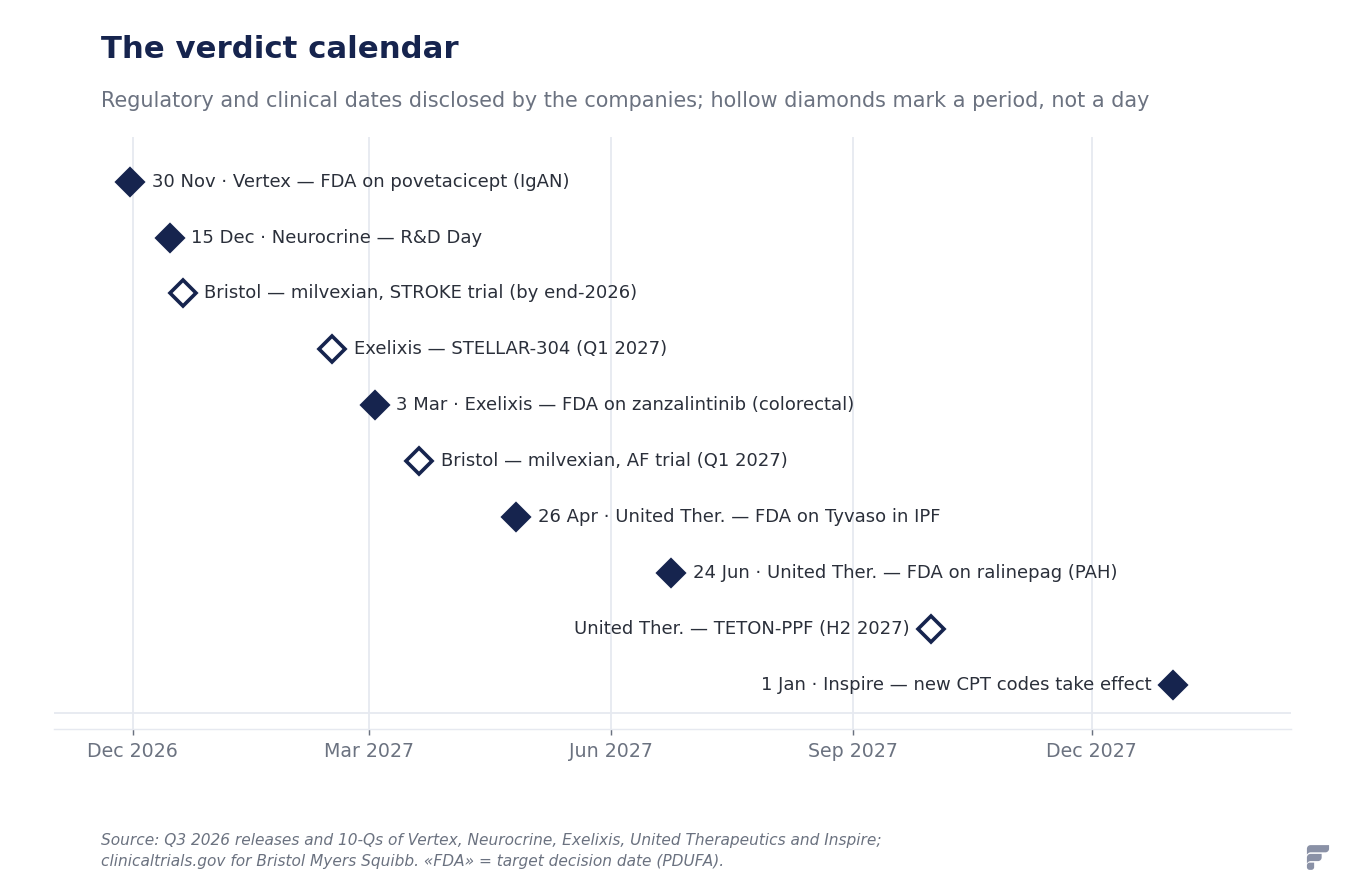
- November 30, 2026 — Vertex. FDA decision on povetacicept in IgA nephropathy, under priority review for accelerated approval.
- December 15, 2026 — Neurocrine. R&D Day in New York, with an in-depth focus on Vykat XR.
- By end of 2026 and first quarter 2027 — Bristol Myers. The two studies on milvexian: these are the steps that will determine how much of the gap left by Eliquis can be filled.
- March 3, 2027 — Exelixis. FDA decision on zanzalintinib in previously treated colorectal cancer; data from the STELLAR-304 study also due in the first quarter.
- April 26 and June 24, 2027 — United Therapeutics. FDA decisions on Tyvaso in idiopathic pulmonary fibrosis and on ralinepag, with the already declared supplier risk.
- January 1, 2028 — Inspire. New procedure codes come into effect that should stabilize reimbursements.
The overall picture
| Company | Q3 Revenues (Y/Y Δ) | Earnings per share: GAAP · adjusted | The weight of deals | First session |
|---|---|---|---|---|
| Neurocrine | 1,122.7 M$ (+41%) | 1.96 · 3.29 $ | Soleno: costs excluded from non-GAAP | +13.4% |
| Jazz | 1,243 M$ (+10.4%) | −7.48 · −3.88 $ | Actio: 11.03 $ also in adjusted | +7.1% |
| Amarin | 39.6 M$ (−20%) | break-even | — | +6.7% |
| Exelixis | 658.7 M$ (+10.2%) | 0.85 · 0.94 $ | None | +4.8% |
| Gilead | 8.30 B$ (+7%) | 1.94 · 2.55 $ | 12.4 B$ expected for the year, also in adjusted | +3.1% |
| Teva | 4,395 M$ (−2%) | 0.20 · 0.86 $ | Impairments and debt, excluded | +3.0% |
| AbbVie | 17.40 B$ (+10.3%) | 2.37 · 3.82 $ | 216 M$ also in adjusted | +1.4% |
| Bristol Myers | 13.08 B$ (+7%) | 1.05 · 1.35 $ | 0.58 $ also in adjusted | +1.4% |
| United Ther. | 832.5 M$ (+4.1%) | 5.71 $ · not published | Thymmune: 133.6 M$ non-deductible | +1.2% |
| Pfizer | 16.58 B$ (stable) | 0.56 · 0.87 $ | Innovent: 650 M$ also in adjusted | −2.2% |
| Vertex | 3.44 B$ (+12%) | 2.56 · 4.76 $ | Crinetics: 502 M$ excluded | −4.0% |
| Inspire | 206.7 M$ (−7.9%) | −0.84 · 0.14 $ | None: the problem is reimbursements | −7.9% |
| CVS Health | 108.4 B$ (+5.4%) | 1.68 · 2.09 $ | None: spin-off announced | −12.5% |
Thirteen companies do not make a statistic, but the rule that emerges is useful: this quarter, the earnings line primarily measures how much each company has acquired, not how much it has sold. Anyone who wants to understand how the business is performing must start with individual drug revenues and guidance, and only read earnings after disentangling items related to operations — knowing that, depending on the company, these may be included in or excluded from the "adjusted" figure. The market has shown it understands this: it rewarded Jazz despite a loss and punished CVS despite raised guidance. In the review of the previous week's earnings, the same pattern was observed with Biogen, which reported a GAAP loss due to acquisitions but revenue growth.
Sources
Third quarter 2026 earnings reports and related SEC filings (8-K with exhibit 99.1 and 10-Q) from AbbVie, Bristol Myers Squibb, Gilead Sciences, Pfizer, Jazz Pharmaceuticals, Teva, CVS Health, Neurocrine Biosciences, United Therapeutics, Vertex, Exelixis, Amarin, and Inspire Medical Systems; CVS Health press release on the spin-off (November 4, 2026); conference call transcripts; clinicaltrials.gov registry (study NCT05702034); Reuters for LSEG consensus on Bristol Myers Squibb; Investing.com for CVS Health reaction; CMS for the 2027 outpatient reimbursement final rule. Closing prices: Yahoo Finance, cross-referenced with stockanalysis.com; variations and per-share estimates calculated by Hub Finanza. Data as of November 4, 2026.
Disclaimer: this article is for informational purposes only and does not constitute financial advice. Any investment decision should be evaluated based on one's own situation and, if necessary, with a qualified professional.