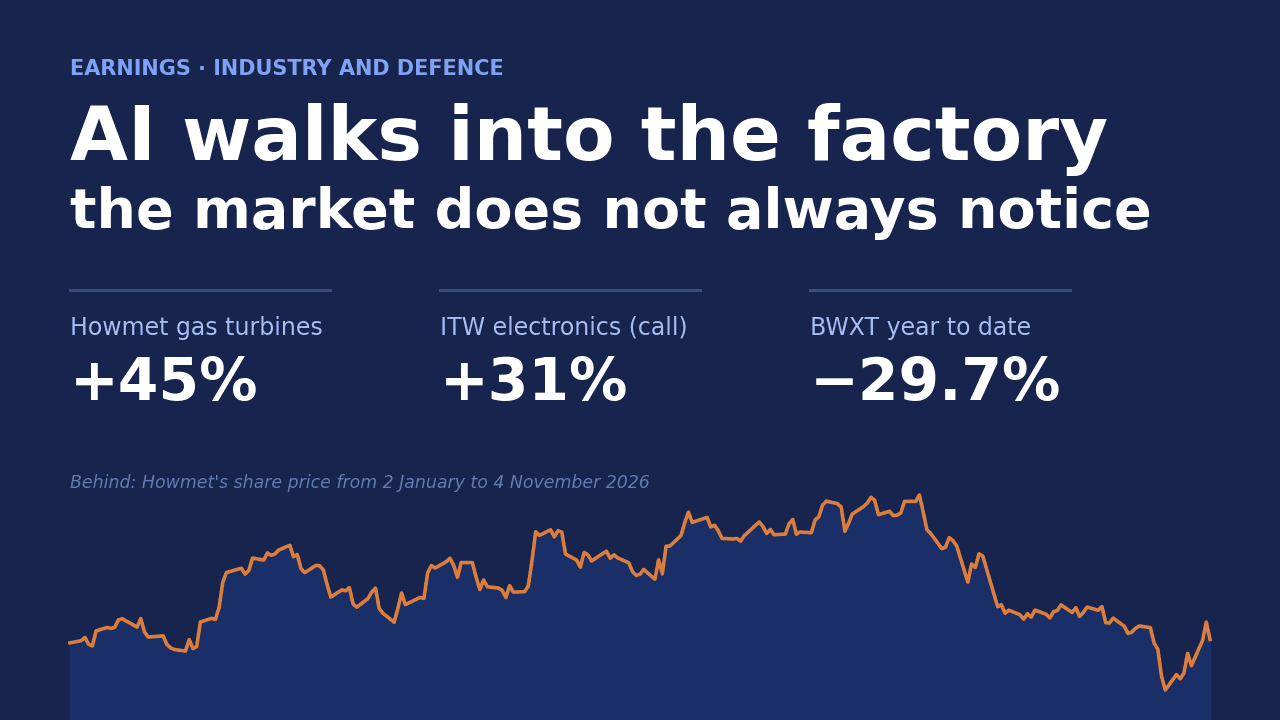
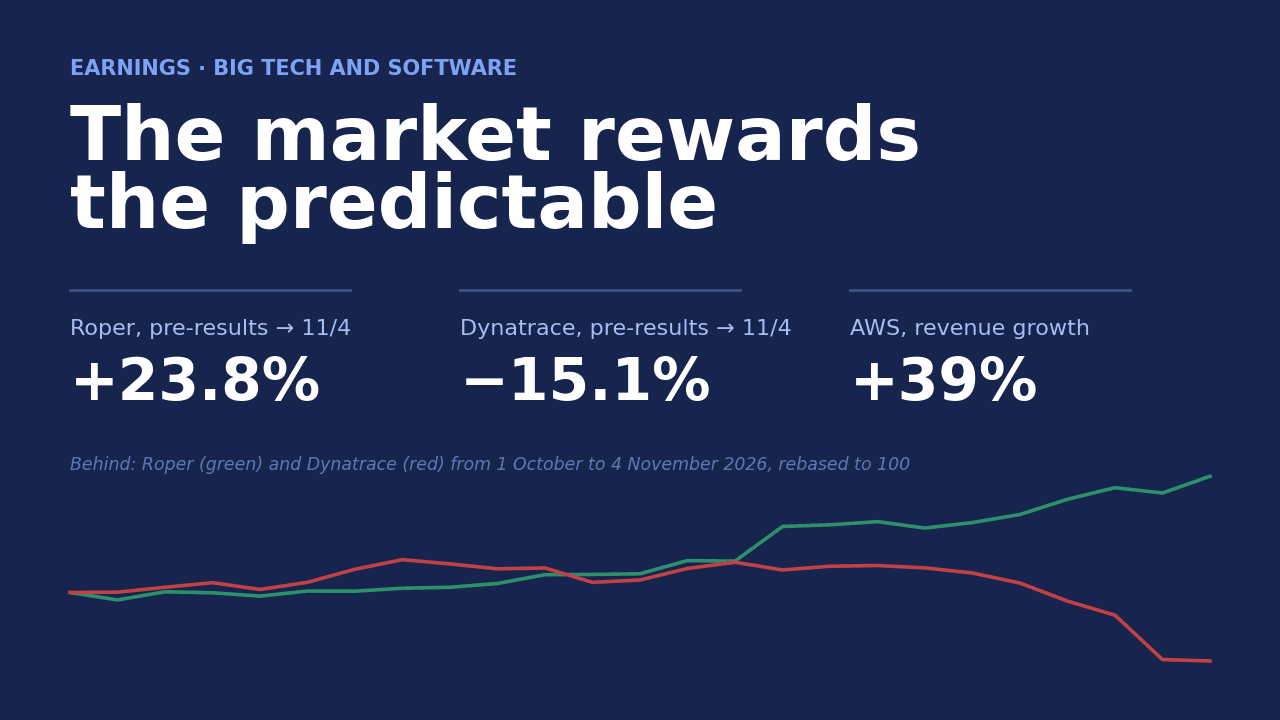
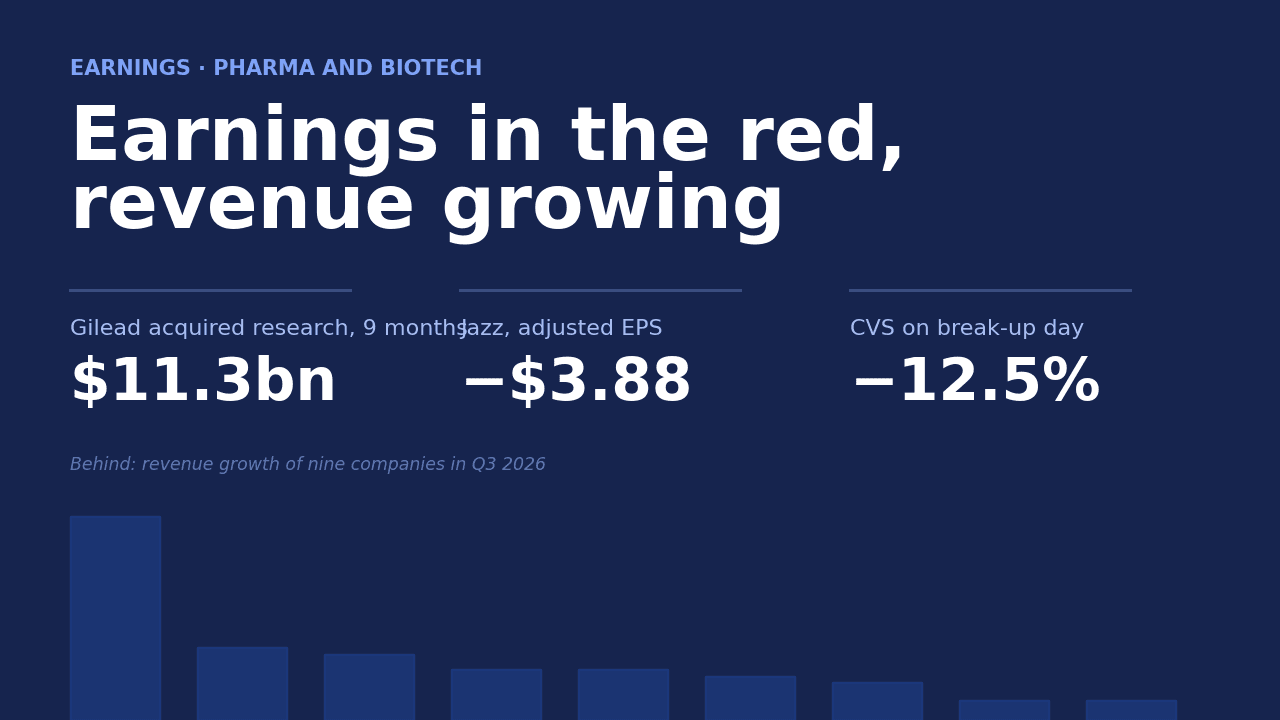
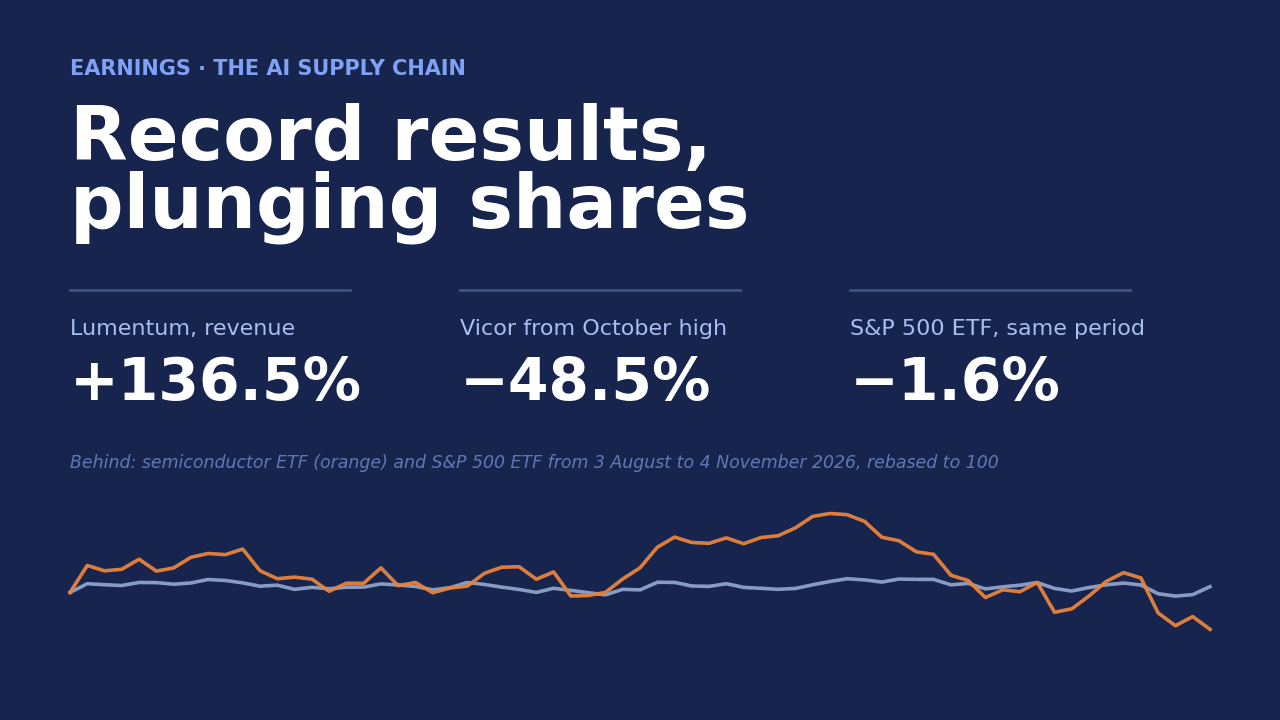
Between October 27 and November 2, 2026, five American industrial companies showed data center demand in their earnings: Howmet's gas turbines +45%, ITW's electronics +31%. On the stock market, however, the reward went only to those who had already converted it into margins and cash.
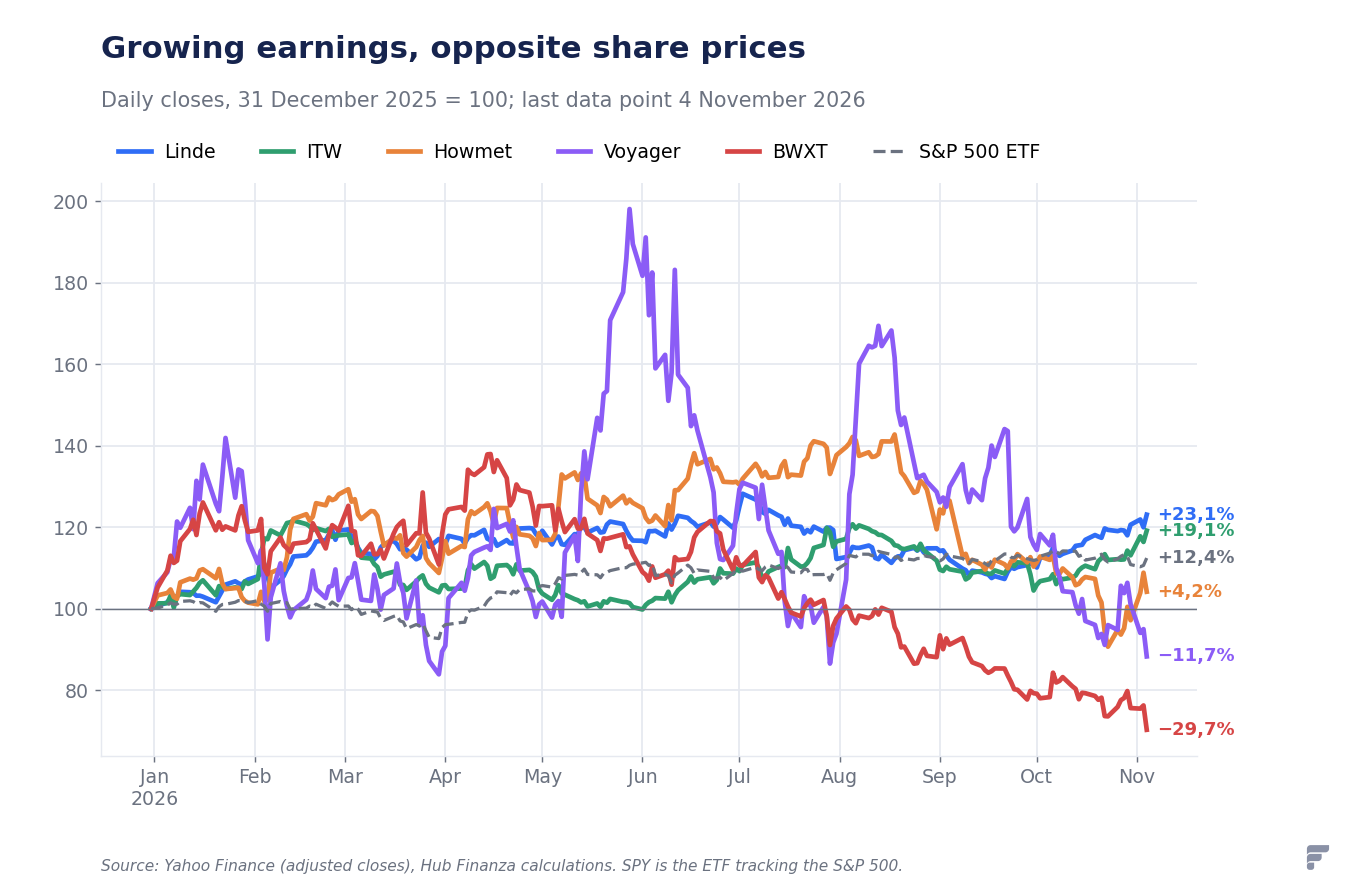
The contrast can be seen in two numbers. From December 31, 2025, to the close of November 4, 2026, Linde gained 23.1% and ITW 19.1%, more than the ETF tracking the S&P 500 (+12.4%). In the same period, BWX Technologies lost 29.7% and Voyager Technologies 11.7%, while Howmet Aerospace, which just raised its guidance for the third time this year, is 27% below its August high. Five earnings reports, five operational confirmations, and three very different market reactions.
Why does AI appear in the earnings of turbine, tools, and industrial gas manufacturers?
Because artificial intelligence, before being software, is an enormous physical construction site. A data center needs electricity, which in the United States increasingly comes from gas turbines installed next to computing campuses. The chips that fill it come from factories that consume ultra-pure gases and precision measuring instruments. And the power needed has also reopened the nuclear file, from large reactors to transportable microreactors.
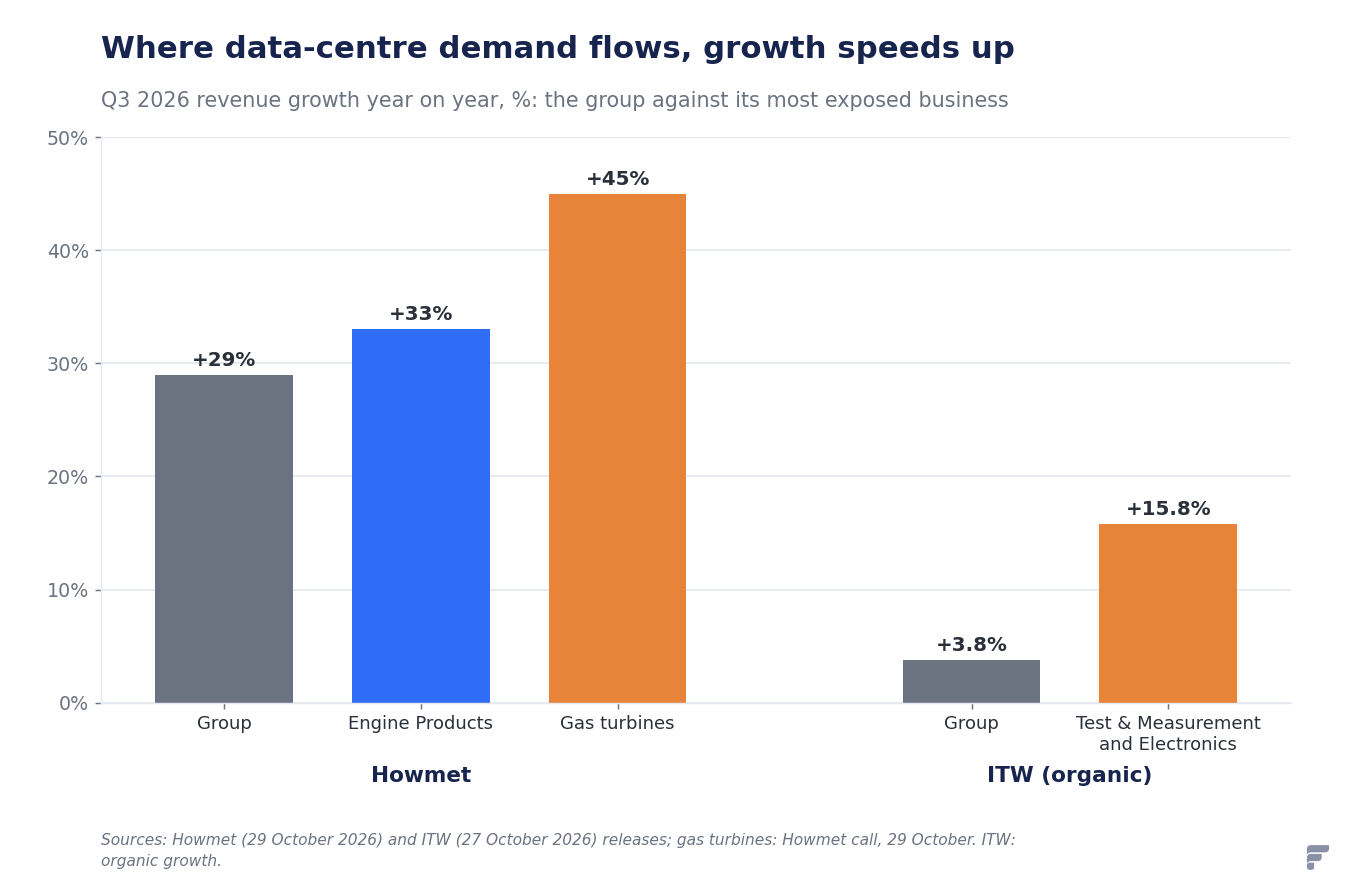
It's the same value chain we described in the guide to artificial intelligence put to the test, but seen from the other side: not from chip manufacturers, but from those who sell them the «shovels and pickaxes». The quarter ended September 30 is the first in which this demand is measurably visible across multiple segments of multiple companies at the same time. The chart below isolates the most exposed segments and compares them with the growth of the group they belong to.
A methodological caution before delving into individual accounts: five companies are not a statistical sample, and the word «AI» almost never appears in official press releases. The connection is made by managers in conference calls and should be weighed for what it is: an interpretation of demand by those who see it, not a separate accounting datum.
Howmet: data center turbines grow more than aircraft engines
Howmet Aerospace manufactures critical components for aircraft engines — blades, rings, fasteners in special alloys — and, in the same division, parts for industrial gas turbines. On Thursday, October 29, before the opening of Wall Street, it published a third quarter with revenues of 2,703 million dollars, +29% on the 2,089 million of a year earlier (+25% on an organic basis) and adjusted earnings per share of 1.46 dollars against 0.95 (+54%). The group's adjusted EBITDA margin rose to 32.5%, an increase of 310 basis points: a profitability rare in industry.
The main driver remains aviation. The Engine Products division recorded 1,451 million in revenue (+33%) with an adjusted EBITDA margin of 39.1%, the group's commercial aerospace market grew by 32%, and spares by 30%, to approximately 570 million, 21% of revenues. However, the data point that changed the conversation was another: gas turbines grew by 45%. On the call, CEO John Plant explained that the doubling of industrial turbine component sales compared to 2025 — a base of approximately one billion dollars — is now expected in three years instead of three to five, with the goal of reaching approximately 2.5 billion by the end of the decade. Driving this is gas-fired electricity generation for data centers. For General Electric, the segment's main customer, Howmet has decided on a separate capacity increase, which requires two years to install.
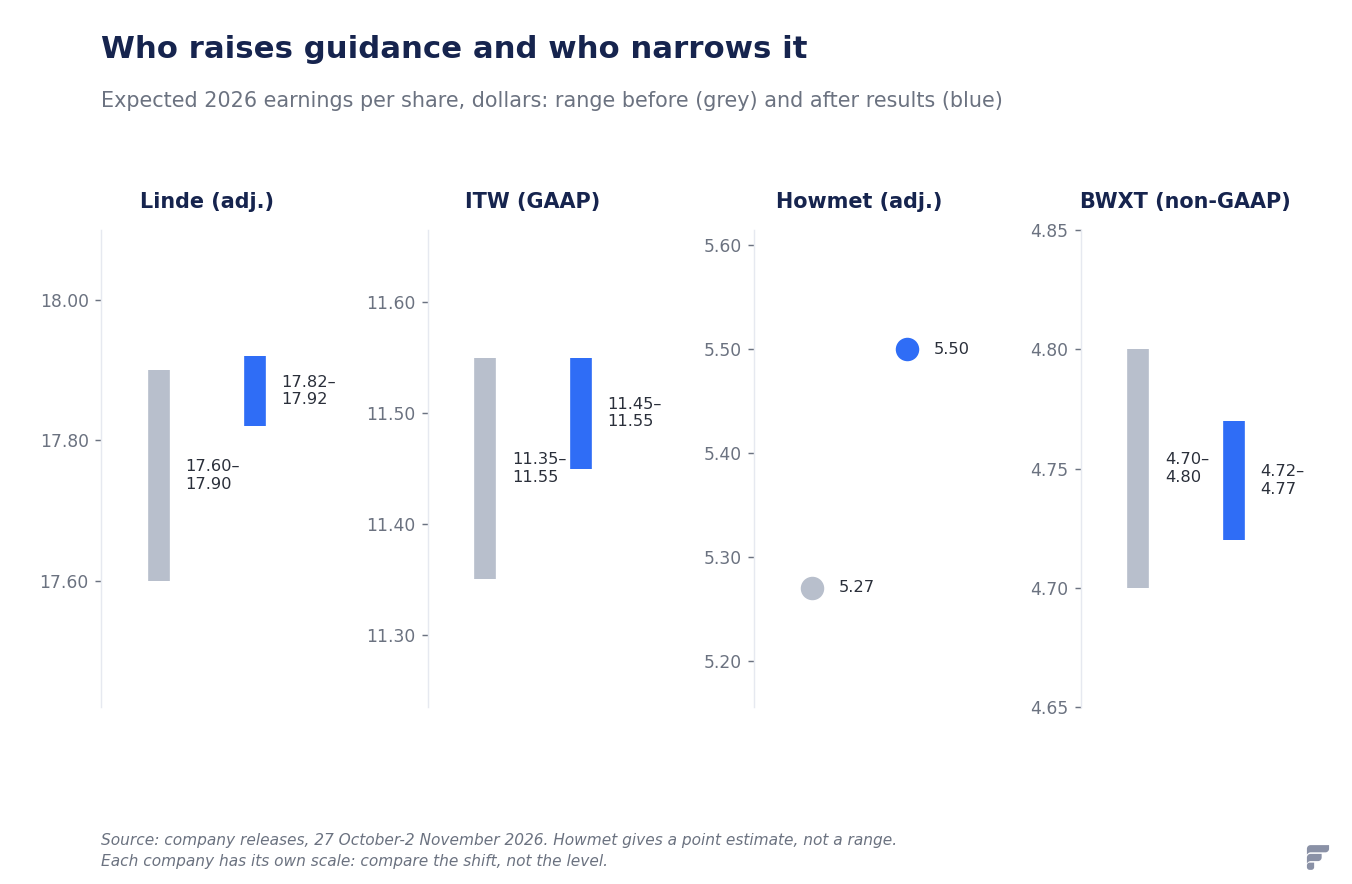
The 2026 guidance was raised on every item: revenues to approximately 10.3 billion, adjusted earnings per share to 5.50 dollars (previously 5.27), free cash flow to 2 billion. For 2027, the company gave an initial reference of approximately 11.5 billion in revenues, +12%, and the board authorized an additional 5 billion in share buybacks, for a total plafond of 5.397 billion.
On the stock market, the stock closed on October 29 at +5.5% (from 195.19 to 205.94 dollars), gave up 3.3% the next day, and recovered 6.9% on November 2 and 4.8% on November 3. On November 4, it closed at 213.56 dollars (−4.3% in the session). The point is the starting level: on August 18, the stock closed at 292.65 dollars. Even after the rebound, Howmet is worth 27% less than then, and year-to-date, it has gained just 4.2%. The market rewarded the quarter, but has not yet recovered the ground lost between late August and October.
ITW: the margins machine and the segment that follows chips
Illinois Tool Works is the opposite case: a conglomerate of seven divisions that grows little and earns a lot, and which the market treats like a clock. On Tuesday, October 27, it reported revenues of 4,236 million dollars, +4.4%, with organic growth of 3.8% which would have been about 5% without the tornado that hit two plants in the Welding division at the end of July (approximately 40 million in lost revenues, largely covered by insurance). The operating margin reached 27.8%, up from 27.4%, with a record operating income of 1,177 million; internal efficiency programs, which ITW calls enterprise initiatives, alone account for 130 basis points of margin. Earnings per share rose 6.8% to 3.00 dollars, despite a more difficult comparison due to a 27 million tax benefit in the third quarter of 2025.
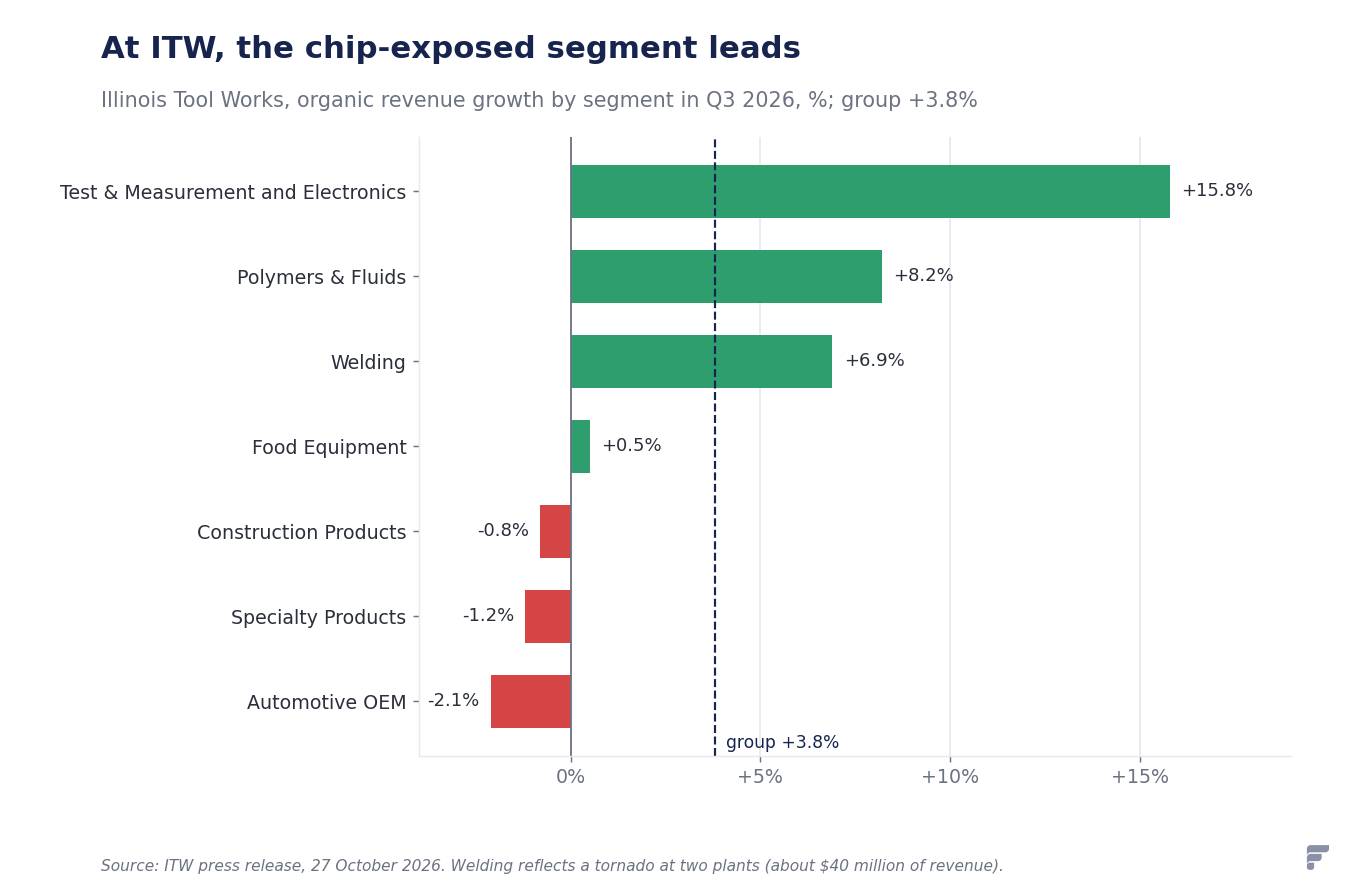
Within that 3.8% average, there is a wide range. Test & Measurement and Electronics showed +15.8% organic growth (819 million, about 19% of the group), Polymers & Fluids +8.2%, Welding +6.9% (about +15% net of the tornado); Food Equipment was flat (+0.5%), while Construction Products (−0.8%), Specialty Products (−1.2%), and Automotive OEM (−2.1%) declined. In the conference call, management specified that the electronics part of the division grew by 31%, driven by customers expanding chip manufacturing capacity and printed circuit board production for AI-related demand. The official press release does not mention semiconductors: the connection is in the words of the executives.
The guidance was adjusted upwards where it mattered: 2026 earnings per share to 11.45-11.55 dollars (from 11.35-11.55), revenues to +4.5-5.5% (from +4-5%), organic growth confirmed at 3-4%, buybacks of approximately 1.5 billion. The stock closed flat on earnings day (−0.1%), then rose in six sessions by 6.35% to 293.45 dollars on November 4, while the S&P 500 ETF lost 0.4%. Year-to-date, ITW gained 19.1% and is one step away from its February high.
Linde: semiconductor gases within an 11 billion portfolio
Linde, the world's leading producer of industrial gases, reported on Thursday, October 29, record revenues of 9,404 million dollars, +9% on the 8,615 million of a year earlier. Net of currency effects and energy costs passed on to customers, underlying growth was 5%, split between prices (+3%) and volumes (+2%), positive in all three areas: Americas +9%, Asia-Pacific +8%, Europe-Middle East-Africa +3%. Adjusted earnings per share rose 9% to 4.59 dollars; reported earnings fell to 3.66 dollars from 4.09 due to the accounting for the acquisition of Linde AG and charges from the cost reduction program — items that do not affect the quarter's cash flow.
The link with AI comes through volumes. The press release attributes them primarily to electronics, chemicals, and energy, and mentions ultra-pure and specialty gases for semiconductor manufacturing. The portfolio of already contracted projects is worth 11 billion dollars, of which 7.9 billion are linked to gas supply contracts, and CEO Sanjiv Lamba described the offering activity to customers as «robust, particularly in electronics». The 2026 guidance for adjusted earnings was raised to 17.82-17.92 dollars (+8-9%), from the previous 17.60-17.90: the minimum increased by 22 cents, the maximum by 2. For the fourth quarter, the company indicates 4.40-4.50 dollars.
The market reacted with the indifference it reserves for predictable stocks: −1.0% on October 29, then a recovery up to 524.74 dollars on November 4 (+2.6% in that session alone). Year-to-date, Linde gained 23.1%, the best result in the group, and is 4% below its July high. A detail that the press release does not hide: the adjusted operating margin for the quarter, 29.4%, fell by 30 basis points. This is the price of energy passed on in prices, not a weakening of the model, but it is the only line of the income statement that did not improve.
BWXT: army microreactors aren't enough for a halved stock
BWX Technologies is the almost sole supplier of the U.S. Navy's nuclear reactors and, for some years, one of the most accredited candidates for the new generation of small reactors. On Monday, November 2, after markets closed, it reported revenues of 953 million dollars, +10% (+7% organic) and non-GAAP earnings per share of 1.26 dollars, up from 1.00 (+26%); reported earnings were 1.11 from 0.89. The Government Operations division achieved an adjusted EBITDA margin of 22.6%, which management on the call called a record.
The quarter was rich in news about new-generation nuclear power. The BANR microreactor was chosen by the U.S. Army for the Janus program — more than twenty microreactors in five military bases, starting with Fort Campbell — and by Canada's Prodigy for a transportable nuclear power plant in Belledune, New Brunswick: it is BWXT's first international microreactor order, although the project is still in its early stages. For the Department of Defense's Pele project, core assembly was completed, with delivery to the Idaho National Laboratory planned for next year. The acquisition of PCG, closed in early July, added approximately 500 million to the order backlog, which at the end of September was worth 8.56 billion.
On the front of large civilian reactors, management said it expects the first orders for new plants in the United States «by the first half of next year at the latest,» and identified the sticking point: not financing, but the risk allocation among government, utilities, and hyperscalers, i.e., the large cloud operators who buy energy. This is the most explicit connection to AI in BWXT's entire quarter, and it also indicates how long the road still is.
The 2026 guidance was narrowed, not raised: adjusted EBITDA to approximately 667 million (was 662-672), non-GAAP earnings per share to 4.72-4.77 dollars (was 4.70-4.80), revenues confirmed at approximately 3.8 billion, and free cash flow at 350-360 million (was 345-360). For 2027, the company sees revenues growing at a «high single digit rate», and reaffirmed the target of 5.5-6 billion in revenues by 2030. The stock lost 2.1% in after-hours trading on November 2, gained 1.0% on November 3, and gave up 7.8% on November 4, closing at 121.50 dollars: −29.7% year-to-date and −49% from its April 15 high (238.42 dollars). It is the clearest case in the group of an industrial story that the market had priced in advance, and which now demands to see orders.
Voyager: bought growth and the appointment with the Moon
Voyager Technologies, listed on the New York Stock Exchange since June 11, 2025, with an offering price of 31 dollars, is the youngest and riskiest company in the group: it works on defense, space systems, and the Starlab commercial station, destined to take over some of the functions of the International Space Station. On Monday, November 2, it reported revenues of 88.7 million dollars, more than doubled (+124%) and up 68% from the previous quarter; the 2026 guidance was raised to 285-305 million, with the minimum increased by 10 million.
Most of that growth, however, is acquired. The record order backlog of 742 million (+293%) includes 347 million brought by Astrobotic, the lunar lander company acquired in July 2026, along with a 298 million NASA contract. And profitability is going in the opposite direction: the gross margin fell to 11.5% from 15.4%, adjusted EBITDA is negative by 44.9 million (from −17.7), loss per share increased to 0.91 dollars from 0.28. On the positive side, Starlab's commercial bookings rose to approximately 700 million (from approximately 500), the company announced a partnership with Anduril for defense technologies and a contract for a radio spectrum management platform based on artificial intelligence agents, and had 553.6 million in cash at the end of September.
The market looked at margins more than revenue: +1.0% on November 3 after a daily high of +9%, then −7.1% on November 4, to 23.08 dollars. The stock is 25.5% below its offering price and 55% below its late May high. The next test is not accounting: Astrobotic's Griffin-1 lunar mission is scheduled for late 2026, and the company postponed its December Investor Day to focus on the launch.
The overall picture: who beat the market and why
| Company | Q3 Revenues (Δ y/y) | 2026 Guidance | The link to AI | Year-to-date to 11/4 |
|---|---|---|---|---|
| Linde | 9,404 Mln$ (+9%) | Raised | Gases for chips, backlog 11 Bln$ | +23.1% |
| ITW | 4,236 Mln$ (+4.4%) | Raised | Electronics +31% (call) | +19.1% |
| Howmet | 2,703 Mln$ (+29%) | Raised | Gas turbines +45% | +4.2% |
| Voyager | 88.7 Mln$ (+124%) | Minimum raised | Defense software with AI agents | −11.7% |
| BWXT | 953 Mln$ (+10%) | Narrowed | New nuclear, risk to be shared with hyperscalers | −29.7% |
Taken together, the five earnings reports suggest a rule that holds as a hypothesis, not a law: the market pays for industrial AI when it already comes within margins, and discounts it when it is still a promise in the order backlog. Linde and ITW do not grow more than the others — in fact, they grow less — but they transform every extra dollar of electronic demand into immediately visible profit and cash, with raised guidances. Howmet is in the middle: the numbers are the best in the group, but the stock came from a summer in which the market had already priced in a lot. BWXT and Voyager sell options on a future — new reactors, the commercial station, the Moon — whose value depends on orders and missions yet to arrive.
There is also a factor that no press release can control. On October 28, the Federal Reserve left interest rates unchanged at 3.75-4.00% with two votes in favor of a hike, as we reported in the review of the previous week's earnings: a cost of capital that does not decrease weighs more heavily on stocks whose value is distant in time. It is not a complete explanation for BWXT's −29.7%, but it helps to understand why the same news — an army contract, a record backlog — is worth less today than a year ago.
For those who want to review how the numbers cited in this article are read — the difference between organic and total growth, between reported and adjusted earnings, and why guidance often matters more than the just-closed quarter — our guide on how to read an earnings report starts right here.
What to watch in the coming months
- Late 2026 — Griffin-1. The launch of Astrobotic's lunar mission is Voyager's first real test after the acquisition.
- By the first half of 2027 — new nuclear orders. BWXT expects them «by the first half of next year at the latest»: they will signal that the risk allocation among government, utilities, and hyperscalers has reached an agreement.
- Between late January and February 2027 — full year earnings. Howmet will transform the 11.5 billion reference for 2027 into formal guidance; Linde and ITW will say whether electronic demand holds up even if weaker segments — auto and construction — remain stagnant.
- Turbine capacity. The capacity increase for GE requires two years of installation: this is the data point to follow to understand if the 45% growth is a peak or a new level.
Sources
Third quarter 2026 earnings press releases and related SEC filings (8-K with exhibit 99.1 and 10-Q) from Linde (October 29), Howmet Aerospace (October 29), Illinois Tool Works (October 27), BWX Technologies (November 2), and Voyager Technologies (November 2); transcripts of Howmet, ITW, and BWXT conference calls; Voyager Technologies listing press release (June 10, 2025). Closing prices: Yahoo Finance, cross-referenced with stockanalysis.com; variations calculated by Hub Finanza. Data as of November 4, 2026.
Disclaimer: This article is for informational purposes only and does not constitute financial advice. Any investment decision should be evaluated based on your own situation and, if necessary, with a qualified professional.