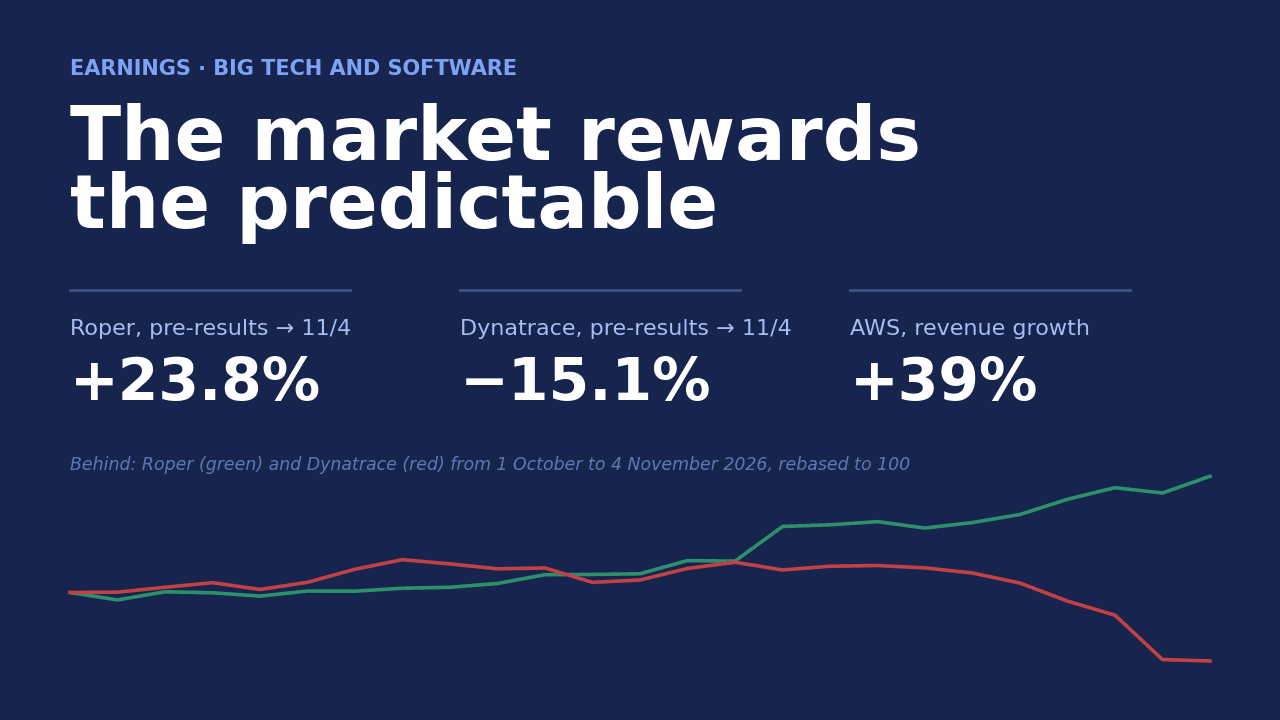
Between October 22 and November 4, 2026, eleven technology and software companies published their earnings, and most beat estimates. Not on the stock market: Roper gained 23.8% from the eve, Dynatrace lost 15.1%. The market rewarded predictability, not growth.
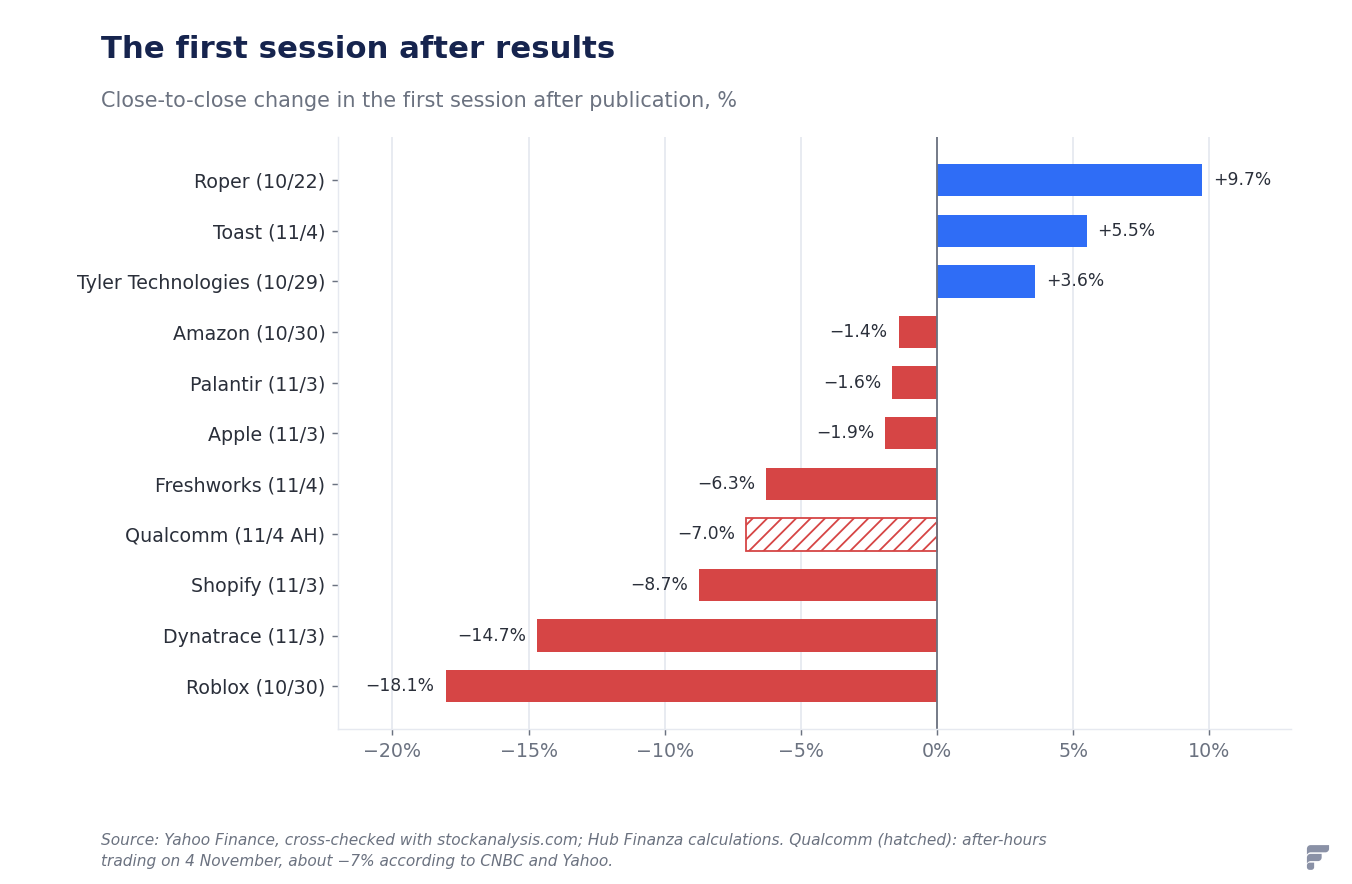
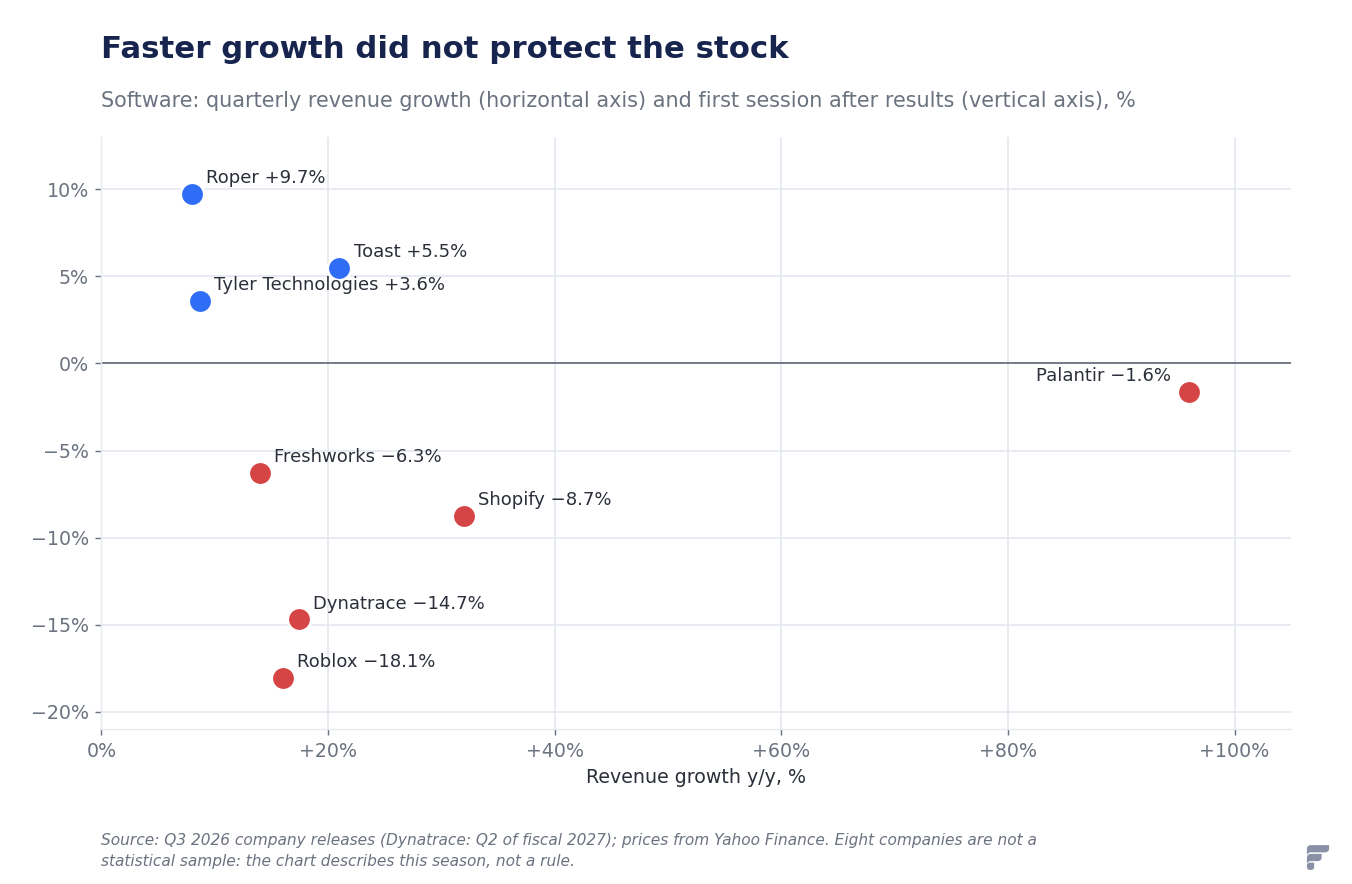
The sharpest contrast is within software. Palantir doubled its revenue (+96%) and the stock, the day after, closed down 1.6%, after opening at −5.7%; Roblox had +16% revenue and lost 18.1% in one session. Roper and Tyler Technologies grew by 8-9% and were among the few stocks in the group that rose during a period when the Nasdaq-100 ETF lost up to 4.6%. Among the giants, Amazon and Apple experienced a day of selling and recovered it in two sessions; Qualcomm, which published on Wednesday, November 4 after markets closed, was down about 7% in after-hours trading.
Why does the market sell a company that beats expectations?
Because the price of a stock, the day before earnings, already contains a forecast — and that forecast, for companies growing the most, is more ambitious than analysts' official consensus. Beating the published estimate is not enough if the market expected more, and especially not enough if one of the metrics measuring future demand slows down: the backlog of signed contracts, the number of users, the increase in spending by existing customers. This is the mechanism we explained in the guide on how to read a quarterly report and why a stock collapses on results, and this season is an almost didactic application of it.
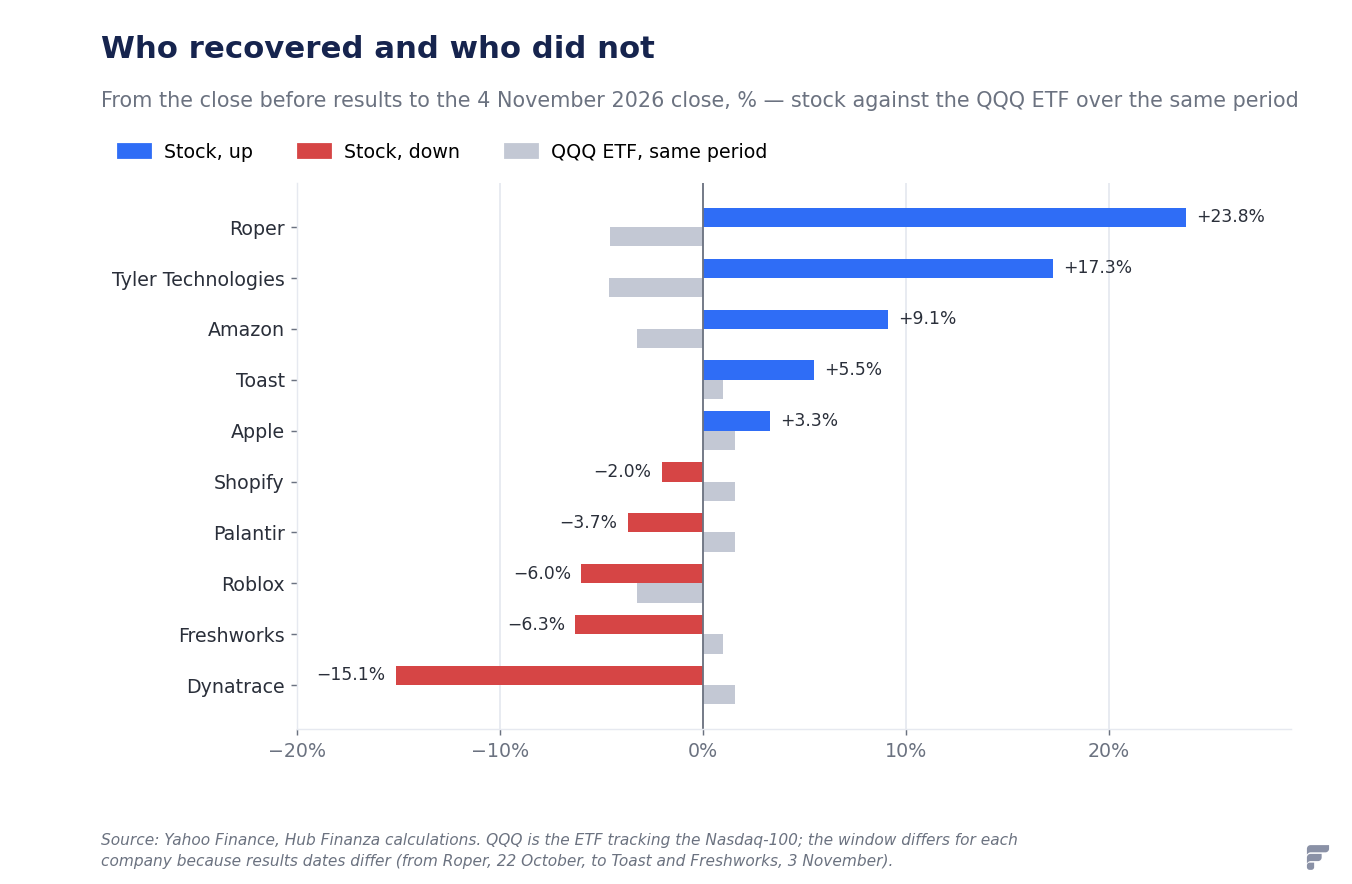
Then there's a context that weighs on everyone. The sessions on October 22, 29, and 30, and November 2 were negative for the Nasdaq Composite (up to −2.9% on October 30), while November 4 saw a general rally (+1.4%). Those who published close to the worst days also paid for the sentiment; those who had a positive session immediately after recovered quickly. For this reason, alongside the first-day reaction, it is also worth looking at the trajectory from the eve of earnings until November 4.
Amazon and Apple: two giants the market forgave in two sessions
Amazon published on Thursday, October 29, after markets closed, the best quarter in years for its cloud division: Amazon Web Services (AWS) reported 45.98 billion dollars in revenue, +39%, against an expected growth of around 37%, the highest in almost five years, with an operating margin that rose to 38.7% from 34.5%. The group's operating profit reached a record 28.1 billion (+61%, 13.9% margin), 1.6 billion above the top end of the range indicated by the company in July; North American commerce also raised its margin to 7.7% from 4.5%. Total revenues were 201.9 billion (+12%). Earnings per share, 1.89 dollars versus 1.95, only appear to decline: a year ago, the third quarter included 9.5 billion in capital gains from the Anthropic stake, this year non-operating income was negative by 703 million.
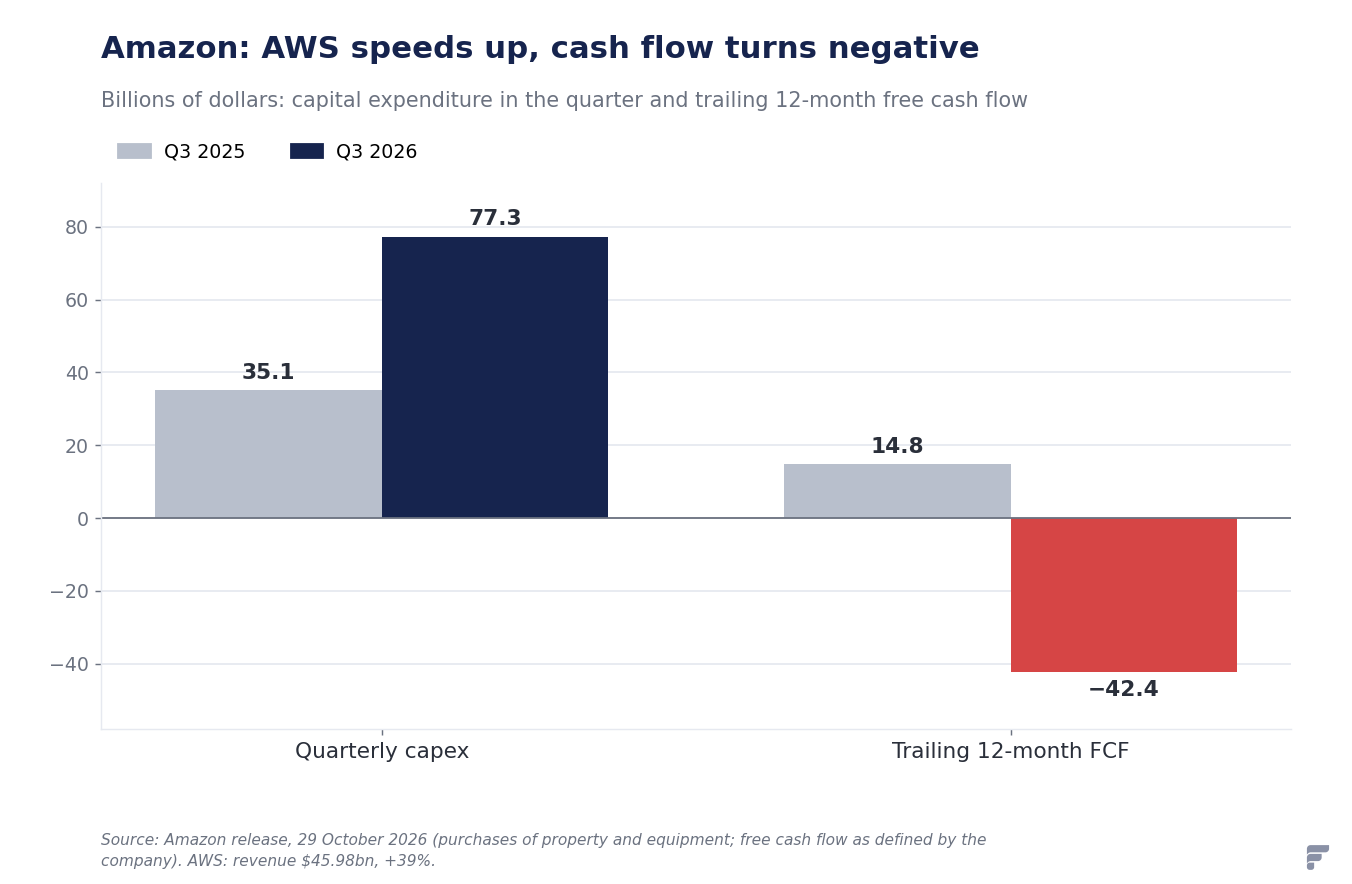
The price of that growth lies in the cash flow statement. Capital expenditures — data centers, chips, networks — were 77.3 billion in a single quarter, more than double the 35.1 billion a year ago; for 2026, Amazon indicates approximately 220 billion, and for 2027 a "significantly higher" figure. The free cash flow for the last twelve months thus went from +14.8 billion to −42.4 billion. It's the same bet the market punished in Alphabet and rewarded in Microsoft a week earlier: with Amazon it chose to look at the acceleration of AWS, whose contract backlog is worth 578 billion (more than doubled), and CEO Andy Jassy's forecast of cloud growth above 40% in both 2027 and 2028. The stock lost up to 7% in after-hours trading, closed October 30 at −1.4%, and by November 4 was at 266.03 dollars, 9.1% above the eve of earnings.
Apple closed its 2026 fiscal year on Monday, November 2, with record revenues of 479 billion, and a September quarter of 114.5 billion (+12%) with iPhone at 57.6 billion (+17.5%) and Greater China at +21%. It was John Ternus's first conference call, CEO since September 1, replacing Tim Cook, and the phrase that moved the stock was his: what Apple sees today on memory prices is "unprecedented," and costs continue to rise. The guidance for the December quarter forecasts revenue growth of 7-10%, above expectations, but a gross margin of 45-46% against the 46.3% estimated by analysts. Services, at 31.6 billion, are a record but grew by 9.8%, the slowest pace since 2022. Price increases, clarified CFO Kevan Parekh, have already been applied: to iPad and Mac in June, to iPhone in September. The stock lost 3% after the close and 1.9% on November 3, then rose 5.3% on November 4 to 349.51 dollars, reaching a new 52-week session high.
Qualcomm: auto nearly doubles, but phone weighs more
Qualcomm published last, on November 4 after the close, and its quarterly report has the most eloquent composition. September quarter revenues fell 8% to 10.32 billion, but were above expectations, because the decline in smartphone chips (5.14 billion, −26%) — largely due to Apple's transition to its own modems — was partly offset by the auto segment, which rose 89% to 1.99 billion, for the first time above two billion in a quarter. Adjusted earnings of 2.17 dollars were in line with consensus. For the new fiscal year, the company indicates the start of growth in data centers, with a target of 5 billion in revenue by 2027, following the collaboration with Amazon on AI inference chips announced on September 8. The guidance for the first fiscal quarter forecasts revenues between 10.4 and 11.2 billion, above expectations, but adjusted earnings between 2.15 and 2.35 dollars, with the midpoint below the 2.27 consensus: in after-hours trading, the stock lost about 7%, after a 5.3% rise in the session. It should be noted that Qualcomm had already lost 11.1% in a single day on October 30, five sessions before earnings.
Palantir, Shopify, Dynatrace, and Freshworks: the detail that costs dearly
Palantir has numbers that would be unrealistic elsewhere: revenues at 2.313 billion dollars (+96%), net income of 1.13 billion, a "rule of 40" — the sum of growth and margin, which for healthy software should exceed 40 — at 158, and for the first time American commercial revenue (984 million, +148%) above government revenue (953 million). The 2026 guidance was raised to approximately 8.53 billion. The problem, for the market, lies in two lines: the remaining performance obligations (RPO) stalled at 4.88 billion compared to the previous quarter, and the value of new commercial contracts signed in the United States grew by 11%, compared to +153% in the second quarter. The stock opened November 3 at −5.7% and closed at −1.6%; but it had already lost 6.3% on October 30 and 3.1% on November 2, and from October 29 to November 4 the decline is 12.6%.
Shopify missed its target for the first time after a long streak: revenues in line (+32% to 3.74 billion) but merchant gross merchandise volume at 119.15 billion (+29%) versus 120.08 expected, and subscriptions at 836 million versus 850. Free cash flow rose to 22% of revenue (816 million). On Tuesday, November 3, the stock lost up to 19% before opening and closed at −8.7%; the next day it recovered 7.3%. Dynatrace, which sells application monitoring software, had the worst reaction among software companies: revenues +17.4% and above guidance, but net new annual recurring revenue stalled at 70 million, the same as a year ago, and guidance on fiscal year earnings per share was cut to 1.88-1.90 dollars (from 1.97-1.99) due to dilution from the acquisition of Arize, specializing in AI model control. On November 3, the stock lost 14.7%, and from October 28 to November 4, 25.5%. Freshworks exceeded one billion in annual recurring revenue and a free cash flow margin of 30%, but 14% growth and a customer spending expansion rate that fell to 104% from 105% cost the stock 6.3% in the November 4 session.
Roblox and Toast: when users slow down
Roblox reported on Thursday, October 29, what financial press described as the first annual decline in its history: 138 million daily active users, 9% less than a year ago, and approximately 34 billion hours of engagement (−15%). Revenues grew 16% to 1.572 billion, above expectations, and spending per hour of engagement rose 4%; but bookings, meaning how much players spend in the quarter, fell 12% to 1.697 billion, and for the fourth quarter, the company forecasts 1.89-2.00 billion, between 10% and 15% less than a year ago and approximately 3.5% below consensus at the midpoint of the range. The quarter also includes 49 million in costs for agreements with some American states on child protection. The stock lost 18.1% on October 30; by November 4, at 49.31 dollars, it had recovered 14.7% from its low but remained at −54.5% from its 52-week high.
Toast, the restaurant software provider, is the opposite case: revenues +21% to 1.981 billion, approximately 189,000 locations served (+21%), annual recurring revenue at 2.5 billion (+24%), and adjusted EBITDA guidance raised to 840-850 million. The announcement of CFO Elena Gomez's departure at year-end and a fourth-quarter forecast read as a slowdown caused the stock to drop 4.8% after the November 3 close; the next day it closed at +5.5%.
Roper and Tyler: the boredom the market pays for
Roper Technologies, a group that acquires and manages vertical software companies, published a quarter without surprises on Thursday, October 22: revenues +8% (organic +7%) to 2.171.8 million, adjusted earnings per share +15% to 5.89 dollars, guidance raised for the second time in three months to 22.35-22.40 dollars. An important part of the per-share growth comes from buybacks: 2.7 billion year-to-date, with the number of shares down 8%, also financed by 1.2 billion collected from the sale of Indicor. The stock closed at +9.7% on a day when the Nasdaq Composite lost 2.6%, and continued to rise: from the eve to November 4, +23.8%, against the Nasdaq-100 ETF's −4.6% in the same period.
Tyler Technologies, which sells software to U.S. government entities, slightly missed revenue estimates (647.6 million, +8.7%) and beat adjusted earnings (3.52 dollars). Cloud subscription revenue grew 21.2% to 242.2 million, annual recurring revenue 11% to 2.28 billion, and free cash flow reached a record 277 million, 42.8% of revenue. Earnings guidance was confirmed at 12.95-13.20 dollars. On October 29, the day of the call, the stock opened lower and closed at +3.6%; from the eve of earnings to November 4, it gained 17.3%.
The overall picture
Company | Revenue (Y/Y Δ) | The decisive factor | First session | Eve → 4/11 |
|---|---|---|---|---|
Roper | 2,171.8 Mln$ (+8%) | Guidance raised twice, shares −8% | +9.7% | +23.8% |
Tyler | 647.6 Mln$ (+8.7%) | Cloud +21.2%, record free cash flow | +3.6% | +17.3% |
Amazon | 201.9 Bld$ (+12%) | AWS +39%, free cash flow −42.4 Bld$ | −1.4% | +9.1% |
Toast | 1,981 Mln$ (+21%) | EBITDA guidance raised, CFO change | +5.5% | +5.5% |
Apple | 114.5 Bld$ (+12%) | Memory prices «unprecedented», guided margin down | −1.9% | +3.3% |
Shopify | 3.74 Bld$ (+32%) | Transactions and subscriptions below expectations | −8.7% | −2.0% |
Palantir | 2,313 Mln$ (+96%) | RPO flat, new US contracts +11% | −1.6% | −3.7% |
Roblox | 1,572 Mln$ (+16%) | Users −9%, bookings −12% | −18.1% | −6.0% |
Freshworks | 245.4 Mln$ (+14%) | Growth in line, customer expansion down | −6.3% | −6.3% |
Dynatrace | 579.9 Mln$ (+17.4%) | New ARR flat, guided earnings down | −14.7% | −15.1% |
Qualcomm | 10.32 Bld$ (−8%) | Auto +89%, guided earnings below consensus | ≈ −7% (after-hours) | n.d. |
Eleven companies do not make a rule, but the thread linking them is recognizable: this season the market paid for predictability more than growth. Roper and Tyler surprised no one, and for this very reason were bought while the rest of the sector fell. Palantir, Dynatrace, Shopify, and Roblox are growing much more, but each showed a metric of future demand slowing down, and at multiples that discount years of uninterrupted growth, a single decelerating line weighs more than ten accelerating ones. Amazon and Apple are in the middle: the market accepted their doubts — cash burned for AI, the cost of memories — because the most important part of each's income statement improved. This is the same lesson we drew from the quarterly reports review of October 29, when ServiceNow lost a quarter of its value due to a single contractual metric; and the context of spending on artificial intelligence, with its risks, is what we reconstructed in the guide on artificial intelligence put to the test.
What to watch in the coming months
Thursday, November 5 — Qualcomm. The first full session after earnings will tell if the after-hours drop is confirmed.
November-December — the holiday shopping season. For Shopify and Toast, holiday data is the first test after earnings; Shopify has already indicated a cautious forecast for consumer spending.
January 1, 2027 — Toast. Michael Senno takes over as CFO and will present the first annual guidance.
Between late January and February 2027 — fourth quarter earnings. Amazon will provide the 2027 investment figure; Palantir will show if RPO has resumed growth; Roblox will say if the user decline has stopped.
February 16, 2027 — Dynatrace. Investor day in Las Vegas, the first opportunity to explain the effect of Arize.
Sources
Third quarter 2026 earnings releases and related SEC filings (8-K and 10-Q) for Amazon, Apple (fourth quarter of fiscal year 2026, 10-K), Qualcomm, Palantir, Shopify, Dynatrace (second quarter of fiscal year 2027), Freshworks, Toast, Tyler Technologies, Roper Technologies, and Roblox; transcripts of conference calls for Apple, Amazon, Dynatrace, Tyler, and Roblox; CNBC for after-hours trading of Apple and Qualcomm and for LSEG and StreetAccount consensuses. Closing prices: Yahoo Finance, cross-referenced with stockanalysis.com; variations calculated by Hub Finanza. Data as of November 4, 2026, 6:50 PM New York time.
Disclaimer: this article is for informational purposes only and does not constitute financial advice. Any investment decision should be evaluated based on one's own situation and, if necessary, with a qualified professional.