


NVIDIA Corporation (Nasdaq: NVDA) closed the third quarter of fiscal year 2027, ended on 25 October 2026, with revenue of $115.8 billion (+103% year on year) and guides to $130 billion for the fourth quarter, according to the press release of 17 November 2026: the first results after Jensen Huang's exit.
The $115.8 billion tops by about $6.7 billion the LSEG consensus ($109.10 billion, reported by CNBC on 17 November) and the guidance NVIDIA gave on 26 August, $108.0 billion. Non-GAAP diluted earnings per share are $2.68, against the $2.48 expected according to LSEG.
The guidance for the fourth fiscal quarter (Q4 FY2027), which has an extra week, nonetheless puts gross margin between 71.0% and 72.0%, from the 74.8% just reported. And the filings with the SEC show a balance sheet increasingly exposed to its customers: receivables at $81.0 billion, future commitments of $518 billion and guarantees of up to $118 billion.
The stock went into the results at $155.46, the Nasdaq close on Tuesday 17 November (−0.4%). It rose in after-hours trading: CBS News put it at $161.57 (+3.9%), and at 6:15 p.m. in New York (12:15 a.m. in Italy) Yahoo Finance quotes had it at about $163.1, 4.9% above the close. These are prices on thin volumes: the market's verdict will come with the session on Wednesday 18.
Revenue at $115.8 billion: the widest beat on guidance in the last six quarters
In the Q3 FY2027 income statement, revenue is $115,844 million, against $57,006 million in the same quarter of fiscal 2026: according to the chief financial officer's commentary it is the company's quarterly record.
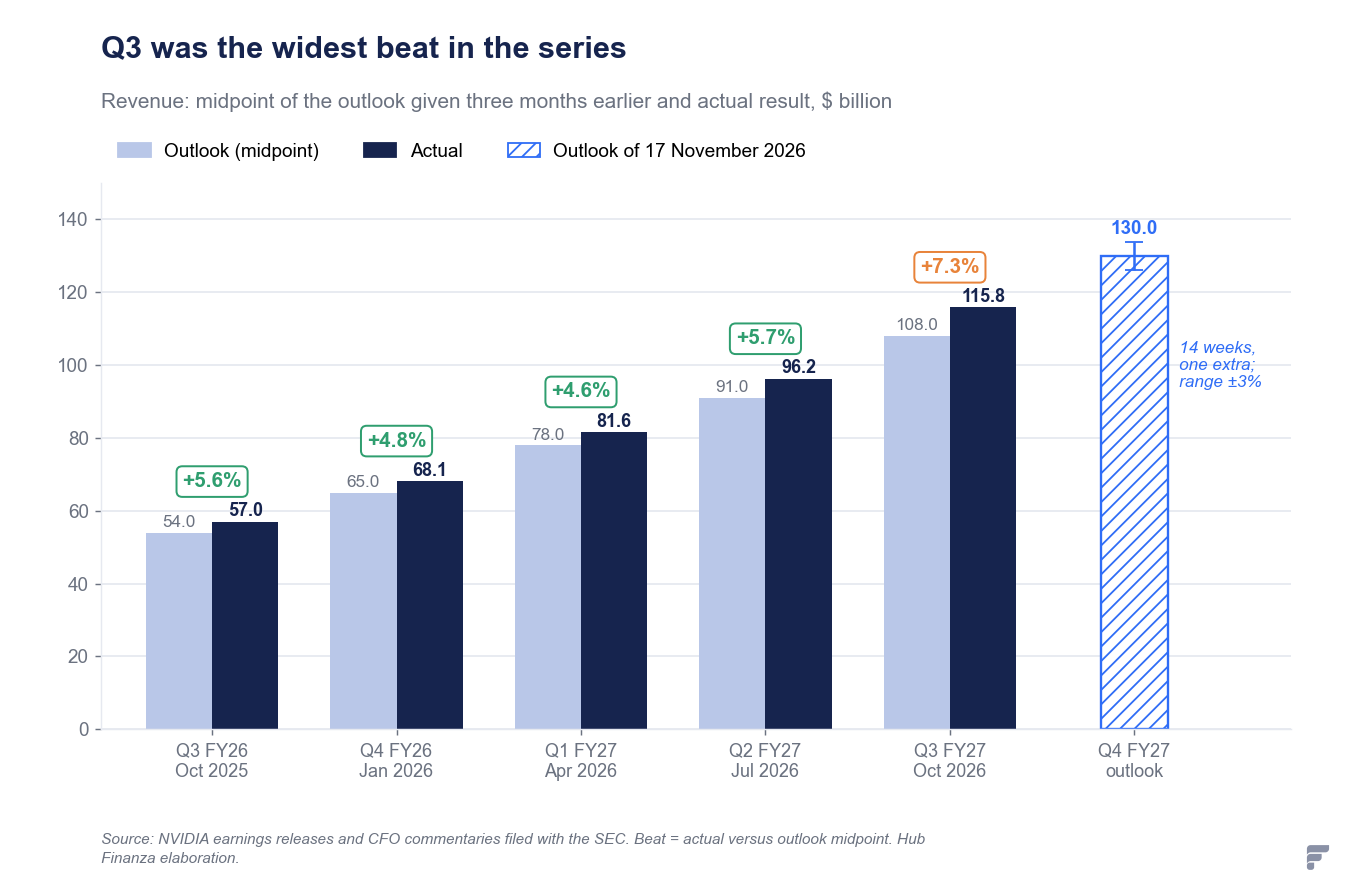
The gap versus the midpoint of the August guidance ($108.0 billion, plus or minus 2%) is 7.3%, and the result also exceeds the top of the range, about $110.2 billion (editorial calculations). It is the widest gap in the series: between Q3 FY2026 and Q2 FY2027 NVIDIA had beaten its own guidance by a percentage between 4.6% and 5.7%.
The comparison with the consensus, line by line, with estimates reported by the press on 17 November:
| Item, Q3 FY2027 | Result | Expected | Source of the estimate |
|---|---|---|---|
| Revenue | $115.8bn | $109.10bn | LSEG, via CNBC |
| Non-GAAP diluted earnings per share | $2.68 | $2.48 | LSEG, via CNBC |
| Data Center revenue | $107.6bn | $101.87bn | StreetAccount, via CNBC |
| Edge Computing revenue | $8.2bn | $7.47bn | StreetAccount, via CNBC |
| Non-GAAP gross margin | 74.9% | 74% | StreetAccount, via CNBC |
| Revenue guidance for Q4 FY2027 | $130.0bn ± 3% | $125.1bn | LSEG, via CNBC |
The GAAP gross margin of 74.8% is also above the top of the August guidance (74.0% plus or minus half a point). A methodological caveat: since the first quarter of fiscal 2027, NVIDIA's non-GAAP measures no longer exclude stock-based compensation, which is why GAAP and non-GAAP are so close. The meaning of these items is explained in the guide on how to read a quarterly report.
Data Center is 93% of revenue, and grows more outside the big clouds
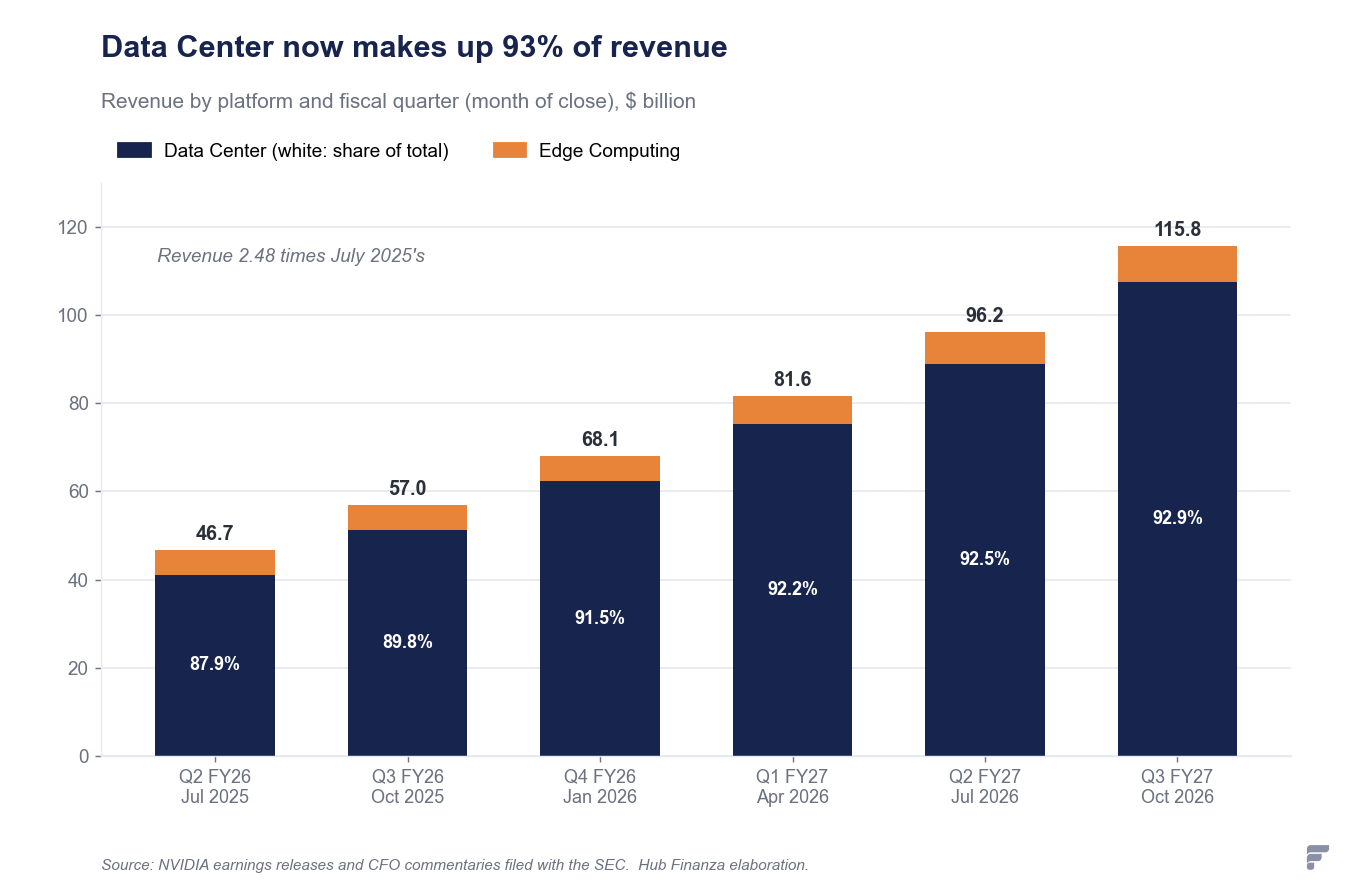
NVIDIA's Data Center generated $107.6 billion in Q3 FY2027, +21% on the quarter and +110% on the year. Its weight in total revenue rose to 92.9%, from 89.8% a year earlier (editorial calculation).
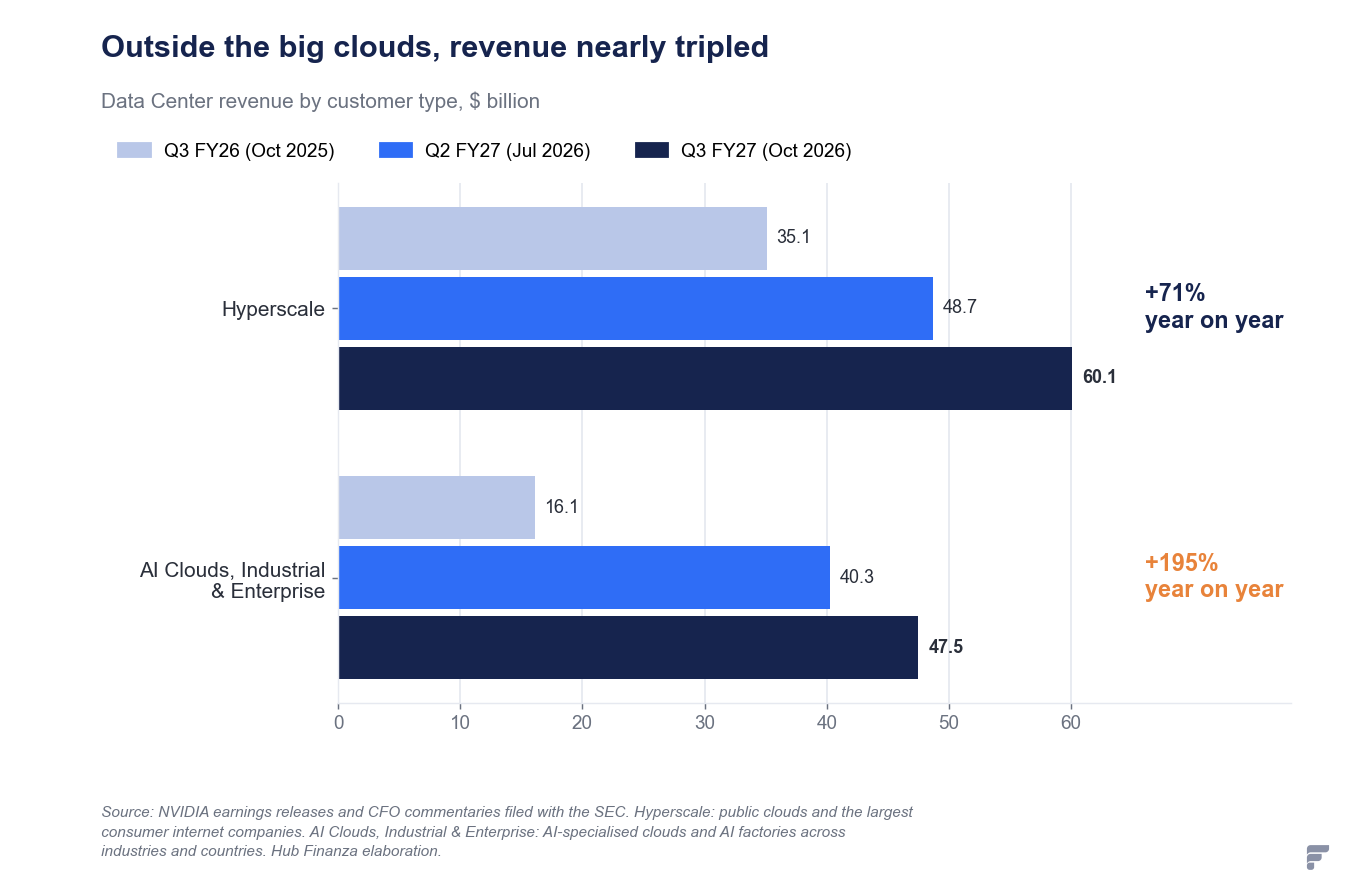
Within Data Center NVIDIA distinguishes two groups of customers, and the difference in pace is the newest datum of the quarter:
- Hyperscale (public clouds and large internet companies): $60.1 billion, +23% on the quarter and +71% on the year;
- AI Clouds, Industrial & Enterprise (clouds specialized in artificial intelligence and AI factories of companies and countries): $47.5 billion, +18% on the quarter and +195% on the year, almost triple the $16.1 billion of a year earlier.
According to the chief financial officer's commentary, growth comes from Rubin, the company's "fastest architecture ramp," from Vera CPUs sold on their own and from Blackwell Ultra. In the quarter shipments of Vera Rubin NVL72 systems began, with racks live at CoreWeave, Google Cloud, Microsoft Azure, Oracle Cloud Infrastructure and Nebius. Edge Computing (PCs, consoles, workstations, robotics and cars) produced $8.2 billion, +14% on the quarter and +42% on the year.
Concentration remains high: according to the financial supplement filed with the SEC, three direct customers accounted for 14%, 11% and 11% of the quarter's revenue, 36% in all. In the press release Colette Kress sums up: «Our momentum is real» and «Vera Rubin is off to an explosive start».
In six quarters revenue is almost two and a half times that of July 2025
Quarterly revenue went from $46.7 billion in Q2 FY2026 to $115.8 billion in Q3 FY2027, 2.48 times as much (editorial calculation). The changes are those in each quarter's press releases.
| Fiscal quarter (end) | Revenue ($bn) | QoQ chg. | YoY chg. | Data Center ($bn) | QoQ chg. | YoY chg. |
|---|---|---|---|---|---|---|
| Q2 FY2026 (27/7/2025) | 46.7 | +6% | +56% | 41.1 | +5% | +56% |
| Q3 FY2026 (26/10/2025) | 57.0 | +22% | +62% | 51.2 | +25% | +66% |
| Q4 FY2026 (25/1/2026) | 68.1 | +20% | +73% | 62.3 | +22% | +75% |
| Q1 FY2027 (26/4/2026) | 81.6 | +20% | +85% | 75.2 | +21% | +92% |
| Q2 FY2027 (26/7/2026) | 96.2 | +18% | +106% | 89.0 | +18% | +117% |
| Q3 FY2027 (25/10/2026) | 115.8 | +20% | +103% | 107.6 | +21% | +110% |
Year-on-year growth rose from 56% to 106% in four quarters and in Q3 FY2027 eased slightly, to 103%; quarter-on-quarter growth has stayed between 18% and 22% since Q3 FY2026. The first nine months of fiscal 2027 add up to $293.7 billion, already more than the $215.9 billion of the whole of fiscal 2026.
Gross margin stays near 75%, but Q4 guidance puts it between 71% and 72%
GAAP gross margin was 74.8% in Q3 FY2027, 0.2 points below the previous quarter and 1.4 above a year earlier. According to the chief financial officer's commentary, the year-on-year gain was helped by the Blackwell Ultra mix; on the quarter, the slight decline reflects the start of Rubin production.
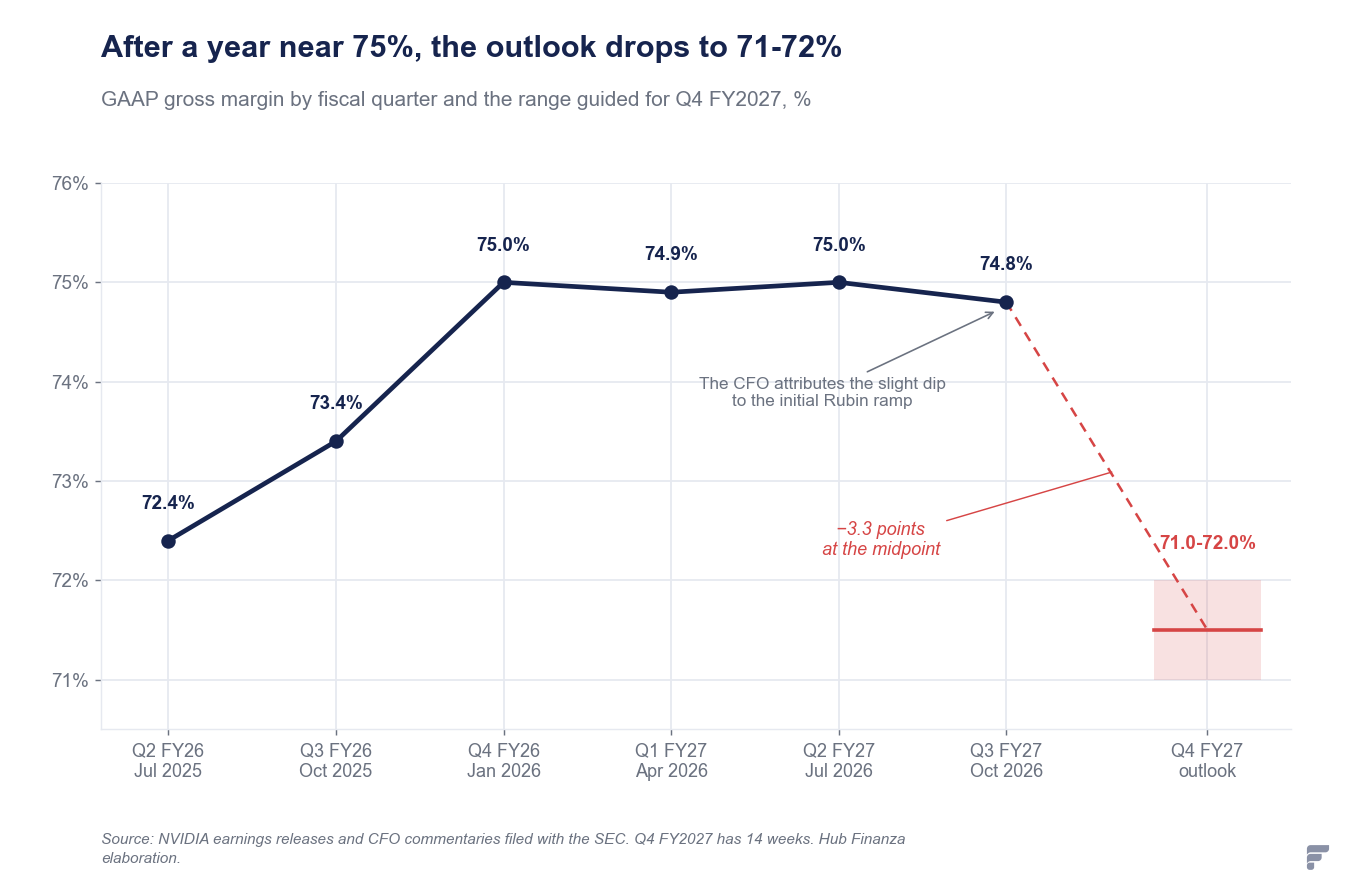
After four quarters between 74.8% and 75.0%, the guidance indicates a Q4 margin between 71.0% and 72.0%: 3.3 points lower at the midpoint (editorial calculation). Neither the press release nor the commentary explains the drop, and the commentary does not say whether the reason for the slight Q3 decline, the start of Rubin, also applies to Q4. It is the variable that most separates the next quarter from the last ones.
Net income at $65.3 billion, free cash flow at $43.8 billion and $28.1 billion to shareholders
GAAP operating income is $77.5 billion (+22% on the quarter, +115% on the year), 66.9% of revenue (editorial calculation). GAAP net income is $65.3 billion, +9% on the quarter, less than revenue: net gains on equity stakes fell to $1.8 billion from $7.8 billion, with $2.8 billion of gains on listed securities and a $1.0 billion loss on unlisted stakes, which includes $1.8 billion of write-downs. GAAP earnings per share are $2.70 (+10% on the quarter), non-GAAP $2.68 (+21%).
At the end of October NVIDIA held listed equity securities of $44.2 billion and unlisted stakes of $65.5 billion, together about $109.7 billion (editorial sum).
The quarter's free cash flow is $43,777 million, double the $21,341 million of Q2 FY2027; over nine months it is $113,672 million, against $61,675 million a year earlier. According to the chief financial officer the jump on the quarter is also affected by the timing of federal taxes, so it is partly non-recurring. NVIDIA returned $28.1 billion to shareholders, a record: $22.1 billion of buybacks and $6.0 billion of dividends. About $227.3 billion of authorized buybacks remain, which the company expects to use by fiscal 2028; the next dividend, $0.25 per share, will be paid on 23 December to shareholders of record on 2 December.
Receivables at $81 billion and inventories at $39.7 billion: working capital grows faster than revenue
Trade receivables at the end of Q3 FY2027 are $81.0 billion, 143% more than a year earlier, while the quarter's revenue grew 103% (editorial calculations). Days sales outstanding (DSO) rose to 64, from 60 in July and 45 in April. The company attributes this to the concentration of shipments in the Rubin launch and to longer payment terms granted to some investment-grade customers on multi-quarter contracts. Two customers alone accounted for 18% and 17% of receivables.
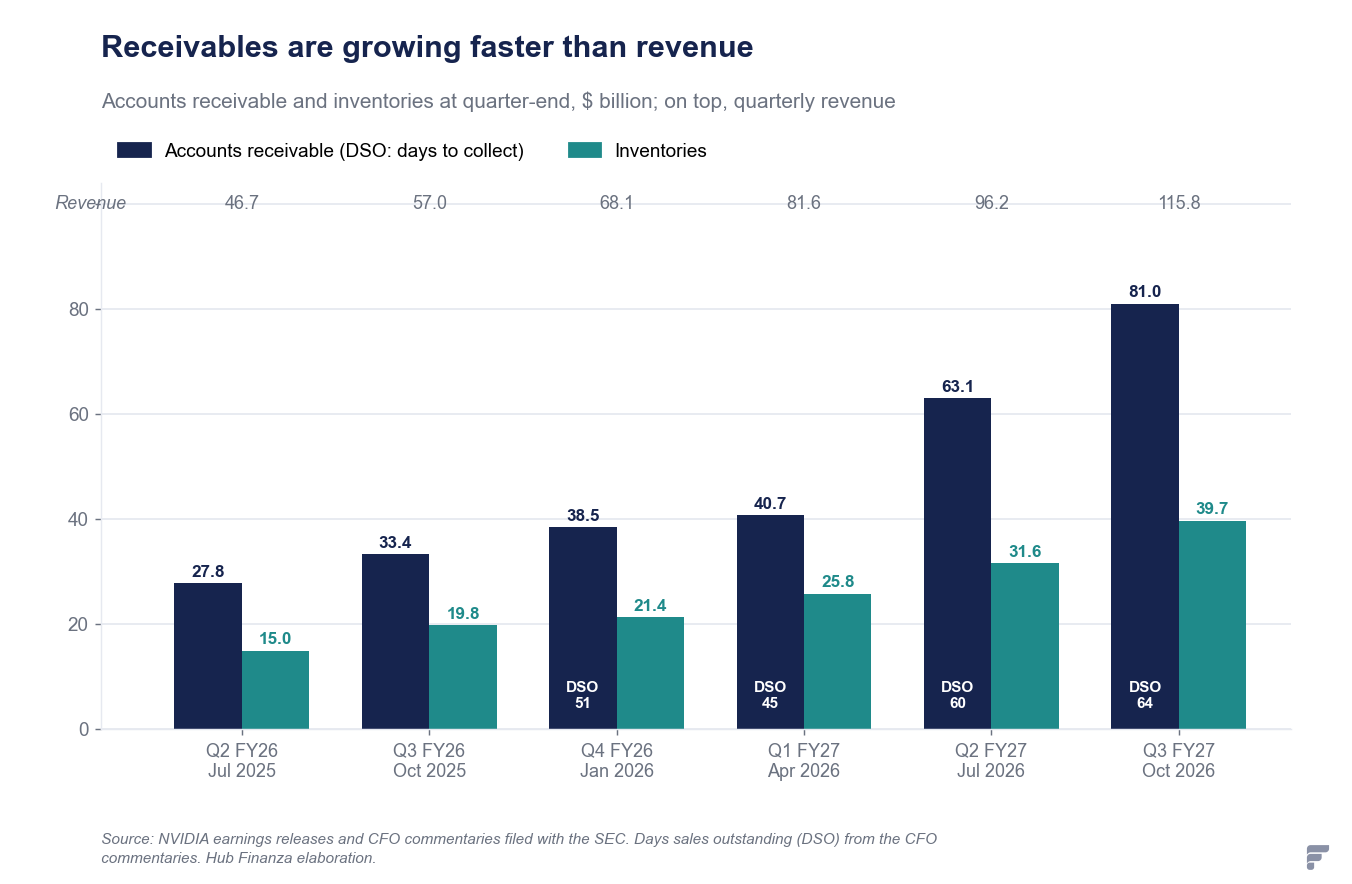
Inventories are $39.7 billion, from $31.6 billion at the end of July: +25.8% in one quarter (editorial calculation on values in millions). They serve the Rubin ramp, and the composition confirms it: raw materials of $15.8 billion against $3.8 billion at the end of January, work in process of $17.8 billion against $8.8 billion, finished goods down to $6.2 billion from $8.8 billion. Cash and marketable debt securities add up to $53.5 billion, from $56.6 billion at the end of July; long-term debt is $32.4 billion, against $7.5 billion at the end of January.
Commitments of $518 billion and guarantees of up to $118 billion: NVIDIA exposes itself for its customers
The chief financial officer's commentary contains the part that the press release does not summarize. At 25 October 2026 future commitments amount to $518 billion:
- supply and production capacity: $390 billion, from $279 billion at the end of July and $119 billion at the end of April, mainly for the multi-year purchase of memory; $203 billion fall in fiscal 2028;
- data center leases not yet commenced: $74 billion, up to twenty years, starting between Q4 FY2027 and fiscal 2033;
- cloud services $28 billion, equity investments $20 billion, facilities $6 billion.
On top of these come $32 billion of agreements with neoclouds, which become commitments only if the neoclouds obtain financing and the capacity is delivered and accepted by NVIDIA.
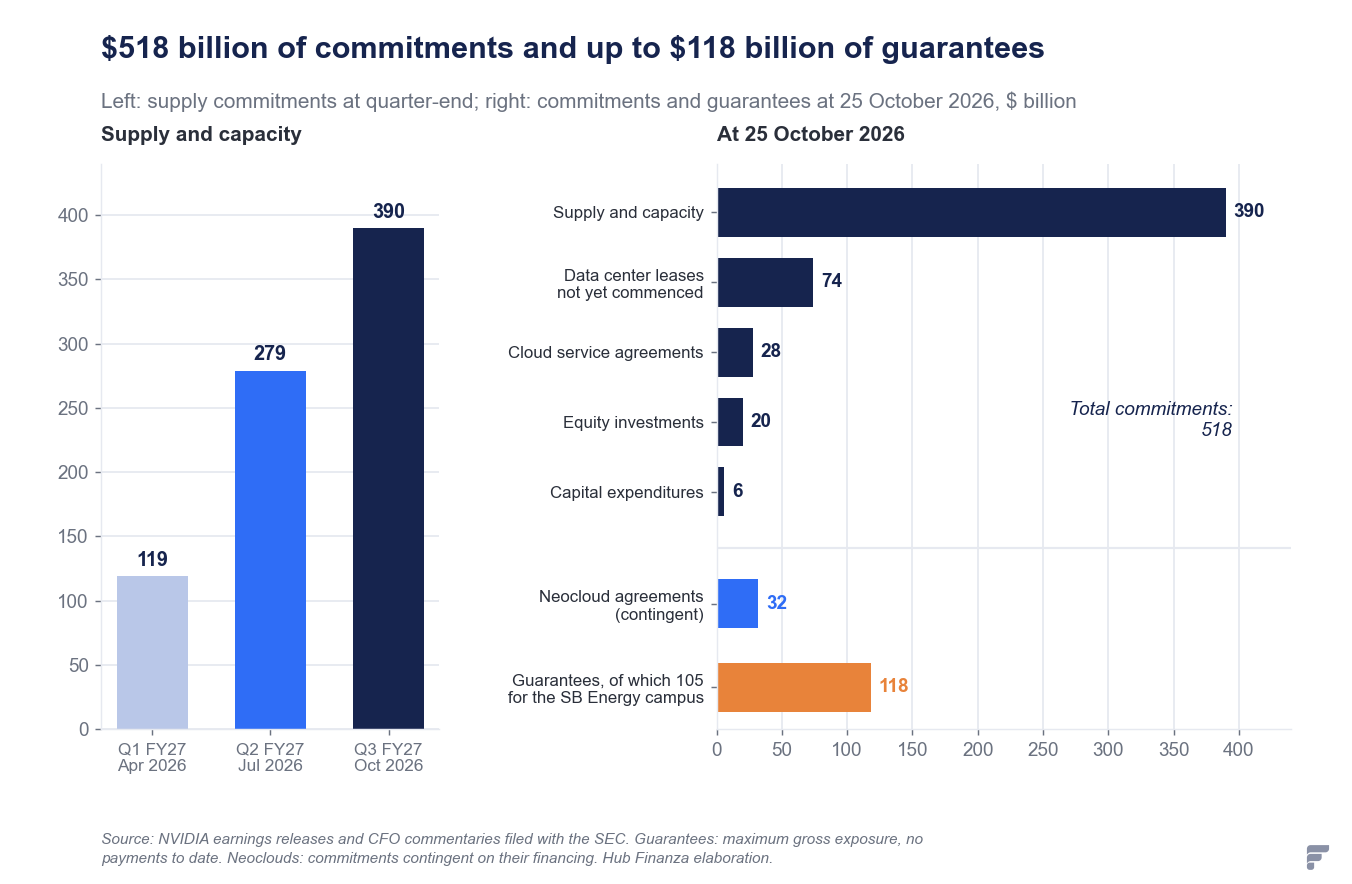
The sharpest jump is in guarantees: at the end of July the maximum exposure was $3.5 billion, at 25 October it is $118.0 billion. Almost all of it comes from an August agreement: NVIDIA guarantees the credit for land, power and buildings of about 4.25 gigawatts at SB Energy's PORTS-Pike campus in Ohio, which will host only NVIDIA infrastructure with twenty-year leases to OpenAI. The guarantee kicks in building by building from fiscal 2029, rises to up to $105 billion and then declines as OpenAI pays rent. So far NVIDIA has paid nothing under any guarantee.
The company's explanation: neoclouds and frontier labs see extraordinary demand, but many are growing faster than their balance sheets can support. For investors it is the point to watch, already raised with NVIDIA's guarantees on the debt of those who buy its chips: if demand holds, the commitments are the basis of future revenue; if a customer stops, NVIDIA bears part of the risk.
China: $11 billion from customers based in the country, but the guidance excludes it
According to the financial supplement, in Q3 FY2027 direct customers based in China, Hong Kong included, generated $11,050 million of revenue, 9.5% of the total, against $2,973 million a year earlier. NVIDIA attributes revenue based on the location of the direct customer, which may differ from the shipping destination and from the end customer.
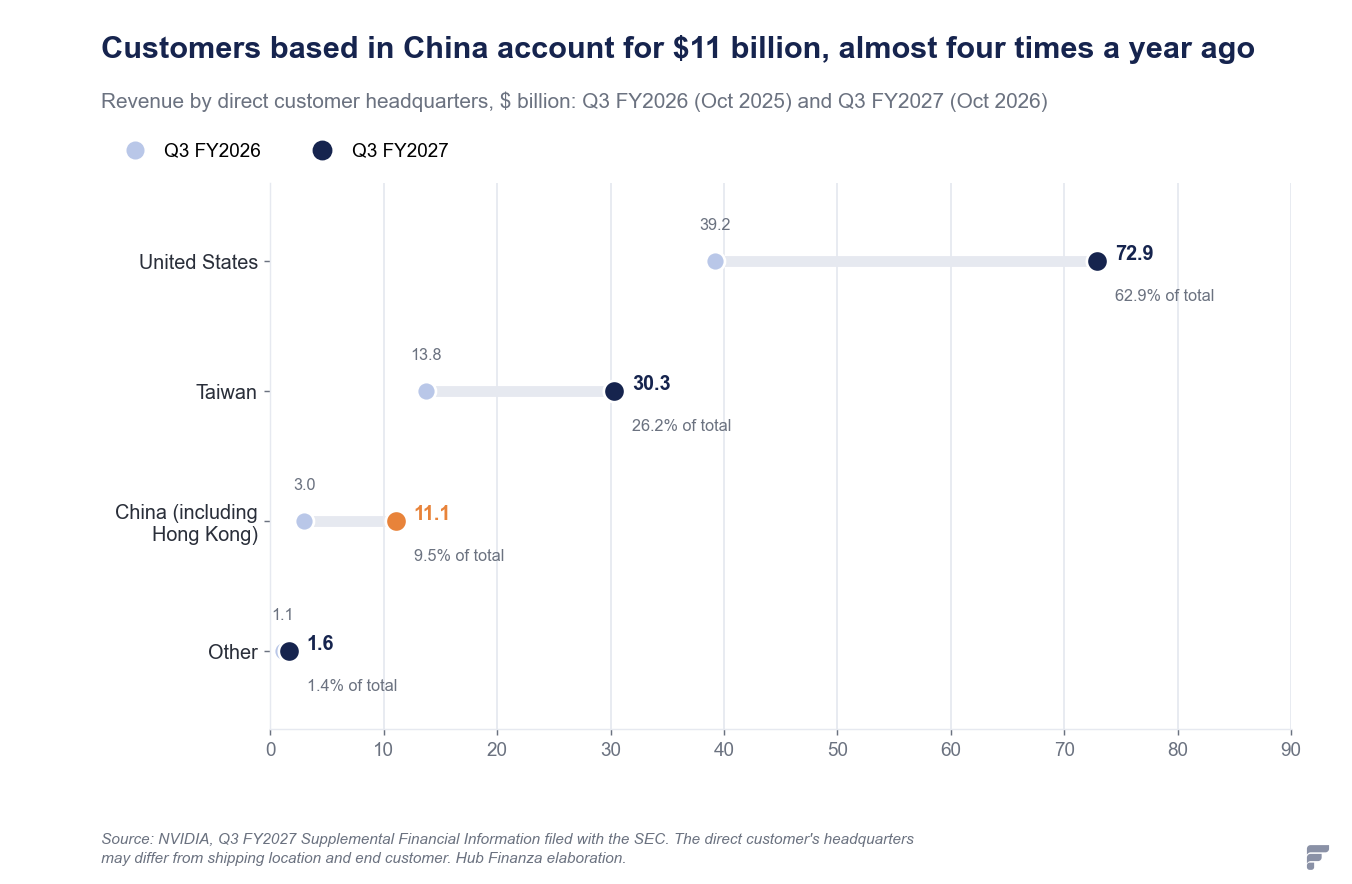
The chief financial officer's commentary adds that shipments of Hopper Data Center products to China were $2.4 billion. Yet the Q4 guidance, like the previous ones, does not count on any Data Center compute revenue from China. On Monday 16 November the US Department of Commerce issued an interim rule that, according to CNBC, requires licenses for advanced chips also for data center operators in countries such as Singapore, Indonesia, Malaysia and Thailand; according to CBS News, Kress said the company will study the new controls.
The Q4 guidance: $130 billion with an extra week, and 75% for 2028
NVIDIA guides to Q4 FY2027 revenue of $130.0 billion, plus or minus 3% (about $126.1-133.9 billion): the midpoint is 3.9% above the LSEG consensus of $125.1 billion and about 12% above Q3 (editorial calculations). Operating expenses are expected at about $11.0 billion GAAP and $10.7 billion non-GAAP, the full-year tax rate between 16% and 18%.
On the call Kress also looked further ahead: according to CNBC and Newsquawk, NVIDIA now expects fiscal 2028 revenue to grow 75%, against the 70% indicated previously and the 70% of the LSEG consensus. The forecast, she explained according to CNBC, takes into account data center availability, the strength of demand and customers' access to capital.
But there is the extra week, and it is worth measuring. Calculation example: Q3 lasted 13 weeks, from 27 July to 25 October 2026; Q4 has 14. Let us assume revenue spread evenly across the weeks.
| Assumptions and results | Q3 FY2027 | Q4 FY2027 (guidance) |
|---|---|---|
| Weeks | 13 | 14 |
| Revenue | $115.8bn | $130.0bn (midpoint) |
| Revenue per week | about $8.9bn | about $9.3bn |
| Q4 restated to 13 weeks | — | about $120.7bn |
With this assumption growth per week is about 4.2%, far less than the +12% headline. In August, however, the guidance implied +12% and the result was +20%: the company had been cautious by about eight points.
What Kress and Jones said on the call
The call, at 11 p.m. Italian time, was opened by Harvey C. Jones, Chair of the board of directors. The main statements, as reported by the US press:
- Jones on Huang: the board unanimously accepted the resignation and «does not intend to reinstate Jensen as CEO» (CNBC, NBC News, CBS News);
- Jones on succession: according to NBC News the search is entrusted to Heidrick & Struggles, with internal and external candidates; on timing Kress and Jones did not answer;
- export: the board has set up a committee on national security and export controls (CNBC, NBC News, CBS News);
- Kress on demand: «we are seeing demand acceleration even at our scale» (CNBC); with customers and suppliers it is «business as usual»;
- Kress's closing, according to NBC News: «We've got this».
Who leads NVIDIA after Huang and what remains open
The 8-K filed with the SEC on 12 November 2026 and the attached press release establish it: Jensen Huang resigned as President, chief executive officer and director with immediate effect, and the board accepted on 11 November. Colette Kress, 59, chief financial officer since September 2013, is interim chief executive officer and retains the finance role; Harvey C. Jones, 73, a director since 1993 and former chief executive officer of Synopsys, is the first Chair of the Board in the company's history.
The results press release cites among the risks the ongoing investigation by an independent committee of the board, the search for the new chief executive officer and possible litigation and reviews by the authorities, without details; the non-GAAP reconciliation excludes $107 million of legal settlement costs. The rest is reported by the press and is not confirmed by NVIDIA documents: according to CNBC the investigation is entrusted to the firm Wachtell, Lipton, Rosen & Katz, and Huang stated on 17 November that he is cooperating and that he would be «honored» to return if the board found it useful; according to NBC News, citing Representative Hakeem Jeffries, on 1 December he will be heard behind closed doors by three House committees.
On the Nasdaq NVDA lost 16.7% in the eight sessions before the results
Between the close on Friday 6 November, $186.64, and that on Tuesday 17, $155.46, the stock lost 16.7% on the Nasdaq. Yahoo Finance closes, with press news:
- 9 November: $178.67 (−4.3%) after the announcement of the investigation; 10 November: $168.89 (−5.5%), with market capitalization briefly falling below $4,000 billion according to CNBC; 11 November: $173.73 (+2.9%) after CoreWeave's results;
- 12 November, the day of the resignation: $166.19 (−4.3%), after a session low of $148.80, 14.3% below the previous close (editorial calculation); 13 November: $162.85 (−2.0%);
- 16 November: $156.14 (−4.1%), with the new chip rule and analysts' price target cuts according to The Motley Fool; 17 November: $155.46 (−0.4%), while the S&P 500 lost 1.03% and the Nasdaq Composite 0.74%.
On the eve of the results the stock was 35.0% below the record close of 6 October, $239.24 (editorial calculation, confirmed by NBC News). With about 24.1 billion average shares in the quarter, the 17 November close is worth a market capitalization of about $3,750 billion (editorial estimate). The after-hours price is just above the 13 November close: to get back to 6 November a further rise of about 14% would still be needed. The precedents of leadership changes are in Huang leaves Nvidia, the stock plunges up to −14% and then rebounds; the link between record results and falling stocks in the AI supply chain in October.
Scenarios for NVDA: the conditions that would support the stock and those that would weigh on it
The scenarios below are not forecasts or trading indications.
Supporting conditions
- Q4 revenue within or above the range of about $126.1-133.9 billion, with a margin at least in the 71-72% band;
- the Vera Rubin ramp and confirmations of the 75% growth expected for fiscal 2028;
- a succession defined in a short time and an investigation without material consequences;
- cash: $113.7 billion of free cash flow in nine months and $227.3 billion of authorized buybacks.
Weighing conditions
- a margin below the range, or signs that the pressure lasts beyond the start of Rubin;
- receivables and inventories that keep growing faster than revenue, or difficulties at a customer financed or guaranteed by NVIDIA;
- investigation outcomes, litigation or new restrictions on chip exports;
- misleading comparisons: the extra week inflates Q4 growth.
The results say demand has exceeded estimates; the stock's reaction will depend on how the market weighs margin, exposure to customers and corporate governance.
What to watch: the December dates and the signals on succession
- 1 December 2026: Huang's House hearing, according to NBC News;
- 2 December: record date for the $0.25 dividend, paid on 23 December;
- 10 December: according to NBC News, the public hearing of Commerce Secretary Howard Lutnick, with export controls in the background;
- undated: the 10-Q, the full quarterly report, expected «in the coming weeks»; the appointment of the permanent chief executive officer; the outcomes of the investigation; the closing of the Hugging Face acquisition, announced in the press release;
- the next quarterly report, on Q4 FY2027: it will say whether the margin settled at 71-72% and how much of the growth comes from the extra week.
Sources
- NVIDIA – Q3 FY2027 results press release (SEC, 17/11/2026)
- NVIDIA – CFO commentary on Q3 FY2027 (SEC, 17/11/2026)
- NVIDIA – Supplemental Financial Information, Q3 FY2027 (SEC, 17/11/2026)
- NVIDIA – Q2 FY2027 results press release (SEC, 26/8/2026)
- NVIDIA – CFO commentary on Q2 FY2027 (SEC, 26/8/2026)
- NVIDIA – Q1 FY2027 results press release (SEC, 20/5/2026)
- NVIDIA – CFO commentary on Q1 FY2027 (SEC, 20/5/2026)
- NVIDIA – Q4 and fiscal 2026 results press release (SEC, 25/2/2026)
- NVIDIA – Q3 FY2026 results press release (SEC, 19/11/2025)
- NVIDIA – Q2 FY2026 results press release (SEC, 27/8/2025)
- NVIDIA – Form 8-K, items 5.02 and 9.01 (SEC, 12/11/2026)
- NVIDIA – NVIDIA Announces CEO Transition, exhibit 99.1 (SEC, 12/11/2026)
- CNBC – Nvidia interim CEO Kress says it's 'business as usual' at company: live updates (17/11/2026)
- NBC News – Nvidia earnings live updates (17/11/2026)
- CBS News – Nvidia records strong growth in first earnings report without Jensen Huang (17/11/2026)
- Newsquawk – Nvidia now expects fiscal 2028 revenue to grow 75% (17/11/2026)
- CNBC – Nvidia hires law firm Wachtell Lipton to lead Jensen Huang probe (10/11/2026)
- CNBC – Stock market today, 10/11/2026
- The Motley Fool – Stock Market Today, Nov. 9 (2026)
- The Motley Fool – Stock Market Today, Nov. 11 (2026)
- The Motley Fool – Stock Market Today, Nov. 16 (2026)
- Yahoo Finance – Stock market today, 17/11/2026
- Yahoo Finance – NVIDIA (NVDA), historical and after-hours quotes
Disclaimer: this article is for information purposes only and does not constitute financial advice. Any investment decision should be assessed against your own circumstances and, if needed, with a qualified professional.